Britain Walks a War Tightrope as Iran Crisis Explodes
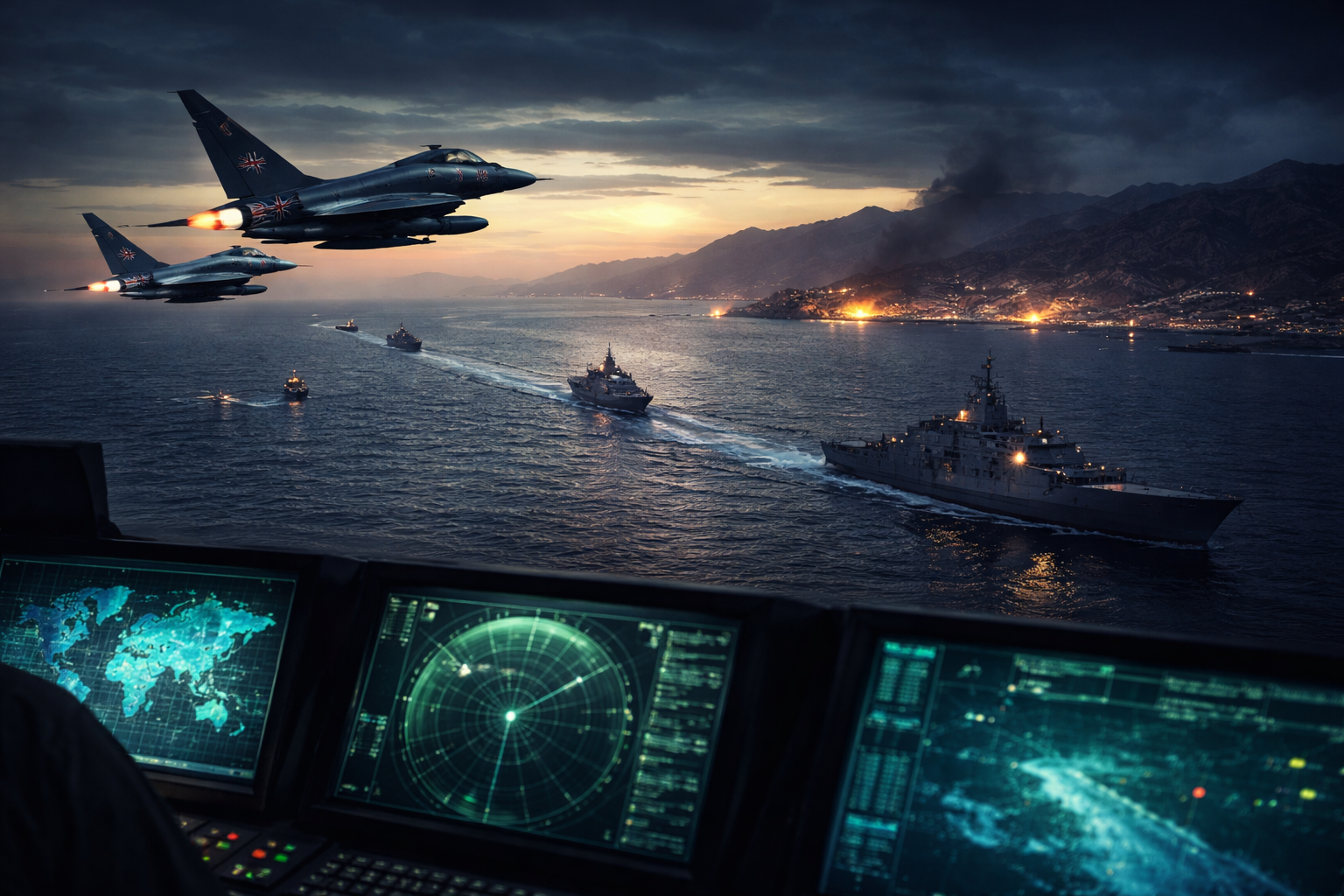
UK Military Moves as Starmer Calls for Calm in Middle East Crisis
The Iran War Is Expanding—And Britain Is Being Pulled In
Britain finds itself pulled toward the center of a rapidly escalating Middle East crisis. Prime Minister Keir Starmer has urged the country to maintain a calm demeanor, cautioning against making decisions based on panic as tensions rise between Iran, Israel, the United States, and regional powers.
His appeal comes at a moment of extraordinary volatility. The conflict has widened across the region following U.S.–Israeli strikes on Iran and a wave of retaliatory attacks targeting military installations, shipping lanes, and energy infrastructure.
Yet Britain is not standing aside. British aircraft, naval deployments, and air-defense capabilities are already operating in the region in a defensive role. The government is trying to strike a delicate balance by supporting allies, safeguarding national interests, and preventing the country from becoming embroiled in another Middle Eastern conflict.
There is a deeper tension beneath the political messaging. Britain’s attempt to calm the crisis comes while the UK is quietly reinforcing its military posture and coordinating closely with Washington.
“The story turns on whether Britain can stay a stabilizing force without becoming a combatant.”
Key Points
Britain’s prime minister has urged calm as the Middle East crisis intensifies, calling for a measured response despite rising geopolitical pressure.
The UK has deployed defensive military assets in the region, including aircraft and counter-drone systems.
Britain initially declined to support U.S. offensive strikes on Iran but later allowed limited defensive use of British bases.
The crisis is expanding beyond the battlefield, affecting global shipping routes and energy markets.
Political tensions have emerged between the UK and the United States over strategy and escalation risks.
The central question now is whether the conflict will remain regional or draw Western powers into confrontation.
The current crisis traces back to a dramatic escalation between Israel, the United States, and Iran. U.S. and Israeli forces carried out major strikes against Iranian targets in what they described as a preemptive operation linked to security concerns.
Iran responded with missile and drone attacks across the region, targeting military facilities and infrastructure linked to Western and Israeli interests. The confrontation has rapidly spread into neighboring states and strategic waterways.
For Britain, the crisis presents a familiar strategic dilemma. The United Kingdom maintains military bases and forces across the Middle East, including Cyprus and facilities used by allied forces. These positions make Britain both a key logistical partner and a potential target if the conflict widens.
Prime Minister Starmer initially resisted requests to support offensive strikes from British territory. His government argued that such action required legal justification and a clear strategic objective.
However, as the conflict expanded, Britain agreed to allow limited defensive use of certain bases while reinforcing regional deployments.
At the same time, London has stressed that its objective remains de-escalation rather than regime change or prolonged war.
Political and Geopolitical Dimensions
Britain’s position reflects a fragile diplomatic balancing act.
On one side stands the transatlantic alliance. The United States remains the UK’s closest military partner, and coordination between the two countries is essential in global security crises.
On the other side is domestic political memory. The Iraq War continues to have a significant impact on British politics, and any perception that the UK is entering another Middle Eastern war without clear justification would be highly controversial.
Several scenarios could unfold:
One possibility is managed containment. Western allies maintain defensive operations while avoiding deeper military involvement.
Another scenario involves gradual escalation, where defensive missions evolve into offensive operations as attacks spread.
A third possibility is diplomatic intervention, where European powers attempt to broker a ceasefire to prevent wider war.
Key signals to watch include NATO deployments, UN Security Council activity, and whether Iran expands attacks beyond the region.
Economic and Market Impact
Even without direct Western intervention, the economic consequences are already visible.
Shipping companies have begun suspending routes through parts of the Middle East as security risks increase.
The Strait of Hormuz—one of the world’s most critical energy corridors—sits at the center of these concerns. Any sustained disruption could send oil prices sharply higher.
For Britain, the stakes extend beyond energy markets. Global trade disruptions can ripple through supply chains, affecting shipping costs, insurance rates, and consumer prices.
Financial markets historically react quickly to Middle Eastern conflict. The longer the crisis persists, the more likely investors will price in a prolonged geopolitical shock.
Technological and Security Implications
Modern warfare technologies are shaping this conflict in new ways.
Iran has increasingly relied on drones and missile systems capable of striking targets across borders. Western militaries are responding with counter-drone defenses, advanced radar systems, and stealth aircraft.
Britain’s deployment of F-35 fighter jets and air-defense systems reflects a shift toward protecting assets and allies from aerial threats rather than engaging in ground warfare.
This technology-driven battlefield reduces the need for large troop deployments but increases the speed at which conflicts escalate.
In a drone-dominated war environment, miscalculation can happen within minutes.
What Most Coverage Misses
Much coverage focuses on whether Britain will join military strikes. But the more decisive issue may be logistical infrastructure.
The United Kingdom sits at the center of the Western military network in the region. British bases, intelligence networks, and logistical hubs are essential for allied operations.
Even if Britain avoids direct combat, its infrastructure enables the coalition’s operational reach.
That means the UK cannot truly remain neutral. Its territory, technology, and supply chains already form part of the strategic architecture of the conflict.
In practical terms, the distinction between “support” and “participation” is often thinner than political rhetoric suggests.
Why This Matters
In the short term, the crisis could reshape Britain’s foreign policy priorities.
The government must balance alliance commitments with domestic caution about military intervention. Decisions taken over the next few weeks could determine whether the UK’s role remains defensive or becomes operational.
In the longer term, the conflict may accelerate a broader shift in global security.
Rising tensions with Iran, combined with fragile alliances and growing geopolitical fragmentation, could redefine Western strategy in the Middle East for years to come.
Key developments to watch include NATO decisions, shipping disruptions, and diplomatic initiatives aimed at preventing wider war.
Real-World Impact
A shipping executive in London pauses new cargo bookings to ports in the Gulf as insurers reassess risk.
A British family living in Dubai registers with the Foreign Office for emergency updates as tensions rise across the region.
Energy traders in European markets monitor shipping routes hour by hour, calculating how long supply disruptions might last.
Defense planners in London map potential threats to British bases across the Middle East.
The Strategic Tightrope Britain Now Walks
Britain's strategy in the Iran crisis relies on a narrow path.
Move too quickly toward military involvement, and the country risks being drawn into a regional war.
Move too slowly or appear detached from allies, and Britain risks weakening the alliances that underpin its security.
Currently, the government is trying to simultaneously reinforce defenses, support allies, and maintain a low profile.
Conflicts often spill beyond carefully drawn boundaries.
The coming weeks will reveal whether Britain can remain a stabilizing power—or whether the gravitational pull of war becomes too strong to resist.
