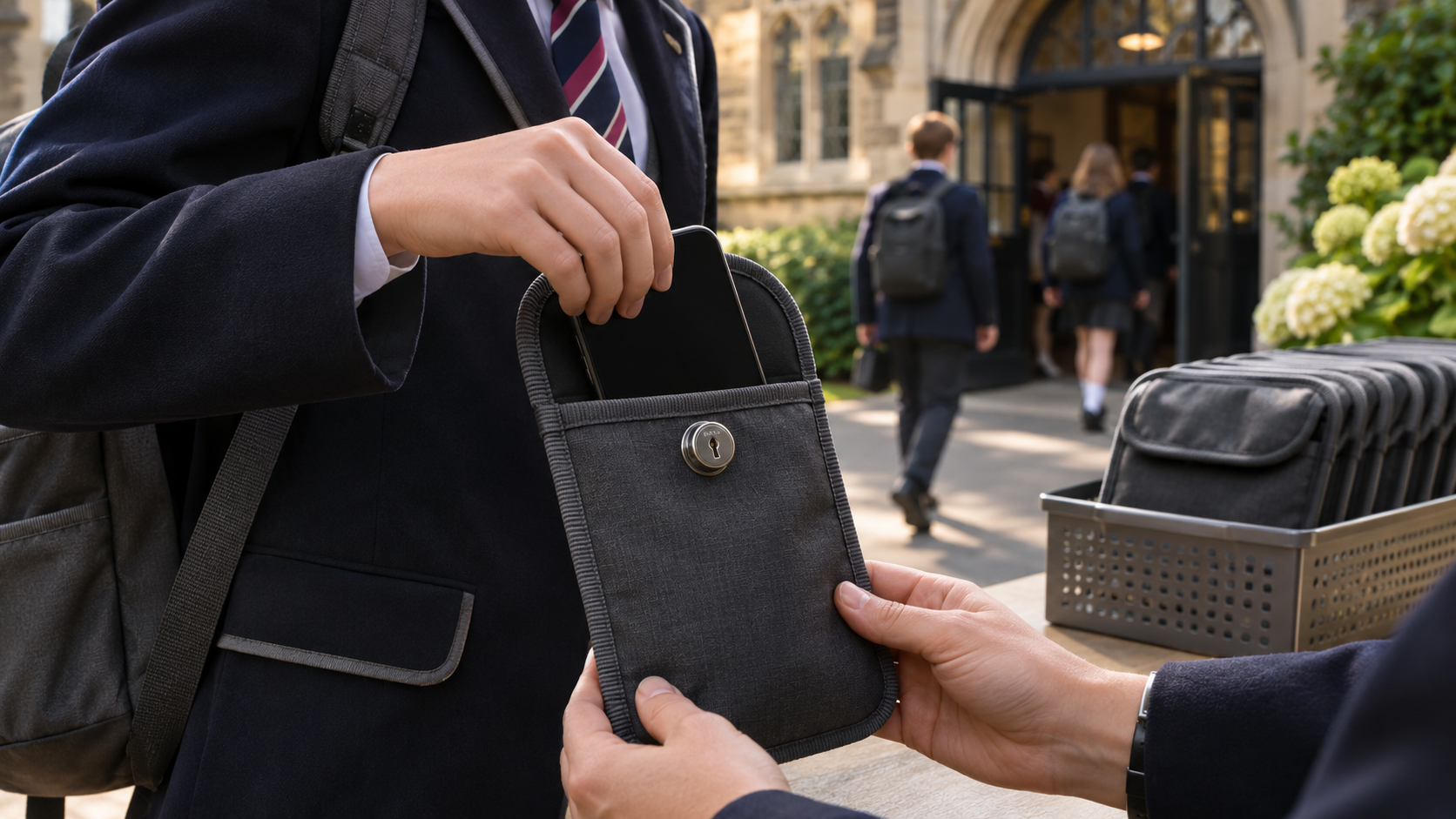
What Parents Should Know About Lockable Pouches
Does a Phone-Free School Day Have To Mean a Phone-Free Journey?
Your child uses a phone to show a bus ticket, lets you know when the bus is late and carries it through the school gates. Can they still do that? In England the answer depends on the school’s policy. The Department for Education wants pupils unable to access their phones during the school day. A school can achieve that by collecting or securing phones on arrival. Some schools prohibit pupils from bringing them onto the site.
The announcement on 10 November 2026 matters because it draws a distinction many family conversations miss. A phone switched off in a blazer pocket may be out of use. It remains accessible in a way that a phone handed in at reception does not. The government wants the strengthened approach to go beyond simply keeping devices out of sight. The local arrangements decide what that means at eight thirty on a wet Monday morning.
What Applies Now and What Is Changing?
Statutory guidance applying in England from 1 September 2026 already covers the whole school day. That includes lessons, breaks, lunchtimes and the intervals between classes. A pupil permitted to carry a switched-off device under their school’s arrangements cannot assume they are free to take it out when the bell goes for lunch.
The November announcement sets out the next step, with strengthened guidance for the following school year, from September 2027. The change concerns how reliably schools prevent access as well as use. Schools already operate different systems. A pupil whose school has collected phones for years may experience very little change. A school relying on devices staying in bags may need materially different arrangements.
A government announcement and a notice changing tomorrow’s collection procedure are different documents. Read the current behaviour policy and the latest communication from the school. If the policy gives a future start date, use it. The England guidance also should not be treated as a UK-wide order applying identically in Scotland, Wales and Northern Ireland.
Why Do Schools Use Pouches, Lockers or Hand-In Systems?
Each system answers the same question about access in a slightly different way. Under a hand-in arrangement, pupils leave devices with staff and collect them at an agreed point. A locker keeps the phone onsite but separates it from the pupil during the day. A lockable pouch can allow the pupil to retain physical possession while preventing ordinary use. Banning phones from the premises removes the need for school storage but can affect the journey.
The everyday details matter. If pupils leave at different times for appointments, somebody has to be able to release a stored phone. If a pupil arrives late after an appointment, the normal morning hand-in point may already be closed. A procedure that works at the main gates at eight forty needs an equivalent at reception at eleven fifteen.
Parents can ask where a device is kept, how it is identified and what happens if it goes missing or is damaged. Schools can explain the arrangements without implying that an expensive phone has to come into school in the first place. Responsibility for a particular loss will depend on the facts. A short announcement about behaviour policy cannot settle every question about custody of a device.
How Can Parents Reach a Child in an Emergency?
Use the school’s published contact route. The office can establish where a pupil is, arrange for them to be told something privately and release them according to the school’s safeguarding procedures. A direct message from a parent may provide information, but the pupil still has to work out how to act on it in the middle of a lesson. An adult who knows what has happened can help with that next part.
Take the common example of a parent unexpectedly going into hospital. A message saying that a different adult will collect a child may be both upsetting and insufficient. The school needs to know who is authorised to collect them. The child may need a quiet place and somebody to stay with them. Contacting the office can set those arrangements in motion while the child’s own phone remains put away.
For everyday changes, agree a simple fallback before the school day begins. A pupil who knows where to wait if a parent is delayed is less dependent on seeing a message at precisely the right time. Make sure the school holds a current number for an alternative contact. A beautifully clear phone policy cannot solve an emergency if the number on file belongs to a handset no one uses.
What About Diabetes Monitoring and Disability Adjustments?
Some pupils use a phone as part of managing a medical condition. A continuous glucose monitoring system, for example, may display readings or alerts on a connected device. Restricting access to that device can interfere with a pupil’s individual healthcare arrangements. The DfE guidance recognises circumstances where access is necessary, and schools have duties concerning disabled pupils and reasonable adjustments.
The useful conversation begins with what the technology actually does. Does an alert need to reach the pupil immediately? Does the pupil need to check a trend before sport? Is a named member of staff involved in the response? The answer may be a carefully defined permission to access a particular function, documented in an individual plan. Asking a pupil to negotiate the exception from scratch with a different teacher every lesson is a poor way to implement it.
An exception also needs to work outside the normal timetable. Cover staff, trips, mock examinations and after-school activities can change who is supervising. Families should discuss the practical plan with the school and relevant healthcare professionals. A photograph of a generic rule on a noticeboard tells you very little about the support a particular pupil has agreed.
Do Sixth Formers and Young Carers Have Different Arrangements?
Schools with sixth forms may distinguish between older students and younger pupils, for instance by permitting access in specified sixth-form areas. An older student should check the local policy before assuming that a privilege in a common room extends to a corridor shared with younger children. A school sixth form and a separate further-education college can also operate under different arrangements.
A pupil with caring responsibilities may have a good reason to need information during the day. Discuss that reason privately with the school. The practical solution could involve staff passing on urgent messages or an agreed exception suited to the pupil. Being contactable and having unrestricted access to a personal device are not quite the same need. A good arrangement identifies which problem the family is actually trying to solve.
What about school-sanctioned technology? A classroom can use a tablet supplied for a particular task while restricting personal phones. The teacher controls the purpose, timing and equipment in a different way. A parent hearing that a school wants a phone-free day need not infer that pupils will never use a computer or that digital learning has been removed from the curriculum.
An overlooked question is how the pupil pays for travel. If a digital ticket is stored on a device the school wants left at home, a family may need to ask the transport operator about a physical pass or another arrangement. If the phone can be collected after school, the more important detail is whether collection finishes in time for the bus. These are practical distinctions a national headline cannot resolve for a particular route.
What Should a Family Check Before the Policy Changes?
Read the part of the policy explaining whether a phone can cross the gate, where pupils leave it and when they can collect it. Ask how the process works for an early finish, a delayed bus or a medical alert. If the school prohibits phones onsite, ask what travel arrangements it expects families to make. If it allows them in secure storage, establish how a pupil gets theirs back before an unfamiliar journey.
A useful test is whether a child can explain the whole day in their own words. They know how to reach school, what to do with the device when they arrive, how to get help while it is inaccessible and where to go before catching the bus home. Once those details are clear, a headline about a national phone ban becomes a much more manageable question about an ordinary school day.
