What Happens if a Lighthouse Alarm Goes Off?
Who Notices if a Lighthouse in Dorset Goes Dark Tonight?
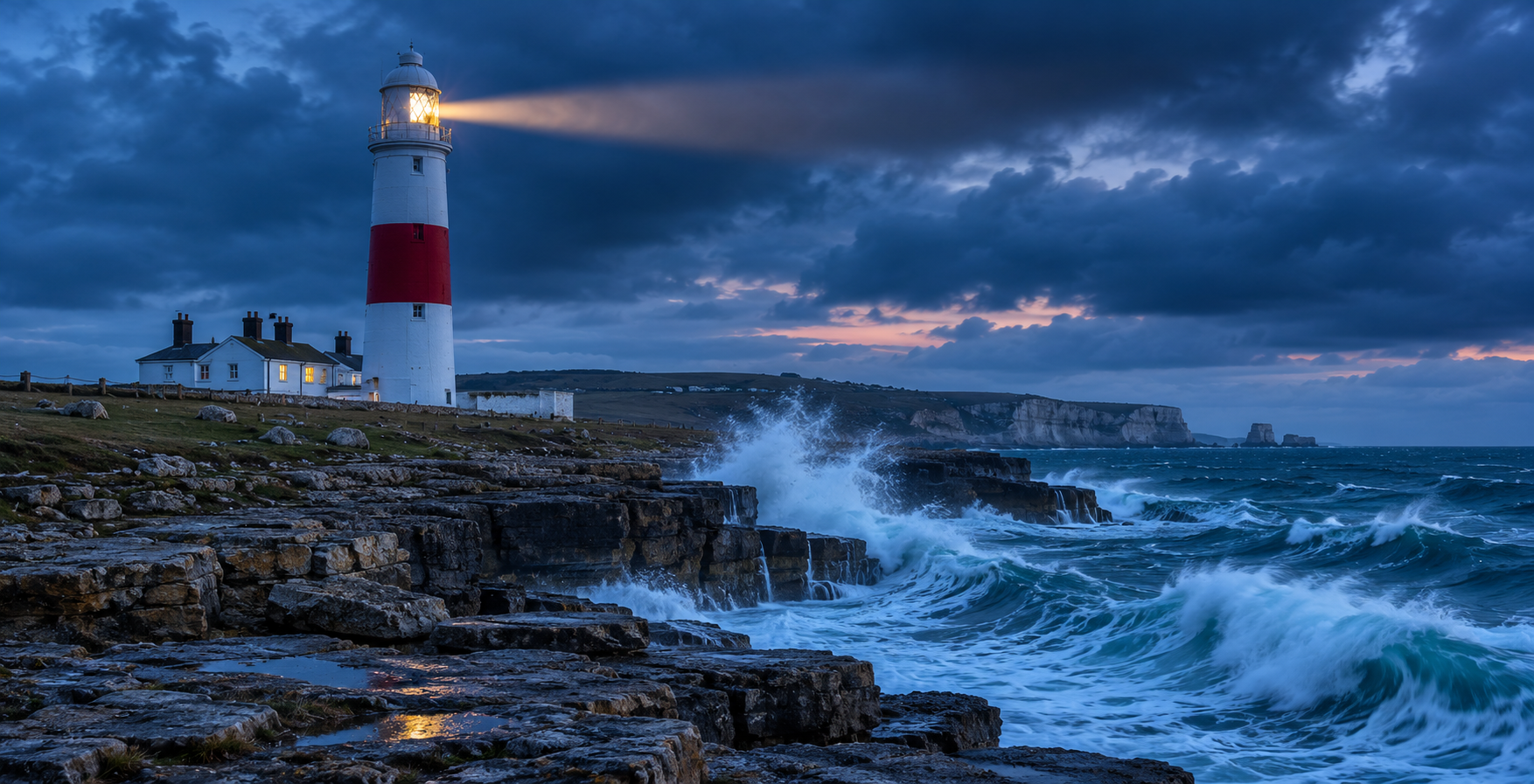
Portland Bill Lighthouse in Dorset is monitored and controlled from Harwich in Essex. The light stands at one end of southern England and the people watching its operating status can be at another. The station was automated on 18 March 1996. Its beam still serves mariners, its building still needs looking after and a fault still requires a human decision. What disappeared was the need for resident keepers to maintain a continuous watch in the old way.
That distinction explains how a news story can describe somebody as a lighthouse keeper decades after automation. Looking after visitors or an historic building, attending a site locally, maintaining navigational equipment and supervising a network from a control centre are different jobs. A person can do valuable work at a lighthouse without being the person who decides what happens when its light fails.
Why Is There a Lighthouse at Portland Bill?
Look at the southern end of the Isle of Portland on a map. A headland extends into waters used by ships passing along the English Channel. A visible mark helps a mariner identify this part of the coast and take account of hazards, including rock extending offshore. Trinity House also records a white stone obelisk erected in 1844 as a warning of a low shelf of rock.
Earlier generations used high and low lights at Portland. The present tower replaced that arrangement in 1906. The former towers survive in different uses, with the old low light now associated with a bird observatory. Seeing a lighthouse-shaped building from the road therefore does not tell you that its lantern is the operational light serving shipping. A coastline can retain the evidence of several generations of navigation at once.
The purpose of a light is more specific than making the coast generally bright. A mariner needs to identify which mark is visible. Position, colour and the timing of flashes help distinguish one aid from another. A decorative floodlight illuminating a beautiful tower on land is a different thing from the navigational signal published for the people offshore.
What Happens on an Ordinary Night?
At an automated station, local equipment operates the light according to its arrangements, and information about the station’s condition is sent to the monitoring centre. The precise equipment varies by site. The point of automation is that ordinary operation can continue without someone climbing the tower each evening to light a lamp and remaining beside it until morning.
Think about what the distant operator needs to know. A station might have power and still have a fault affecting the light. A communications link might be interrupted even though the light itself remains visible. A control system has to distinguish an indication that something has failed from the loss of the ability to see what is happening. A blank status display is not proof that the sea horizon has gone dark.
That is a practical change from a resident keeper’s watch. A person at a station might hear an unusual vibration, notice a leak or smell overheating equipment. Remote monitoring can observe defined conditions reliably at scale but does not possess all those senses. Engineers decide which conditions to instrument and which require a physical inspection. Maintenance schedules cover failures that an alarm might reveal only after deterioration has gone a long way.
What Would Happen if an Alarm Arrived From Portland?
Consider a hypothetical fault, rather than an invented account of an actual Portland incident. A monitoring centre receives an abnormal indication. The immediate question is what the instrument has reported. Has a component failed while a standby arrangement maintains the signal? Has the light ceased operating? Has contact with the station been lost? Each possibility has different consequences for people at sea.
The operator can use the available status information and authorised control procedures, and arrange investigation or attendance as needed. Where the availability or characteristics of a navigational aid have changed, information for mariners matters as well as the physical repair. A ship approaching tonight needs an accurate picture of what it can rely on, even if the engineer expects to restore the equipment tomorrow.
Portland is accessible by road. Other British aids stand on exposed rocks and islands where transport and weather can dominate the response. The same failed part might be straightforward to replace at a mainland station and difficult to reach at a rock tower. A general lighthouse authority has to plan for vessels, aircraft, contractors, technicians, spares and safe access as well as the electrical performance of a lamp.
Once work is completed, the question becomes whether the station is actually delivering the expected service. Confirmation can involve local checks and the remote indications used by the monitoring team. Replacing a defective component is a task. Restoring a dependable aid to navigation is the outcome. The two need to be connected before an incident can be treated as resolved.
Who Actually Employs the People Doing This Work?
Trinity House has responsibilities as a general lighthouse authority for England, Wales, the Channel Islands and Gibraltar. The Northern Lighthouse Board serves Scotland and the Isle of Man. The Commissioners of Irish Lights undertake the corresponding role around the island of Ireland. The division does not follow a simple rule that every tower within sight of Britain belongs to one British organisation.
Ports and harbours can have local aids and responsibilities of their own. A heritage trust may operate a visitor attraction in part of a site. A local attendant may provide eyes and hands in a place that a central engineering team cannot reach quickly. The authority responsible for navigation and the organisation selling tickets at the entrance may therefore answer different questions about the same tower.
For a visitor, the simplest way to find the right person is to say what they are asking. A question about tickets belongs with the visitor operation. A question about the tower’s history may be answered by a guide, archive or local historian. A report about a suspected problem with an operational aid belongs through the appropriate maritime reporting route. Nobody should assume the availability of the light from the opening hours on the visitor-centre door.
What Did Resident Keepers Do That People Can Still Recognise?
Keeping the light required a combination of routine and readiness. Lamps and optical equipment needed care. Machinery had to be kept working, observations and records maintained, stores managed and the building protected against salt water and weather. The particular list changed with fuel, power supply, optics and location. A keeper working with an oil lamp faced different tasks from someone maintaining later electrical equipment.
Isolation added another dimension at offshore stations. Reliefs, weather and the reliability of supplies could determine when a person went home. At a shore station the families and buildings could form part of a local community. The popular image of one solitary man at the top of a tower captures only a fraction of the different arrangements that existed.
The modern technician inherits some of the old keeper’s practical concerns. Salt still corrodes metal. Water still finds weaknesses. A replacement part has to fit a particular installation, sometimes inside a building whose historical fabric matters. The control-centre operator inherits something of the watch. Heritage staff inherit much of the responsibility for explaining the work to people whose experience of a lighthouse is a holiday photograph.
If Modern Ships Use Satellites, Why Keep the Light?
A visible aid provides a local source of information with a different relationship to the vessel from a position displayed on a screen. A mariner can compare a visible mark with the chart and the expected location. Its usefulness depends on conditions, range and line of sight. Fog can defeat excellent optics. No single aid removes the need to navigate with several sources of information and sound judgement.
Navigation authorities review what level of service a particular area requires. Modernisation can therefore change the characteristics of an aid. In 2021 Portland Bill was modernised, hazardous mercury was removed and the published range reduced from 25 nautical miles to 18. A shorter range in a documented modernisation is not in itself a sign that maintenance has failed. It describes a changed service that mariners need to know about.
That example also answers a question sometimes asked about older machinery. Preserving the story of a remarkable optic and continuing to operate it in perpetuity are different commitments. Engineering decisions can consider navigational need, safety, maintainability and environmental risk. Museums and visitor interpretation can preserve knowledge of earlier practice even when an authority changes the working equipment.
Who Pays Attention When Nothing Has Gone Wrong?
Navigation depends on accurate published information as well as operational equipment. If an authority plans a change of range or character, the people maintaining maritime information need to know. A mariner comparing an observed signal with an outdated description may be confused by equipment functioning exactly as intended. Planned work can therefore require communication with the people who produce and update navigational information.
There is a parallel duty to the physical station. A seal replaced before seawater penetrates a cabinet produces no dramatic rescue and no photograph of a failed lamp. Its success consists in an uneventful night. Judging the value of the modern lighthouse service only by the number of emergency visits misses the benefit of all the visits that prevented an emergency.
What Does It Mean To Be a Lighthouse Keeper Today?
At Portland Bill the answer is distributed across the people who design, monitor, visit, repair and explain the station. Imagine a visitor leaving the building on a winter afternoon. The front door closes, the last guided visit is over and a ship offshore still needs the expected light. The division between heritage and navigation becomes very clear at that moment.
A century ago, the sight of a lamp working through the night suggested somebody on watch nearby. Today the same sight can conceal a connection between a tower in Dorset, a planning centre in Essex and a technician who knows how to reach the equipment if it fails. Automation moved the watch. The obligation to keep it never went away.
