What Would a Northern Digital Route Actually Protect?
What Could a Cable Across the North Sea Do That Another Cable South Cannot?
Shetland looks remote on a map centred on London. Centre the same map on the northern North Sea and the islands become an obvious place to ask a different question. Could data leave Britain in another direction, reach western Norway and find an independent path onwards? That possibility is the subject of a feasibility study led by VodafoneThree and reported on 10 November 2026.
The UK has backed examination of a new digital connection. The reported work includes investigating possible underwater routes and landing points in western Norway. That makes it a proposal under study. There is no settled route, operational date or demonstrated household speed increase to announce. What the idea offers already is a particularly clear example of why counting internet cables tells you less than knowing where they go.
Why Can Two Cables Still Leave One Point of Failure?
Imagine an island served by two separate fibre cables running south. The first belongs to one provider and the second to another. They have different names, different maintenance contracts and different fibres. On shore, however, both cross the same bridge inside the same duct. A single excavation at the wrong point can interrupt both.
Now imagine one route heads south and another east, landing in another country. They use different shore crossings, different local power supplies and separate onward networks. An incident on the southern bridge could leave the eastern path available. The advantage comes from physical separation across the parts vulnerable to the same incident. Putting two company logos on the first arrangement would never achieve that.
Real networks sit somewhere between these sketches. Routes can diverge across hundreds of kilometres and share the last few hundred metres into an exchange. Two landing buildings can depend on a common power feed. Wholesale customers buying capacity from different suppliers may unknowingly be using fibres in the same cable. A resilience assessment needs enough detail to identify shared risk without disclosing sensitive engineering information publicly.
How Does Data Travel Through a Subsea Cable?
A modern fibre-optic system carries information as pulses of light through glass fibres. Protective layers around the fibres help the cable survive manufacture, laying and the environment it will encounter. Near shore, designers can use stronger protection and burial where suitable. Farther offshore, conditions and the engineering trade-offs differ. A cable need not have the same construction along every metre of its route.
At either end, terminal equipment turns a glass path into usable communications capacity. The cable landing site has to connect to terrestrial networks that carry data to and from actual destinations. On an internet map drawn at continental scale, a line reaches a coast and seems complete. For an operator, the moment the cable reaches land is the beginning of another set of dependencies.
A packet from Shetland does not have a natural national destination marked on it. Its route depends on the service being used, where that service is hosted, network agreements and routing policies. A new link to Norway could offer a valuable additional path without causing every email from an island resident to travel through Norway. Operators decide how to use a physical connection, and the destination influences which choice makes sense.
Would It Make Broadband Faster in Shetland?
Possibly for some connections and destinations, but an international cable alone cannot promise a faster download to an individual home. A household uses an access network before its traffic reaches the wider network. A slow local line, a congested wireless link or poor coverage inside a house can remain the limiting factor after an enormous new trunk cable opens offshore.
There are also different meanings of faster. Capacity describes how much data can be carried. Latency concerns the delay in getting a response. A larger pipe can help a network handle a busy evening. A more direct physical route can reduce part of the delay to a particular destination. Neither improvement necessarily changes the speed printed on a customer’s retail package.
Take a remote consultation over a video connection. The strongest benefit of a second route might be that the call still works during an outage on the first. When both routes are healthy, the user may notice very little difference. Reliability is economically valuable precisely because it can prevent an event that would otherwise have interrupted work, travel or access to a service. It is consequently harder to photograph than a newly installed cable.
Why Build Towards Western Norway?
Geography gives the proposal its distinctive feature. A route across the northern North Sea can create options different from another connection following existing corridors towards mainland Britain. The feasibility work is expected to examine which routes and potential Norwegian landing points are practical. Landing where an independent and capable onward network already exists could matter more than minimising the sea distance alone.
Consider where customers ultimately need to send traffic. A company connecting facilities in the UK and Scandinavia may value a northern path. A public service concerned about continuity might value the opportunity to buy a second route with different dependencies. A data centre needs power, terrestrial connections and customers as well as an international cable. Each has a different reason to care where the chosen line goes.
Local reporting links the proposal to investigation of further connectivity between Shetland and the UK mainland. The distinction between those segments is fundamental. A new path to Norway can give Shetland an alternative outlet. Its usefulness as a wider UK corridor also depends on how traffic reaches the islands in the first place. An independent crossing from Shetland can only protect mainland customers to the extent that they can get to it during the failure they are planning for.
What Would Engineers Need To Find Out?
The shortest line on a chart might cross difficult seabed, an area of intensive activity, existing infrastructure or a location where bringing the cable ashore is impractical. A marine survey helps establish what the seabed is like and where protection may be needed. Designers must consider other users of the sea, environmental constraints, permissions, installation conditions and the ability to reach a damaged section for repair.
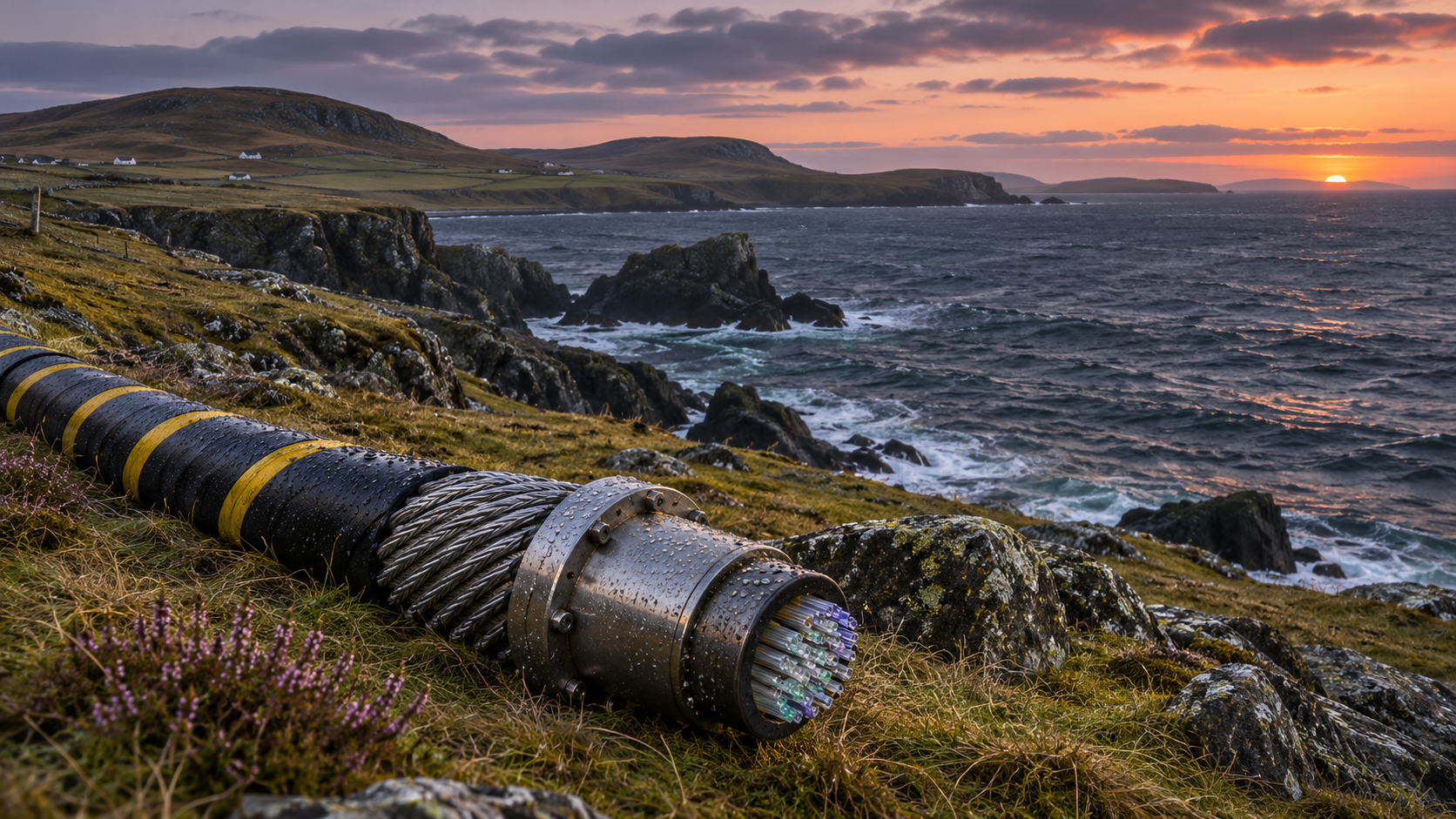
A landing location has its own test. Can equipment be powered and housed safely? Is there access for construction and maintenance? Can separate onward fibres be obtained at a sensible cost? A dramatic image of a cable coming out of the surf captures a small part of a decision involving ports, roads, landowners, power systems, communications operators and more than one jurisdiction.
Commercial feasibility is another question again. Somebody has to commit capital and carry the operating costs. Buyers may value capacity, lower delay, geographical diversity or a combination. Benefits that accrue to a community during a rare emergency can be significant even when private revenues from selling ordinary traffic are modest. A government expressing support for the study has not thereby resolved who would pay to build and run the system.
Is a Data Cable the Same as an Electricity Interconnector?
A power cable moves electrical energy between systems. A telecommunications cable carries information using light in fibres. Both can cross the seabed, both require landfalls and each can appear as a line on a map of North Sea infrastructure. They answer different needs. A proposal to carry data to Norway should therefore not be interpreted as a promise about the price or availability of electricity in Shetland.
The distinction also matters to investment claims. Data centres need power and connectivity, and a northern location can have advantages for one while lacking the other. Calling a proposed fibre connection an economic opportunity is reasonable. Counting a future data centre as a confirmed result before its electricity, customers and financing are in place would go considerably further than the evidence.
Would a Second Route Switch On Automatically in an Emergency?
Only if the networks were configured and resourced to use it. Operators need routing arrangements, suitable interconnection and enough spare capacity for the traffic expected to move. A path designed for a fraction of the normal load might preserve priority services while leaving other users with congestion. A cable can remain physically intact while a commercial or configuration problem prevents a particular customer from using it.
Testing therefore matters. A planned exercise moving services onto the alternative path can reveal an unexpected shared dependency, a capacity shortfall or a system that does not recover cleanly when traffic returns. This is the point at which the engineering drawing meets an operational claim. Two lines on a map establish that there are two lines. Successful operation during the loss of one establishes something more useful.
The useful question about the Shetland proposal is what failure it would allow real users to survive. If an independent route across the North Sea can keep services connected when a southern route is unavailable, the benefit could extend well beyond the people who see the cable make landfall. Whether it can do that, at what cost and for whom, is exactly what a feasibility study is there to discover.
Sources
Britain throws weight behind idea for new subsea data link to Norway
MP welcomes news of Norway-Shetland subsea data cable being explored | Shetland News
