

Labour’s Election Losses Have Triggered Something Far More Dangerous Than A Bad News Cycle
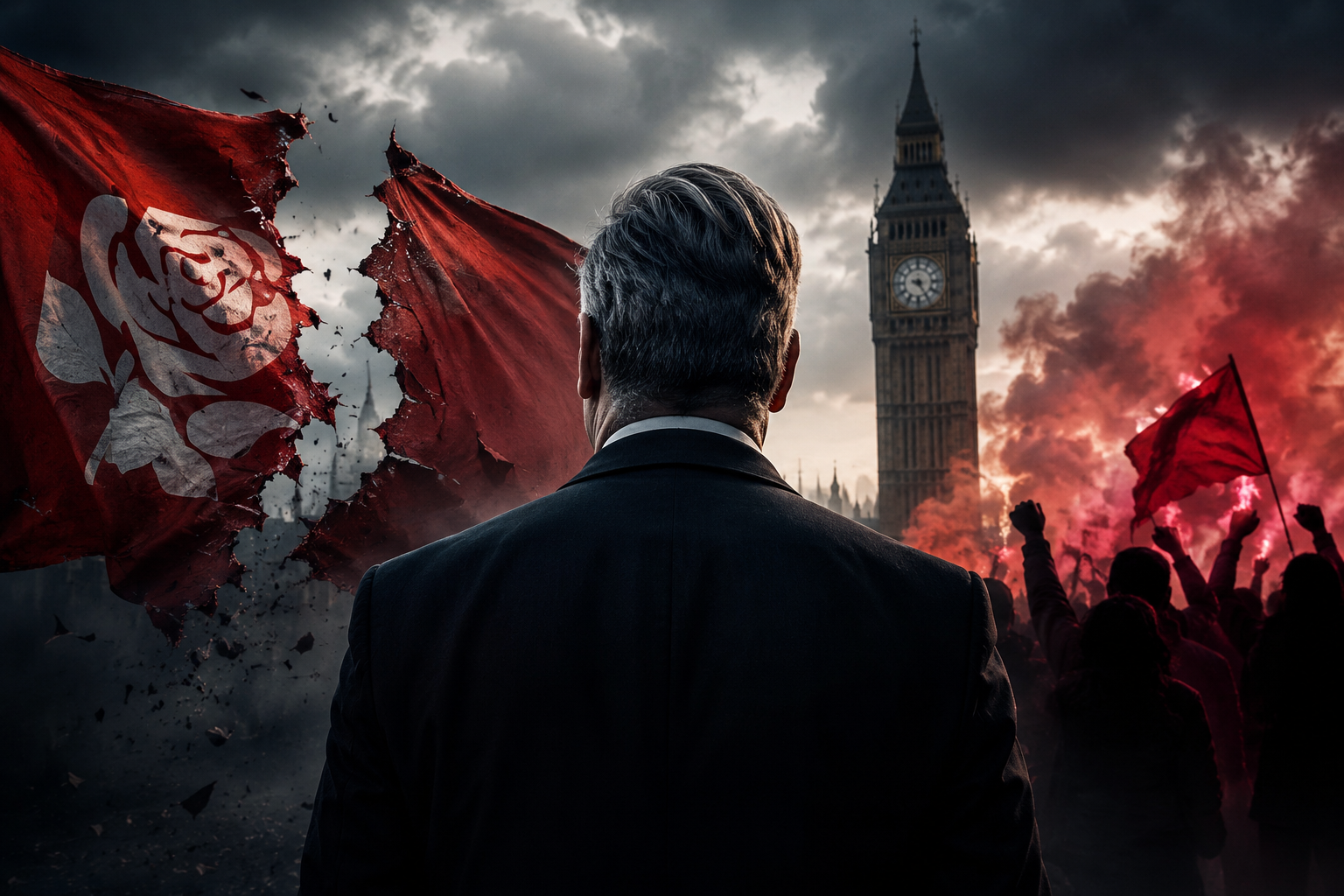
The Result That Suddenly Put Keir Starmer’s Leadership In Danger
Labour’s Election Losses Have Triggered Something Far More Dangerous Than A Bad News Cycle
Keir Starmer insists he is not going anywhere. The problem for Labour is that British politics suddenly feels like it is moving underneath him anyway.
The local election fallout has detonated a narrative Labour figures were desperate to avoid: that the party is drifting into a slow-motion civil war just two years after returning to power. What was supposed to be a difficult but manageable electoral correction has instead opened up something much darker inside the governing party — fear, blame, ideological confusion and growing panic about whether Starmer can actually survive until the next general election.
The numbers alone are brutal enough. Labour has lost hundreds of council seats, suffered heavy defeats in traditional heartlands and watched Nigel Farage’s Reform UK turn itself from a protest movement into a genuine national political threat.
But the real danger is not the headline losses themselves.
It is the feeling spreading through Labour that something fundamental may be breaking.
The Result That Turned Internal Anxiety Into Open Fear
Political parties can survive bad elections. What they struggle to survive is the moment when their own people stop believing that the leadership has a convincing answer.
That moment suddenly feels much closer.
Several Labour figures have now publicly questioned Starmer’s position following the results, with calls emerging for a leadership rethink after the scale of Reform UK’s gains became clear.
The language inside the party has shifted noticeably. What was once a quiet briefing and anonymous frustration is starting to become visible. MPs in vulnerable seats are increasingly looking at Reform UK’s rise and seeing an electoral threat capable of destroying careers that looked safe only months ago.
That matters because Labour’s coalition was always more fragile than its 2024 landslide implied.
Starmer’s project depended on holding together several entirely different voter groups at once:
anti-Tory centrists
metropolitan liberals
traditional Labour working-class voters
younger progressive voters
moderate conservatives repelled by Tory chaos
That coalition worked when Labour represented stability after the Conservative collapse.
It becomes much harder to sustain when voters begin asking what Labour actually stands for beyond competence.
Reform UK Has Changed The Emotional Atmosphere Of British Politics
The rise of Reform UK is now doing something psychologically important inside Westminster: it is making Labour MPs afraid.
Farage’s party is no longer being treated as a temporary protest vehicle. Reform has gained hundreds of local seats and made deep inroads into former Labour territory across parts of northern and central England.
That changes the entire emotional atmosphere around Starmer’s leadership.
The fear inside Labour is no longer simply about losing votes to the Conservatives. It is about losing voters emotionally — voters who feel alienated, economically frustrated, culturally disconnected and increasingly willing to burn down old party loyalties altogether.
That is a much harder problem to solve.
The nightmare scenario for Labour is becoming clearer by the week: Reform UK consolidates itself as the insurgent anti-establishment force while Labour simultaneously bleeds support to the Greens and Liberal Democrats in urban progressive areas.
That would trap Labour in a political vice.
And suddenly, some MPs appear to believe that Starmer himself may be part of the problem rather than the solution.
The Hidden Tension Labour Can No Longer Pretend Does Not Exist
For months, Labour tried to project ruthless message discipline. Internal disagreements were contained. Critics were marginalised. The leadership operation focused heavily on control.
Now the cracks are becoming harder to hide.
The underlying tension is actually ideological.
Starmer’s Labour won power by moving aggressively toward the political centre, softening radicalism and prioritising managerial competence over ideological excitement. That strategy worked electorally in 2024 because the exhausted and divided Conservatives were unable to mount a serious challenge.
But governing differs from opposing.
Once in power, Labour lost the political luxury of being defined mainly by what it was not.
Voters started demanding visible improvement — on living costs, public services, growth, housing and immigration — and many clearly do not feel those improvements arriving fast enough.
That frustration is now colliding with a deeper Labour identity crisis:
Should Labour move further toward technocratic moderation?
Should it pivot left economically?
Should it become tougher culturally?
Should it confront Reform more directly?
Or should it attempt to ignore Farage entirely?
The party does not seem united on the answer.
And when political parties stop agreeing on the diagnosis, leadership questions usually follow.
The Names Already Hovering Around The Conversation
One reason the “civil war” narrative is accelerating is because alternative names are already circulating publicly.
Whenever leadership speculation intensifies, commentators increasingly mention Andy Burnham, Angela Rayner, and Wes Streeting.
That alone matters politically.
Leadership challenges often become self-fulfilling when media ecosystems, activists, and MPs begin to mentally rehearse scenarios for replacement. The existence of potential successors changes the psychological balance around a leader, even before any formal challenge emerges.
Currently, no major figure appears ready to launch an outright coup.
But that does not necessarily protect Starmer.
Modern political leadership can erode slowly before collapsing rapidly. Once MPs conclude a leader cannot recover public authority, events tend to accelerate brutally.
Labour understands such situations from experience better than most parties.
The ghosts of past Labour civil wars still haunt Westminster:
Blair versus Brown
Corbyn versus the parliamentary party
factional warfare between moderates and the left
endless briefing campaigns and ideological purges
Starmer was supposed to end that era.
Instead, the local election fallout has revived fears that Labour may once again be drifting toward internal self-destruction.
For broader context on how insurgent populist movements are reshaping Western politics, see Taylor Tailored’s analysis of the growing anti-establishment wave across Europe.
The Problem For Starmer is that the story now has momentum.
Political narratives become dangerous when they start feeding themselves.
Every poor poll now reinforces the “crisis” narrative.
Every Reform gain strengthens the “collapse” narrative.
Every nervous Labour briefing fuels the “civil war” narrative.
That feedback loop is politically toxic.
Starmer’s allies are trying to stabilise the situation by arguing that local elections are volatile, midterm governments often suffer losses, and that Reform’s surge may eventually plateau. There is truth in that argument.
But emotionally, the political atmosphere has changed.
The public no longer sees Labour as the unstoppable governing machine that emerged from the 2024 election. Instead, the government increasingly looks vulnerable, defensive and uncertain about how to respond to a rapidly fragmenting electorate.
That perception matters enormously because modern politics drives emotional momentum as much as it does policy detail.
Parties that look weak tend to attract more attacks.
Parties that appear divided tend to become more divided.
The Bigger Fear Lurking Behind The Panic
The deepest fear inside Labour is not simply that Reform UK is rising.
It is that Britain may be entering a far more unstable political era altogether.
The old two-party system already looks weaker than it did only a few years ago. Reform UK, the Greens, and the Liberal Democrats are all exploiting fractures that neither Labour nor the Conservatives seem fully capable of containing.
That creates a terrifying possibility for Labour strategists: that traditional electoral assumptions may no longer work.
If voter loyalties continue fragmenting, then even governing majorities can become politically fragile rapidly. A party can technically remain in power while psychologically losing authority over the national conversation.
That is the danger now surrounding Starmer.
This is no longer just a story about local elections.
It is becoming a story about whether Labour still knows how to hold together the coalition that put it into government in the first place — and whether Keir Starmer can stop internal panic before it mutates into something much harder to control.
The election losses hurt Labour politically.
The fear spreading through the party may end up hurting it far more.
