

London School Stabbing: Why Police Treat This Like Terror—Before Calling It Terror
London School Stabbing: Counter-Terror Probe and Motive
A midday school attack in northwest London has left two boys seriously injured—and a 13-year-old in custody on suspicion of attempted murder. The word that now hangs over the case is not just “knife crime” but “motive.”
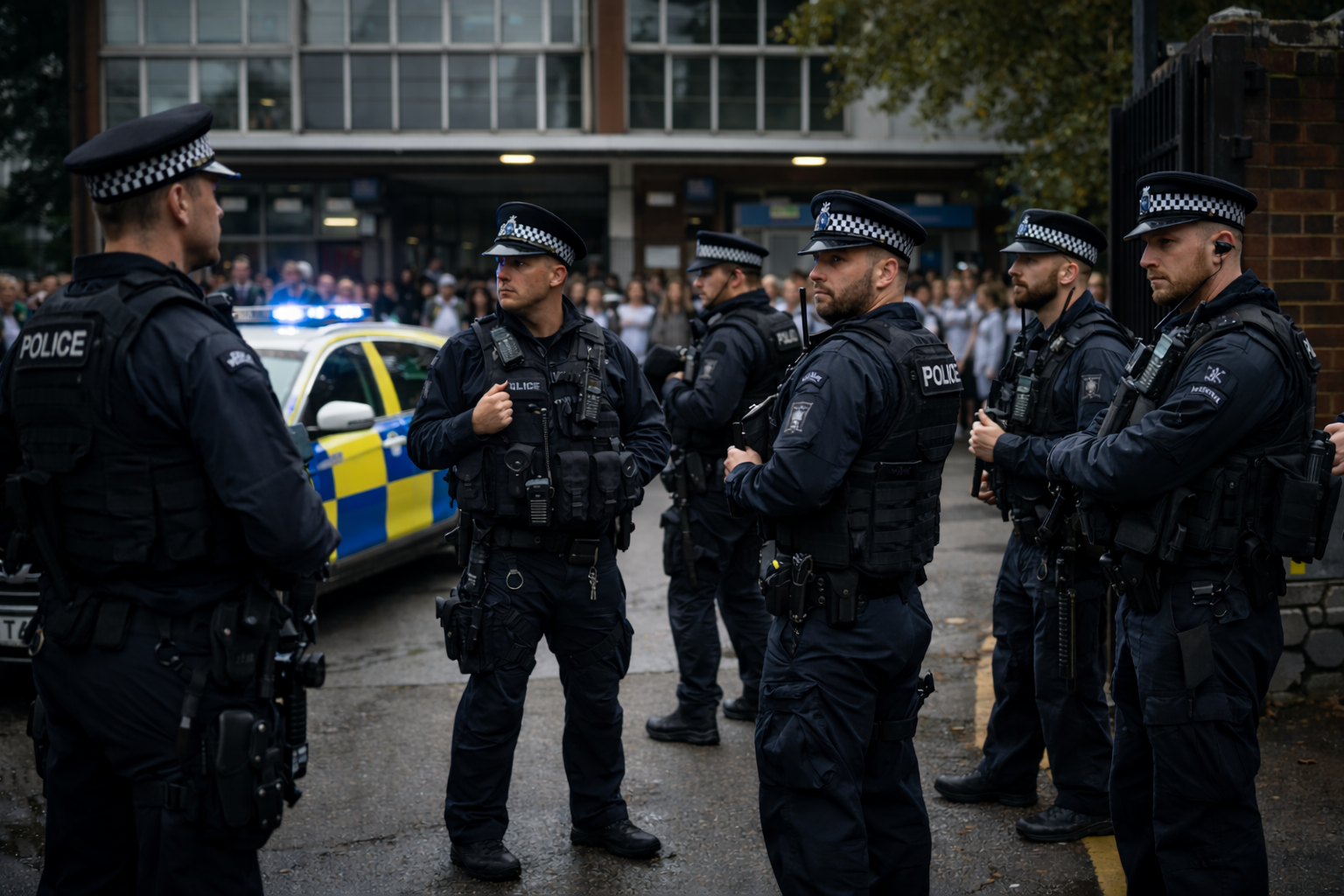
Ten emergency calls brought armed officers to Kingsbury High School in Brent after reports that a 13-year-old boy had been stabbed. Police say they then learned a 12-year-old boy had also been stabbed. Both were taken to the hospital, and police say their conditions were understood to be serious.
A 13-year-old suspect was arrested later that day. Counter-Terrorism Policing London is now leading the investigation, even as police stress it has not been declared a terrorist incident.
That combination—child suspect, school setting, serious injuries, and counter-terror lead—creates a volatile information environment. And it raises a difficult question: are authorities seeing an extremist signal, or are they responding to the risk that others will decide the answer first?
The story turns on whether investigators find evidence of ideology driving the violence—or whether “counter-terror” is simply the fastest way to test that possibility and contain the fallout.
Key Points
Two boys, aged 12 and 13, were stabbed at Kingsbury High School in Brent, northwest London, on February 10 and were taken to the hospital in serious condition.
Police arrested a 13-year-old boy on suspicion of attempted murder and said a weapon believed to be used in the attack was recovered.
Counter-Terrorism Policing London is leading the investigation, but police say the incident has not been declared terrorism-related.
Officials say the motive remains unclear, and investigators are keeping an open mind while evidence is gathered.
Claims circulating online that the attacker shouted a religious phrase during the attack have not been confirmed by police and should be treated as unverified.
The next steps—charging decisions, court process, and any formal classification—will likely depend on evidence of planning, intent, and potential ideological links.
Background
Kingsbury High School sits in Brent, a densely populated part of northwest London. On Tuesday afternoon, police were called to Bacon Lane at around 12:40 p.m. After arriving, officers discovered two boys had been stabbed. The suspect left the scene, but police say urgent inquiries led to an arrest later the same day, and a weapon believed to have been used was recovered.
Detective Chief Superintendent Luke Williams said investigators were keeping “an open mind” about what drove the attack and that, given the surrounding circumstances, counter-terror officers were leading the inquiry—while emphasizing the event had not been declared a terrorist incident.
This distinction matters. In the UK system, “terrorism” is not a vibe or a headline. It is a legal and operational category. Whether something is formally treated as terrorism depends on evidence about intent and purpose, not just the severity of harm. But counter-terror involvement can begin before that threshold is met, particularly where rapid assessment is needed.
Analysis
A School Attack Changes the Clock and the Risk
Violence at a school triggers a different kind of urgency. The immediate priority is medical response and securing the site. The second priority is containment: preventing copycats, calming panic, and stopping rumors from hardening into “facts.”
A school setting also compresses timelines for decision-makers. Parents want answers that day. Students spread fragments instantly. Social media fills gaps with speculation. That environment can pressure authorities to be more visible earlier—while simultaneously making them more cautious about what they confirm.
The constraint is straightforward: investigators need facts, but the public demands certainty.
Why Counter-Terror Might Lead Even Without a Terror Label
Counter-terror involvement does not automatically mean police believe it is terrorism. It can mean the opposite: that police are treating it as a high-risk unknown, where ruling terrorism in or out quickly matters for public safety and social stability.
Operationally, counter-terror teams specialize in:
Rapid motive assessment when ideology is a possibility
Handling sensitive community impacts
Coordinating intelligence checks and safeguarding pathways
Managing the downstream risks if misinformation escalates into disorder
The incentive shift is obvious: once the words “terror” and “school” appear together, the cost of being wrong rises. Authorities may prefer to over-check early rather than under-check and chase the narrative later.
The “Allahu Akbar” Claim: What It Does to a Case Before It’s Proven
Reports and online posts have claimed the attacker shouted “Allahu Akbar” during the incident. Police have not confirmed this.
Even unverified claims like this matter because they can
Pull public perception toward a terrorism frame before evidence supports it
Create immediate fear among families and students
Trigger backlash against unrelated communities
Pressure investigators to address ideology publicly before they have proof
From an evidentiary perspective, a shouted phrase is not, by itself, motive. It may be taunting, mimicry, provocation, or something else entirely. Investigators will look for corroboration: multiple consistent witness accounts, audio/video, digital footprints, and links to planning or ideology.
Until that is established, the safer position is disciplined uncertainty.
Three Plausible Paths From Here
Scenario 1: Non-ideological violence (conflict, grievance, impulsivity)
Signposts: no extremist material or contacts; evidence points to a personal dispute; charging stays within conventional serious violence frameworks.
Scenario 2: Mixed motive (personal grievance plus symbolic signaling)
Signposts: some online interest in extremist content but not organized links; performative elements without coherent ideological planning; prosecutors weigh how (or whether) to frame motivation in court.
Scenario 3: Ideological motive is supported by evidence
Signposts: communications, planning documents, contacts, or intent statements; investigators move from an “open mind” to a clearer public framing, and legal pathways and safeguarding activity widen.
These are not predictions. They are the decision trees the system has to run—fast—because the consequences of misclassification cut both ways.
What Most Coverage Misses
The hinge is not whether counter-terror police are involved—it is what that involvement is trying to prevent.
The mechanism is reputational and social containment: in school attacks, the information vacuum becomes a risk vector because unverified motive claims can trigger secondary harm (panic, backlash, disorder) before the primary facts are known. Assigning counter-terror leadership can be a way to accelerate threat triage and manage the communal impact while evidence is still being gathered.
Two signposts will confirm this in the coming days: first, whether authorities provide a clearer explanation of why counterterrorism is leading while avoiding the terrorism label; and second, whether charging decisions or court disclosures reveal planning or ideological material that justifies a terrorism framework—or decisively rules it out.
What Happens Next
In the near term, everything flows through evidence and process.
Over the next 24–72 hours, police will focus on interviews, forensic work, and digital checks. Because the suspect is 13, the legal process will move through youth justice protocols, with stricter safeguards and typically less public identification.
Over the next days and weeks, the key decisions will be:
Whether attempted murder charges proceed and whether additional charges are considered
Whether prosecutors or investigators introduce any terrorism-related framing based on evidence
What safeguarding measures are put in place for the school community
How authorities communicate in a way that is transparent without inflaming speculation
The main consequence is narrative lock-in: once the public believes they know “why,” it becomes far harder to correct—even if later evidence contradicts it—because first impressions spread faster than court facts.
Real-World Impact
A parent in Brent keeps their child home the next day, not because they think the danger is still present, but because the uncertainty feels worse than the risk.
A school leadership team faces a brutal trade-off: increase visible security and risk making school feel like a checkpoint, or keep routines normal and absorb criticism that they are not doing enough.
A local youth worker spends the week firefighting rumors—trying to stop kids from turning a half-heard claim into a reason to harass one another.
A family across London has the same argument again: should a child carry a personal alarm, avoid certain routes, or travel in a group? —because the fear of knives has become part of daily planning.
The Question Nobody Can Dodge Now
This attack will be argued over as a symbol—about youth violence, school security, policing, and community tension. But the case will ultimately turn on specifics: what happened, who did what, and what the evidence shows about intent.
If the motive proves personal, the counter-terror lead will look like prudent caution in a combustible moment. If the motive proves ideological, early restraint in labeling may still be defended as process discipline. Either way, the next disclosures—charging, court information, and police updates—will matter more than the loudest early narrative.
The last signposts to watch are simple: what police confirm with evidence, what prosecutors choose to allege in court, and whether investigators can close the motive gap without letting rumor write the story first.
