Mandelson Scandal Explodes: Ex-Official Claims “Constant Pressure” From PM’s Office Over US Ambassador Appointment
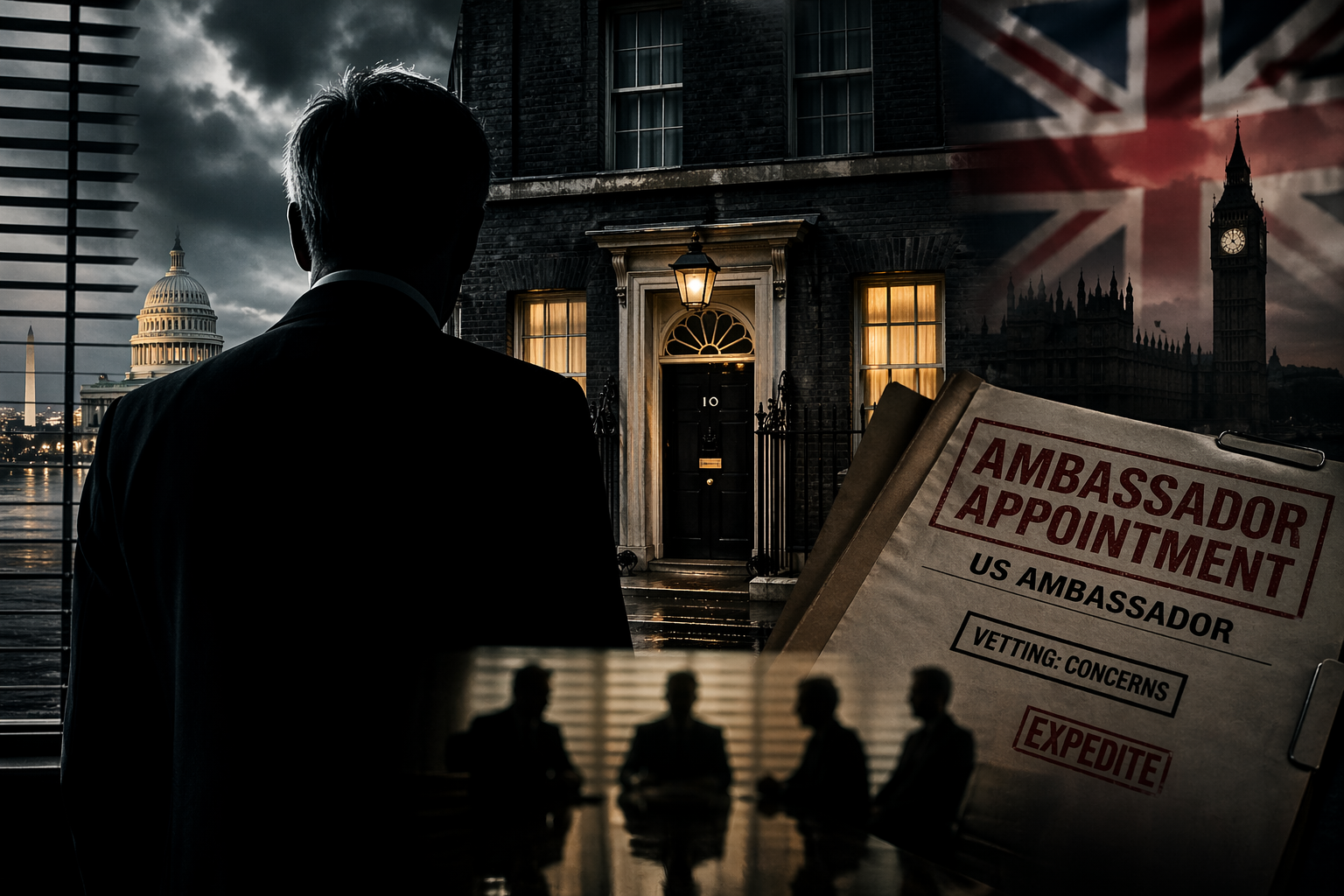
“Constant Pressure”: Testimony Deepens Mandelson Appointment Crisis
Inside the Mandelson Row: Allegations of Political Pressure Shake Downing Street
New testimony describing “constant pressure” to fast-track a controversial diplomatic appointment is transforming a political embarrassment into a deeper crisis about power, process, and accountability at the top of government.
The Mandelson affair has entered a far more dangerous phase. What was initially framed as a failure of process is now being recast as something more deliberate: pressure from the centre of power itself.
A senior former official has told lawmakers he faced sustained pressure from the Prime Minister’s office to accelerate the appointment of Peter Mandelson as ambassador to the United States—despite unresolved concerns during the security vetting process.
The claim is not subtle. It is not procedural. It goes to the core question now hanging over government: was this simply a mistake—or was the outcome effectively pre-decided?
What the testimony actually changes
Until now, the government’s position has relied on a clear line: the Prime Minister was not fully informed about the underlying security concerns, and the system failed beneath him.
That defence becomes harder to sustain in light of new evidence.
The former official described an “atmosphere of constant chasing” from senior political offices, with a strong expectation that Mandelson needed to be in post quickly.
That detail matters. It reframes the timeline. It suggests urgency wasn’t emerging organically from diplomatic necessity—it was being driven.
And when urgency meets a system built on caution, something usually gives.
The deeper fault line: politics vs process
This is where the scandal shifts from a story about one appointment to a story about how power operates.
Diplomatic appointments—especially to Washington—sit at the intersection of politics, intelligence, and national security. They are not supposed to move fast. They are supposed to move carefully.
Security vetting exists for precisely this reason: to introduce friction where political momentum might otherwise override risk.
But this case appears to show the opposite dynamic.
Political urgency accelerated the process
Vetting concerns were treated as obstacles rather than signals
The final decision appeared, to insiders, inevitable
Even the official who ultimately signed off on the appointment suggested it felt like a “foregone conclusion.”
That phrase is doing heavy lifting. It implies the decision may have been politically settled before the formal process had run its course.
Why Mandelson made this uniquely volatile
Any controversy involving a high-profile appointment would have drawn attention. This one carried additional risk from the start.
Peter Mandelson was not a neutral figure. His political history, network, and previous controversies made him one of the most recognisable—and divisive—figures in British public life.
Compounding that were concerns raised during vetting, linked in part to past associations that had already triggered scrutiny.
That combination—high profile, existing risk signals, and political urgency—created a scenario where even a flawless process would have been questioned.
Instead, the process itself is now the story.
The credibility problem for Downing Street
Political scandals rarely hinge on a single fact. They hinge on narrative control—and whether that narrative holds.
The government’s version has been:
The system failed
Information did not reach the Prime Minister
Corrective action has been taken
The emerging counter-narrative is sharper:
Pressure came from the centre
The outcome was expected in advance
The process was shaped to deliver it
Those two stories cannot comfortably coexist.
And once doubt sets in about which is closer to reality, every subsequent explanation becomes harder to defend.
What this exposes about modern government
There is a broader structural tension here—one that extends beyond this case.
Modern political leadership operates at speed: rapid decisions, tight messaging, constant pressure to deliver outcomes.
The civil service operates on principle: process, documentation, layered approval, and risk management.
Most of the time, those systems coexist. Occasionally, they collide.
When they do, the question is not just who wins—but what gets compromised in the process.
This scandal suggests that when political urgency intensifies, institutional safeguards can be bent—sometimes quietly, sometimes under pressure.
What happens next
Three paths now sit in front of this story.
Most likely:
The government continues to hold the line, arguing that pressure does not equal wrongdoing, and that no rules were formally broken.
Most dangerous:
Further evidence emerges—emails, messages, or testimony—that shows direct knowledge or involvement at a higher level than currently acknowledged.
Most underestimated:
The slow erosion of trust becomes the real consequence. Not a single moment of collapse, but a steady weakening of credibility that shapes everything that follows.
Calls for accountability are already intensifying, including questions about whether Parliament was fully informed.
And once a scandal reaches that stage, it rarely stays contained.
The part most people miss
This is no longer about Mandelson.
It is about whether the system around him functioned as intended—or was quietly overridden.
Because if pressure from the centre can reshape decisions at this level, then the implication is wider than any single appointment.
It suggests a model of governance where outcomes are driven first—and processes are expected to catch up.
That is not just a political risk.
It is an institutional one.
The hard landing
Every government faces moments that test its competence.
Far fewer face moments that test its credibility.
This is becoming the latter.
Because the most damaging line in this entire affair is not about vetting, or appointments, or even Mandelson himself.
It is this:
The decision may have been made before the system was allowed to decide.
