

Starmer’s Washington Letter Bombshell: The Decision He Can’t Escape and the Scandal He Can’t Contain
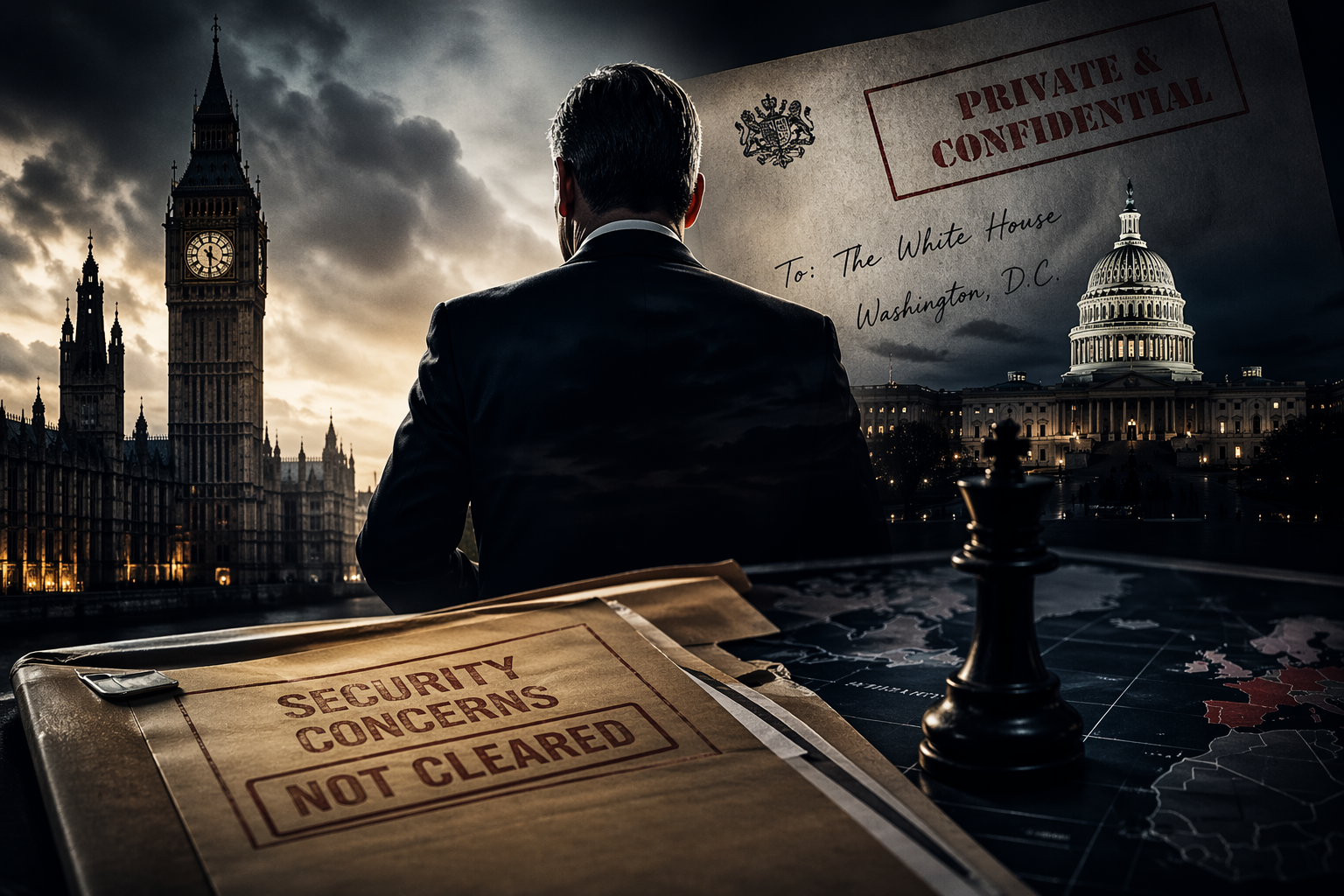
Inside the Mandelson Crisis: Politics, Pressure, and a Prime Minister Under Fire
The Mandelson Scandal Isn’t About One Man — It’s About a Government That Can’t Control Its Own Power
A high-stakes appointment, contested security warnings, and pressure from the center of power have collided into a crisis that raises deeper questions about leadership, accountability, and what governments choose to prioritize in moments of risk.
This was never just about Peter Mandelson.
At its core, the scandal is about something far more uncomfortable: what happens when political ambition collides with national security—and who gets blamed when the system breaks.
Because the facts, as they stand, are stark.
A senior political figure with known controversies was appointed to one of the most sensitive diplomatic roles in the world — the United Kingdom’s ambassador to Washington — despite internal security concerns.
Those concerns were not minor. Security vetting officials had reportedly leaned against clearance.
And yet, the appointment went ahead.
What Actually Happened — And Why It Matters
The sequence matters.
Security vetting raised concerns about Mandelson’s suitability
Those concerns were overridden inside the government.
The appointment was treated, according to testimony, as effectively inevitable
Pressure was reportedly applied to accelerate the process
Prime Minister Keir Starmer has since admitted the decision was a mistake—but insists he was not told about the failed vetting at the time.
Instead, blame has been directed toward senior officials for allegedly withholding key information.
That creates a fundamental tension at the heart of the crisis:
Was this a failure of information…
Or a failure of judgment?
The Starmer Question: Knowledge vs Responsibility
Starmer’s defense rests on a narrow but critical line:
He says he did not know.
That matters legally. It matters procedurally. It matters politically.
But it does not fully resolve the deeper issue—because leadership is not just about what you are told, but what you insist on knowing.
Evidence presented to Parliament suggests that Downing Street was actively engaged in pushing the appointment forward.
Even if Starmer did not see the full security file, the direction of travel was clear: this was a decision driven from the top, not passively received.
That creates an uncomfortable middle ground:
Not clearly deception
Not clearly ignorance
But something closer to structural failure
And that is often more damaging than either.
Politics vs Security—The Real Fault Line
This is where the story sharpens.
Because the Mandelson decision appears to sit at the intersection of two competing priorities:
Political advantage
Security caution
Suggestions already exist that international positioning, particularly relations with Washington, may have influenced the appointment.
If true, the logic becomes clearer:
A high-profile political operator, with deep transatlantic connections, was placed in a role designed to maximize influence.
That is not unusual in diplomacy.
But the risk is obvious.
When political value outweighs security concerns, the system stops being a filter—and becomes a facilitator.
The Washington Dimension — And Why It Raises Stakes
The UK ambassador to the United States is not a ceremonial role.
It is one of the most sensitive postings in global diplomacy—handling intelligence relationships, defense coordination, and strategic alignment.
Which is why the controversy goes beyond domestic politics.
If a figure with unresolved security concerns is placed in that role, the implications are not just reputational — they are operational.
This is where the scandal begins to shift from “political embarrassment” to something more serious:
A question of whether internal safeguards can withstand political pressure.
The Distraction Effect — What Isn’t Being Talked About
There is another layer to this.
Major political scandals have a gravitational pull. They dominate attention. They reshape media focus. They crowd out other issues.
And right now, global tensions — particularly in the Middle East — remain volatile and unresolved.
Yet domestic political bandwidth is being consumed by a controversy over a past appointment.
That doesn’t mean the scandal is irrelevant.
It means it is absorbing attention at a moment when strategic focus matters elsewhere.
That dynamic—whether intentional or not—is a recurring feature of political crises:
The louder the internal conflict, the quieter the external conversation.
What This Reveals About Power
Strip away the personalities, and the Mandelson scandal exposes something structural.
A vetting system that can be overridden
A leadership structure that can claim distance from key decisions
A civil service that can be blamed when outcomes go wrong
Each part, in isolation, is explainable.
Together, they form a system where accountability becomes diffuse.
And diffuse accountability is politically useful—but strategically dangerous.
Because it means no single point of failure…
but also no clear point of control.
What Happens Next
Three paths now sit in front of the government:
Most Likely
Containment.
Internal reviews, procedural reforms, and political survival through managed fallout.
Most Dangerous
Escalation.
Further disclosures — especially around what was known, when — could transform the narrative from misjudgment to misconduct.
Most Underestimated
Erosion.
Not a single dramatic collapse, but a gradual loss of trust—inside government, across institutions, and with international partners.
The Hard Reality
This scandal is not fatal on its own.
But it is revealing.
It shows how decisions are really made under pressure.
It shows how systems bend when political stakes rise.
And it shows how accountability becomes negotiable when power is concentrated.
Peter Mandelson is the trigger.
But the real story is the system that allowed the decision—and the leadership that now has to explain it.
Because in the end, the question is not whether a mistake was made.
It’s whether the system that made it has actually changed.
