Mass Arrests in London: Inside the Law, Backlash, and Free Speech Fight Behind the Palestine Action Protest Crackdown
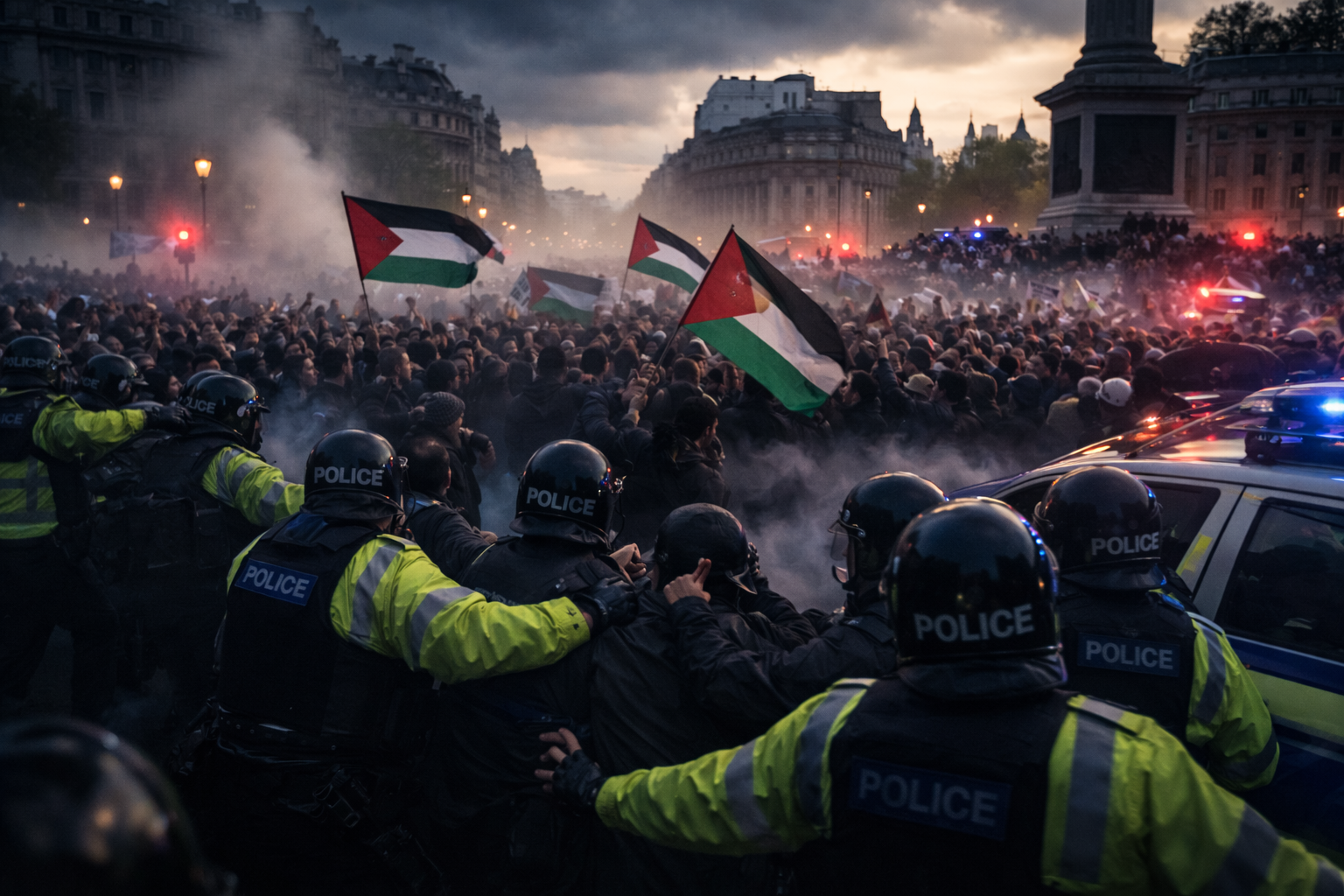
Why Hundreds Were Arrested in London — The Hidden Legal War Over Palestine Action
Over 500 people arrested. A protest deemed criminal. A ban ruled unlawful—but still enforced. This is not just a protest story. It is a test of how far the UK can go in policing dissent.
A Protest That Became a Crime Overnight
More than 500 people were arrested in central London after gathering in Trafalgar Square to support the activist group Palestine Action—a group the UK government has officially banned under terrorism legislation.
Many of those arrested were not accused of violence. They were detained for something far simpler—holding signs, wearing symbols, or expressing support for a proscribed organization.
That is the key to understanding the scale of what happened. This was not a riot. It was a legal boundary being deliberately crossed—by design.
The protesters knew the risk. The law made it explicit.
Why Were So Many People Arrested?
The arrests stem directly from the UK’s decision to proscribe Palestine Action as a terrorist organization in July 2025 under the Terrorism Act 2000.
Under that law:
Membership of the group is illegal
Public support for the group is illegal
Even displaying symbols or slogans linked to it can be illegal
Penalties can reach up to 14 years in prison
That means a protest sign alone can cross the legal threshold into a criminal offense.
Police were not improvising. They were enforcing a clear statutory rule: support = arrestable offense.
Why Was Palestine Action Banned?
The government’s justification centers on direct action tactics, particularly
A high-profile breach of RAF Brize Norton in 2025
Damage to military aircraft
Repeated targeting of defence-related infrastructure
Under UK law, terrorism includes not just violence against people, but also serious damage to property intended to influence government or public policy.
That legal definition is critical— and controversial.
Because it expands “terrorism” beyond traditional definitions.
The Legal Twist: A Ban Ruled “Unlawful”
Here’s where the story becomes far more complex.
In February 2026, the High Court ruled that the ban on Palestine Action was
“Unlawful”
“Disproportionate”
A breach of protest and expression rights
Ordinarily, this would conclude the issue.
But it didn’t.
The government appealed—and crucially, the ban remains in force during that appeal process.
That created a legal contradiction:
A court says the ban is unlawful
The state continues enforcing it anyway
And that contradiction is precisely what protesters targeted.
Free Speech Criticism: “Protest Is Being Criminalised”
Critics — including legal experts, activists, and international bodies — argue the law is being stretched beyond its intended purpose.
The core criticism:
This is not counter-terrorism. This is protest suppression.
The United Nations warned of the ban's risks:
Conflating protest with terrorism
Creating a “chilling effect” on free speech
Criminalising lawful dissent
Civil liberties groups and campaigners argue the following:
Most Palestine Action activity involves property damage, not violence
Supporters with no involvement in illegal acts are being arrested
Peaceful assembly is effectively being redefined as criminal conduct
That’s why many protesters deliberately broke the law — to challenge it.
Government and Supporters: “This Is About Security, Not Speech”
The government’s position is fundamentally different.
Their argument:
Palestine Action is not just a protest group—it engages in coordinated disruption and sabotage
Attacks on military infrastructure carry national security implications
The law must act before escalation into more serious harm
Supporters of the ban argue:
The UK cannot allow infrastructure targeting to be normalized.
Anti-terror laws must adapt to modern forms of disruption
Preventive policing is justified
Some politicians have also backed expanded police powers to restrict repeat protests, arguing cumulative disruption justifies stronger intervention.
What Media Misses
The real story is not just about Palestine Action.
It is about where the UK draws the line between protest and threat.
Because once support speech becomes criminal:
The definition of “support” becomes everything
The threshold for arrest becomes extremely low
The power of the state expands dramatically
This is why critics are alarmed.
Not because of one group, but because of the precedent.
What Happens Next
Three paths now define what comes next:
1. The Court of Appeal Decision
If the ban is overturned, thousands of arrests could collapse legally.
2. Continued Enforcement
If upheld, the current approach becomes entrenched—and likely escalates further protests.
3. Political Spillover
This issue is already moving beyond one group into a broader debate about the following:
Protest rights
Police powers
The scope of anti-terror laws
And that debate is only intensifying.
The Deeper Meaning
This moment sits at a fault line.
On one side:
A state using its strongest legal tools to control disruptive activism.
On the other hand:
Citizens deliberately breaking the law to challenge what they see as unjust power.
The arrests are not the end of that conflict.
They are the clearest signal yet that it is escalating.
And the real question is no longer just about Palestine Action.
It is this:
How far can a democracy go in restricting protest before it changes what protest means altogether?
