Starmer’s EU Alignment Push Ignites Fresh Brexit Battle in Westminster
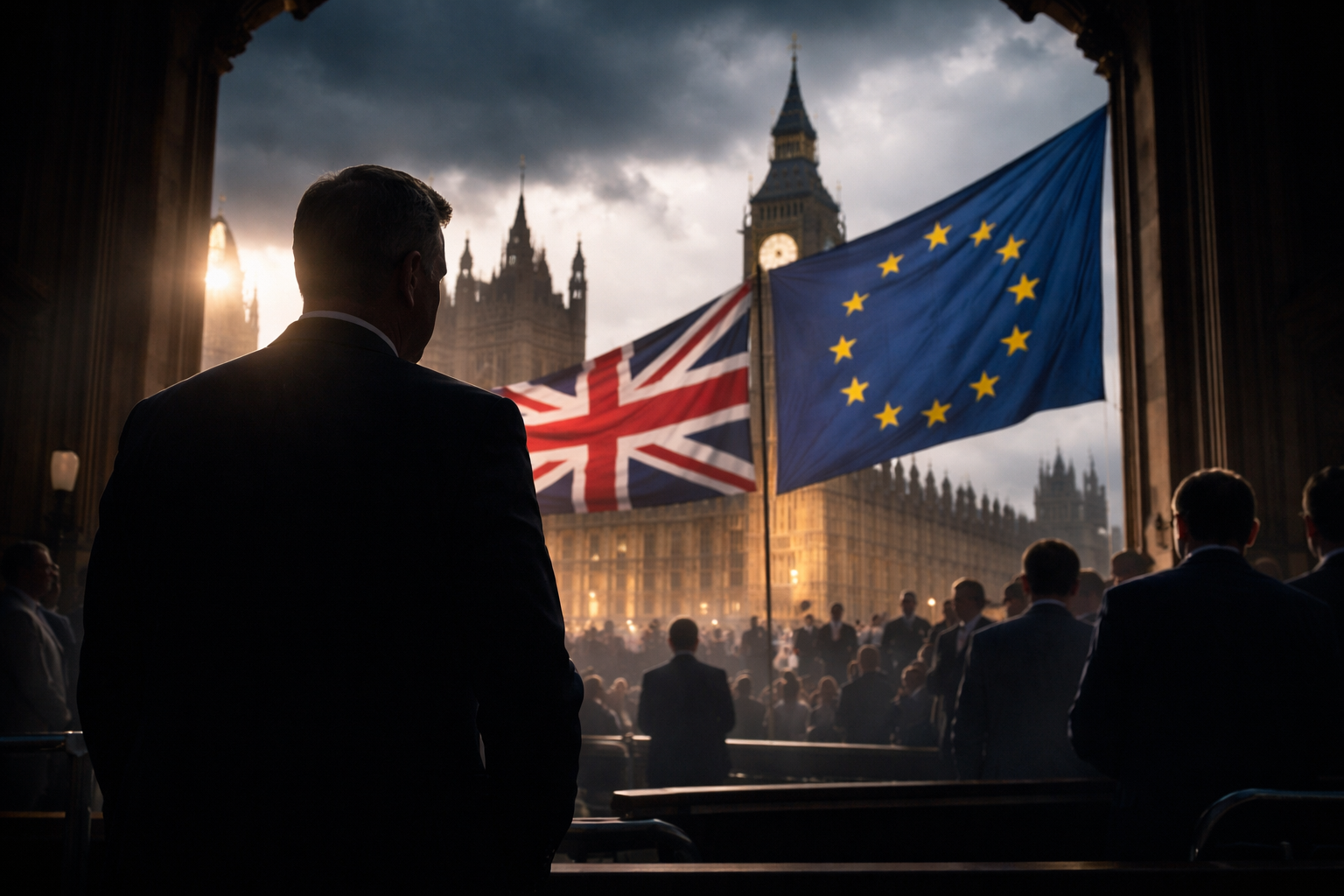
Labour’s EU Reset Plan Faces Fury Over “Henry VIII Powers”
The UK is set to mirror EU rules again—but at what cost to Parliamentary Power?
A new bill promises easier trade and closer EU ties—but critics say it risks quietly rewriting the meaning of Brexit.*
A vote is coming—but the real question is who still holds power.
The UK government is preparing to bring forward legislation that would align parts of British law with European Union rules—and Prime Minister Keir Starmer has confirmed it will go to a parliamentary vote.
On the surface, that sounds straightforward. Parliament votes. Laws pass or fail. Democracy functions.
But beneath that reassurance lies a more complex reality—one that has already triggered accusations of a “backdoor return” to EU influence and a deeper fear: that Parliament may formally approve the framework, only to lose meaningful control over what comes next.
Because the issue is not just about one vote.
It is about how future rules could be made.
What The Plan Actually Does
At the center of the proposal is something known as “dynamic alignment.”
In simple terms, it means the UK will agree to keep certain regulations—particularly in areas like food standards, emissions, and trade— aligned with the EU over time.
Not once.
Continuously.
The government argues the move is practical. British exporters already face friction when EU rules diverge from UK rules. Aligning standards reduces paperwork, cuts costs, and smooths trade flows.
Starmer himself has framed it as a necessary adjustment in a volatile world — a way to strengthen economic resilience and reduce burdens on businesses.
But the mechanism matters more than the intent.
Because the proposal does not just align rules.
It changes how those rules are adopted.
The Mechanism: Where The Controversy Lives
The bill is expected to rely heavily on secondary legislation, including controversial provisions often described as “Henry VIII powers.”
These allow ministers to update or amend laws without going through the full parliamentary process each time.
That means:
MPs may approve the initial framework
But future rule changes could be introduced with limited scrutiny
And crucially, without the ability to amend them
Parliament, in effect, moves from lawmaker to approver of preset options.
Critics argue this is not a technical detail.
It is the entire story.
Why Critics Say This Feels “Anti-Brexit”
Opposition figures — particularly from Conservative and Reform UK circles — have been blunt.
They argue the plan risks reducing Parliament to a “spectator” while EU rules are effectively imported into UK law.
The criticism rests on three core points:
1. Sovereignty Without Control
Brexit was fundamentally about law-making independence.
Aligning with EU rules—especially dynamically—raises the question:
If rules are shaped elsewhere, how independent is the system?
2. Limited Parliamentary Scrutiny
Secondary legislation cannot be amended.
It can only be accepted or rejected — often with minimal debate.
That changes the balance of power.
3. Gradual, Not Sudden, Integration
This is not rejoining the EU.
But it is a step toward regulatory convergence — quietly, incrementally, and structurally.
To critics, that is precisely what makes it politically potent.
Not dramatic.
But directional.
The Government’s Argument: This Is Pragmatism, Not Reversal
Labou’s defense is clear—and strategically disciplined.
This is not about rejoining the single market.
It is about reducing friction where it makes economic sense.
The UK remains outside the EU’s political structures. There is no return to freedom of movement, no customs union, no institutional re-entry.
Instead, the government is making what it calls a “sovereign choice” to align where beneficial—particularly in trade-sensitive sectors.
The logic is straightforward:
Less regulatory divergence = easier exports
Easier exports = lower costs
Lower costs = potential relief for businesses and consumers
In a period of global instability and economic pressure, that argument carries weight.
But it does not resolve the constitutional tension.
What Media Misses
This is not really a story about Europe.
It is a story about how power is exercised inside the UK after Brexit.
The surface narrative is EU alignment versus Brexit purity.
The deeper reality is more structural:
Who writes the rules
Who approves them
And who can challenge them
Dynamic alignment is not controversial because of what it does today.
It is controversial because of what it enables tomorrow.
A system where major regulatory shifts can happen with reduced friction inside Parliament.
That is the real shift.
The Political Tightrope Starmer Is Walking
Starmer is attempting something politically delicate:
Move closer to the EU economically
Without reopening the Brexit referendum debate
While maintaining democratic legitimacy
That requires threading three pressures at once:
Business demand for smoother trade
Voter fatigue with Brexit conflict
Persistent political sensitivity around sovereignty
So far, the strategy is to frame alignment as technical, limited, and economically necessary.
Opponents are framing it as constitutional, expansive, and politically revealing.
Both narratives can coexist, which is why this debate is unlikely to fade.
What Happens Next
The immediate next step is the legislation itself.
Parliament will vote on the framework—and given Labour’s majority, it is expected to pass.
But the real story unfolds after that.
Three scenarios matter:
Most Likely
The bill passes, alignment begins in targeted sectors, and the issue settles into low-level political tension.
Most Dangerous
Successive rule changes accumulate quietly, and the UK finds itself structurally tied to EU standards without ongoing democratic visibility.
Most Underestimated
This becomes the template for broader regulatory alignment—expanding beyond trade into wider policy areas over time.
Each path depends less on the initial vote and more on how the powers are used afterward.
The Real Question Brexit Never Finished Answering
Brexit answered one question clearly:
The UK left the European Union.
But it left another question unresolved:
How independent should the UK be in practice?
Complete divergence has costs.
Close alignment has trade-offs.
Starmer’s plan sits directly in that tension—not undoing Brexit, but reshaping what it means.
And that is why this moment matters more than it first appears.
Because the vote in Parliament is not just about a bill.
It is about defining the next phase of Britain’s relationship with Europe — and with itself.
