

The Birmingham “Suspicious Device” Investigation — Arrest Made, Questions Remain
The Bomb Hoax Arrest That Triggered A Major UK Security Response
What Really Happened At The Birmingham Arena Evacuation
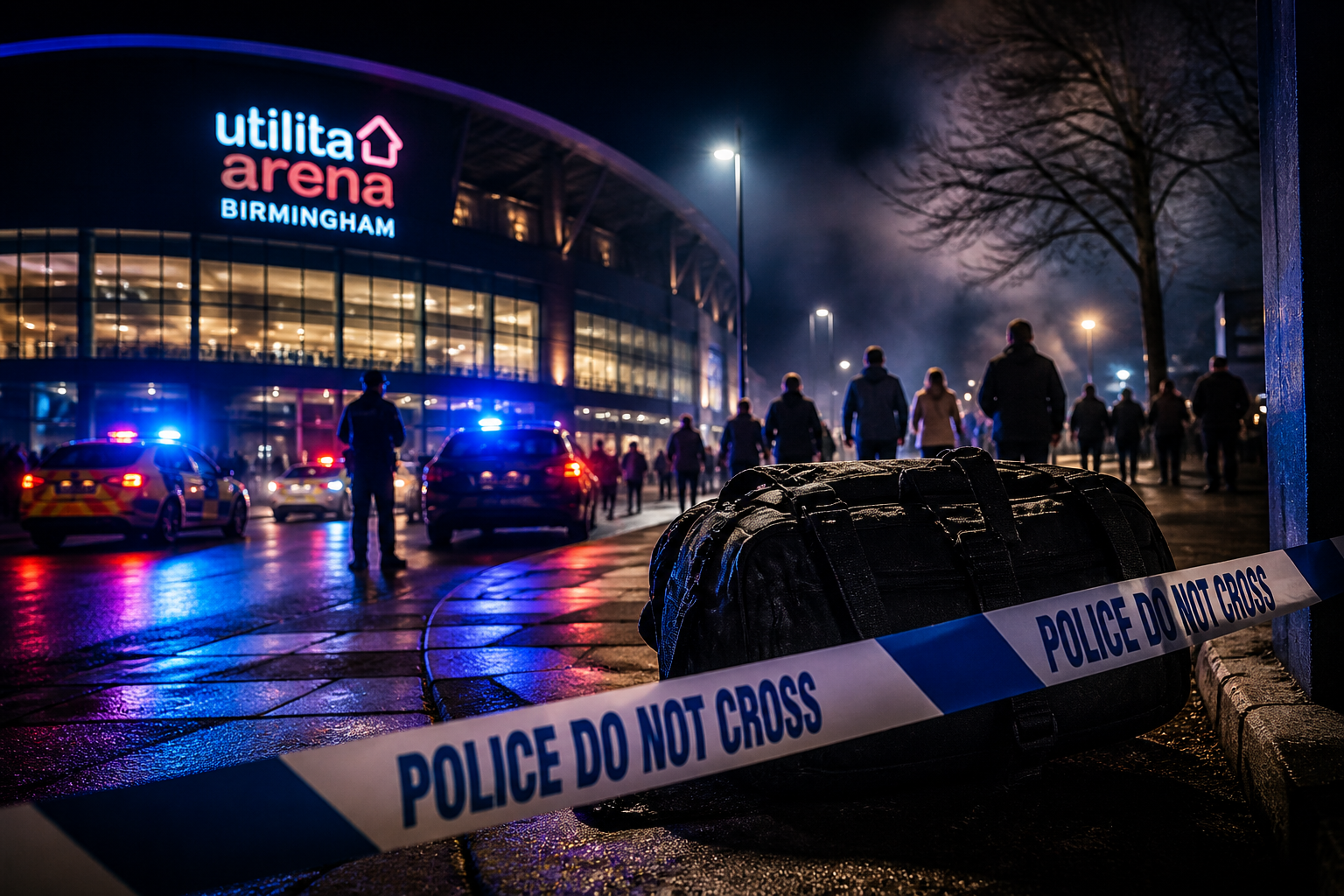
For a few minutes inside a packed Birmingham arena, the atmosphere shifted from laughter to something colder. A live show stopped mid-performance, a crowd of thousands was quietly ushered out, and a single phrase spread through the venue: suspicious bag.
What followed was fast, controlled, and unmistakably serious. Police moved in, the building was searched, and a 19-year-old man was arrested. But the most important detail came later — no device was found.
At first glance, that might sound like a false alarm. It isn’t. Incidents like this sit in a gray zone where the absence of a device doesn’t reduce the significance—it changes the nature of the threat.
What Actually Happened
The disruption took place during a live performance at Birmingham’s Utilita Arena. Around 45 minutes into the show, security intervened abruptly, and the performer was escorted off stage while staff instructed the audience to evacuate.
Police later confirmed the trigger: a “potential suspicious bag” reported within or near the venue. A full security protocol followed: evacuation, search, containment, and arrest.
By the following morning, officers stated clearly that no suspicious item had been found after a full search of the arena.
The arrest, however, remained active. The individual was held on suspicion of a bomb hoax offense, and investigations continued.
That distinction matters. The physical threat may have disappeared, but the legal and security implications did not.
Why “No Device Found” Doesn’t End The Story
A bomb hoax is not treated as a harmless mistake. It is handled as a real threat until proven otherwise, because the cost of being wrong is catastrophic.
In operational terms, police don’t respond to what is proven — they respond to what is possible. A reported device in a crowded venue is treated as credible until fully disproven. That is why thousands of people were evacuated without hesitation.
Even when nothing is found, the event still triggers a full intelligence process:
Who made the claim
Whether it was deliberate or reckless
Whether others were involved
Whether it links to wider activity
This is where escalation risk sits.
The Key Unknowns Still Driving The Investigation
At this stage, several critical questions remain open:
Was This A Genuine Hoax—Or Something Misinterpreted?
Police are treating the case as a suspected hoax, but investigations typically examine intent closely. A hoax can range from a deliberate false threat to behavior that unintentionally triggered a major response.
Was the individual acting alone?
Single arrests are often the starting point, not the conclusion. Authorities will examine communications, movement, and digital activity to rule out coordination.
Could There Be Wider Links?
Even if unlikely, security services test every case against broader patterns—including copycat behavior, coordinated disruption, or links to known individuals.
None of these questions have been publicly resolved yet.
Why Timing Matters More Than It Looks
The incident did not occur in isolation. It came at a moment of heightened national sensitivity, with the UK’s terror threat level recently raised to “severe,” meaning an attack is considered highly likely.
That context changes how events are interpreted.
A suspicious bag in a venue is always serious. A suspicious bag during a period of elevated threat is treated with even less tolerance for risk. The threshold for action drops, and the speed of response increases.
This is why the evacuation was immediate, calm, and non-negotiable.
The Psychology Of The Crowd — And Why It Worked
One of the most striking aspects of the incident is what did not happen: panic.
Witnesses described confusion, but not chaos. People initially assumed the interruption was part of the show before realizing something was wrong.
That moment—where uncertainty meets instruction—is critical. Crowd safety depends on clarity, tone, and trust in authority.
In this case, staff executed a controlled evacuation that avoided escalation. That is not accidental; it reflects years of planning for exactly this type of scenario.
What Most People Miss About Incidents Like This
It is tempting to categorize this as a “false alarm.” That misses the point entirely.
The real story is not whether there was a device. It is how quickly the system responded, how seriously the threat was treated, and how effectively risk was managed.
Events like this test:
Venue security protocols
Police response speed
Public compliance
Communication under pressure
A system that responds strongly to a non-existent device is not overreacting — it is functioning as designed.
Could This Escalate Further?
There are two realistic paths from here.
Scenario 1: Contained Incident
The investigation concludes the suspect acted alone, no device existed, and the case proceeds as a bomb hoax offense. This is the most likely outcome based on current information.
Scenario 2: Expanded Inquiry
If digital evidence, communications, or behavior suggest wider involvement, the case could expand. That may include additional arrests, deeper investigation, or links to other incidents.
There is no confirmed evidence of this at present. But it is exactly what authorities are checking.
The Bigger Signal
A comedy show being halted mid-performance might seem like a one-off disruption. It isn’t.
It is a reminder of how modern security works in public spaces. The threshold for action is deliberately low when risk is high. The system is designed to interrupt normal life before danger is confirmed, not after.
That creates moments like this — confusing, abrupt, and unsettling — but ultimately controlled.
The Final Reality
No device was found. Nobody was harmed. The venue was cleared safely.
On the surface, that looks like a non-event.
But underneath, it is something else entirely: a full-scale test of public safety systems under real conditions—and a reminder that even when nothing happens, the response itself tells the real story.
