

The UK Just Raised Its Terror Threat Level—And This Bank Holiday Weekend Carries More Risk Than It Should
The Hidden Risk Behind Britain’s “Severe” Terror Alert
Britain On “Severe” Alert: Why This Bank Holiday Feels Different—And What You Need To Watch
Britain has quietly crossed a line most people won’t notice—but security services absolutely have.
The UK’s terrorism threat level has been raised to “severe,” meaning an attack is now considered highly likely. That is not fact, not speculation, political messaging, oria exaggeration. It is a formal intelligence assessment made by the Joint Terrorism Analysis Centre.
And it comes just as the country heads into a crowded Bank Holiday weekend.
That timing matters more than it looks.
What Just Changed — And Why It Matters Now
The shift from “substantial” to “severe” is not symbolic. It moves the UK into a category where authorities believe an attack could realistically happen in the near term, based on current intelligence, capability, and intent.
This latest increase follows a series of incidents and a broader pattern of rising threat. Officials have been clear: this is not about one event—it reflects a worsening security environment driven by multiple ideologies and actors.
The threat landscape now includes:
Islamist extremism
Extreme right-wing radicalisation
Smaller, harder-to-detect individuals acting alone
And state-linked encouragement of violence
This is exactly the kind of fragmented, unpredictable threat profile that intelligence agencies consider the hardest to stop early.
Where “Severe” Sits—And What The Maximum Level Actually Is
Most people hear “severe” and assume it is the highest possible warning.
It isn’t.
The UK uses a five-level terrorism threat system, designed to indicate the likelihood of an attack.
Those levels are:
Low — An attack is highly unlikely
Moderate—An attack is possible, but not likely
Substantial — An attack is likely
Severe — An attack is highly likely
Critical—An attack is highly likely in the near future
That final level—"critical"—is ” — is the maximum.
It is used only in short bursts when intelligence suggests an imminent or recent attack and further attacks are expected. It typically triggers the highest possible security posture, emergency coordination, and visible national response.
The UK does not sit at “critical” for long periods. It is a surge state.
So where does that leave “severe”?
It means:
Authorities believe capability and intent are present
Conditions exist for an attack to occur
But there is no confirmed timing or target
That uncertainty is the key detail most people miss.
“Severe” is not the moment before an attack.
It is the phase where one becomes realistically possible — without warning.
Why A Bank Holiday Weekend Raises The Stakes
Bank holidays concentrate people.
City centers fill up. Transport networks stretch. Events multiply. Policing becomes visible — but also distributed across more locations.
This weekend creates exactly the kind of environment that security planners consider higher risk:
Crowded public spaces
Transport hubs
Nightlife zones
Large gatherings and events
Authorities have already confirmed increased vigilance and operational adjustments in response to the raised threat level.
But visible policing is only one layer. Much of the response is intelligence-led and invisible.
That is where the real signal sits.
The Gap Between Messaging And Reality
Official advice remains steady: stay alert, but do not panic.
That messaging is deliberate. It keeps public life functioning and avoids unnecessary fear.
But it also creates a blind spot.
Because “don’t panic” can quickly become “don’t pay attention.”
At the same time, political messaging tends to lean toward reassurance—funding announcements, stronger laws, and visible responses. Yet the underlying intelligence signal is sharper: the threat is rising, and it is harder to predict.
That gap is worth understanding.
Not emotionally. Strategically.
What You Should Actually Be Wary Of
Modern attacks usually look like simple, single-layered plans.
They are more often:
Fast
Localised
Low-tech
Carried out by individuals or small groups
That pattern aligns directly with current UK threat assessments.
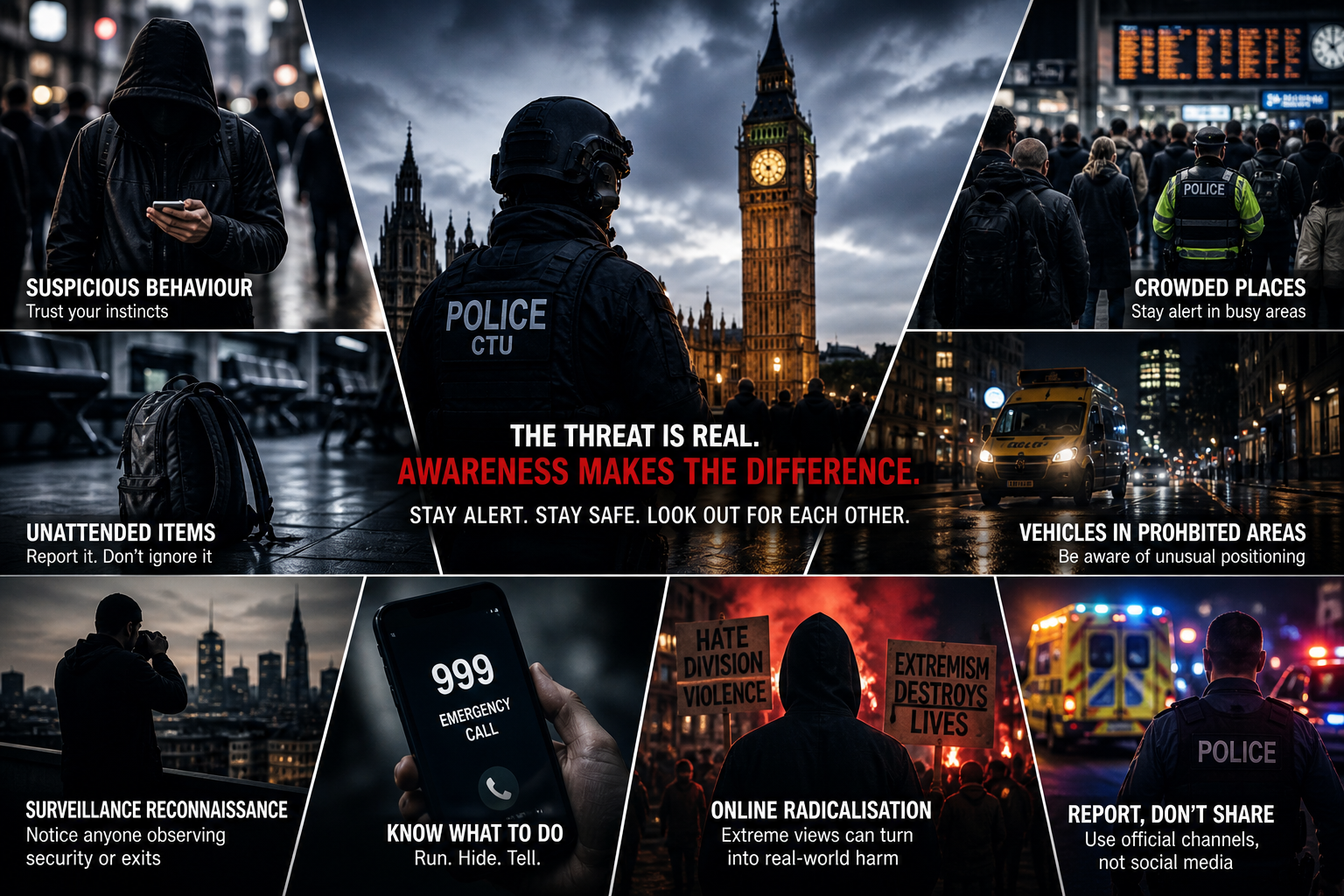
So awareness is not about spotting something dramatic. It is about noticing something slightly off:
Behaviour that feels out of place or deliberately evasive
Unattended items in busy environments
People focusing unusually on entrances, exits, or security
Sudden agitation or erratic movement in crowded areas
Authorities consistently emphasize early reporting. The system depends on it.
How To Stay Safe Without Living Differently
The core public guidance remains simple: Run, Hide, Tell.
Run — Move away from danger quickly
Hide — Find real cover
Tell — Contact emergency services when safe
Beyond that, staying safe is about reducing reaction time:
Know exits in public spaces
Stay aware in crowded areas, especially transport and nightlife
Keep your phone accessible
Avoid being fully absorbed in your screen
Trust instinct
This is not about changing your life. It is about staying switched on.
What Most People Will Miss
The biggest misunderstanding about a “severe” threat level is timing.
People assume it signals something immediate.
It doesn’t.
It signals that the conditions for an attack exist, without clear timing or location.
That ambiguity is why these periods can last — and why complacency builds.
The risk does not feel urgent.
Until it is.
The Real Takeaway
There is no confirmed imminent attack. There is no reason to cancel plans or avoid normal life.
But there is a clear signal.
The UK is in a phase where an attack is considered highly likely over time, based on current intelligence and threat patterns.
And this Bank Holiday weekend — with crowds, travel, and distraction — is exactly the kind of environment where awareness matters most.
Not fear. Not panic. Not paranoia.
Just attention.
Because the difference between a normal weekend and a dangerous one is often decided before anyone realizes it has changed.
