

Birmingham Concert Evacuated Mid-Show After Suspicious Bag Sparks Arrest And Security Lockdown
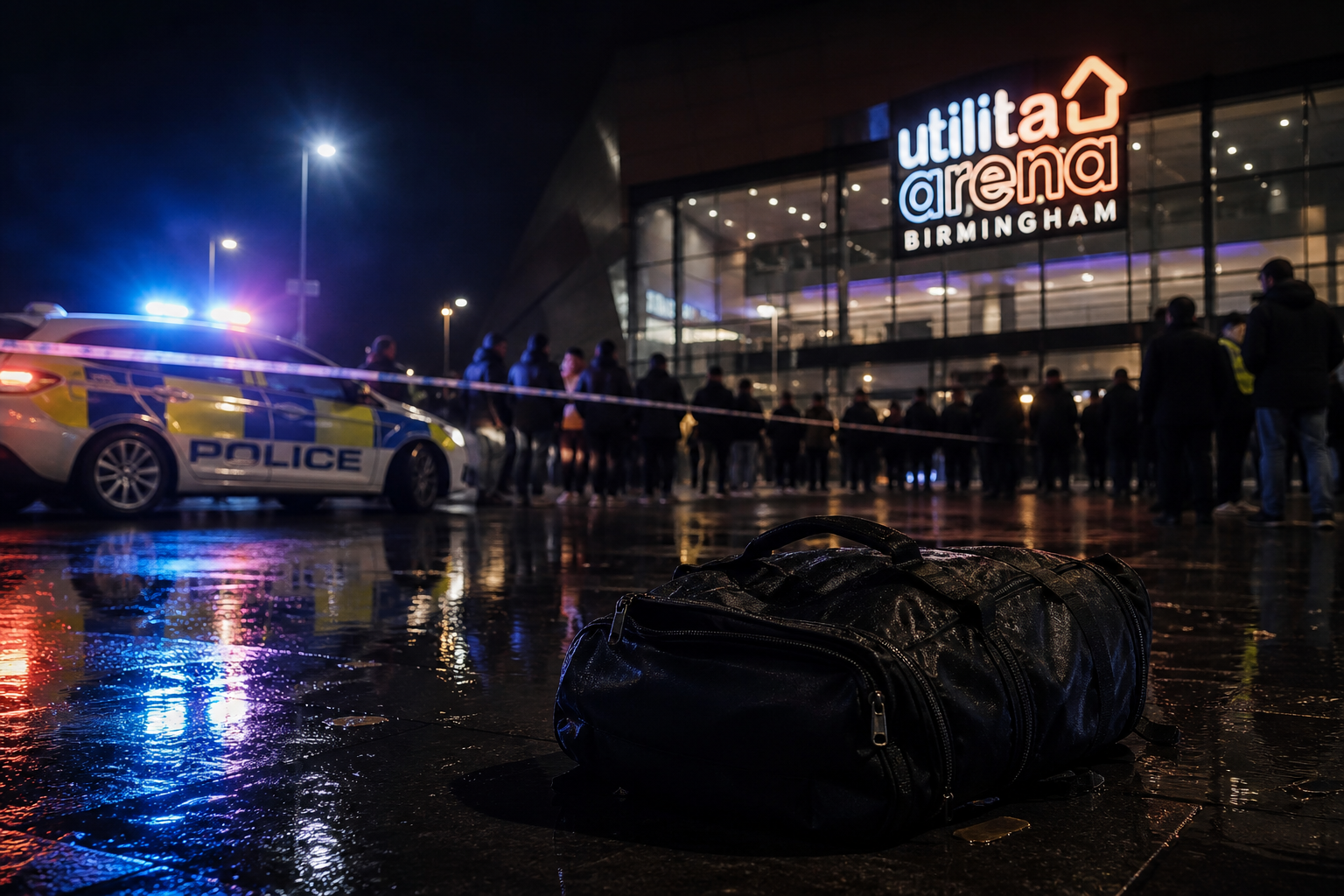
The Moment A Packed Birmingham Arena Fell Silent As Police Halted A Live Show
One Moment The Show Was Alive—The Next, Thousands Were Told To Leave
For nearly an hour, it was just another live performance—laughter, noise, a packed arena. Then, without warning, everything changed. A quiet interruption on stage. A few words exchanged. And within moments, the entire event stopped.
At a major venue in Birmingham, security staff abruptly halted a live show after someone reported a suspicious bag near the arena. The crowd, initially confused, was quickly instructed to evacuate. What looked like part of the act at first became something far more serious as security and police took control.
A 19-year-old man was taken into custody, and the site was placed under immediate search.
What Happened Inside The Arena
According to police and eyewitness accounts, the disruption came roughly 45 minutes into the performance. Two members of staff approached the performer, spoke briefly, and escorted him off stage.
There was no dramatic announcement. No visible panic at first. Many in the audience believed it was part of the show—until security began directing people to the exits.
The evacuation itself was described as swift and controlled. Staff prioritized order over alarm, guiding thousands of attendees out of the venue without disclosing immediate details.
Outside, the scale of the response became clear: police vehicles, increased security presence, and a growing sense that something serious had triggered the shutdown.
The Arrest And Police Response
West Midlands Police confirmed that the evacuation was triggered by what they described as a “potential suspicious bag.”
A 19-year-old man was detained as part of the response, and officers began a full search of the area as a precaution.
At the time of reporting, authorities had not confirmed the nature of the item or whether it posed a genuine threat. That uncertainty is key. In incidents like these, the response is not based on confirmed danger—it is based on risk.
The decision to evacuate is made in seconds, often with incomplete information, because the cost of hesitation can be catastrophic.
Why Events Like This Are Treated Seriously
To an outside observer, a suspicious bag might sound minor. But in modern event security, it is one of the most sensitive triggers possible.
Large venues operate under strict protocols shaped by decades of security incidents. Any unattended item, especially in a high-capacity arena, can prompt immediate escalation. The logic is simple: assume risk first, verify later.
This is not an overreaction. It is design.
Crowded events present a unique vulnerability. Thousands of people in a confined space, limited exits, and high emotional energy create conditions where even a small threat can have amplified consequences.
The response that Birmingham saw—rapid evacuation, arrest, and full site search—demonstrates exactly what those protocols are built for.
The Context Most People Miss
There is a deeper layer to this story that most headlines will not emphasize.
This incident did not happen in isolation. It comes at a time when the UK's security posture has heightened, and authorities are reviewing event safety across the country.
That means responses are sharper, faster, and less tolerant of uncertainty than they might have been years ago.
What looked to attendees like a sudden overreaction was, in reality, a system working exactly as intended. The speed of the interruption—the immediate removal of the performer, the controlled evacuation—shows how rehearsed and embedded these protocols have become.
The Human Moment Inside The Chaos
Perhaps the most revealing detail is how the crowd initially reacted.
Many thought it was part of the performance.
That moment—when reality has not yet caught up with risk—is where modern security lives. The gap between normality and emergency is now measured in seconds, not minutes.
Witnesses described confusion rather than panic, a sign that the evacuation was handled with control. That matters. In large-scale evacuations, the biggest risk is not always the threat itself, but how people respond to it.
In this case, the response appears to have avoided that secondary danger.
What Happens Next
At the time of writing, the investigation is ongoing. The venue has been secured, and further updates are expected from police regarding the nature of the suspicious item and the circumstances around the arrest.
For attendees, the immediate questions are practical—rescheduled events, ticket validity, and whether the show will continue as planned. Authorities, however, have a different focus: verifying the threat, understanding intent, and ensuring that no wider risk remains.
Why This Matters Beyond One Night
It would be easy to treat the situation as a one-off disruption. A cancelled show. A brief scare. But the significance is broader.
This is what modern public safety looks like: invisible systems suddenly becoming visible. Protocols designed for worst-case scenarios activate in real time.
The fact that thousands of people were evacuated safely, with no reported injuries, is not a footnote. It is the outcome those systems are built to deliver.
In the end, the show stopped—but the system held.
