Why Britain Lost Control Of Immigration — And Why Fixing It Is So Hard
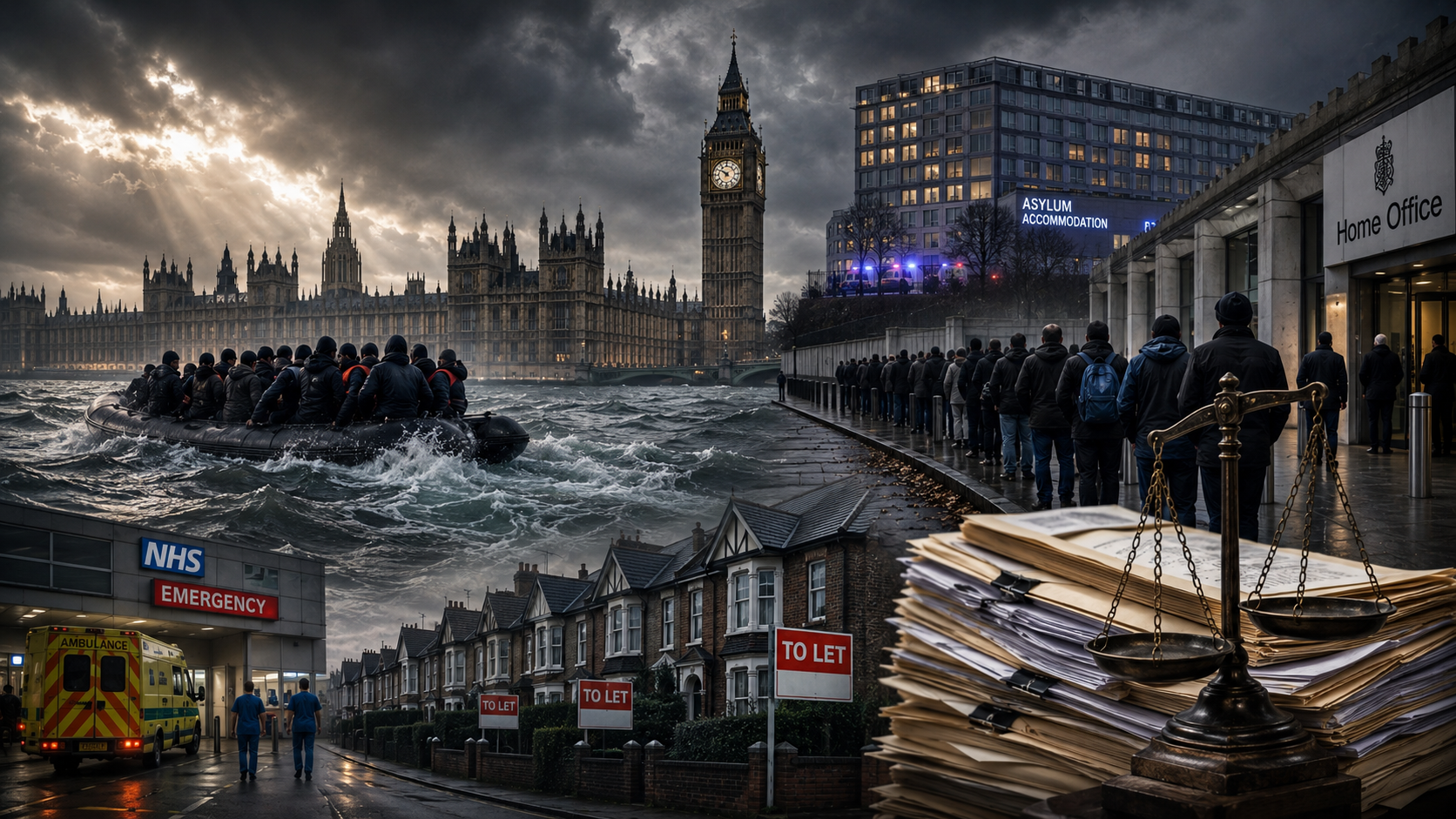
The Immigration System Britain Can No Longer Pretend Is Working
How Britain Became Trapped By Its Own Immigration Laws
Britain’s immigration crisis is not one single crisis. It is a pile-up of legal migration, asylum pressure, small boats, slow removals, weak state capacity, court challenges, hotel costs, public-service strain, and a political class that has repeatedly promised control without building the machinery to deliver it.
That is why the public anger is so sharp. People can see the contradiction. Net migration has now fallen sharply from the extreme post-pandemic peak, but the system still feels out of control because the most visible parts of the system — small boats, asylum hotels, failed removals, foreign national offenders, appeals, and local pressure — remain unresolved. Official ONS figures put long-term net migration at 171,000 in the year ending December 2025, down from an updated 331,000 in 2024 and far below the record surge of 2022–23. But gross immigration was still 813,000, with 642,000 people leaving, which means Britain is still operating a very large migration churn even after the headline net figure fell.
The strongest anti-mass-illegal-immigration argument is therefore not that every migrant is a burden or a danger. That would be false. The stronger argument is that a sovereign state has lost public consent when it cannot decide who enters, who stays, who is removed, and how fast the law is enforced. That is the core failure.
The Numbers Show A System That Peaked, Fell, But Did Not Reset
The post-Brexit immigration system was meant to restore control. Instead, after free movement ended, Britain built a points-based route that still allowed very high inflows through work, study, health and care, dependants, family, humanitarian routes, and asylum. The result was a huge legal migration surge, followed by a partial correction when rules were tightened on dependants, salary thresholds, and care-sector recruitment.
By 2025, net migration had dropped to 171,000, but that does not mean the problem disappeared. The Migration Observatory notes that non-EU immigration was still about 627,000 in 2025, with large shares arriving for study, work, or as dependants of work migrants. It also notes that asylum accounted for around 14% of non-EU immigration, but asylum migrants are less likely to leave quickly, so their long-term population effect can be larger than the raw arrival share suggests.
The asylum numbers remain politically toxic. Home Office statistics show 94,000 people claimed asylum in the year ending March 2026, down 12% on the previous year, while just over half of claimants arrived through illegal entry routes such as small boats and a further 39% had previously arrived on a visa or with other leave. Initial asylum decisions rose to 128,000, with a grant rate of 39%, down from the peak of 77% in 2022.
Small boats are the symbol because they make the failure visible. Commons Library figures say 39,000 people arrived by small boat in the year ending March 2026, about 90% of detected unauthorised arrivals; around 75% were adult men, 12% adult women, and 13% children.
That is why people do not feel reassured by a lower net migration figure. They see a state that can count arrivals but struggles to prevent them, house them cheaply, process them quickly, or remove those with no lawful right to remain.
Why Britain Cannot Just “Do A Trump”
The Trump comparison matters because it exposes the difference between deterrence politics and process politics.
In the United States, Trump’s second administration moved fast through executive orders, border emergency powers, troop support, detention expansion, removals, and a hard message that illegal entry would produce immediate consequences. The White House says illegal crossings declined in 2025 as enforcement resources were redirected, removals accelerated, and cooperation with state and local partners expanded. DHS claimed in January 2026 that more than 675,000 people had been removed and an estimated 2.2 million had self-deported or otherwise left. CBP said in June 2026 that southwest border apprehensions were 94% lower than under Biden-era levels and that there had been 13 straight months of zero releases by Border Patrol.
That is the pro-Trump case: he changed incentives. He made illegal entry less likely to lead to release into the interior. He increased the expected cost of trying. He used executive power aggressively and forced institutions to align around border control.
Britain does not work like that. The UK Prime Minister is powerful in Parliament, but immigration enforcement is constrained by a dense legal web: the Refugee Convention, the European Convention on Human Rights, the Human Rights Act, modern slavery rules, judicial review, asylum appeals, devolution concerns, international agreements, lack of detention capacity, lack of return agreements, and operational weakness inside the Home Office.
Also, the US is not free of legal barriers. A US appeals court ruled in July 2026 that the Trump administration could not hold migrants beyond 90 days without bond hearings, showing that even America’s harder system still faces constitutional due-process limits.
So the real answer is blunt: Trump’s approach works faster because the US executive has a stronger enforcement machine and because his administration chose certainty of consequence as the centre of policy. Britain has chosen legal process, appeals, case-by-case balancing, and institutional caution. That makes removals slow, expensive, and vulnerable to challenge.
The Laws That Block Quick Removal
The most important legal barrier is non-refoulement: the rule that a person must not be sent somewhere they face persecution, torture, serious harm, or onward removal to danger. The UNHCR describes Article 33 of the 1951 Refugee Convention as the cornerstone of refugee protection: a refugee should not be returned to a country where they face serious threats to life or freedom.
That principle exists for a real reason. It was built after the catastrophes of the twentieth century, when states turned people away or returned them to danger. It was designed to stop governments sacrificing vulnerable people to political convenience.
But in modern Britain it creates a hard enforcement problem. Once someone reaches UK soil and claims asylum, the state usually has to process that claim. It cannot simply push them back across the Channel without legal authority, a safe third-country agreement, and a process that survives court scrutiny.
The ECHR adds another layer. The Commons Library explains that Article 3 and Article 8 can be used to contest immigration decisions. Article 3 blocks removal where someone would face torture or inhuman or degrading treatment. Article 8 protects family and private life and can be invoked where removal would interfere disproportionately with a person’s family ties or settled life in Britain.
Article 8 is the political flashpoint because it can look, to the public, like a loophole. Someone may enter illegally, stay for years while the system delays, build family links, and then argue removal would breach private or family life. The law does not guarantee success, but it creates litigation space. That litigation space becomes a practical veto when the Home Office is slow, detention space is limited, and appeals take time.
Modern slavery rules add another route. The government’s 2026 Immigration and Asylum Bill aims to reform the modern slavery framework and reduce opportunities for misuse, while encouraging earlier disclosure and speeding removals.
That alone tells the story. If a new bill is needed to stop late legal claims delaying removals, then the current system is already conceding that delay has become part of the game.
Why These Laws Are Hard To Overturn
They are not literally impossible to overturn. Parliament is sovereign. A government with the votes could repeal or amend domestic law, change the Human Rights Act, restrict appeal rights, leave the ECHR, rewrite immigration rules, expand detention, and legislate more aggressively.
But “legally possible” is not the same as “easy”.
Leaving or weakening the ECHR would trigger major political, diplomatic, constitutional, and Northern Ireland arguments. Some legal and political voices argue the Good Friday Agreement does not legally require continued ECHR membership, while others argue ECHR enforcement is embedded in the peace settlement and withdrawal would be destabilising. The existence of that dispute alone makes reform harder.
The Refugee Convention, the Convention Against Torture, domestic common-law principles, and international reputation would remain issues even outside the ECHR. The Rwanda litigation showed this clearly. The UK Supreme Court found the Rwanda scheme unlawful because of the risk of refoulement — people being sent onward to danger — and parliamentary committees noted that non-refoulement is protected by several international instruments binding on the UK.
Then there is institutional resistance. Courts test legality. The Lords revises. Civil servants warn about implementation. Councils object to asylum accommodation. Charities litigate. International bodies criticise. Labour MPs rebel from one direction; Reform and Conservative critics attack from the other. Every attempted reform becomes a constitutional battle before it becomes an enforcement policy.
That is why Britain gets announcements instead of control.
The Cost Is Politically Unsustainable
The cost issue is devastating because it turns a border argument into a fairness argument.
The Public Accounts Committee reported that asylum support costs rose to about £4.0 billion in 2024–25, driven largely by reliance on expensive hotel accommodation. At the end of September 2025, about 36,300 asylum seekers were in hotels, still far below the 2023 peak but slightly higher than the year before. The committee warned that the Home Office had not demonstrated a credible long-term strategy for asylum accommodation.
Migration Observatory data suggests hotel reliance has fallen since 2023, with asylum seekers requiring accommodation support falling from 112,000 in March 2023 to 98,000 in March 2026, and the hotel share falling from 42% to 21%. That is improvement, but not victory. It still means nearly 100,000 people being supported in a system the public sees as expensive, unfair, and badly planned.
The government is now proposing that some asylum seekers repay about £10,000 towards state-funded support before applying for settlement, explicitly because asylum support costs have become politically toxic.
The broader fiscal picture is more complicated. Migration Observatory’s 2026 fiscal briefing says studies usually find the fiscal impact of immigration is within +1% or -1% of GDP, recent migrants tend to be more positive fiscally than longer-settled migrants, and EEA migrants historically had a more positive impact than non-EEA migrants.
But that nuance does not rescue an uncontrolled system. A skilled worker paying high tax is not the same as an asylum claimant in hotel accommodation. A doctor staffing the NHS is not the same as a foreign national offender resisting deportation. A student who leaves after study is not the same as a low-wage dependant household requiring long-term support. The serious policy failure is that Britain spent years talking about immigration as one number instead of separating routes by contribution, risk, cost, and capacity.
Crime: The Hard Truth And The Limits Of The Data
The immigration-crime debate is emotionally explosive because high-profile cases destroy trust quickly. The public does not need every migrant to be a criminal to be furious. It only takes a small number of serious cases, combined with failed deportations, to make the state look reckless.
But the data must be handled carefully. The ONS has said police recorded crime data does not provide a clean public dataset on crime by nationality and immigration status. That means sweeping claims about asylum seekers causing a specific share of serious crime are often not provable from official UK data.
What is official is the foreign national prison figure. Commons Library prison statistics show foreign nationals made up around 12% of the prison population, roughly the same share as in June 2015. A 2024 Commons Library briefing recorded at least 10,321 foreign nationals in prisons in England and Wales at the end of June 2023, out of 85,851 prisoners, with common nationalities including Albanian, Polish, Romanian, Irish, and Jamaican.
That does not prove “immigrants cause crime”. It does prove a narrower but powerful point: Britain has a significant foreign national offender problem, and removal is too slow. Home Office returns data shows 39,000 returns in the year ending March 2026, up 7% year on year, but that includes both voluntary and enforced returns and is not enough to restore public confidence if serious offenders remain in the country for years.
The anti-illegal-immigration position should focus on enforceable principles: foreign criminals should be removed faster; repeat illegal entrants should face certain consequences; asylum abuse should be deterred; and serious offenders should not be able to convert delay into settlement rights. That is not racism. That is state competence.
NHS, Schools, Housing, And Assimilation
The NHS argument cuts both ways. Immigration adds population demand, but the NHS also relies heavily on migrant labour. Commons Library data shows around 325,000 NHS staff in England reported a non-British nationality in June 2025, about 21% of staff with known nationality; non-British nationals made up around 36% of doctors and 30% of nurses.
So blaming NHS collapse on immigration alone is too crude. The better argument is capacity: if the state admits large numbers of people, it must expand GP capacity, dentistry, hospital capacity, housing, interpreters, safeguarding, and public health services in the same places where people settle. Britain did not do that properly.
Schools are more localised. Nationally, pupil numbers are falling: DfE statistics show just over 8.9 million pupils in January 2026, down 112,200 from the previous year, mainly because of demographic changes. That means immigration is not causing a national school-place explosion. But it can still create local pressure in specific towns, cities, and reception areas where asylum hotels, low-cost rentals, or work routes concentrate families faster than councils can plan.
Housing is the clearest pressure point. The Migration Advisory Committee’s housing evidence review states that immigration can affect house prices and rents, depending on local supply conditions. In a country with chronic undersupply, high migration becomes a demand shock layered onto a broken housing market.
Assimilation is the hardest to measure but politically decisive. Britain can absorb immigration when numbers are controlled, work is real, English is strong, housing is stable, schools are not overwhelmed, law is enforced, and local people feel consulted. It struggles when communities experience sudden demographic change, male-only asylum accommodation, hotels converted without consent, visible disorder, and a sense that objections are dismissed as bigotry.
That is how domestic uproar builds. Ipsos found in February 2026 that 41% of the public named immigration as one of the biggest issues facing Britain, ahead of the economy and NHS. YouGov found in April 2026 that 47% of adults believed more migrants were crossing the Channel in small boats than in previous years, while only 13% thought fewer were.
Public anger is not only about numbers. It is about disbelief. People no longer believe the state’s promises.
Forecast: What Lies Ahead
The official long-term forecast is not a return to zero. ONS 2024-based population projections put the UK population at 69.3 million in mid-2024, rising to 71.0 million by mid-2034, with the increase driven by net international migration. Over that decade, ONS projects 7.278 million long-term immigrants and 5.096 million emigrants, creating about 2.182 million net international migration, while deaths exceed births.
A simple scenario shows the political risk. If the current 2025 level were repeated, annual net migration of 171,000 would add about 1.71 million people over ten years. Under the approximate ONS projection path, annual net migration of around 218,000 would add about 2.18 million people over ten years. Under an end-decade rebound scenario, annual net migration of 300,000 would add about 3.0 million people over ten years.
The anti-mass-immigration case is that even the “lower” path still adds the equivalent of a large city every few years unless housing, infrastructure, NHS capacity, and enforcement capacity expand with it. The pro-growth counterargument is that cutting migration too far can reduce labour supply, tax receipts, and NHS staffing. The OBR has warned that net migration affects trend growth through labour supply, with a 50,000 annual change in net migration affecting 16+ population growth by about 0.1 percentage points per year.
That is the dilemma. Britain has built an economy and NHS partly dependent on immigration while voters increasingly demand sharp reductions. That model is unstable.
The Bottom Line
UK immigration got out of control because politicians tried to have everything at once: high labour supply, cheap care staffing, international university income, humanitarian credibility, ECHR compliance, low detention, slow courts, limited removals, weak local consultation, and no serious infrastructure expansion.
Trump’s approach is stronger because it starts from deterrence: illegal entry must not produce release, delay, or eventual settlement. Britain’s approach starts from process: claim, support, assess, appeal, review, accommodate, and maybe remove. Process without consequence becomes invitation.
The path ahead is ugly unless Britain makes a clean choice. It can keep the current legal architecture and accept slower enforcement, higher cost, and public anger. Or it can radically rewrite the system: expand detention, fast-track appeals, restrict Article 8 use, reform modern slavery claims, secure return agreements, remove foreign criminals faster, cap low-value routes, require English and self-sufficiency, and make illegal arrival a practical dead end.
The public will not accept another decade of speeches. The next phase of British politics will be dominated by whether the state can prove that borders are real, laws mean something, and citizenship still has priority inside its own country.
