Who Created Pudsey Bear?
Pudsey’s Famous Bandana Has a Longer History Than His Yellow Fur
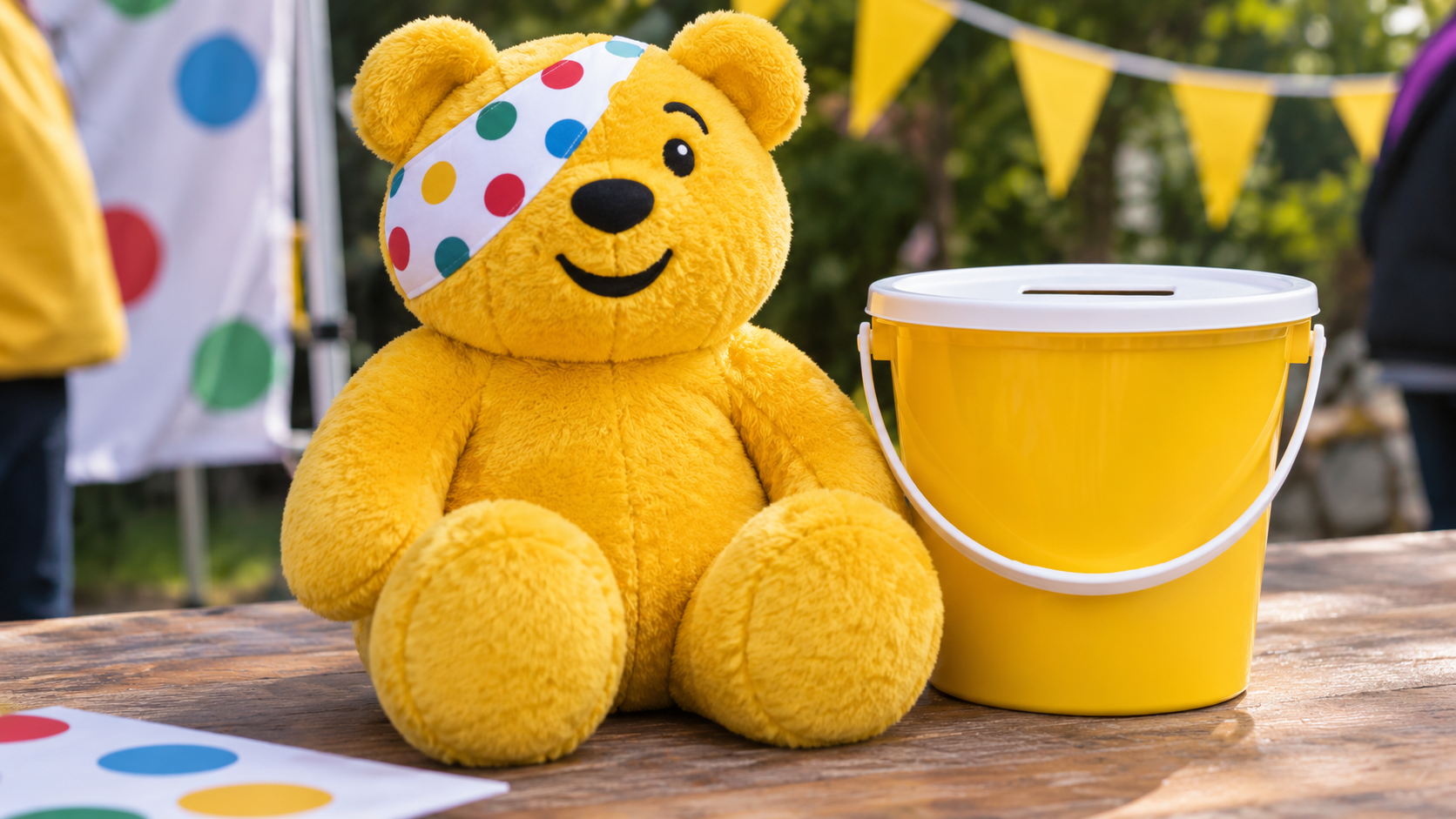
Ask someone to draw Pudsey Bear and the first detail they add will probably be the spotted fabric over one eye. BBC Children in Need calls it a bandana. It has been part of the character in different forms since his early days. The charity’s public history tells us who designed him, when he appeared and where his name came from. It offers no definitive accident story explaining what happened to his eye.
That distinction makes this a good question for a family watching the appeal together. There is a documented answer about the picture. There is room for imagination about the bear inside it. The most surprising thing the archive reveals is how different that first picture looked.
Who Created Pudsey Bear?
BBC graphic designer Joanna Lane created the character for Children in Need. Pudsey made his first appearance in 1985. The bear was brown, with a bandana already visible. A child who recognises the modern mascot from his yellow fur and coloured spots might walk straight past the original artwork. Cover the colours, however, and the family resemblance becomes easier to see.
A bear was an ingenious choice for a television appeal. Children recognise the form from a toy they can hold. Adults recognise the same form from childhood. Unlike a presenter, a drawn character can appear on a school collection sheet, a jumper or a cake without requiring an introduction. A distinctive detail over one eye gives even a wobbly homemade version a good chance of being recognised.
Is Pudsey a Real Place?
Yes. Pudsey is a town in West Yorkshire, between Leeds and Bradford. Lane named the bear after her home town. The geographical connection explains a name that can sound as if someone chose a pleasing pair of syllables especially for a teddy. A place familiar to the designer became familiar to millions of people who had never visited it.
Place names used this way acquire two separate lives. On a map, Pudsey directs someone to a particular part of Yorkshire. On a school notice asking pupils to dress in spots, it evokes an entire appeal. A child can know the second meaning for years before discovering the first.
Why Do People Call It an Eye Patch?
Because that is what it looks like at first glance. One eye is covered, and the dressing gives the bear a vulnerable, approachable expression. The charity’s word “bandana” describes the fabric wrapped around his head. Calling it a patch describes the feature most viewers notice. Neither observation establishes a medical diagnosis.
It is easy to see why an origin story circulates. Children ask what happened to someone with a plaster or bandage. A mascot with a covered eye invites exactly that caring response. It is fair to read the design as encouraging empathy. It would take evidence from the designer or charity to turn that reading into a particular injury, disability or childhood adventure.
When Did He Turn Yellow?
The charity dates the redesign to 1986, the year after Pudsey’s debut. The familiar yellow bear developed from that change, with further refinements over the years. Set an early appeal image beside a modern one and notice which details you use to identify him. Fur colour is powerful, but the diagonal line of fabric across the face does much of the work.
There is a practical reason visual continuity matters. A charity asks people to recognise a campaign in many settings, often with very little space. A shop window gives it seconds of attention. A badge may be smaller than a coin. A child decorating biscuits may have only two colours of icing. A character with one memorable asymmetrical feature can survive all three translations.
How Can You Tell Which Details Are Documented?
Look at what each kind of source is in a position to establish. A photograph from an early broadcast can answer questions about colour, fabric and shape. A charity timeline can establish when a mascot was introduced. An interview with a designer can explain a creative decision. A story told by a parent about a bear hurting himself is evidence of how families interact with the character. It cannot on its own establish what a designer intended forty years ago.
Even the present-day costume can mislead somebody looking for an origin story. Its proportions have to work for a performer, and its markings need to read from a distance. A drawing fitted to a fundraising leaflet faces different constraints. Treating every difference between the two as an event in Pudsey’s fictional life would produce a lively biography with very little historical foundation.
Why Do Children Draw the Spots Themselves?
A good fundraising symbol gives people something manageable to do. Drawing a technically accurate bear takes practice. Adding coloured circles to a piece of paper takes seconds. A nursery, an office and a television studio can all borrow the visual idea at very different scales. Participants recognise one another’s efforts even when their materials look nothing alike.
That is a different achievement from simply making a popular toy. A toy asks a customer to take home the finished design. A fundraising mascot thrives when people remake it with whatever they have. The original drawing, a homemade cake and a school jumper belong to the same appeal because viewers can do the last piece of interpretation themselves.
Did Children in Need Begin With Pudsey?
No. The BBC’s charity appeals for children predate the mascot, and the televised Children in Need appeal was already running before 1985. Pudsey gave an existing fundraiser a face. Confusing his first appearance with the origin of the appeal makes the institution younger than it is and misses the problem his design solved. A recurring television event needed a character who could travel beyond the broadcast.
That is why the image turns up wherever people organise their own fundraising. The bear a classroom draws will rarely match the neat official artwork. It may have the ears in the wrong place or too many spots. Yet put a bandana across one eye and somebody will say his name. The answer to where that name came from is a town in Yorkshire. The answer to what happened to his eye remains a story the official design leaves open.
