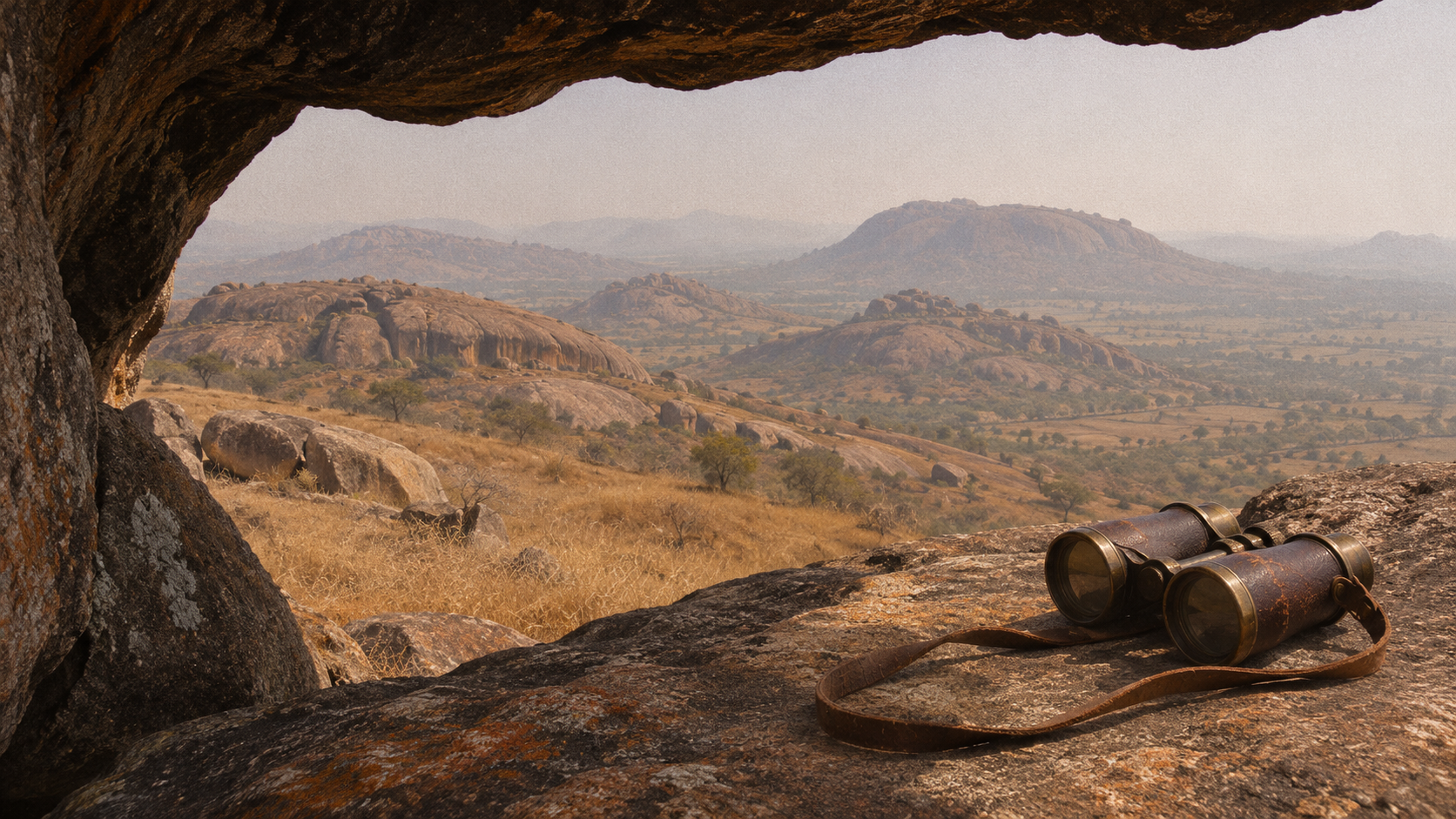
Mrs Moore, the Echo and the Broken Field Glasses
An Englishwoman Has Already Removed Her Shoes
Dr Aziz enters a mosque in Chandrapore and sees an Englishwoman where he least expects one. He calls out to warn her about her shoes. She has already taken them off. In E. M. Forster’s A Passage to India, a friendship begins because a man makes a reasonable assumption, a woman corrects him and both are willing to enjoy what follows. That modest sequence becomes much harder to repeat elsewhere in the city. Aziz is an Indian Muslim doctor living under British rule. Mrs Moore is visiting the magistrate who governs people like him. For a few minutes, each gets to decide what to make of the other before anyone else can tell them.
What Happens Before the Mosque
Aziz is having dinner with friends when Major Callendar, his British superior at the hospital, summons him. He leaves his meal and makes the journey, only to discover that Callendar has gone out without leaving a message. Two Englishwomen then take the carriage Aziz hired. Neither appears to think that the Indian gentleman who secured their transport might have a further use for it. By the time he reaches the mosque, his evening has twice been redirected by people who have barely registered his existence.
Those inconveniences explain the heat of his first words to Mrs Moore. He assumes another English visitor has entered a space important to him without troubling to learn how to behave there. Her answer surprises him twice. She understands the custom, and she would observe it even if nobody were present to notice. Aziz apologises. They discover that both know what it is to lose a spouse and that both have children. He even ventures a complaint about the Englishwoman who took his carriage. Mrs Moore listens with sufficient attention to have an opinion about the woman herself.
The meeting works because Aziz can be several things in quick succession. He is indignant, mistaken, courteous, grieving, funny and a little indiscreet. Mrs Moore can revise her estimate of him with every remark. Back among the British at the club, the account of their encounter loses much of that movement. Her son Ronny Heaslop, Chandrapore’s city magistrate, hears that an Indian subordinate criticised a British official’s wife. His professional ear picks up an offence where his mother heard a confidence. Aziz’s name has travelled only a short distance across town and already the circumstances in which he spoke have fallen away.
Mrs Moore has come to India with Adela Quested, who is considering marrying Ronny. Adela would like to find out what he is like in the place where they would live. She also wants to meet Indians. At first those wishes seem compatible. It takes her some time to discover that the daily performance of being a British official has supplied Ronny with a different set of manners from the ones she remembers in England. Learning about Chandrapore may oblige her to reconsider the very marriage that brought her there.
A Party Where the Hosts Keep Their Distance
The British Collector arranges a Bridge Party intended to bring the English and Indian communities together. Indians attend, the invitations have been issued in good faith by some of those involved, and the physical conditions for an encounter appear to be in place. Yet the English guests largely keep to one another. When Mrs Turton, the Collector’s wife, approaches the Indian women, the social distance she wishes to maintain is apparent even in her efforts at politeness. Everyone can see who owns the lawn, who had the power to issue the invitation and who was expected to feel honoured to receive it.
One of the party’s best jokes belongs to the Indian women. Mrs Turton approaches them on the assumption that she knows much more about the world than they do. Some have travelled in Europe and speak English. The discovery might free her from the awkward business of talking down to women she has never met. Instead it deprives her of the only kind of conversation for which she has prepared. Forster lets embarrassment expose a habit of mind that a direct accusation might simply have driven underground.
Cyril Fielding, the English principal of the government college, offers a more promising invitation. He brings Mrs Moore and Adela together with Aziz and Professor Godbole, a Hindu colleague, for tea. Fielding’s first encounter with Aziz is hardly ceremonious. He is dressing, talks to his guest before he has quite finished and needs a collar stud. Aziz supplies his own. By the time both men are ready to join the others, one has done the other a small service and neither feels particularly beholden. Fielding has allowed himself to be caught needing something. It is more effective hospitality than anything at the official reception.
Later, Ronny notices the defect in Aziz’s dress and takes it as evidence of a familiar Indian failing. The missing stud is particularly good evidence for the reader because we know where it went. Ronny has seen accurately and understood almost nothing. Had Aziz been punctilious about his appearance and kept the stud, he would have denied Fielding a kindness. Having given it away, he furnishes Ronny with a reason to think less of him. There is no choice available to Aziz that will make an observer like Ronny see the exchange for what it was.
At tea, the Marabar Caves come up in conversation. Adela wants to see them, although Professor Godbole proves curiously difficult to draw on what makes them remarkable. Aziz offers an expedition. The invitation grows out of a generous impulse and a little embarrassment about entertaining the women at his own home. He would like to be a host of consequence. A visit that the Englishwomen might remember with pleasure promises him a welcome change from being the doctor who comes when a British officer calls.
The Price of an Invitation
Adela is meanwhile trying to decide whether she loves Ronny enough to become his wife. She tells him that she will not marry him. Later, a motor accident briefly makes them feel close, and the engagement goes ahead. The two decisions arrive sufficiently close together to suggest how much the sensation of a shared experience can alter her estimate of a relationship. She is honest about her feelings at each moment. The difficulty is deciding which moment deserves to govern a marriage.
Aziz turns his offer of an excursion into a demanding piece of work. Transport, provisions and the differing requirements of his guests have to be considered. He spends money he can ill afford and calls on other people for help. From inside his preparations, the expedition looks like the undertaking of a widowed doctor who has fastened his pride to a promise. From a visitor’s seat on the train, much of that trouble will be invisible. The more smoothly his arrangements work, the less occasion his guests have to notice what they cost.
Fielding and Godbole miss the train. Aziz meant to have companions who knew him and could help put his guests at ease. Now he must carry the social occasion with Mrs Moore and Adela himself. The missed connection later acquires enormous significance, although there is nothing ominous about how it happens. A train goes, two people are on the wrong side of the departure, and the distribution of witnesses for the rest of the day is settled.
The hills offer little of what Adela might have hoped to collect from a visit to a famous sight. One cave looks very like the next. Their remarkable interiors supply few distinguishing features with which to describe a particular visit afterwards. The field glasses Adela carries are a traveller’s sensible aid to examining distant things. It is characteristic of this expedition that she has brought an instrument for bringing the world into sharper focus to a place where even identifying the right doorway will prove difficult.
What Mrs Moore Hears Inside the First Cave
Members of the party crowd into the first cave with Mrs Moore. In the darkness she feels bodies pressing around her and something disconcertingly close to her face. Ordinary movement becomes frightening when she cannot see what touches her or how to get clear. Sound offers little help. The chamber sends back an echo in which distinct noises acquire much the same booming response. A remark meant to reassure might come back as menacingly as the noise that prompted it.
Outside, some of the physical experience can be accounted for. There were too many people in a confined space, including a child. The echo is harder for Mrs Moore to put away because it reaches into a conviction that has guided her conduct. She has taken for granted that a kind word differs meaningfully from a cruel one and that the words of her faith communicate something worth hearing. The cave can receive any of those utterances and give back much the same noise. Once she has heard that possibility, she continues to hear it in thoughts that once sustained her.
Forster has given the experience to the woman least likely to dismiss an unfamiliar place because it refuses to reward her expectations. Mrs Moore was willing to sit quietly in the mosque. She respected what another person heard there. It leaves her especially vulnerable to a space in which listening harder yields no greater distinction. Her distress also has an immediate consequence for somebody else. She declines to continue to the upper caves. Adela goes on with Aziz and a guide.
During the ascent, Adela confronts a private discovery. She does not love Ronny. Her mind moves from her engagement to the subject of marriage, and she asks Aziz whether he has more than one wife. She knows far too little about his marriage to understand what she is asking. Aziz loved his late wife. Adela has turned to a widower, in a moment of doubt over her own future, and addressed him as an example of a marriage custom she associates with Muslim men.
Aziz feels the insult and withdraws into a cave to recover his composure. The action matters in its own right. He has spent the morning worrying about whether his guests have everything they need. For a short interval he wants the privacy to be hurt without showing it. Forster follows him into that interval. He does not provide a corresponding account from inside Adela’s cave. The gap at the centre of the book opens while an embarrassed man is trying to remain a courteous host.
What Can We Know About Adela’s Cave?
When Aziz emerges, Adela is no longer where he expects to find her. The guide cannot identify which cave she entered. From the hillside, Aziz sees her at a distance with Miss Derek, an Englishwoman who has arrived by car. He also finds Adela’s field glasses with their strap broken and puts them in his pocket. As far as he knows, a guest has left abruptly and abandoned something he ought to return. His worries concern the success of the picnic and what account he can give of her departure.
Adela reaches the English community frightened and scratched after her descent through thorny ground. An allegation takes shape that Aziz followed her into a cave and made a sexual advance. The broken strap is understood to record a struggle. When the party gets back to Chandrapore, Aziz is arrested. Fielding, who has managed to join the expedition after missing the train, goes from enjoying his friend’s hospitality to trying to discover what the authorities believe his friend has done.
The field glasses deserve a second look here. McBryde, the British police superintendent, can put an object into Fielding’s hands. The strap really has broken. The glasses really were in Aziz’s possession. These are two of the most solid facts available, and together they appear to support the allegation. What the police lack is the part the reader has witnessed. Aziz found the glasses after seeing Adela at a distance. Nobody who examines the damaged strap can tell, from its condition, how it got into his pocket.
Fielding argues that somebody who had just attacked a woman would hardly keep such an incriminating possession. That sounds persuasive until one remembers that it too is a guess about how a man would behave. What gives Fielding an advantage over McBryde is his willingness to seek an account of this particular man. McBryde repeatedly appeals to ideas about Indians in general. A fact that unsettles his first explanation can be absorbed into a larger prejudice about the strange ways an Indian might act. He scarcely has to risk being wrong.
Forster leaves Adela’s precise experience inside the cave unresolved. Darkness, isolation, the echo and her recognition that she is about to marry a man she does not love all belong to the episode. They make a terrifying confusion conceivable. They do not establish a diagnosis or identify an alternative attacker. The guide’s presence on the hillside cannot establish what he did in the interval either. Readers have good grounds to reject the case against Aziz without appointing someone else to take his place.
That unresolved interval also gives the British residents room to discover how much agreement they can manufacture without obtaining any fresh information. People who took little interest in Adela’s independent judgement now invest her with immense importance as an Englishwoman in danger. Supporting her comes to mean accepting the accusation in advance. Anybody who asks what can be proved risks being understood as indifferent to her suffering. The arrangement leaves Adela herself very little freedom to be uncertain in public.
How Adela’s Testimony Changes the Trial
Fielding publicly supports Aziz and puts his standing among the British at risk. Mrs Moore also believes Aziz innocent. Adela hopes for something from the older woman that neither the police nor the club can provide. Mrs Moore knew Aziz before the expedition, shared the first cave with her and understands something of what the echo can do. Yet Mrs Moore did not witness what happened higher up. By now she is exhausted, impatient with the people making claims on her and unwilling to undertake the work of helping them find their way through it.
Ronny helps arrange his mother’s departure for England. She dies at sea. There is a real cruelty in the distance between the person who leaves India and the part she comes to play in Chandrapore. In life she was capable of warmth, irritation, indifference and spiritual despair. Around the trial, a version of her name passes through the crowd as Esmiss Esmoor. The absent Englishwoman becomes an imagined ally of Aziz. She can mean more to people now that she is beyond anybody’s power to question. Her moral influence grows just as her ability to take responsibility for its use disappears.
Inside court, even the seating arrangements become contentious. The British want to attend as the people most deeply concerned with what has happened to one of their own. Their visible elevation beside the officials suggests that the racial loyalties of the courtroom have already settled its business. An Indian magistrate, Mr Das, presides. The case will turn on whether a witness can answer him in public, under circumstances where her answer might also count as a betrayal of almost everyone who brought her there.
As the questioning proceeds, Adela mentally retraces the visit. Details come back to her with a clarity she had been unable to command while other people tended to her and interpreted her experience. She can follow Aziz to a point on the expedition. When she reaches the decisive question of whether he followed her into the cave, she cannot place him there. She says she was mistaken and withdraws the accusation. With the essential testimony gone, the prosecution collapses and Aziz is released.
What changes in court is narrower and more convincing than a complete recovery of everything that happened in the dark. Adela becomes clear about what she can say concerning Aziz. She does not suddenly know the full cause of her terror. The court needs an answer to a claim about a particular defendant, and she finally gives it. Her withdrawal costs her the protection of the English community that has gathered in her support. It also ends a danger to Aziz for which, however frightened she was, her own words had been indispensable.
What an Acquittal Cannot Give Back
After the trial, Fielding gives Adela shelter when she is exposed and largely abandoned. To him this follows the principle that led him to stand by Aziz. One should respond to the person currently in difficulty and to what that person has actually done. Adela has publicly corrected a grave wrong when it would have been easier to continue. Aziz sees his friend extending tenderness to the woman whose accusation might have destroyed his life. Both men can point to something true, and each has difficulty appreciating why the other has chosen this moment to insist upon it.
Money brings the disagreement into focus. Aziz has grounds to seek substantial damages. Fielding wants him to show generosity to Adela. From Fielding’s side, there is a woman who told the truth at considerable cost and might now be financially ruined. From Aziz’s side, the English are once again in a position to discover a virtue that an Indian ought to exercise for their benefit. He has already paid for the expedition, endured imprisonment and heard intimate aspects of his life turned into material for a prosecution. Forgiveness starts to look like one further expense he is expected to meet.
Aziz ultimately relinquishes his claim, with his love for Mrs Moore weighing heavily. It matters to him that generosity should be something he can choose. The gift of the collar stud came easily because nobody demanded it or paused to appraise his character before accepting it. What Fielding asks now is far greater, yet in one respect harder still to give. An English friend has presumed to advise the injured man on the correct moral scale of his injury.
Adela’s engagement to Ronny ends, and she goes back to England. Fielding also travels to Europe. Rumour and incomplete communication persuade Aziz that Fielding has married Adela. The suspicion has an emotional neatness that helps it survive. Aziz can reread his friend’s defence of her as the beginning of a love affair and imagine that the English couple have profited from his sacrifice. The reader who saw prejudice shape the British account of the field glasses can recognise the temptation here too. Once an explanation satisfies a powerful grievance, contradictory evidence needs an unusually patient hearing.
Why the Story Moves to Mau
Two years later, Aziz is working as a doctor in the princely state of Mau. Professor Godbole is there too. The third part of the novel, called Temple, opens into a Hindu celebration of Krishna’s birth. After the oppressive intimacy of a court intent on establishing where one man stood, Forster asks the reader to enter an occasion so crowded with people, music, movement and competing demands on attention that no individual can occupy its centre for long.
During worship, Godbole remembers Mrs Moore and a wasp. The association reaches back to an almost incidental moment in Chandrapore, when Mrs Moore noticed a wasp resting indoors and addressed it affectionately. The people who subsequently elevated her into an emblem of justice knew nothing of that encounter. Godbole’s act of recollection restores something their tribute could scarcely accommodate. The Englishwoman once made room in her attention for a creature from which she wanted absolutely nothing.
Godbole tries to extend that love still further, even to the stone on which the wasp rested, and finds a limit to what he can do. The detail prevents the festival from becoming a conveniently complete answer to the Marabar echo. In the cave, radically different sounds receive one indifferent response. At Mau, there is an aspiration to include different lives in love. A stone defeats the attempt, at least on this occasion. Forster leaves the effort unfinished and gives it the dignity of something somebody has actually tried.
Fielding arrives in Mau with his wife and her brother. His wife is Stella Moore, Mrs Moore’s daughter, and the young man is her son Ralph. Aziz has allowed his belief about Adela to keep him from understanding communications that could have corrected it. When the truth reaches him, a cherished grievance loses its factual basis. Even so, accurate information alone does little to restore intimacy. For that, Aziz needs another encounter in which he can give something without first being asked to decide whether the English deserve it.
He finds it with Ralph. The young man has a quality of sympathy that reminds him of Mrs Moore. Aziz takes him out on the water during the festivities. In the confusion, their boat collides with the boat carrying Fielding and Stella. The collision briefly gives the characters a shared physical predicament so immediate that there is little opportunity to arrange themselves by race or grievance. It also helps release a genuine return of affection. After all the damage caused by people seeing patterns where none existed, an accident finally does a little good.
Why Can’t Aziz and Fielding Be Friends at the End?
On their final ride together, Aziz and Fielding have recovered enough warmth to argue honestly. Aziz wants the British out of India. He can imagine a future in which he and Fielding meet as friends after independence. Fielding asks why that friendship must wait when they both want it now. It is a reasonable question from a man who has already incurred real costs by standing beside Aziz. It is also a question only one of the two men can afford to regard as sufficient.
Fielding has been able to choose when to oppose his compatriots, when to travel back to Europe and when to resume a place within British official life. Even his most admirable act was a choice. Aziz had no comparable option to step outside the racial assumptions that governed his arrest. Fielding’s friendship made a difference to him in prison and at trial. It could never guarantee that the next missed train, broken strap or confident police officer would have a different result.
Their horses move apart as the ground obliges them to take separate paths. Forster lets rocks, buildings, animals and sky participate in the answer to Fielding’s plea. The landscape has been furnishing each man with a different route long before this ride. Yet the closing refusal concerns this time and place. It keeps open Aziz’s hope that independence could alter the terms on which two people meet, while leaving the quality of any future friendship to the people who would have to make it.
At the mosque, Mrs Moore could tell Aziz he had made a mistake about her shoes. He could apologise, and they could begin again with no official record of the error. Fielding wants something of that freedom on the ride at Mau. Aziz knows what happened the last time a mistake about him became the business of an empire. He can care for the Englishman riding beside him and still want a country in which being believed by one good Englishman counts for rather less.
Sources
A Passage to India — full text, Project Gutenberg. The novel’s account of the field glasses, Adela’s withdrawal, the festival at Mau and the final ride. Project Gutenberg
A Passage to India: Full Book Summary — SparkNotes. Supporting account of the chronology, trial and relationships across the three parts. SparkNotes
A Passage to India: Plot Summary — LitCharts. Additional corroboration of the expedition, the misunderstanding about Fielding’s marriage and the reunion in Mau. LitCharts
Next Reads
Rebecca Explained: Manderley, the Second Mrs de Winter and the Ending — Another novel in which possessions survive an encounter and appear to tell a clearer story than they really can.
The Secret History Explained: Summary, Themes and Ending — Donna Tartt follows a close-knit community whose loyalties influence what its members are prepared to believe about a crime.
Beloved Explained: Sethe, the Haunting and Toni Morrison’s Ending — For another novel in which the difficulty of putting an experience into words shapes what a community can acknowledge.
