The Funeral, the Judge and the Servant
A Judge Leaves a Vacancy
Ivan Ilyich Golovin has died, and the men at the law courts are already doing the arithmetic. His position will need filling. Whoever fills it may leave another position open. One colleague sees an opportunity for a relative. Then there is the tiresome business of paying a condolence call when everyone would rather get home. Leo Tolstoy gives us several perfectly recognisable thoughts before allowing one of these men into the room with the body. By then an uncomfortable question has begun to form. Had a different judge died, would Ivan himself have passed a more generous afternoon? The Death of Ivan Ilyich takes us back through his life to find out.
An Evening Call on the Widow
Peter Ivanovich, a colleague who has known Ivan since their student days, attends the service at the family home. At first, he is occupied by a problem of etiquette. Should he cross himself? Should he bow? What do the other people appear to be doing? Anyone who has attended an unfamiliar ceremony can understand his uncertainty. Tolstoy lets the nervous comedy run just long enough for us to notice what it enables Peter to avoid. While he is working out what to do with his hands, he has little need to consider what has happened to his friend.
The dead face briefly defeats that defence. Peter senses a reproach in Ivan’s expression. He also feels the force of an unwelcome possibility. What happened to the man in the coffin might happen to the man looking down at him. Then he sees his colleague Schwartz, whose manner conveys the reassuring prospect of a game of cards. Nothing philosophical passes between the two men. A glance is enough to restore Peter’s faith that the evening can still turn out well.
Ivan’s widow, Praskovya Fyodorovna, draws Peter aside. Her account of her husband’s last days is dreadful. He screamed for so long that she cannot understand how she bore it. Peter is shaken until the conversation reaches a question with which he feels better equipped to deal. Praskovya wants to know whether she can obtain more money from the government on account of Ivan’s death. She already understands the available arrangements rather well. Peter discovers that he has little to add and eventually gets away to his game.
It would be easy to take the pension enquiry as proof that Praskovya feels nothing. The detail about the screaming should stop us. She has heard sounds in her own home that Peter can scarcely endure hearing described. There are bills to consider, and she has children. What is so uncomfortable about her conversation is how readily a financial question becomes the one thing two old acquaintances can discuss with competence. Neither can help the other speak about the man. Much of Ivan’s history turns out to be the history of how they learned to converse like this.
How Ivan Learns What Counts as a Good Life
Tolstoy now goes back to Ivan’s youth. Ivan is the middle of three brothers and, by the standards of his circle, the success of the family. He is neither as stiff as his elder brother nor as disreputable as his younger one. At law school, he develops a gift for recognising which men command respect and modelling his conduct on theirs. He can be lively, amusing and genuinely good company. There is no childhood cruelty hidden here to explain what happens to him. Most people who meet the young Ivan have sound reasons to like him.
One habit at law school carries unusual weight. Ivan does things that initially trouble him. When he discovers that distinguished people do much the same things, his discomfort fades. He has found a way of settling a question about conduct without examining the conduct itself. The higher the standing of the person whose example he follows, the safer he feels. It works beautifully in a profession where a young man needs to learn which rules are written down and which ones his seniors simply expect him to recognise.
As an examining magistrate, Ivan appreciates the power that comes with office. People who once had no reason to pay attention to him must now answer his questions. He takes pride in exercising that authority with restraint. He can transact disagreeable business smoothly and keep personal feelings out of official matters. These are real professional abilities. A court would be a frightening place if every official acted on personal likes and dislikes. The difficulty begins when Ivan takes the ability to exclude feeling from a legal matter home with him and finds a use for it there.
He marries Praskovya because she is attractive, because the match pleases him and because people whose judgement he respects consider it suitable. Tolstoy is exact about the mixture. Ivan has enough affection to regard himself as a man marrying for love and enough approval to feel he has acted prudently. Only later does he discover what little guidance either consideration offers when his wife is distressed, a child is ill or a disagreement outlasts the evening.
During Praskovya’s first pregnancy, married life becomes more demanding. Ivan experiences her jealousy, complaints and calls for attention as intrusions upon an arrangement that had been agreeable to them both. His solution is to give more of himself to work. At court, a matter has admissible features, defined procedures and a point at which the business can be declared complete. A distressed wife may bring up yesterday’s quarrel again tomorrow. Ivan gradually builds a marriage in which he can carry out the duties he recognises and absent himself from much of the rest.
Years pass quickly in this part of the novella. Children are born, some die, the family moves and Ivan advances through the service. The compression can feel shocking. The death of a child occupies less space than the decoration of a room will shortly receive. But we are learning how Ivan himself has valued and arranged experience. The room belongs to one of the happiest periods he can remember. Several of the things a stranger might suppose would have mattered more have been filed away among the difficulties of domestic life.
The Curtains and the Bruise
A professional disappointment finally disturbs Ivan’s composure. He is passed over for a post he expected, and his income is insufficient for the life he considers proper to his position. He goes to St Petersburg determined to secure a better appointment. A change in the fortunes of men above him creates an opening. Ivan obtains a more senior, better-paid position and can return to his family with excellent news. Even the atmosphere between husband and wife improves. For once, they want exactly the same things.
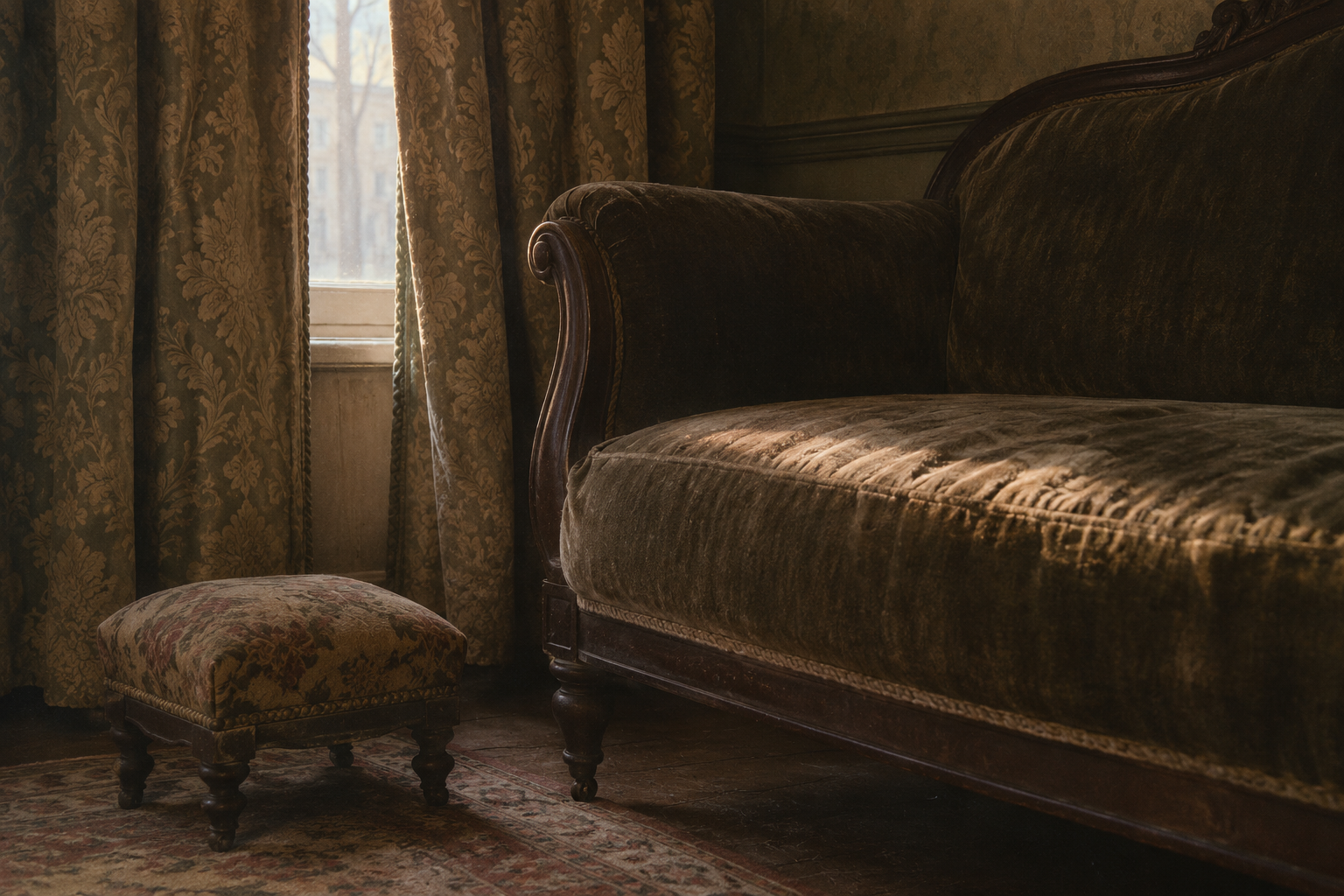
The new home brings out an enthusiasm that is easy to share. Ivan finds pieces of furniture that look more expensive than they were. He chooses wallpaper, arranges ornaments and gives particular thought to how the curtains should hang. He imagines his family arriving and discovering what he has done. Some of his pleasure is competitive, certainly, but some is the familiar delight of preparing a place for people you hope to please. The house would have less power over the story if it were simply a monument to bad taste.
Tolstoy lets us stand far enough back to see the joke Ivan misses. In setting out to make his home distinctive, he has arrived at much the same interior as other people of comparable means trying to look a little richer. Every purchase felt individual because he compared alternatives, inspected the finish and made the decision himself. Seen from across the street, the collective result might have been predicted before he bought a chair. It is the domestic equivalent of his early moral education. He experiences himself as freely choosing the things his circle has taught him to want.
While showing a workman how he wants the curtains arranged, Ivan loses his footing on a stepladder and strikes his side against the window frame. He takes some pride in his agility. A less fit man, he thinks, might have been seriously hurt. The bruise seems a modest price for getting the job done properly. Later, when pain develops in that side and persists, the incident acquires much greater significance for him. Tolstoy supplies the blow and the worsening symptoms. The novella never establishes a definitive diagnosis or proves that the fall caused the illness.
The house changes more certainly than the diagnosis ever will. Once Ivan has achieved the finish he wants, every scratch or stain begins to irritate him. An object bought to give pleasure has become an object whose condition other people can spoil. His family finally occupies the rooms he enjoyed preparing in their absence, and the evidence of people living there threatens his satisfaction. Soon an even less manageable presence will enter this carefully arranged household. Nothing he has learned about furnishing a room will tell him how to inhabit it as a sick man.
The Judge on the Other Side of the Desk
An unpleasant taste in his mouth and a persistent pain drive Ivan to a doctor. He wants an answer to a question that seems to him both reasonable and urgent. Is his condition dangerous? The doctor examines him with practised gravity and weighs competing explanations. For the doctor, the matter under consideration concerns which organ is responsible and what further evidence might settle the issue. Ivan’s question has the status of an interruption by someone unfamiliar with the proper order of proceedings.
Ivan recognises the manner. It is his own judicial manner, encountered from the chair reserved for the person awaiting a decision. He knows from experience what professional concentration feels like to the person exercising it. He now discovers what the same concentration can feel like to somebody whose future hangs on the answer. The doctor leaves with an interesting case to consider. Ivan goes home trying to extract a forecast of his remaining life from the expression on another man’s face.
Successive opinions make matters worse. A new possibility briefly gives him hope because it comes with something new to try. Then pain returns, two authorities disagree, or the promised improvement fails to arrive. Ivan begins monitoring his body closely. An absorbing conversation can briefly make him think he feels better, until the fact that he is measuring his improvement returns his attention to the pain. Even a good hour becomes difficult to enjoy once he starts examining it for evidence about tomorrow.
At cards, where Ivan once found some of his happiest evenings, the change is particularly cruel. A good hand and the prospect of skilful play used to hold his attention completely. Now the pain enters the game. The other players adjust themselves around him, and he senses that his condition has become an inconvenience to people who came for a pleasant evening. We have already seen Peter Ivanovich hurry away from Ivan’s funeral to play. Now we know what that evening meant to Ivan when he was well enough to take his place at the table. He would once have understood Peter perfectly.
A lesson remembered from school offers him no more comfort. In a familiar exercise in logic, a man called Caius must die because all men are mortal and Caius is a man. Ivan has always accepted the conclusion. Yet Caius never knew Ivan’s mother, the rustle of her dress or the particular pleasures Ivan remembers from boyhood. Ivan can prove that the rule applies to himself and still feel that the proof has failed to touch the person who is frightened. A syllogism requires only that he be human. What he stands to lose consists of everything that made being this particular human being unlike being anyone else.
Why Only Gerasim Can Ease His Loneliness
As Ivan weakens, the household preserves the assumption that treatment and proper behaviour can still make him well. It governs the little exchanges at his bedside. His wife asks whether he has taken what he was prescribed. A visitor encourages him. Another doctor can always be consulted. Ivan understands that the people speaking to him know more than they can bring themselves to say. He has to receive their encouragement politely while undergoing the experience they decline to name.
The most humiliating part of his dependence concerns bodily functions he can no longer manage alone. Gerasim, a young peasant servant, takes on the work of cleaning up after him. Ivan is acutely conscious of what he has asked another man to handle. Gerasim does the task readily, without the faint withdrawal that would turn Ivan’s embarrassment into shame. He understands that a sick man needs help and sees no injury to his own dignity in providing it.
On one occasion Gerasim helps to raise Ivan’s legs. The position eases the pain, so Ivan asks him to stay and hold them. Gerasim does, sometimes for hours, with Ivan’s legs resting on his shoulders. There is a remarkable change of scale here. Doctors have argued about conditions hidden inside Ivan’s body. A servant notices what happens when that body is held at a different angle. We understand exactly what Gerasim contributes, roughly what it costs him in effort and why Ivan asks for it again.
Gerasim also acknowledges that Ivan is dying. He can bear the thought because death belongs to his understanding of what happens to people, himself included. From him, the truth feels kinder than reassurance. It allows Ivan to accept help without performing optimism as the price of receiving it. Even Gerasim’s health, which might have seemed an unbearable affront to a man losing his strength, gives Ivan pleasure. The strength of those shoulders is available to him. Someone else’s capacity to enjoy life has become, for a few hours, one of the things that makes his own life easier.
Tolstoy grants Gerasim less interior complication than he grants the judge. We know what the servant does and something of what he believes, but relatively little about what he would choose to do with a night of his own. That inequality is worth noticing, especially in a story concerned with attending to other people. Ivan’s discovery remains moving partly because it is so late and so specific. A man whose home has always depended on the labour of servants finally understands the difference between having the means to summon someone and being glad that this particular person has entered the room.
An Evening at the Theatre Goes Ahead
One evening, Praskovya and the rest of the family come into Ivan’s room dressed to go to the theatre. His daughter Lisa’s suitor is with them. Tickets have been obtained, the occasion has been anticipated, and there are reasons why going ahead seems reasonable. An ill man does not necessarily wish his family to abandon every pleasure. Nobody quite knows, however, how to stand in good evening clothes beside a man who is visibly dying and make an easy conversation about an actress.
Ivan sees how attractive the younger people are and feels the distance between their evening and his. From the doorway, he may look like an unfortunate interruption to a family occasion. From the sofa, the theatre party appears almost indecently absorbed in its pleasures. The scene offers no simple rule about whether they should go. Remaining at home and resenting him could be crueller still. What nobody can do is acknowledge the awkward truth kindly enough for Ivan to feel included in the decision.
His schoolboy son, Vasya, looks at him differently. Fear and grief show on the boy’s face. He has yet to acquire the composed social manner that makes the adults so hard to reach. Ivan longs at times to be comforted as a child might be, held and pitied without any demand to display courage or gratitude. Saying this aloud would have embarrassed the healthy judge almost beyond endurance. Now the only member of his family whose face offers such comfort is the child the adults might reasonably suppose needs protecting from the sight of him.
Time itself changes as Ivan’s room becomes his world. Whole professional appointments went by in a few paragraphs. Now an attempt to find a position that eases his pain can command his entire attention. He cannot sleep his way reliably from night to morning, and the household’s timetable continues audibly beyond his door. The dinner and the theatre will have endings. Another person can look forward to getting home, undressing or going to bed. Ivan can no longer count on a change of activity to deliver him into a tolerably different state.
Why Ivan Cannot Get Through the Black Sack
Ivan begins to experience his struggle as an attempt to pass through a narrow, dark sack. He dreads what is on the far side and suffers terribly from being unable to get through. The image gives his fear a physical shape. A man caught in a constriction may fight to stay where he is even when the fight itself prolongs his pain. Ivan’s efforts to defend the life he has led work in much the same way.
When he asks himself what he wants, the first answer is obvious. He wants to live as he once did, pleasantly and well. Memory complicates the request. He can recover the taste and texture of childhood pleasures with astonishing vividness. Later successes, examined one by one, seem to offer less of that original happiness than he thought. His progress through the world had appeared to him as an ascent. Looked at from the sickroom, some of the higher stations seem strangely barren.
The question he has spent his life equipped to decide for other people comes home to him. What if his defence is unsound? He can produce witnesses in abundance. His career was respectable. His household resembled other desirable households. His mistakes were ones honourable men routinely made. Yet these arguments all depend on the authority of the very people whose conduct now seems unbearable to him. He has heard professional courtesy from the patient’s chair and sociable tact from the dying man’s sofa. It has become difficult to offer either as decisive evidence in his favour.
There is a related question in Anna Karenina, where Levin’s practical competence and domestic happiness leave him wondering what gives an ordinary day its value. Ivan has less time than Levin and fewer opportunities to test an answer. A change of profession, a better marriage or a return to childhood lies beyond him. If there is anything he can still put right, it will have to be possible here, in the same room, with the people who have disappointed him.
A priest comes, and Ivan receives communion. For a moment he feels easier. The possibility of recovery returns, and Praskovya asks whether he feels better. The old arrangement closes round him again. His wife wants an encouraging answer, and he sees in her manner the same refusal to face what is happening. His distress intensifies into the prolonged crying out that Praskovya will later describe to Peter. We now hear both sides of that terrible sound. To the family it seems to go on for days. Inside Ivan, a lifetime’s defence is breaking down and he can find no way to live without it.
What Ivan Sees in the Final Light
During the third day, Vasya slips up to the bed. Ivan’s flailing hand falls on his son’s head. The boy takes the hand, kisses it and begins to cry. Around the same moment, Ivan experiences the passage through the darkness and sees light. He understands that his life could have been different and that something can still be put right. The revelation leaves him with a practical question. What can he do now?
He feels the boy kissing his hand, opens his eyes and looks at him. Then he looks at Praskovya. Her face is wet and desperate. For much of the illness, Ivan has watched his family for evidence of what they are doing to him. He now sees what they are undergoing beside him. His wife’s grief is physically untidy. His son is holding a hand that can scarcely respond. Ivan feels sorry for them both. This change in the direction of his attention gives the light its meaning within the scene.
He tries to tell Praskovya to take the boy away and to communicate his sorrow for her too. He wants to ask forgiveness, but the word comes out wrong. Earlier, a professionally successful Ivan could make himself understood through exact formulations and gestures appropriate to his position. The dying man cannot produce the sentence he intends. He abandons the attempt to correct his speech, trusting that what needs to be understood can be understood. The boy has already done something similar. A kiss conveyed what nobody at the bedside could get into words.
Ivan looks for the fear of death that has occupied him and finds it gone. Pain still belongs to the scene. So do the failing body, the breathing heard by the people around the bed and the time that elapses before he dies. But his experience of those remaining moments has changed. The future no longer consists of a vast personal injury he must resist. There is light where he expected annihilation, and there are people immediately beside him whose distress he would like to ease.
The ending supports a Christian reading through communion, forgiveness and the disappearance of death’s power. It also gives a reader who cannot share Ivan’s belief a precise human event to understand. Gerasim once saw a suffering man and asked, through his actions, what might make the next hour easier for him. Ivan can no longer give anybody that hour of physical labour. He can recognise another person’s suffering and want to relieve it. Tolstoy places the two acts close enough in spirit for one to illuminate the other.
At the funeral, Peter imagines that his dead friend’s face carries a message for the living. He feels uneasy and turns away. The last person to touch Ivan with unembarrassed affection was a schoolboy who had no message prepared and no idea what his father was seeing. He took the hand that fell within his reach. By the time Peter starts wondering what a visitor ought to do with his hands, the book has its answer.
Sources
The Death of Ivan Ilich: Russian and English Texts — University of Minnesota. The twelve chapters of Tolstoy’s novella alongside the English translation by Louise and Aylmer Maude. open.lib.umn.edu
The Death of Iván Ilích, Final Chapter — Complete Works of Count Tolstoy. A second English rendering of Vasya’s gesture, Ivan’s recognition and his difficulty speaking. en.wikisource.org
The Death of Ivan Ilych: Full Book Summary — SparkNotes. Supporting account of the chronology, Gerasim’s care and the black sack. SparkNotes
Next Reads
Anna Karenina Summary and Ending Explained: Anna, Vronsky and Why Levin Gets the Last Word — Tolstoy gives Levin more time, more freedom and much the same difficulty deciding what makes a life good.
The Grapes of Wrath Summary and Ending Explained: The Joad Family, the Peach Strike and the Barn — Steinbeck also closes with an act of bodily care whose meaning depends on everything the reader has seen beforehand.
A Passage to a Different Household: Rebecca Explained — For another home in which getting the rooms exactly right reveals a great deal about the life its occupants feel obliged to lead.
