What Does Ivan Understand at the End?
Someone Has Brushed Against the Wet Paint
A diamond disappears from Rachel Verinder’s sitting room on the night of her eighteenth birthday. By morning, almost everyone in the house has an opinion about who took it. The most useful witness may be the door. Rachel and her cousin Franklin Blake have decorated it together, and the paint was still wet when somebody brushed against it. Find the garment that touched the door and the household might learn who entered the room. Wilkie Collins builds The Moonstone around the considerable distance between that discovery and a solution. A stain can establish where someone stood. It takes a servant, a doctor’s assistant and a London office boy to explain the rest.
The First Theft Happens in India
Before Collins lets us into the Yorkshire house, he gives us a document concerning the storming of Seringapatam in 1799. An English soldier describes his cousin, John Herncastle, acquiring a remarkable yellow diamond during the British assault. The witness comes upon Herncastle with a bloodied dagger and the jewel. An Indian man lies dying. What the witness sees convinces him that Herncastle has killed for the stone, although he cannot give a complete eyewitness account of the killing. He refuses his cousin’s hand. Herncastle leaves India with the diamond.
The jewel has a history much older than this English family dispute. In the account that opens the novel, it belongs in the forehead of a Hindu moon god. Successive generations of guardians have undertaken to recover it. By putting their undertaking first, Collins gives the reader a permanent advantage over the guests who will admire the jewel at dinner. We know why someone might cross a continent to get it back. The English family tends to date the trouble from the day the diamond enters its own house. Its Indian guardians could date the trouble from the day an Englishman carried it out of theirs.
Nearly half a century later, Herncastle leaves the Moonstone to his niece Rachel. Her mother, Lady Verinder, had refused to receive him. His gift can therefore be read as an extravagant kindness or as revenge delivered in a form the recipient will find difficult to refuse. Rachel gets an object of extraordinary beauty. She also inherits a dispute in which nobody has consulted her, along with the public responsibility of deciding what to do with something too valuable to wear without attracting notice.
Franklin Blake brings the diamond to Yorkshire. He has reason to believe he has been watched, and three Indian men travelling as entertainers appear near the house. Franklin takes precautions and worries over where the jewel should be kept. His anxiety matters because it is present well before he has anything personal to gain or lose from an investigation. At this stage, his problem is recognisable to anyone entrusted with another person’s valuables. Handing the object over does not quite put an end to the sensation that its safety is still your affair.
A Birthday in Gabriel Betteredge’s House
Gabriel Betteredge, the Verinders’ elderly steward, tells the Yorkshire part of the story. He has known Rachel since infancy, considers the interests of the family inseparable from his own and consults Robinson Crusoe when ordinary judgement fails him. He is excellent on the physical organisation of a country house. He knows who did the washing, where people sleep and what they would usually be doing at a given hour. Ask him what a young woman sees in a man, however, and his daughter Penelope is generally the witness one would prefer to hear.
Betteredge writes at Franklin’s request, after the principal events are over. The contributors have been asked to describe what came within their own knowledge. It sounds like a tidy way to build a case. Collins makes it a source of comedy as soon as Gabriel picks up his pen. An honest narrator can fill a page with a prejudice quite as easily as a dishonest one can fill it with a lie. Gabriel scarcely needs to conceal evidence from his reader. It is enough that he has settled, years before our arrival, which people in his household he finds worth watching.
Rachel has two prominent admirers. Godfrey Ablewhite enjoys an excellent reputation for his charitable work, commands a room with ease and looks like the sort of man a family might confidently welcome as a husband. Franklin is harder to classify. His education abroad has furnished him with what Betteredge regards as several national temperaments, sometimes at odds within the same conversation. With Rachel, though, Franklin can settle down to a shared occupation. They spend long hours painting her sitting-room door. By the time it becomes a piece of evidence, the reader has already seen what it looked like as a courtship.
Rachel receives the Moonstone on her birthday in June 1848 and wears it at dinner. Among the guests are Mr Murthwaite, a traveller familiar with India, and Mr Candy, the local doctor. Murthwaite takes the danger surrounding the diamond seriously. Candy and Franklin fall into an argument about the usefulness of medicine. Franklin has given up smoking to please Rachel and has been sleeping badly. These details seem to belong to separate conversations, as details at a dinner usually do. It will take a year to discover which of them belong together.
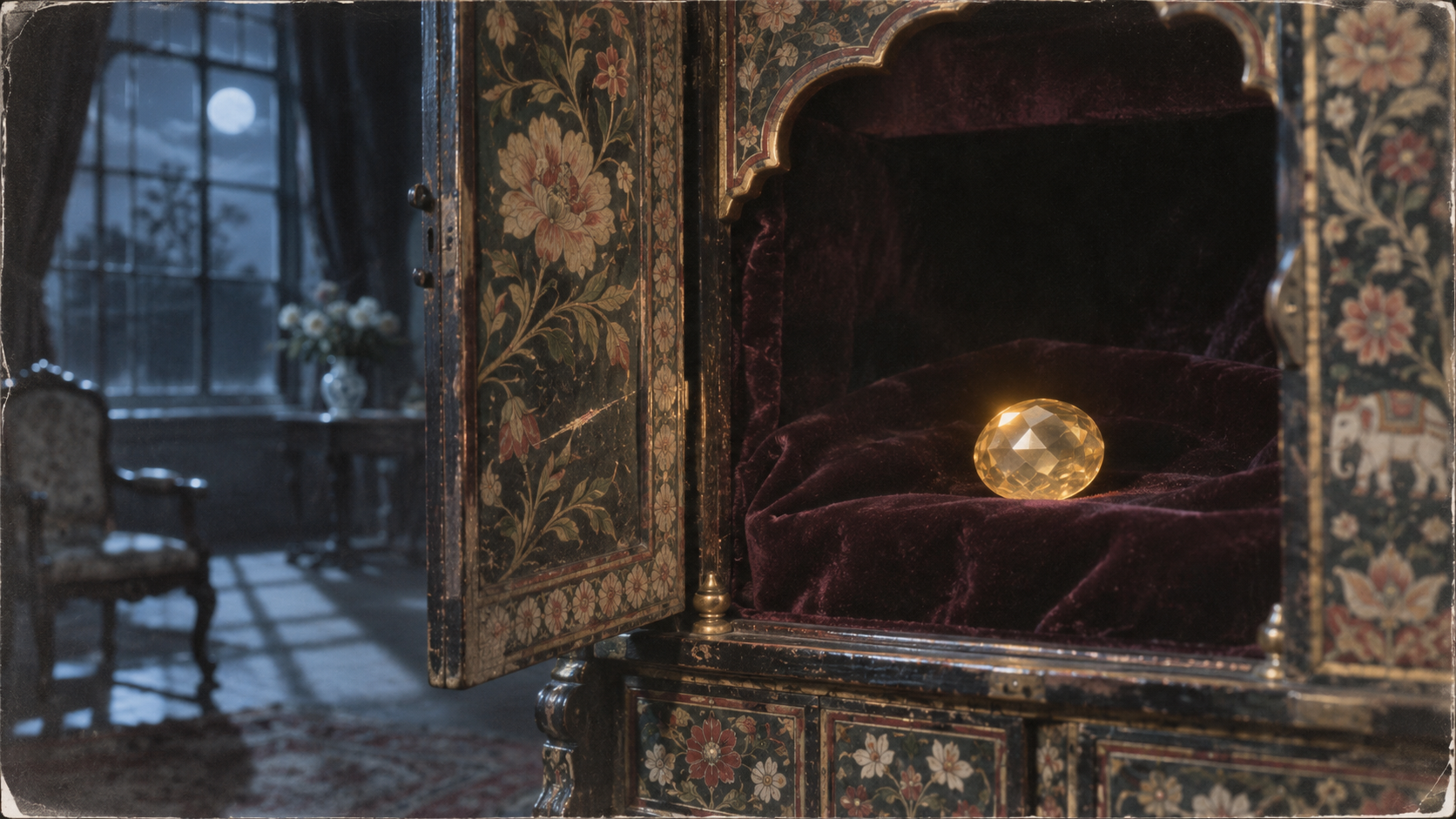
That evening the diamond goes into a drawer in a small Indian cabinet in Rachel’s sitting room. By morning it has vanished. There is no mystery about how the stone entered the house, who wore it, or where its owner put it. The household can account for almost every stage of its movements up to the point at which people retire. The missing hours turn relations who had been eating at the same table into witnesses who cannot vouch for one another once the bedroom doors are shut.
What Sergeant Cuff Learns from the Door
The local police superintendent, Seegrave, manages to antagonise the servants while learning very little. Sergeant Cuff comes from London with a quieter manner, an absorbing interest in roses and a professional willingness to find significance in something another officer has already dismissed. The smear on Rachel’s newly painted door interests him because the paint took a known time to dry. Something touched it during the relevant period. There ought to be another half of the mark somewhere in the house.
The obvious place to look is on whoever was moving about in nightclothes. A search of the laundry seems a small thing to ask when an entire household is under suspicion. In practice, the question of who may inspect whose clothing goes to the heart of the case. The servants have already learnt how quickly they can become suspects. Rachel has the social authority to refuse a search and uses it. Cuff is too experienced to take the word of a young lady merely because she owns the missing jewel. He also knows that people sometimes report valuable property stolen when they have privately disposed of it themselves.
Rachel gives him further reason to wonder. She is furiously uncooperative and treats Franklin, who has exerted himself to recover her property, with a hostility he cannot explain. Rosanna Spearman, a housemaid, also behaves secretively. She has a previous conviction for theft. Lady Verinder gave her a chance at respectable employment, but the history that makes her mistress’s kindness possible also makes Rosanna exceptionally easy to accuse. Cuff sees reason to connect the two women. One has the power to put property into circulation secretly. The other has the experience and opportunity to help her.
It is an intelligent theory. It is also wrong. Cuff has accurately identified Rachel’s concealment and Rosanna’s interference with evidence. His error is to assume that, since both women are protecting somebody, they must be working together. Readers of The Name of the Rose will recognise the peculiar danger facing a good investigator here. A bad theory can survive a surprising number of correct observations, particularly when it has a plausible explanation for every fresh refusal to talk.
Rosanna makes visits to the Shivering Sand, a stretch of treacherous quicksand on the coast. She buys material, works privately and makes efforts to speak to Franklin. Betteredge finds the idea that a housemaid could love a gentleman embarrassing enough to brush aside. Penelope is more perceptive. When a conversation matters desperately to Rosanna and scarcely registers with Franklin, the difference in social position has a precise consequence. He can forget in a minute an encounter on which she has spent hours of hope.
Rosanna dies by suicide at the Shivering Sand. Her death costs the household more than a witness, although that is largely how a detective story has trained us to value her at this point. Someone who had been offered a fresh start has found that the people around her still have a ready-made explanation of anything she does. Her friend Limping Lucy, who distrusts Franklin on Rosanna’s behalf, will eventually make it possible for Rosanna’s own account to be heard. Lady Verinder ends Cuff’s involvement for the time being. The diamond remains missing, and Rachel lets Franklin leave without telling him why she can barely stand to see him.
What Respectability Buys in London
The narrative moves south and passes to Miss Drusilla Clack, an evangelical relative. Clack distributes religious tracts with inexhaustible energy and can satisfy herself that some highly questionable conduct serves the spiritual interests of others. She even manages to report conversations she hears while out of sight without losing her sense of moral superiority. Where Betteredge was inclined to defend the household, Clack arrives with an altogether different loyalty. She has already decided what a good man looks like, and Godfrey Ablewhite fits the description beautifully.
In London, Godfrey and a moneylender named Septimus Luker are separately attacked and searched. Luker has had dealings involving a valuable object, and the men pursuing it appear interested in the paperwork that could lead them to it. Godfrey’s involvement becomes a subject of gossip. A man can be searched because he possesses something or because his pursuers mistakenly think he does. Nothing about the attacks settles which explanation applies to him. Rachel publicly defends him with a confidence that seems almost reckless. She has a reason for that confidence, but Clack cannot tell us what it is.
Lady Verinder dies, leaving Rachel bereaved as well as estranged from Franklin. Rachel agrees to marry Godfrey, then breaks off the engagement after learning from the family solicitor, Mr Bruff, about Godfrey’s interest in her financial position. He has taken the trouble to investigate how her mother’s will affects her property. His willingness to release her once the settlement is understood tells Rachel more about his intentions than his expressions of devotion did. Like the paint smear, the enquiry is small and specific. Its force comes from knowing when it was made.
Mr Bruff contributes another piece of reasoning. The terms on which money might be raised against a valuable item give the Indian pursuers a reason to wait. If the diamond has been pledged, its owner cannot simply walk in and reclaim it whenever he likes without regard to the loan. The date when the pledge falls due could bring the stone, the borrower and the moneylender within reach of one another again. The search now has two distinct tasks. Follow the money in London, and discover who actually opened the cabinet in Yorkshire. Progress on one does not guarantee an answer to the other.
The Name on Rosanna’s Nightgown
When Franklin returns to England in 1849, he still wants to clear up what happened and understand Rachel’s rejection. Lucy directs him towards the message Rosanna left. Her instructions lead him back to the Shivering Sand, where a chain allows him to recover a concealed case. Inside is the missing nightgown with the paint from Rachel’s door. At last Franklin has the object Cuff knew must exist. The owner’s name marked on it is his own.
It is hard to imagine a fairer clue or a more disconcerting answer. Franklin knew the door because he had helped paint it. He knows his own name. He has been willing to follow physical evidence when it pointed towards other people. Now his conviction that he spent the night innocently in bed has to compete with precisely the sort of proof he hoped to obtain. An easier novel might give him a flash of recovered memory. Collins makes him continue investigating an action to which his own mind gives him no access.
Rosanna’s written account explains what she did. She found the marked garment, recognised its owner and made a replacement so its absence would escape detection. She preserved the original while hiding it from the police. Her devotion to Franklin produced a series of actions that looked remarkably like evidence of her own guilt. Cuff had seen her concealment correctly. What he missed was the extraordinary disproportion between the risk she would take for Franklin and the amount of attention he had ever given her.
Reading her letter offers Franklin a painful experience of the same disproportion. Ordinary remarks he scarcely remembers making have acquired the weight of promises or dismissals in her account. His failure towards Rosanna needs no secret act of cruelty to explain it. He could afford to be casually pleasant and casually distracted. She had almost no other means of discovering how he felt. The result is that Franklin finally gives her the sustained attention she wanted when she is beyond receiving the smallest benefit from it.
Then Rachel tells him what she saw. Awake in her bedroom, with a view into the sitting room, she watched Franklin take the Moonstone from the cabinet. She has been living for a year with the memory of a man she loved apparently stealing from her and then throwing himself into the investigation. His enthusiasm the following morning, which struck Betteredge as admirable, looked to Rachel like a sustained performance at her expense. She refused to expose him and could neither forgive him nor explain her anger without disclosing his secret.
Rachel’s evidence settles the identity of the person at the drawer. It still leaves open two questions of enormous importance. Did Franklin understand what he was doing? And where did the diamond go once he carried it away? Rachel saw enough to recognise his face. She could scarcely have observed the state of his consciousness across a room, and she did not follow him to find out what happened next. Her mistake lay in the perfectly natural belief that she had seen an entire theft.
What Ezra Jennings’s Experiment Proves
The way forward comes through Mr Candy, the doctor who quarrelled with Franklin at dinner. Candy fell seriously ill after the birthday party. He survived, but his memory and ability to communicate suffered. He seems to have something important to tell Franklin and cannot bring it to mind. His assistant, Ezra Jennings, attended him during his fever and wrote down fragments of what he said. Words that meant little at the bedside begin to acquire a pattern once Jennings can compare them with Franklin’s account of the dinner and his troubled sleep.
Jennings reconstructs a deeply irresponsible intervention. Candy wanted to answer Franklin’s disparagement of medicine by demonstrating that it could give him a good night’s rest. An opium preparation was put into Franklin’s drink without his knowledge. Knowing nothing about it, Franklin had no reason to mention a drug when the investigation began. Candy intended a professional joke whose subject would eventually appreciate the point. His illness removed the one person who could readily have told Franklin there was a missing fact about the night.
For Jennings, the combination of Franklin’s preoccupation with the jewel, loss of sleep and exposure to opium suggests an explanation. Franklin could have acted on his wish to put Rachel’s diamond somewhere safe while in an altered state, then woken without remembering what he had done. The theory lets Rachel’s sight and Franklin’s good faith coexist. But Franklin has already suffered enough from theories. He wants grounds for asking Rachel to believe him.
Jennings proposes an experiment at the Yorkshire house. With Franklin’s consent, he will reproduce as closely as possible the circumstances surrounding the birthday night. Franklin again gives up tobacco. Familiar rooms and furnishings are restored to their earlier arrangement. A substitute stone goes into the cabinet. Franklin’s mind is once more occupied by the diamond’s safety. This time there will be witnesses who know about the drug and can watch what follows. The difference between Candy and Jennings begins well before the results. One doctor thought a patient’s ignorance would improve a joke. The other explains what he intends and lets the patient choose.
Franklin rises, makes his way to the sitting room, opens the cabinet and takes the imitation diamond. Jennings records his hesitation and watches for the next step. This is where the two nights diverge. Franklin grows drowsier, drops the substitute and sinks into sleep. He has repeated the part Rachel witnessed. He has given them no demonstration of carrying the original to its eventual hiding place or passing it to anyone else.
The experiment answers the question that had separated Rachel and Franklin. She can see how the man at the cabinet could have been acting on anxiety for her property and could honestly have known nothing about it afterwards. The experiment is less decisive as a replay of the original night. Everyone has brought expectations to it, Franklin knows its purpose beforehand, and its ending differs. Collins builds those limits into the action. The witnesses gain a reason for reconciliation and a better explanation of the taking. The London trail must still supply the thief.
That modest success means a great deal to Jennings. His appearance, mixed ancestry and an old accusation have made respectable people wary of him. He lives with severe pain and knows from experience how little can be learned about a stranger’s character by looking at his face. That experience informs his patience with Candy’s broken speech and Franklin’s unlikely claim. For a brief period, a man accustomed to being mistrusted receives the confidence of people with something important at stake. His journal treats their happiness as an event in his own life.
Who Actually Steals the Moonstone?
When the pledge falls due, attention returns to Luker and the London bank where the diamond has been kept. Franklin and Bruff try to follow the person to whom Luker appears to pass it. They attach themselves to an entirely innocent man who turns out to work for Bruff’s own chemist. The comic error is well placed. Hours of careful reasoning have brought them to the right counter on the right day. It is still possible to walk out behind the wrong customer.
A boy in Bruff’s employment, nicknamed Gooseberry, makes the more useful observation. He follows a man dressed as a sailor and traces him to a public house near the river. Sergeant Cuff joins the enquiry. When the room is opened, the sailor is dead and the diamond gone. The darkened complexion and false hair are a disguise. Beneath them is Godfrey Ablewhite, the philanthropist whom Miss Clack had regarded as practically above reproach.
Cuff’s report reconstructs the missing stage of the birthday night. Godfrey was in financial trouble. He had misused money entrusted to him and faced exposure unless he could replace it. He was also involved in Candy’s trick. It was Godfrey who slipped the preparation into Franklin’s drink. Their bedrooms communicated. Still awake over his own troubles, Godfrey saw Franklin leave and followed him. From his position near the sitting-room door, Godfrey could see both Franklin taking the stone and Rachel watching him.
Godfrey got back to the bedroom first. When Franklin returned, he entrusted the Moonstone to Godfrey with instructions concerning its safekeeping at the bank. Here, finally, is the transaction that reconciles the Yorkshire evidence with the London money trail. Franklin removed the diamond from Rachel’s cabinet. Godfrey received it for safekeeping and deliberately converted it to his own use. The person on whose clothing the paint dried had fully intended that the jewel should be protected. The person who profited from its loss had every reason to leave the stained nightgown where it was.
Godfrey pledged the diamond to Luker to obtain funds. His connection to the moneylender now explains why the Indian guardians searched both men. His enquiries into Rachel’s inheritance also look different. Marriage had offered another possible answer to an urgent financial problem. Later, able to redeem the jewel, he retrieved it in disguise, intending to realise its value. The guardians recovered it from him at the cost of his life. Cuff can account for Godfrey’s need for money and his dealings. The final attack must be reconstructed from its aftermath. No witness takes us inside the room to narrate the killing.
What makes Godfrey an effective culprit is how little he initially has to invent. Rachel has seen Franklin. Franklin remembers nothing. Rosanna independently suppresses the best physical evidence. Every one of those circumstances comes into existence without Godfrey arranging it. His principal skill is recognising what other people’s loyalties have made possible. His good reputation completes the arrangement by making acquaintance after acquaintance feel faintly ashamed of suspecting him.
Where Does the Diamond Finally Belong?
Franklin and Rachel marry. They have recovered the part of their lives that depended on understanding what passed between them. They cannot restore Rosanna to the household, and Jennings dies after his short interval of companionship and recognition. A detective’s explanation can revise everybody’s opinion of the dead. It cannot give either outsider another afternoon among people who now know what they owe them.
Collins could have ended with the marriage and Cuff’s report. Instead he gives the closing account to Murthwaite, travelling in India. At a religious gathering, he sees the great yellow diamond shining again in the forehead of the moon god. The guardians have fulfilled their charge. Their own religious obligations also demand a personal price for the journey they undertook and the boundaries they crossed. Restoration matters enough to them to survive consequences that an English investigator would never have entered into his calculation of the stone’s value.
Look back from that ceremony to Rachel’s birthday dinner and one oddity of the English mystery becomes apparent. Almost every honourable person in Yorkshire has spent the novel trying to return stolen property to its owner. Very few have looked further back than the wording of an English will to decide who that owner is. Rachel personally committed no wrong in receiving her present. Yet precisely the same can be said of Franklin when an entire household believes that possession of a stained nightgown tells them everything they need to know about him. In both cases, the missing history changes the meaning of apparently decisive facts.
The finest touch in the ending is the change of light. At the birthday party the diamond shines on one young woman while the guests admire its effect. At the Indian ceremony Murthwaite must look across a crowd to see it, and nobody there needs him to explain what it means. The reader who began by trying to picture a stain on a bedroom door finishes a continent away, looking at the one place nobody in the Verinder household thought to search for the Moonstone’s proper setting.
Sources
The Moonstone — Project Gutenberg. Full text, including Jennings’s journal, Cuff’s reconstruction of the birthday night and Murthwaite’s closing account. Project Gutenberg
The Moonstone: Full Book Summary — SparkNotes. Supporting chronology for Rosanna’s letter, Rachel’s eyewitness account and the investigation. SparkNotes
The Moonstone: Plot Summary — LitCharts. Cross-check for the narrators, the diamond’s movements and the resolution. LitCharts
Next Reads
The Name of the Rose Summary and Ending Explained: William, Adso and the Secret of the Abbey Library — Another investigator reads physical clues brilliantly and has to reconsider the story he built from them.
Rebecca Explained: Manderley, the Second Mrs de Winter and the Ending — A country house preserves objects that seem to tell its history, until witnesses supply what the objects leave out.
The Secret History Explained: Summary, Themes and Ending — Donna Tartt also makes affection a practical obstacle to investigation, influencing who will talk and whom a witness is prepared to believe.
