All the Pretty Horses Summary and Ending Explained: Why John Grady Cole Rides Away Alone
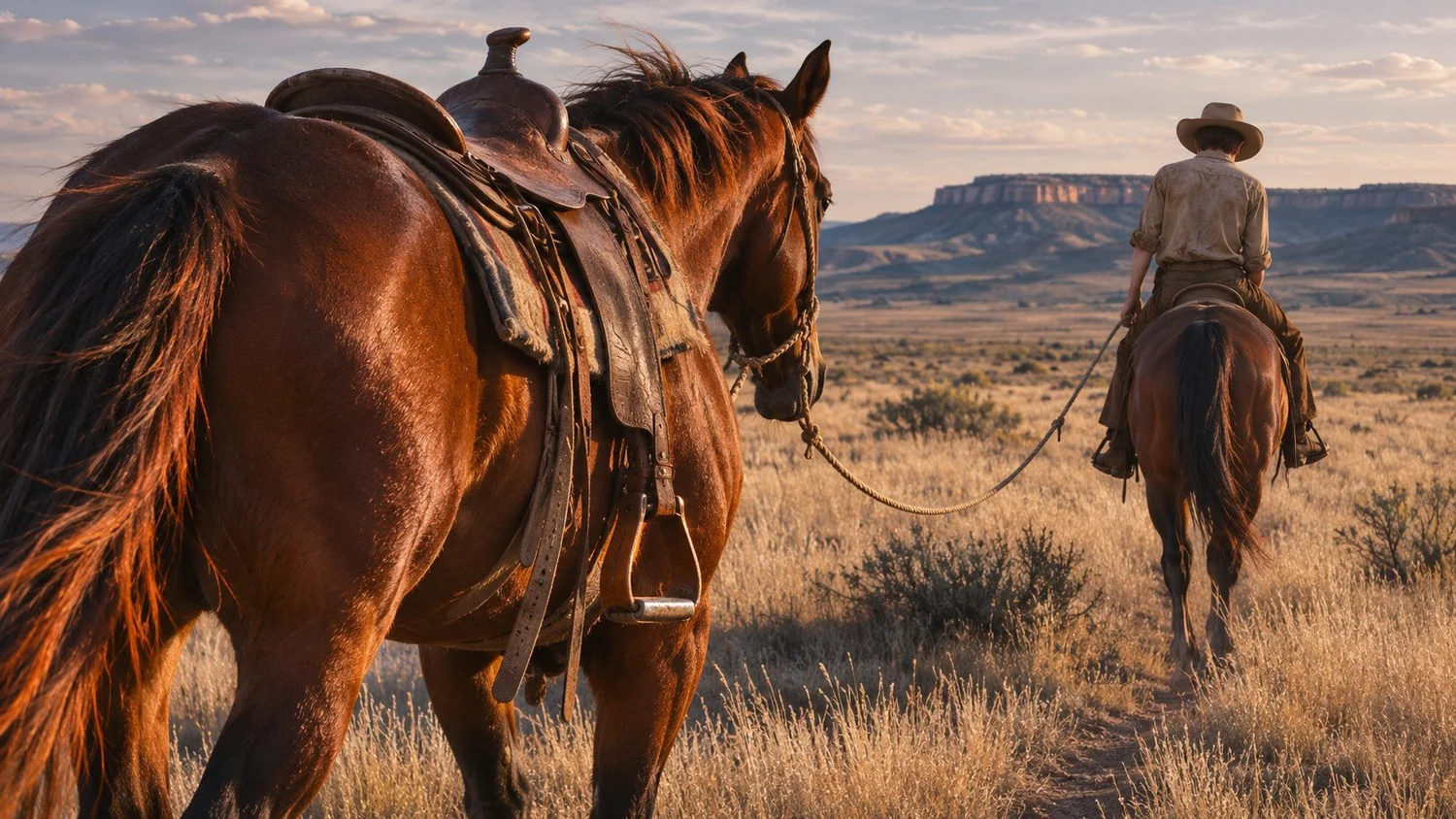
Cormac McCarthy's All the Pretty Horses ends with John Grady Cole riding west out of Texas with a dead boy's horse on a lead, having lost almost everything he set out to find. The ranch he grew up on has been sold, his father is dead, the woman he loves has refused him, and his best friend has gone home and become a near stranger. The final pages are not a defeat in the ordinary sense, though. John Grady has paid for his choices in blood and guilt, told the truth about them in open court, and refused to become the kind of man who kills for revenge. He rides on because the world he was made for has gone, not because he has given up on how to live in it.
The novel, first published in May 1992, has found a new audience this month. Billy Bob Thornton's 2000 film adaptation, starring Matt Damon and Penélope Cruz, entered Netflix's global top 10 for English-language films at No. 9 in the week of 9 to 15 November 2026, with 2.6 million views in its first charting week, according to Netflix's weekly figures as reported by What's on Netflix and CBR. Many of those viewers will have finished the film with questions the film itself barely answers. This guide covers the whole story of the book, explains what happens to Jimmy Blevins and Alejandra, unpacks the ending, and sets out how the film differs.
Spoiler warning: everything below reveals the full plot and ending of the novel, and of the 2000 film.
Quick Answer: How Does All the Pretty Horses End?
- Jimmy Blevins is executed. A corrupt Mexican police captain leads him into the trees during a prisoner transfer and shoots him. John Grady and Lacey Rawlins hear it and do nothing, which John Grady never forgives himself for.
- Alejandra refuses to marry John Grady. Her great-aunt, Alfonsa, paid for his release from prison on the condition that Alejandra would never see him again. Alejandra meets him once more, in Zacatecas, and keeps her word to her family.
- The captain is taken hostage by John Grady when he goes back for the stolen horses. John Grady chooses not to kill him. A group of Mexican men who call themselves "men of the country" take the captain away instead.
- Back in Texas, a judge hears John Grady's whole story at a hearing over Blevins's horse and lets him keep it. That night John Grady goes to the judge's house to confess what still haunts him.
- The last image is John Grady riding west past the Pecos into the evening, his shadow and his horse's merging into one. His father has died, the family's old servant Abuela has been buried, and he has told Rawlins that Texas is no longer his country.
The Book at a Glance
All the Pretty Horses was published by Alfred A. Knopf in May 1992. It won the National Book Award and the National Book Critics Circle Award and became a bestseller. It is the first volume of what became known as the Border Trilogy and was followed by The Crossing. It came after Blood Meridian, McCarthy's far bloodier western, and it shares that book's borderlands while telling a very different kind of story: a coming-of-age tale, a love story and a moral reckoning, all at once.
The novel is set in 1949 and 1950. Its hero, John Grady Cole, is 16 at the start. He has grown up on his grandfather's cattle ranch near San Angelo in west Texas, speaks Spanish as easily as English, and is happiest on horseback. The book follows him over the border into Mexico and back again.
Main characters
- John Grady Cole: a 16-year-old Texan with an extraordinary gift for horses and an old-fashioned code of honour.
- Lacey Rawlins: his best friend and companion on the ride south; more cautious and more practical.
- Jimmy Blevins: a boy of about 13 who attaches himself to the pair, riding a magnificent bay horse that may or may not be his. Even his name may be borrowed.
- Don Héctor Rocha y Villarreal: the wealthy owner of the Hacienda de Nuestra Señora de la Purísima Concepción, the vast ranch in Coahuila where the boys find work.
- Alejandra: Don Héctor's daughter, educated in Mexico City, with whom John Grady falls in love.
- Dueña Alfonsa: Alejandra's great-aunt and godmother, a formidable woman with a revolutionary past.
- The captain: a corrupt police officer in the town of Encantada, who is never given a name in the novel.
- Pérez: a powerful, privileged inmate in the Mexican prison where the boys are held.
- The judge: a Texas judge who hears John Grady's story at the end.
Full Plot Summary
Why John Grady leaves Texas
The novel opens with the death of John Grady's grandfather in 1949. The ranch has been in the family for generations, but John Grady's mother, an actress who has no interest in ranch life, intends to sell it. His parents have divorced, and his father has never really recovered from his time as a prisoner of war in the Second World War. A family lawyer, Mr Franklin, tells John Grady plainly that a 16-year-old cannot take over the ranch. With the place he loves about to disappear, John Grady decides to go to Mexico, where he believes the cowboy life still exists. He persuades Lacey Rawlins to ride with him.
Jimmy Blevins and the lost horse
Near the border the pair are followed by a much younger boy riding a superb bay horse. He says his name is Jimmy Blevins, which the older boys doubt, and they suspect the horse is stolen. Rawlins wants nothing to do with him, but Blevins rides into Mexico with them anyway.
Blevins is terrified of lightning. When a violent storm breaks, he strips off his clothes, abandons his horse and hides. By the next morning his horse and his pistol are gone, and he is almost naked. John Grady lets him ride double, over Rawlins's objections.
In the town of Encantada they find the bay horse in someone else's possession. The boys cannot prove it belongs to Blevins, and they urge him to leave it. Instead, Blevins steals it back at night. The town wakes, riders give chase, and the three split up. John Grady and Rawlins escape and keep riding south. They assume they have seen the last of Blevins.
La Purísima and Alejandra
In the Bolsón de Cuatro Ciénegas region of Coahuila, John Grady and Rawlins are hired at Don Héctor's enormous ranch. They begin as ordinary hands, but John Grady volunteers to break a herd of 16 wild horses in four days, and does it. The feat makes his reputation. Don Héctor moves him up to the main house to work on his horse-breeding plans and plays billiards with him.
John Grady falls for Alejandra, Don Héctor's daughter. They dance in a nearby town and ride out together. Her great-aunt, Alfonsa, summons him and warns him gently but unmistakably: in Mexico, a young woman's reputation is all she has, and he must not be seen riding alone with her. John Grady ignores the warning. Alejandra comes to his bunk at night and the two begin a secret affair.
Arrest and the death of Blevins
Mexican rangers come to the ranch and leave again without explanation. Soon afterwards they return and arrest John Grady and Rawlins. The reason becomes clear when they are thrown into a cell in Encantada and find Blevins there. He had gone back to the town alone to recover his pistol and, in the gunfight that followed, killed a man.
The captain beats and interrogates the Americans, trying to get them to confess to horse theft and to admit they are not who they say they are. Rawlins, under pressure, signs a false statement. The prisoners are then loaded into a truck to be taken to a larger prison. On the way the captain orders a detour. At an abandoned hacienda, he and a charro lead Blevins into the trees. John Grady and Rawlins hear the shot. Before he was taken, Blevins had pressed his last few pesos on them.
It is one of the most quietly devastating scenes in McCarthy's work. Nothing heroic happens. Two boys sit in a truck while a third, younger boy is murdered, and they live with it afterwards.
The prison in Saltillo
The larger prison, in Saltillo, is a world run by its inmates. The Americans are set upon day after day. Pérez, an inmate who lives in comfort and wields real power, offers them protection in return for money. They say they have none and refuse to deal with him.
The violence then escalates. Rawlins is stabbed and carried out, and John Grady does not know whether he has survived. John Grady buys a knife. In the mess hall he is attacked by a young cuchillero, a knife fighter, apparently sent to kill him. John Grady is wounded but kills his attacker, then collapses. He wakes in a dark room, badly hurt.
Release, and Alfonsa's price
When he has recovered enough, John Grady is brought to Pérez and given an envelope of money. He learns that he and Rawlins are free. Rawlins, who has also survived, buys a ticket home to Texas. John Grady will not go with him. He returns to the ranch.
There, Alfonsa tells him the truth. She paid for their release. The price was Alejandra's promise never to see him again. Alfonsa then explains why she acted as she did, telling him about her own youth: her friendship with the revolutionaries Francisco and Gustavo Madero, her family's disapproval, her exile to Europe, and the violence that swept away the hopes of the Mexican revolution. She offers him a parable about fate as a puppet show in which the strings lead only to other puppets, never to a final hand. Her point is that people want to believe in either total freedom or total destiny, and neither is true. John Grady tells her he believes in fate.
Zacatecas
John Grady phones Alejandra from Torreón, and she agrees to meet him in Zacatecas. They spend a day and a night together. She tells him she loves him. She also tells him she cannot break the promise she made to Alfonsa, and that she has seen her father's love for her falter once and cannot bear to destroy it altogether. He asks her to marry him. She refuses. John Grady gets drunk and gets into a fight.
Going back for the horses
He then does the most reckless thing in the book. He rides back to Encantada, takes the captain prisoner at gunpoint and forces him to lead him to the three horses the boys lost when they were arrested: his own, Rawlins's and Blevins's bay. At a hacienda there is a gunfight and John Grady is shot in the leg. He escapes with the horses and the captain as his hostage.
Over several days of hard riding he treats his wound himself, heating his pistol barrel in the fire and pushing it into the bullet holes to cauterise them. He considers killing the captain, the man who murdered Blevins. He does not. Instead, a group of Mexican men find them in the hills and take the captain away. They tell John Grady they are men of the country. What they intend to do with the captain is left unsaid.
The hearing in Texas
Back across the border, John Grady spends weeks trying to find the true owner of Blevins's horse and fails. When the ownership of the horses is challenged, the matter comes before a judge at a hearing. John Grady tells the whole story from the day he met Blevins. The judge checks a few details, including the wounds in his leg, which John Grady shows him, explaining that he burned them out with a hot pistol barrel. The judge tells the court he believes him and awards him the horse.
That night John Grady goes to the judge's house. He confesses that he killed the boy in the prison, that he came close to killing the captain, and that the thing he cannot forgive himself for is that he stood by while Blevins was led into the woods. The judge tells him he could not have saved Blevins and should put what happened behind him. He also admits that he once sent a man to the electric chair, would do the same again, and still feels it. The judge's kindness offers absolution. It does not remove the guilt.
The last search and the return home
One Sunday John Grady hears a radio broadcast by a preacher called the Reverend Jimmy Blevins. He tracks him down, hoping the boy might have been connected to him. The reverend has never owned a horse and knows nothing of any boy called Jimmy Blevins. Many people, he says, share the name. The boy's real identity is never discovered.
John Grady returns Rawlins's horse to him in San Angelo. Their conversation is short and awkward. Rawlins offers him a place to stay, but John Grady says he is moving on because this is not his country any more. He has also learned that his father has died.
He goes to the funeral of Abuela, the old Mexican woman who had worked for his family for many years. He stands apart from the mourners, then visits the grave, takes off his hat and says goodbye in Spanish. Then he rides west with Blevins's horse, across the Pecos river and on into the red desert, as the evening comes on.
The Ending Explained
Why John Grady cannot stay in Texas
The ending completes a circle that begins at a funeral. The novel opens with John Grady at his grandfather's burial and the loss of the ranch, and it closes with Abuela's burial and the deaths of his father and the old way of life. When he tells Rawlins that Texas is not his country, he is describing more than a mood. The ranch has been sold, the family is gone, and the cowboy world he dreamed of finding in Mexico turned out to be governed by money, property and power just as much as the world he left. There is nowhere left for him to belong.
What the Reverend Jimmy Blevins scene means
John Grady's search for Blevins's family is his attempt to put one thing right, to return what is owed to the dead boy. The search ends in an odd, almost comic encounter with a radio evangelist who shares the name and nothing else. It is McCarthy's way of showing that some debts cannot be paid. The boy who called himself Jimmy Blevins remains unknown, and the horse he died for stays with the one person who remembers him.
Is John Grady a hero?
He is, but a diminished one. He has skill, courage, loyalty and honour, the virtues of the cowboy code. None of them saved Blevins, kept Alejandra or kept the ranch. Yet the novel draws a sharp line between him and the men who wield power in it. The captain kills a child to protect his own standing. Don Héctor appears to have handed the boys over to the police once he learned of the affair. John Grady, given the chance to kill the captain, does not. He cauterises his own wounds rather than take a life he could easily justify. At the hearing he tells the truth, including the parts that shame him. That is where his heroism lies: not in winning, but in accepting responsibility.
Fate versus choice
Alfonsa's speech sits at the heart of the novel's argument. John Grady says he believes in fate, which might be read as an excuse: if everything is fixed, nothing is his fault. Yet the rest of the book shows him refusing that excuse. He takes on the blame for Blevins, confesses to the judge, and keeps trying to make amends. McCarthy never settles whether the world is governed by destiny, chance or God. What he shows is a young man who behaves as if his choices matter, even after the world has shown him how little control he has.
The final image
In the last lines John Grady and his horse ride into the evening until their shadow becomes a single shape on the land. It is a classic western ending, the lone rider heading into the sunset, but here it carries grief rather than triumph. He crosses country where, he reflects, Native Americans once roamed, a reminder that the frontier he mourns was itself built on someone else's loss. The rider and the horse are one, which is the only kind of belonging John Grady has left. He is still the young man who loves horses and the open country. He simply has nowhere to take that love.
All the Pretty Horses: Book vs Film
The 2000 film was directed by Billy Bob Thornton from a screenplay by Ted Tally, and released in the US on 25 December 2000. It was the first film adaptation of a Cormac McCarthy novel. Matt Damon plays John Grady Cole, Henry Thomas plays Lacey Rawlins, Lucas Black plays Jimmy Blevins and Penélope Cruz plays Alejandra. Rubén Blades plays Don Héctor, Míriam Colón plays Alfonsa, Bruce Dern plays the judge and Sam Shepard plays the family lawyer, J. C. Franklin.
The famous lost cut
The film's troubled post-production is almost as well known as the film itself. Thornton's early version was reported to run three hours and 40 minutes. Harvey Weinstein, then co-chairman of Miramax, demanded a cut under two hours and replaced the original score by Daniel Lanois with new music by Marty Stuart. The released version runs just under two hours. Damon later said the studio wanted to sell it as a love story, and argued that the book is not one. In 2008 Thornton said his own director's cut runs two hours and 42 minutes, not the longer figure often quoted, and that he would not release it without Lanois's score, out of respect for the composer, who owns the rights to it.
The film cost a reported $57 million and earned about $18.1 million worldwide. Reviews were mixed to poor. It holds a Rotten Tomatoes score of roughly a third, although Roger Ebert gave it three and a half stars out of four.
Key differences
- Length and depth: a novel full of long rides, landscape and internal reflection is compressed into under two hours. Alfonsa's long account of the revolution and her fate parable, the philosophical centre of the book, are much reduced.
- The romance: the marketing pushed the love story to the front. In the novel the affair matters chiefly because of what it costs: Blevins, the prison, and Alfonsa's bargain.
- The return to Texas: according to the film's plot synopsis on Wikipedia, the film has John Grady arrested in a Texas town because the horses carry different brands, which leads to his appearance before the judge. In the novel the matter comes to a hearing after his search for the horse's owner.
- The ending: the film closes on John Grady returning Rawlins's horse. The novel goes further, through the radio preacher, his father's death, Abuela's funeral and the final ride west.
Where to watch
Netflix has licensed the film in several international territories, according to Collider, which reported that it did not appear to be available on Netflix in the US. Availability varies by country, so check Netflix in your region.
Is the Book Worth Reading After the Film?
Yes. The film's plot follows the novel's broad outline, but the book's power lies in what the film had to cut: McCarthy's descriptions of the land and the horses, the long silences between the boys, Alfonsa's history lesson and the slow, painful final chapter. It is also the most approachable of McCarthy's major novels. Readers who found Blood Meridian too brutal will find more warmth here, and readers who loved Lonesome Dove will recognise its elegy for the end of the cowboy era.
Conclusion
All the Pretty Horses is a story about a boy who goes looking for a world that no longer exists and comes back a man who knows it. Blevins dies, Alejandra keeps her promise, and the ranch is gone. What John Grady keeps is his honesty and his refusal to kill when he could have. The ending sends him west not because he has learned nothing, but because he has learned that the life he loved can only be carried with him, not found anywhere. Thirty-four years after publication, and 26 years after a film that disappointed its own star, the story is reaching new readers and viewers. The book is still the fullest way to understand why John Grady rides away alone.
Sources
- All the Pretty Horses (novel), Wikipedia
- All the Pretty Horses (film), Wikipedia
- All the Pretty Horses: Full Book Summary, SparkNotes
- All the Pretty Horses: Chapter IV, Part 2, SparkNotes
- All the Pretty Horses Plot Summary, LitCharts
- All the Pretty Horses Part 4 Summary and Analysis, LitCharts
- Netflix Top 10 Report, week ending 15 November 2026, What's on Netflix
- Matt Damon and Penélope Cruz's Western Gets Rediscovered 26 Years Later, CBR
- Billy Bob Thornton's Forgotten Matt Damon Western Is Officially a Netflix Hit, Collider
