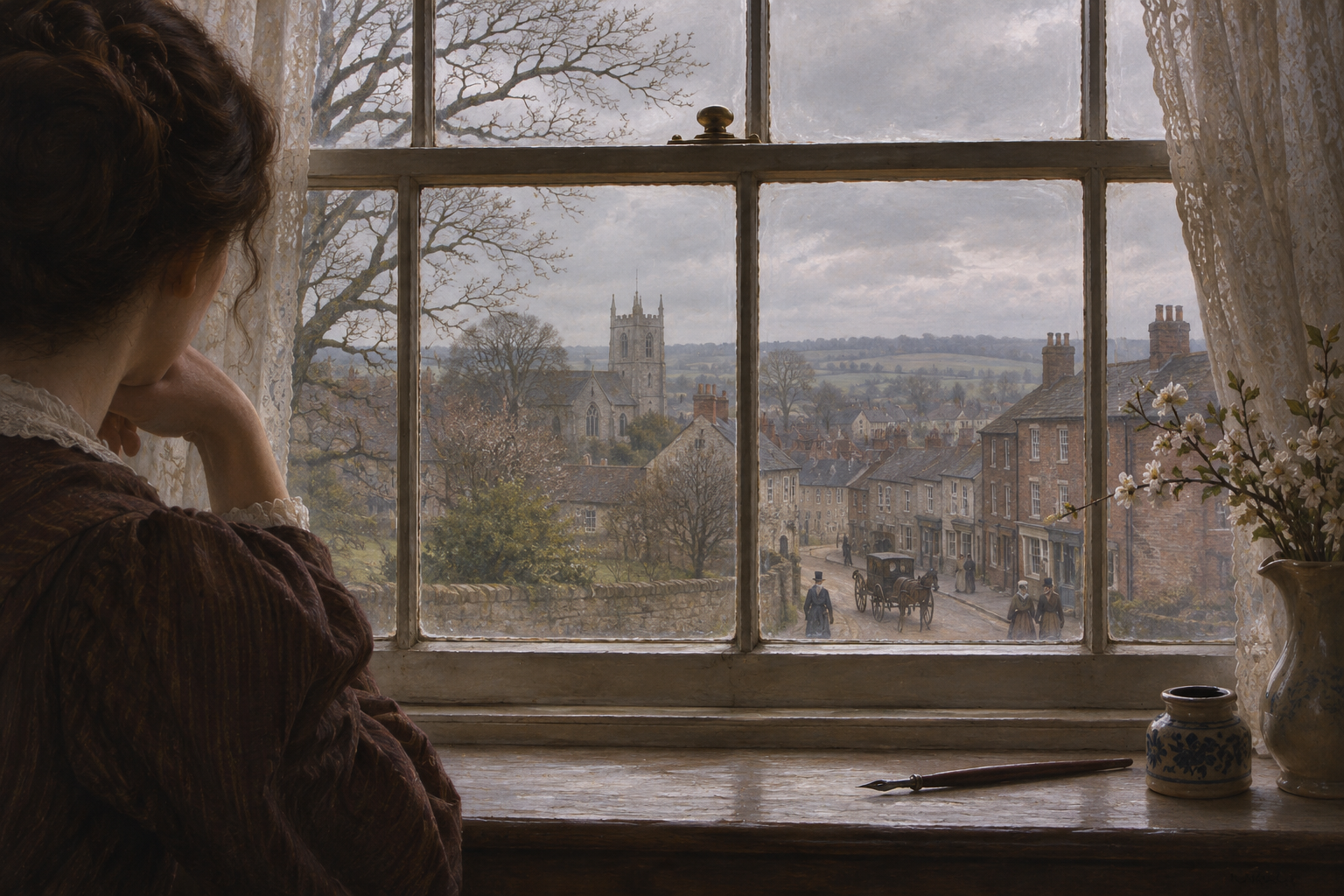
George Eliot’s Wills, Debts and Divided Loyalties
Dorothea Wants Something Worth Doing
Dorothea Brooke has drawn plans for better cottages. She has money, time and neighbours who live in houses she considers a disgrace. What she lacks is the authority to get anything built. Then an older clergyman takes her seriously, speaks to her about the great scholarly enterprise that occupies his life, and offers her a place beside him. To Dorothea, marriage begins to look like an education and a vocation arriving in the same envelope. George Eliot’s Middlemarch follows what happens when a young woman with unusually good reasons for wanting more from life makes a remarkably bad guess about where to find it.
Spoiler warning: the following summary discusses the plot, major twists and ending.
Two Sisters Divide the Jewels
Dorothea’s younger sister Celia would like to wear some of their late mother’s jewellery. The difficulty is asking Dorothea to divide it. Dorothea’s principles have a way of turning an ordinary pleasure into a small examination of conscience, and Celia has no wish to be found morally deficient for liking a necklace. Then Dorothea tries on a ring and bracelet set with emeralds. The colour gives her unexpected pleasure. She finds a religious association that makes keeping them seem quite reasonable.
The exchange gives us an excellent reason to trust Celia’s observations about her sister. She can see when Dorothea has made a private inclination sound like a principle. It also gives us a reason to be fond of Dorothea. The green stones catch the light, she wants them, and her pleasure gets a word in before her earnest intelligence can talk her out of it. The trouble will come when the thing she wants is a husband and nobody can persuade her to try him on for size.
The sisters live with their uncle, Mr Brooke, a landowner whose interests extend comfortably from agriculture to politics provided nobody insists on immediate action. Sir James Chettam, a neighbouring landowner, means to marry Dorothea. He listens to her ideas about labourers’ cottages and is willing to have some built. Dorothea appreciates this evidence of good sense while remaining almost entirely unaware that he is courting her. She thinks he would do very well for Celia.
Edward Casaubon appeals to a different appetite. A clergyman approaching fifty, he has spent years collecting material for a work called The Key to All Mythologies. He believes the world’s ancient myths can be traced back to a common source. Dorothea imagines the intellectual range such a project must require. When Casaubon talks about his work, she experiences the rare pleasure of hearing someone discuss an undertaking to which she might devote herself wholeheartedly. She has scarcely any basis for judging whether he is good at it.
Casaubon’s letter of proposal is revealing in a way she cannot yet appreciate. He has considered what marriage might do for his remaining years and concluded that her character suits his requirements. She reads the letter as an invitation to share his mind. He has, more cautiously, invited her to share his arrangements. Dorothea accepts. Celia, who has noticed the little physical peculiarities of a man one might actually have to kiss, receives the news with considerably less enthusiasm.
The Doctor Who Thinks He Can Choose His Obligations
Tertius Lydgate arrives in Middlemarch with a professional ambition Dorothea would understand. He wants to treat patients, pursue research into the elementary structure of living tissue and help establish better medical practice. Provincial life seems an intelligent choice. A doctor might have room to investigate a problem here without spending his best years cultivating influential men in London. Lydgate expects to decide for himself which local customs deserve his compliance.
He soon encounters a decision that has little to do with medicine. Nicholas Bulstrode, a wealthy banker who supports the new hospital, wants Mr Tyke to receive a hospital chaplaincy. The Reverend Camden Farebrother, whom Lydgate likes considerably better, also has a claim. Farebrother has relatives to support, an interest in natural history and an inconvenient habit of winning money at cards. Bulstrode’s religious preferences and his influence over the hospital give him strong reasons to favour Tyke. Lydgate would dearly like to separate the appointment from his own prospects.
When the vote comes, he supports Tyke. He can give reasons for his decision. He also knows which man can make his hospital work possible. A vote that occupies only a few minutes has taught Middlemarch something about the new doctor. Whenever he thinks of himself as professionally independent, there will now be people who remember seeing him choose a side.
At the Vincy house, Lydgate meets Rosamond, the daughter of a prosperous manufacturer. Her manners give an impression of effortless refinement. Considerable education has gone into producing that effect. She has learned music, deportment and the art of making an encounter pleasant without disclosing how closely she has studied everyone’s position. Lydgate’s family connections interest her. So does the possibility that marriage to him might carry her beyond the society in which she grew up.
Each finds the other restful for precisely the reason the marriage ought to alarm them. Rosamond assumes that a gentleman of good family who practises medicine will maintain a household appropriate to his connections. Lydgate sees graceful habits already formed and gives little thought to what it costs to sustain them. He thinks of marriage as something to consider once his career is established. He treats the admiration of a young woman who thinks otherwise as one of the incidental pleasures available along the way.
A Honeymoon Among the Ruins of Rome
In Rome, Dorothea has the opportunity she wanted. There are antiquities all around her and a learned husband who ought to be able to make them intelligible. Instead, Casaubon spends much of his time pursuing research, while Dorothea encounters an overwhelming accumulation of objects that other people already know how to admire. Her education has given her an appetite without supplying much of the knowledge that would allow her to satisfy it alone. A city full of things to see makes her loneliness worse.
Will Ladislaw, a young relative whom Casaubon has assisted financially, comes across Dorothea there. Will’s friend Naumann, a painter, sees her as a possible subject. Will is more interested in what she makes of the encounter. Here, at last, is somebody with whom she can admit that a picture leaves her cold or that an explanation has made a difference. Having spent so much of her honeymoon hoping to become an intelligent listener, she discovers the pleasure of being asked to speak.
Will also knows something about the intellectual world in which Casaubon hopes to make his name. Continental scholars have developed approaches to mythology with which Casaubon’s research has failed to keep pace. Dorothea has assumed that a man who works slowly and carefully is accumulating authority. Will opens the possibility that scholarship can move on while a scholar is still arranging his notes. No quantity of patient copying by a devoted wife can put a project back at the front of its field.
Dorothea urges Casaubon to begin shaping his materials for publication and offers to assist him. The suggestion hurts him. From her side it is an offer of labour and a declaration of confidence. From his, the young woman who has seen almost nothing of his work has immediately put her finger on the thing he fears most. Publication would expose the distance between the importance he assigns to his enterprise and the judgement other scholars might pass on it.
Eliot does something generous here. Having shown us what it costs Dorothea to live with Casaubon, she takes us inside the experience of being him. He knows people find him dull. He suspects that work which has absorbed the greater part of his adult life may disappear with him. Now he has acquired a young wife whose sorrowful face makes another demand on resources he already fears are inadequate. His unhappiness makes perfect sense from inside his marriage. Dorothea still has to live with the consequences.
What Fred Vincy Owes the Garths
Back in Middlemarch, Rosamond’s brother Fred expects an inheritance to resolve several uncertainties about his future. His wealthy, disagreeable relative Peter Featherstone encourages attendance at his house without making a binding promise to reward it. Fred has allowed the prospect of money to influence decisions that would look reckless if he admitted the money might never come. One of them involves a £160 debt guaranteed by Caleb Garth, the father of the woman Fred loves.
Fred attempts to improve his position by trading horses. When the venture goes wrong, he has £50 with which to meet the £160 bill. His creditor has the signature of a man who can be made to pay the rest. At the Garths’ house, Fred must therefore perform an errand for which his easy good nature has given him very little preparation. He must explain to people who work harder than he does that their savings are needed to settle his account.
Caleb had signed without telling his wife Susan. Money she has put aside for their son’s future must now help cover the loss. Their daughter Mary contributes from her earnings. Fred is painfully ashamed, although his first instinct is still to describe what has happened as a run of bad luck. Hearing what the family had intended to do with its money begins to change the unit in which he measures his debt. The extra £110 means training for one person, hours of work for another and a conversation between husband and wife that neither expected to have.
Mary works as Featherstone’s companion. During his last night, the old man asks her to retrieve and destroy a will. He has made two, and destroying the later one would alter the distribution of his property. Mary cannot independently establish what his wishes have been, what the documents contain or what anyone would subsequently believe about a young woman who interfered with a dying man’s papers. She refuses, even when he tries to pay her.
The later will stands, and Fred loses the expected inheritance on which so much of his confidence rested. Mary has acted scrupulously and helped bring about an outcome she would hardly have chosen for the man she loves. It would have been easy to write this episode as a reward for integrity. Eliot makes it an awkward beginning instead. Fred must now find work he can actually do, and Mary will have to decide whether the likable young man she knows has it in him to do it.
What Casaubon Tries to Settle in Advance
Casaubon’s health deteriorates. Lydgate advises him about the danger to his heart, but cannot supply a timetable. For Dorothea this makes every quarrel feel potentially final. For Casaubon it gives an uncomfortable urgency to the question of what might happen to his work, his estate and his wife when he is no longer there to direct them. His increasing jealousy of Will Ladislaw belongs to this fear of being superseded.
Will has taken up political and journalistic work with Mr Brooke. It keeps him within reach of Dorothea and gives him a reason to remain in the district independent of Casaubon’s favour. Will and Dorothea value their conversations, although her sense of marital duty makes her reluctant to examine the nature of that attachment. Casaubon can restrict their meetings. He has less power over the obvious fact that his wife brightens in the company of someone who enjoys her opinions.
One evening he asks Dorothea to promise that, after his death, she will carry out his wishes. He wants her answer before telling her exactly what those wishes are. She asks for time. The night she spends considering the request exposes the severity of a predicament that could look quite trivial from outside the house. A refusal may wound a frightened and gravely ill man. An agreement may surrender years of her life to an undertaking she has begun to doubt.
By morning she has decided to give him the answer he wants. She finds him dead before she can speak. The sequence matters. Dorothea has experienced the full moral cost of deciding without undertaking the obligation itself. Casaubon, meanwhile, has already put a different demand into a document that can operate without her consent. A codicil to his will provides that she will lose the property he leaves her if she marries Will Ladislaw.
The clause does immediate damage whether or not a marriage ever happens. People who learn of it can infer that Casaubon had reason to suspect his wife. Dorothea, who has hardly permitted herself to name her feelings, is now liable to be treated as if she conducted an attachment under her husband’s roof. Will discovers that any declaration he might make can be interpreted as evidence in a case a dead man has drawn up against him. Casaubon has found a way to introduce an embarrassing third person into a future conversation between two people who have yet to have it.
Two People Discover the Price of Their Household
Lydgate has meanwhile married Rosamond. Local gossip helped hurry along a courtship he imagined he could suspend at will. When he tried to withdraw, he discovered that conduct he considered flirtation had created a powerful expectation. Rosamond’s distress moved him, as did the attractive thought that he had the power to relieve it. He proposed with much less practical deliberation than he would have given to a change in treatment for one of his patients.
Their furnishings arrive before their income is secure. Tradesmen extend credit. Lydgate’s practice brings in money unevenly, and his hospital work cannot be made to pay the household bills simply by being scientifically valuable. He postpones the humiliating conversation in which he will have to tell his wife how much they owe. Every month he preserves the appearance that all is well makes the eventual economies harder to bear.
Rosamond hears his proposals to give up the house or sell possessions as a threat to the marriage she thought she contracted. Her husband chose the furniture alongside her. He let people see them living this way. Now he speaks as though her attachment to their surroundings were a personal failing he has only just discovered. She responds with characteristic quietness, frustrating an arrangement to let the house and writing privately to his wealthy relative in the hope of obtaining help. The reply increases his humiliation.
Neither understands the other’s idea of consultation. Lydgate expects to announce a sound decision, explain its necessity and receive affectionate co-operation. Rosamond sees little advantage in arguing openly with a husband who considers the matter decided before the conversation begins. She lets him suppose he has prevailed, then acts separately. Her gentleness once seemed evidence that there would be no contest of wills. It has given her a means of conducting one without raising her voice.
The Garths offer a different education in living with another person’s judgement. Caleb finds a place for Fred in estate management. Fred has to improve his handwriting and learn work whose results experienced people can inspect. Mary has made it clear that she could never respect him as a clergyman who entered the Church merely because his family regarded it as a suitable profession. She takes his choice of occupation seriously enough to let it affect whether they will marry.
Farebrother, the clergyman Lydgate once voted against, quietly helps the pair, although he loves Mary himself. Asked to speak to her on Fred’s behalf, he does the errand honestly. What gives the action weight is how little would have been required to do it badly. A slight change of emphasis could have made Fred sound presumptuous or Mary sound discouraging. No audience would have known. The man who lost a public appointment partly because his habits could look questionable conducts himself beautifully on a matter where nobody can check his work.
The Return of a Man Who Knows Bulstrode
A visitor named John Raffles brings trouble to the banker. He knew Bulstrode when the respectable Middlemarch financier was making his way in a London business that handled stolen goods. Bulstrode married the wealthy widow who owned it. Her estranged daughter had a claim on her affections and stood to benefit if found. Bulstrode learned enough to help reunite mother and daughter and deliberately withheld what he knew. The missing woman was Will Ladislaw’s mother.
This history alters what money can mean between Bulstrode and Will. The banker offers him financial provision. Will wants to know enough about its origins to judge what acceptance would involve. When he learns about the business and Bulstrode’s conduct, he refuses. The offer might have improved Will’s circumstances considerably. It also asks him to regard a private payment as an adequate conclusion to a deception that affected his mother throughout her life.
Raffles cannot be relied upon to accept money, leave the district and stay silent. He drinks, talks and returns. Eventually he becomes dangerously ill at Stone Court, the property acquired by Bulstrode. Lydgate attends him there. The doctor has recently appealed to Bulstrode for a loan and been refused. Now, with Raffles under his roof and Lydgate responsible for the sick man’s care, Bulstrode advances the doctor £1,000. Lydgate accepts the financial rescue he had almost given up hope of finding.
The timing invites a suspicion that has to be separated from what actually happens. Lydgate gives clear instructions about Raffles’s care. He orders that no alcohol be given and explains how the administration of opium should be limited. Bulstrode fails to communicate the stopping point to the housekeeper, Mrs Abel. When she asks for access to brandy, he makes it available despite the doctor’s direction. Raffles dies.
Bulstrode knows what he hoped for when he let the instructions lapse. He has had opportunities to intervene and has allowed a sequence favourable to himself to continue. The reader has grounds to judge those choices without claiming certainty about whether Raffles would have survived under different care. Lydgate knows even less. He neither agrees to harm his patient nor exchanges a favourable medical decision for a loan.
Once Raffles’s disclosures circulate, Middlemarch places the payment beside the death and supplies a bargain to connect them. It is easy to see why. A banker with something to hide has given a desperate doctor a large sum of money while the only man in a position to expose him lies gravely ill. Lydgate’s earlier dependence on Bulstrode at the hospital makes the story easier to believe. A vote for a chaplain, a set of furnishings bought on credit and a conversation beside a sickbed have become parts of the same public account.
What Dorothea Sees at Rosamond’s House
Bulstrode faces public disgrace. His wife Harriet, who had no part in the old deception, goes to him after learning of his humiliation and lets him see that she means to stay. She cannot give him back his public position. She can spare him the ordeal of having to ask whether he has lost his wife as well. Her quiet decision makes its own demand on the reader. Knowing what Bulstrode did does little to reduce what this discovery costs the woman who married him.
Dorothea wants to hear Lydgate’s account before accepting the town’s judgement. She can offer something more useful than general encouragement. She has the money to free him from the obligation to Bulstrode, and enough standing to make her continued confidence visible. Here, after years of hoping to attach herself to an important undertaking, she encounters a job for which she already has the necessary qualifications. She listens, asks what happened and uses resources she controls.
She calls on Rosamond and finds her in an apparently intimate moment with Will. Dorothea leaves believing that the man she loves has given his affections elsewhere. This time the novel allows its most sympathetic observer to make the same sort of error the town has made about Lydgate. She has seen something real. The meaning seems painfully obvious. Another few moments in the room, or access to what each person thought had just happened, would have made it look different.
After a wretched night, Dorothea looks out at people beginning their day. They have work and journeys of their own. Rosamond, too, had a life before the instant in which Dorothea saw her with Will. Dorothea recognises that she went to the house because Lydgate’s wife might need a friend, and that this remains true even if the visit has brought her private unhappiness. She goes back. There is no guarantee in advance that a second conversation will be less painful than the first.
Her return makes it possible for Rosamond to speak with an unusual degree of generosity. She tells Dorothea that Will loves her and corrects the impression their encounter gave. Rosamond has wanted to feel that she possesses an exceptional place in Will’s affections. Giving Dorothea the truth costs her that small consolation. For once she uses her sensitivity to another woman’s feelings to relieve a misunderstanding she could profit from leaving intact.
The exchange resolves a difficulty neither Will nor Lydgate could have managed on the women’s behalf. Dorothea’s first marriage trained her to regard self-sacrifice as agreeing to another person’s wishes, however obscure. Here she makes a much more intelligent sacrifice. She gives up the comfort of believing she already understands what happened. That leaves Rosamond enough freedom to surprise her.
What Becomes of Dorothea, Lydgate and Fred?
Will and Dorothea finally acknowledge their love. Casaubon’s codicil gives the decision a price that both understand. Marrying Will means giving up the fortune Dorothea inherited from her husband, although she retains her own independent income. Her family has good practical reasons to prefer the wealthy widow of Lowick to the wife of a politically ambitious man with uncertain prospects. Celia, who loves her sister, would particularly like to know how anyone could have chosen to give up such a house.
Dorothea marries Will. He goes on to a career in public life and becomes a Member of Parliament. They have children. In the eyes of people who once expected something remarkable of her, she largely disappears into the recorded facts of her husband’s career and her family. There is a sting here that a conventionally happy marriage cannot remove. As a girl Dorothea wanted work adequate to her abilities. Adult happiness and the full public use of those abilities turn out to be separate questions.
Lydgate leaves Middlemarch and builds a lucrative medical practice. Patients value him and he provides the prosperous household Rosamond wanted. He dies at fifty, feeling that he has failed in the work that once gave medicine its deepest interest for him. Somebody counting income, reputation and professional demand would have excellent evidence of success. The person who remembers what he hoped to discover about living tissue has evidence of another kind. Both accounts describe the same career.
Fred and Mary marry and make a life in practical estate management and farming. The young man who once treated an inheritance as a substitute for a profession has become knowledgeable enough to write about his work. There is a final joke about people crediting the clever Mary with Fred’s writing and attributing her own work to him. Even a happy marriage cannot make a provincial readership distribute intellectual credit accurately.
Why does Middlemarch give so much of its ending to lives that might merit a sentence in somebody else’s biography? Because we now know what would disappear from that sentence. A record of Lydgate’s practice would scarcely mention the woman who believed his account at the worst moment of his career. Will’s parliamentary history might omit the conversation in which Rosamond gave up a flattering illusion. Fred’s professional life rests partly on a clergyman delivering a message faithfully to a woman he loved.
Near the beginning, Dorothea mistakes access to a celebrated undertaking for the chance to do something of consequence. By the end she has made a difference to people who could name the day she came to see them and tell you exactly what changed afterwards. Her best work leaves few documents. Eliot has given us something more exacting than an assurance that it mattered. She has let us spend long enough in Middlemarch to meet the people who would have been worse off without it.
Sources
Middlemarch — George Eliot, Project Gutenberg. Complete novel, including the financial arrangements, instructions for Raffles’s care and the finale. www.gutenberg.org
Middlemarch: Full Book Summary — SparkNotes. Supporting reference for the intersecting plots and principal relationships. SparkNotes
The 100 Best Novels of All Time — The Guardian. Further reading on the novel’s critical standing and its selection for the 2026 list. The Guardian
