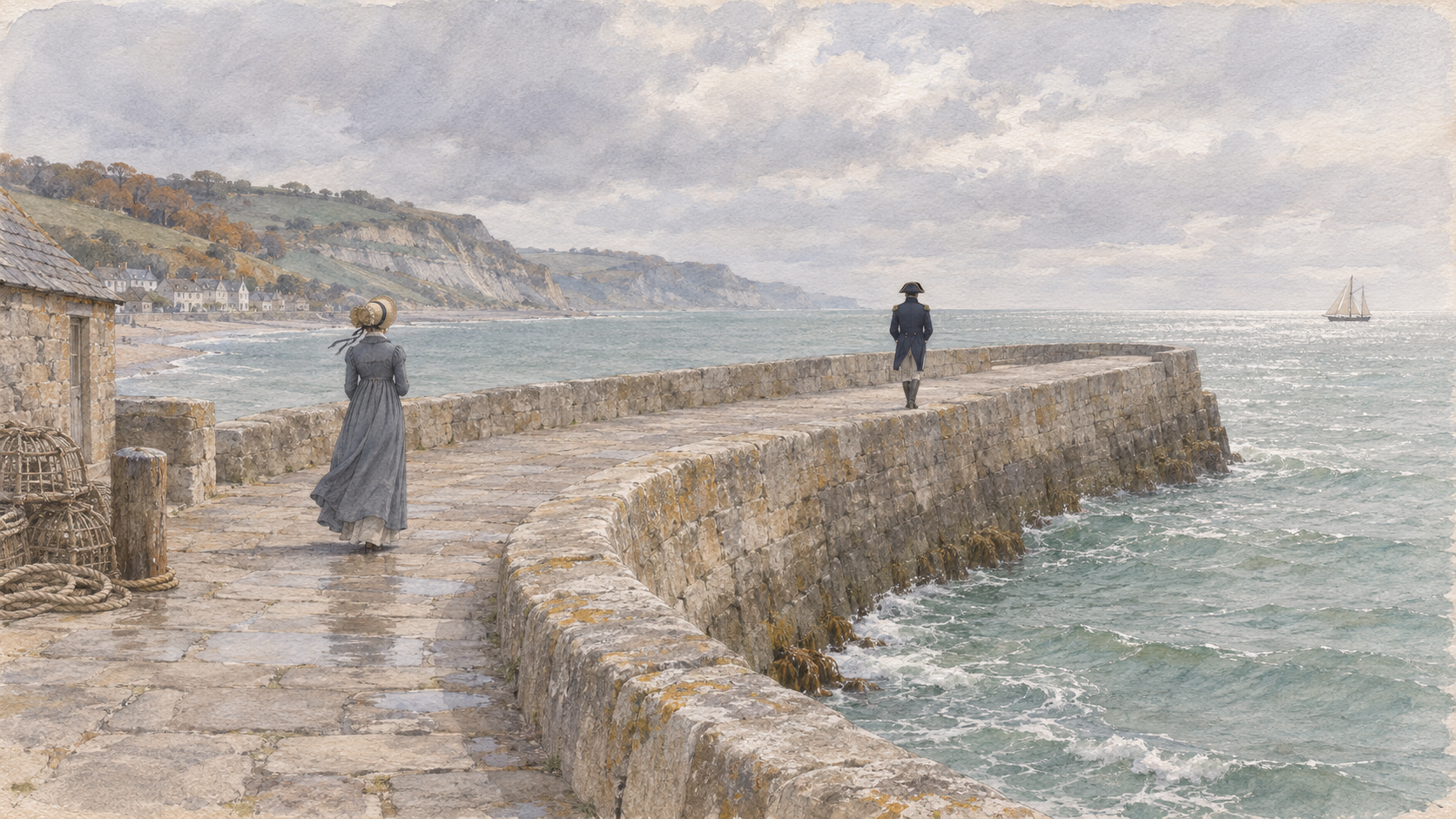
The Fall at Lyme: How Louisa Musgrove Changes the Course of Persuasion
The Man Anne Refused Is Coming Home
Anne Elliot learns that Captain Wentworth may soon be in the neighbourhood because her father can no longer afford to live in his own house. It is the sort of indignity Sir Walter Elliot takes very seriously. He gives considerably less thought to what the change might cost his daughter. Eight years ago, Anne broke her engagement to Wentworth on the advice of someone she trusted. Now his sister is about to move into the Elliot family home. Anne would quite like to know whether she can bear to meet him. The rest of the family is chiefly concerned with whether the new tenants can be trusted with the shrubberies.
The Elliots Have a Name and Need an Income
Sir Walter Elliot’s favourite reading is the entry for his own family in the Baronetage. He can open the volume at Kellynch Hall and find printed confirmation of the event he considers most interesting in English history: his birth. The page records his marriage, his children and his late wife. It gives no account of how much she did to keep his household solvent. Since her death, Sir Walter and his eldest daughter, Elizabeth, have maintained the expenditure while dispensing with the inconvenient restraint. Their creditors are now in a position to suggest some revisions to the family’s idea of itself.
Anne, the middle daughter, would make substantial economies. Her father finds almost every proposed saving incompatible with the dignity of his position. Letting Kellynch and moving to Bath offers a way out. He can enjoy being Sir Walter at a fashionable address while somebody else pays to occupy the house that makes the title look impressive. Admiral Croft and his wife become the tenants. Peace has brought naval officers home with money to spend, and the Elliots possess exactly what successful sailors lack: a handsome landed estate with owners sufficiently embarrassed to negotiate.
Sir Walter objects to the navy on two memorable grounds. It allows men of obscure birth to rise, and life at sea is dreadful for the complexion. He scrutinises the admiral accordingly. Anne has an altogether different reason to take an interest in Mrs Croft. Before her marriage she was a Wentworth. Her younger brother Frederick was the man Anne once expected to marry.
The financial reversal does more than bring former lovers into the same neighbourhood. It corrects the social calculation on which they were separated. Sir Walter’s inherited property has failed to keep him financially independent. Wentworth’s profession, once regarded as too precarious to support a wife, has made him wealthy. That outcome is a rebuke to the Elliot estimate of an officer’s worth. Whether it proves that Anne made a foolish decision eight years earlier is a harder question. The difference between those judgements will matter to her long after everyone else assumes the answer is obvious.
What Lady Russell Persuaded Anne to Give Up
Anne was nineteen when she fell in love with Frederick Wentworth. He had ambition, professional ability and an excellent opinion of his prospects. He had little money and no influential connection guaranteeing his advancement. Sir Walter received the engagement with disdain. The decisive opposition came from Lady Russell, a close friend of Anne’s dead mother who regarded Anne almost as a daughter of her own.
Lady Russell could picture how a long, uncertain engagement might consume a young woman’s best years. If the couple married without sufficient income, Anne would exchange the security of Kellynch for anxieties that Wentworth’s confidence could scarcely pay away. Her advice was coloured by rank, but her concern was real. So was the authority with which it reached Anne. A girl readily overlooked by her surviving parent had one older person prepared to consider her future carefully. Asking Anne to disregard Lady Russell meant asking her to mistrust the affection on which she had most reason to rely.
Anne ended the engagement. She believed she was acting partly for Wentworth’s sake by releasing him from an obligation while he tried to establish himself. He understood the decision as proof that her feelings could be overruled. He went to sea angry, advanced in his profession and made his fortune. She stayed home. Much of the pain that remains between them comes from the different occupations available to an unhappy naval officer and an unmarried daughter in a country house.
Anne has since refused Charles Musgrove, a good-natured local landowner’s son who went on to marry her younger sister, Mary. Lady Russell would have approved of that match. Anne’s refusal is easy to miss and essential to understanding her. The young woman who yielded on the question of a dangerous engagement held firm when offered a safe one. Someone entirely governed by other people’s wishes would have been Mrs Musgrove years ago.
At twenty-seven, Anne does regret the lost years. She would give a younger woman different advice. Yet she has no appetite for punishing Lady Russell with the knowledge that Wentworth became rich. He might have died at sea before earning a penny. A good outcome can show that a risk was worth taking without making the risk imaginary. Anne’s mature judgement is more generous than the simple fantasy in which she proved everybody wrong and collected eight years of happiness as her reward.
At Uppercross, Everyone Has a Use for Anne
While Sir Walter and Elizabeth establish themselves in Bath, Anne stays with Mary at Uppercross. Mary is the kind of invalid whose condition improves considerably at the prospect of an invitation. She feels slighted by her husband’s family and unappreciated by her own. Anne listens to her, then listens to the Musgroves’ complaints about Mary. Everyone finds Anne exceptionally sensible, particularly when hoping she will convey an awkward message to somebody else.
Uppercross is nevertheless a happier place than Kellynch. The older Musgroves enjoy their children. Their daughters, Henrietta and Louisa, can dance, entertain visitors and take pleasure in a handsome naval officer without conducting a preliminary enquiry into his ancestry. The ease of this household allows Wentworth to occupy Anne’s immediate world again. It gives him plenty of agreeable company through which he can avoid addressing her directly.
When Mary’s little boy Charles suffers a serious fall, Anne helps nurse him. Once the immediate danger passes, both parents find reasons why the other ought to stay while they go out. Anne volunteers. She has a particular reason to avoid the gathering, since Wentworth is expected, but she is also the person who can be relied on to make the practical arrangement work. It is characteristic of her position that being useful affords more privacy than saying she would rather stay home.
When she and Wentworth finally meet, there is very little for a spectator to see. Afterwards Mary reports his opinion that Anne has changed almost beyond recognition. He knew her when she was nineteen, and the people at Kellynch have long spoken as though she has lost her looks. What hurts is the apparent confirmation that for him the interval has done its work. She has carried the details of his face through eight years in which he may scarcely have pictured hers.
His conduct supplies evidence more difficult to interpret. When a small child clambers onto Anne’s back while she is occupied with his injured brother, Wentworth quietly lifts him off. Later, on a long walk, he sees that Anne is tired and arranges for the Crofts to take her up in their carriage. He can identify her discomfort before the people loudly professing their affection have noticed it. Neither gesture amounts to a declaration. That is precisely what makes them moving. A man trying to remain indifferent keeps remembering how to look after her.
In the carriage Anne gets a glimpse of a marriage with its own method of arriving safely. The admiral drives rather carelessly. Mrs Croft occasionally takes the reins and corrects their course. Neither appears humiliated by the arrangement. Mrs Croft has accompanied her husband on voyages and objects to the assumption that a sailor does his wife a kindness by deciding in advance what hardships she can bear. Had Anne married Wentworth, there would have been risks. Beside her is a woman who understands those risks from experience and considers separation the greater inconvenience.
What Wentworth Gets Wrong About Louisa
Louisa Musgrove has two qualities Wentworth is disposed to admire. She likes him and prides herself on knowing her own mind. During the walk, Anne overhears him praising firmness. Using a sound hazelnut as his example, he commends the character that remains intact under pressure. Louisa has no difficulty understanding which qualities in herself have earned his approval. Anne has equally little difficulty understanding whose weakness is being condemned.
Wentworth has made a theory of character out of a personal injury. Since somebody he loved once took advice that hurt him, resistance to advice feels like evidence of loyalty. Louisa’s lively determination gives him the pleasure of conducting the old argument in front of a sympathetic new audience. He pays insufficient attention to what public admiration from an eligible, unmarried man may encourage a young woman and her family to expect.
A visit to Lyme Regis introduces the party to two naval friends, Captain Harville and Captain Benwick. Harville has made an ingenious, welcoming home despite limited space and the effects of injury. Benwick is grieving for his fiancée, Harville’s sister Fanny, who died while he was away. Anne talks to him about poetry. She knows enough about the appeal of sorrowful verse to suggest that a different reading diet might do him good, and enough about herself to recognise the comedy of her giving this advice. A woman who has mourned an engagement for eight years is counselling somebody else on the merits of moderation.
Lyme also brings an unexpected change in how Wentworth looks at Anne. The sea air and activity have brought colour back to her face. A gentleman passing them is visibly struck by her appearance, and Wentworth notices his interest. The stranger proves to be Mr William Elliot, heir presumptive to Sir Walter’s title and estate. From Anne’s perspective the incident is fleeting. From Wentworth’s, another man has seen something he has been taking considerable trouble to overlook.
The party’s most consequential walk takes place on the Cobb, the great stone harbour wall. Louisa enjoys jumping down steps into Wentworth’s arms. He advises against another jump, but she insists. She moves before he is ready, falls and strikes her head. In a moment the quality he praised with his hazelnut becomes indistinguishable from an inability to respond to good advice. Louisa lies unconscious, and the man who encouraged her to regard determination as a virtue cannot wish her back to her feet.
Anne suggests immediate action, identifies who should fetch a surgeon and helps direct the frightened group. Her usefulness at Uppercross had looked like the agreeable habit of fitting in with other people’s plans. On the Cobb it becomes clear that she can also produce a plan when nobody else has one. Wentworth wants her near the injured Louisa. He has finally encountered a situation in which he urgently needs the judgement he once dismissed as weakness.
Bath Offers Anne an Apparently Excellent Match
Louisa remains at Lyme to recover under the Harvilles’ care. Anne eventually joins her father and Elizabeth in Bath, where the family has acquired an unexpected admirer. Mr Elliot, once conspicuously uninterested in his titled relations, now visits, listens and says the right thing. He appreciates Anne. Lady Russell begins to picture a future in which her favourite becomes Lady Elliot and returns to Kellynch as its mistress. Few prospects could appeal more intimately to a woman who loved Anne’s mother.
Anne likes Mr Elliot well enough to enjoy talking to him. Indeed, her objections are hard to state because almost every conversation with him goes well. His opinions accommodate those of the company. His history has discontinuities he explains gracefully without making them much clearer. Anne misses the warmth that might cause an otherwise sensible man to say the wrong thing in the service of an honest feeling. Wentworth, by contrast, has been visibly angry with her. Painful as that was, she has seldom doubted that something real lay behind it.
News then arrives that Louisa is to marry Captain Benwick. Their attachment has developed during her recovery. The pairing surprises everyone who thought Wentworth was courting her and everyone who believed Benwick likely to remain inconsolable. It is tempting to make a joke of the man who once knew more melancholy poetry than his companions could endure. Austen lets Anne be surprised without requiring us to conclude that his grief for Fanny was counterfeit. He loved one woman, endured her loss and spent a long period in the company of another. A capacity to become happy again tells us little about how much the original loss hurt.
The news frees Wentworth from an obligation he had belatedly recognised. Whatever he privately meant by his attentions, he had behaved in a way that might entitle Louisa to expect an offer. He could not honourably pursue Anne while leaving Louisa to discover how little his preference signified. He went away after the accident, and Louisa formed an attachment of her own. She has a future independent of the lesson her fall taught him. Crucially, he did not secure his freedom by publicly disowning the young woman whose interest he encouraged.
Now in Bath, Wentworth encounters Anne under circumstances almost perfectly designed for another misunderstanding. At a concert she can give him grounds for hope in conversation, only for Mr Elliot’s attentions to suggest that her future is already settled. Lady Russell’s evident satisfaction makes the prospect still more convincing. Wentworth once mistook Anne’s willingness to hear another person’s advice for an inability to make up her mind. Eight years later, he is in danger of letting the sight of somebody else’s approval do his thinking for him.
What Mrs Smith Knows About Mr Elliot
Anne’s most revealing social engagement in Bath takes place well away from her father’s drawing room. She visits Mrs Smith, an old school friend who once showed her kindness when she was a bereaved girl. Mrs Smith is now widowed, poor and restricted by illness. Sir Walter considers the acquaintance beneath his daughter, particularly when more distinguished company is available. Anne keeps the appointment. Her family’s idea of an advantageous connection would have lost her both an old friend and the opportunity to learn why their new friend has taken such an interest in them.
At first Mrs Smith believes Anne is likely to marry Mr Elliot. She has a practical reason to welcome the match. Her late husband’s affairs remain entangled, and she hopes that Anne could influence a man who has failed to assist her. Only once Anne makes clear that she has no intention of marrying him does Mrs Smith tell her what their acquaintance has cost. The timing keeps Mrs Smith human. Poverty has given her strong reasons to calculate what a friendship might achieve, alongside her genuine pleasure in seeing Anne.
Mr Elliot had been close to her husband, encouraged expensive habits and later declined the responsibilities that might have helped his friend’s widow. Mrs Smith also possesses an old letter in which he writes contemptuously about the family he now cultivates. It carries particular weight because Anne need not take a disappointed creditor’s word for his earlier attitude. She can compare the younger man’s private amusement with the older man’s public deference and ask what has changed in between.
The inheritance supplies an answer. Sir Walter could still remarry and have a son, displacing his present heir. Mrs Clay, Elizabeth’s widowed companion, has become a sufficiently constant presence to make that possibility worth Mr Elliot’s attention. The title he once felt free to ridicule is now something he wants. Returning to the family allows him to observe the danger at close quarters. An interest in Anne can coexist with that calculation. Her mistake would have been to treat the sincerity of a compliment as proof that the man offering it had dealt honourably with everybody else.
Importantly, Anne has already decided against marrying him before she obtains this evidence. Mrs Smith confirms the wisdom of a judgement that Anne reached while Lady Russell was leaning the other way. At nineteen Anne had to decide how much trust to place in her older friend’s estimate of a man. Here she faces a comparable decision without announcing that she has become independent or picking a quarrel to prove it. She listens, enjoys what she can of Mr Elliot’s company and retains the right to decline.
The Conversation Wentworth Hears
The decisive encounter takes place at the White Hart in Bath. Wentworth is writing a letter while Anne talks with Captain Harville. A miniature portrait has given Harville an immediate reason to think about constancy. Benwick had his likeness made for Fanny. Now that likeness is to be set for Louisa. For Benwick it may be possible to love again without repudiating his first attachment. For Fanny’s brother, the very same face is being prepared for another woman to wear. Grief has given a theoretical question a small, portable and painfully specific form.
Harville argues that men can love as faithfully as women. He appeals to what has been written about female inconstancy. Anne points out who historically had the education, leisure and authority to write the books in question. She also draws on the different lives open to the sexes. Men have work, travel and occupations that can force their attention elsewhere. A woman whose engagement ends may continue in the same rooms, among people who scarcely noticed that her life had begun to change. Her claim for women concerns the endurance of affection when hope and opportunity are gone.
Listen to whom she is addressing. Harville loved his sister. Anne has no wish to insult the dead or to deny the suffering of sailors who leave their families without knowing whether they will see them again. Her disagreement leaves him room to speak about that pain. It is possibly the first courtship scene in the novel in which Anne can say exactly what she means, because she is engaged in a conversation that matters quite apart from courtship.
Wentworth is close enough to hear. Earlier, Anne had to listen while he discoursed to Louisa on the kind of woman a man ought to trust. Now he hears a woman describing an experience he had never properly imagined. He has had eight years of movement, danger, success and injured pride. She has spent much of that time being useful to a household in which her absence might be regretted sooner than her feelings would be consulted. His years away did not prove that he had ceased to love her. Her quietness at home was equally poor evidence that she had ceased to love him.
He writes a second letter, this one to Anne, and finds a way to leave it where she can read it. The apparent bustle of the room suddenly becomes an advantage. He need not ask her to declare herself in front of the Musgroves. She need not interpret another act of assistance or hope he understood a look across a concert room. For the first time since they met again, one of them has put a request to the other in a form that permits a direct answer.
Why Wentworth’s Letter Changes the Ending
The letter works because Wentworth takes a risk before he knows how Anne will respond. He tells her that he loves her still, acknowledges how wrongly he has understood her and asks for some indication that there is hope. He has enough evidence to write. He has no guarantee that she will say yes. For years he resented Anne for allowing someone else’s opinion to influence a private attachment. Now, instead of allowing Mr Elliot’s presence or Lady Russell’s preferences to settle the matter, he lets Anne speak for herself.
After she reads it, they meet again and walk together. At last they can distinguish what each actually did from what the other took it to mean. Wentworth acknowledges the resentment that kept him from approaching her once his career had prospered. She tells him that, had he written to her at an earlier point, she would have accepted him. Years they regarded as the necessary consequence of one youthful refusal could have ended with an envelope. Lady Russell had considerable influence over the original separation. Wentworth exercised quite as much influence over its duration.
Anne’s position on that first decision remains unusually exact. She thinks the advice mistaken. She also believes that at nineteen, given her understanding of duty and Lady Russell’s place in her life, refusing to heed her would have troubled her conscience. Present happiness does not require her to despise the girl she was. Wentworth, for his part, has to recognise a less flattering possibility about the young man he remembers. Confidence in his prospects was justified. Confidence that wounded pride entitled him to judge Anne’s character was considerably less so.
They marry with none of the financial objections that once made the match so alarming. Sir Walter can accommodate a handsome captain of substantial fortune. Lady Russell has to adjust her opinion because the marriage will bring Wentworth regularly into the life of somebody she loves. Anne retains her old friend and her friendship with Mrs Smith. Wentworth helps Mrs Smith recover property whose affairs she could not manage alone. The marriage produces a practical benefit beyond the happiness of the couple: a widow who once had to calculate whether a friend might marry the right man finally receives assistance freely given.
The closing uncertainty belongs to Wentworth’s profession. Peace brought the Crofts to Kellynch and gave Anne a second chance. War could take her husband away again. Austen leaves her with the knowledge Lady Russell once tried to spare her and with the freedom Mrs Croft exercised throughout her married life. The sea remains dangerous. What has changed is who gets to decide whether loving a sailor is worth the risk.
Sources
Jane Austen, Persuasion — Project Gutenberg. Complete novel, including the accident at Lyme, Mrs Smith’s evidence, the White Hart conversation and Anne’s final judgement on Lady Russell’s advice. Project Gutenberg
Jane Austen’s Fiction Manuscripts — Persuasion. Scholarly account of the surviving manuscript chapters and Austen’s replacement of her earlier ending with the published conclusion. janeausten.ac.uk
Cambridge University Press — Persuasion, Publication Chronology. Bibliographical evidence for publication with Northanger Abbey in December 1817, under an 1818 title-page date. assets.cambridge.org
Next Reads
The Remains of the Day: Stevens, Miss Kenton, Lord Darlington and the Cost of Duty — for a later meeting between two people who must decide how honestly they can discuss the years they spent apart.
The Time Traveler’s Wife Explained: Henry, Clare, the Timeline and the Ending — for another love story attentive to the different experiences of the person who leaves and the person who waits.
Rebecca Today: Could You Escape Your Partner’s Digital Past? — for a darker question raised by Benwick’s miniature: what happens to the traces of a first love when somebody loves again?
