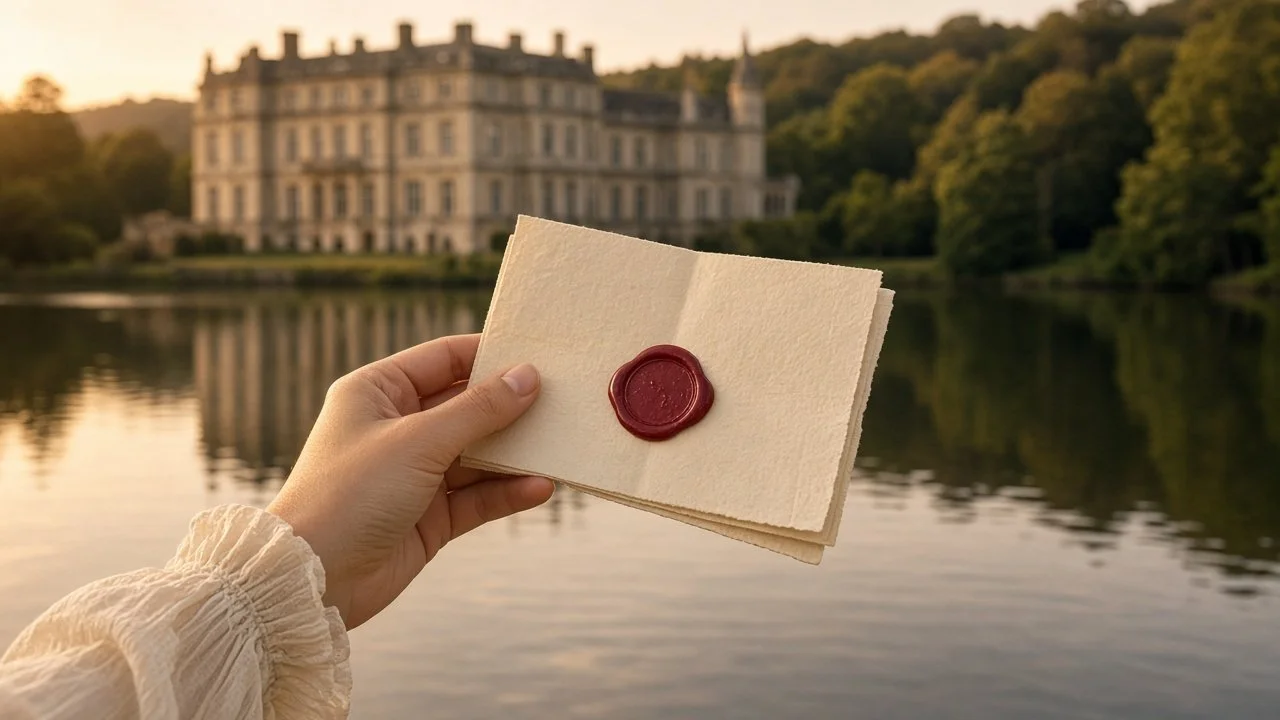
A rude remark, a charming liar and a letter that turns everything upside down. We explain Pride and Prejudice and what Netflix's new series changes.
Five Daughters, No Fortune and a First Impression That Goes Badly Wrong
Elizabeth Bennet is clever, funny and very sure of her own judgement. She has four sisters, a mother desperate to see them married, and a father whose house will pass to a cousin the moment he dies. Then two rich young men move into the neighbourhood, and one of them insults her within an hour of arriving. Jane Austen's Pride and Prejudice, published in 1813, follows what happens when a woman who prides herself on reading people meets a man who seems impossible to read. With Netflix's six-part series arriving on 3 December 2026, this guide sets out the background first, then gives a clear spoiler warning and tells the story in the order Elizabeth discovers it, before explaining Darcy's letter, Lydia's scandal and the ending. It closes with what the series is confirmed to change and revision notes for GCSE students.
Where and When Is Pride and Prejudice Set?
The story takes place in England in the early 19th century. The Bennets live at Longbourn, a modest estate near the market town of Meryton in Hertfordshire. Other key settings are Netherfield, the house Mr Bingley rents nearby; Rosings, Lady Catherine de Bourgh's grand estate in Kent; and Pemberley, Mr Darcy's house in Derbyshire.
Why Money Matters So Much
Mr Bennet's estate brings in about £2,000 a year, but it is entailed: by a legal arrangement it can pass only to a male heir. Because he has five daughters and no son, Longbourn will go to a distant cousin, Mr Collins, when Mr Bennet dies. His wife and daughters will then lose their home, with only small fortunes of their own.
That is why Mrs Bennet's matchmaking, which can look comic, has deadly serious stakes. Marriage is close to the only route to security for women of her daughters' class. Mr Darcy, by contrast, is reported to have £10,000 a year, about five times Mr Bennet's income. Every encounter in the novel happens against that gap in wealth and rank.
Netflix's Pride and Prejudice: Release Date, Cast and Where to Watch
Netflix's Pride and Prejudice premieres on Thursday 3 December 2026 and streams on Netflix in both the UK and the US. It is a six-part series written by Dolly Alderton, the author of Everything I Know About Love, and directed by Euros Lyn, who made Heartstopper. Lookout Point produces.
Emma Corrin plays Elizabeth Bennet and Jack Lowden plays Mr Darcy. Olivia Colman is Mrs Bennet and Rufus Sewell is Mr Bennet. Freya Mavor plays Jane, Rhea Norwood plays Lydia, Daryl McCormack plays Mr Bingley, Louis Partridge plays Mr Wickham, Jamie Demetriou plays Mr Collins and Fiona Shaw plays Lady Catherine de Bourgh. It is the first major screen adaptation since Joe Wright's 2005 film with Keira Knightley and Matthew Macfadyen, and before that the BBC's 1995 series with Jennifer Ehle and Colin Firth.
Spoiler warning: the following summary discusses the plot, major twists and ending.
The Ball at Meryton
The novel opens with one of the most quoted sentences in English, a narrator's joke about how every rich single man is assumed to need a wife. News arrives that a wealthy young man, Charles Bingley, has rented Netherfield Park. Mrs Bennet is thrilled, and the family meets him at a public ball in Meryton.
Bingley is friendly and dances twice with Jane, the eldest and gentlest Bennet sister. His closest friend, Fitzwilliam Darcy, is richer, handsomer and far ruder. When Bingley suggests that he dance with Elizabeth, Darcy says, within her hearing, that she is tolerable but not handsome enough to tempt him. Elizabeth laughs it off and repeats the story to her friends, but the insult sets her opinion of him.
What she does not see is that Darcy soon begins to change his mind. Over the following weeks he notices her wit and her fine eyes, and he starts to listen to her conversations. The reader, guided by Elizabeth's viewpoint, barely notices either.
Jane at Netherfield
Jane is invited to Netherfield, rides there in the rain at her mother's insistence and falls ill. Elizabeth walks three miles through muddy fields to nurse her, arriving with dirty petticoats, which Bingley's sister Caroline mocks. Caroline wants Darcy for herself and grows jealous as his interest in Elizabeth becomes obvious. Elizabeth and Darcy spar in the Netherfield drawing room, and she enjoys teasing him without realising that he enjoys it too.
Mr Collins and Mr Wickham
Mr Collins, the cousin who will inherit Longbourn, arrives to visit. He is a pompous young clergyman who owes his position to his patroness, Lady Catherine de Bourgh, and he has come to choose a wife from among the Bennet daughters. He settles on Elizabeth and proposes in a speech that is mostly about himself. She refuses him firmly, and Mrs Bennet demands that her husband make her accept. Mr Bennet calmly tells Elizabeth that an unhappy alternative is before her: her mother will never see her again if she does not marry Mr Collins, and he will never see her again if she does. It is the funniest line in the book, and it also shows the habit that will later cost the family dearly. Mr Bennet would rather make a joke than take charge.
At the same time a militia regiment is stationed in Meryton, and the youngest Bennet girls, Kitty and Lydia, are obsessed with the officers. Elizabeth meets a charming new officer, George Wickham. Wickham tells her that he grew up at Pemberley as the son of the late Mr Darcy's steward, that the old man promised him a living as a clergyman, and that the younger Darcy refused to honour it out of jealousy. Elizabeth believes every word. It fits what she has already decided about Darcy, and it never occurs to her to ask why a man would tell such a private story to someone he has only just met.
Two Shocks for the Bennet Sisters
At a ball at Netherfield, Darcy asks Elizabeth to dance, and she uses the dance to raise Wickham's name. Darcy stiffens and says little, which she takes as guilt. Meanwhile Mrs Bennet loudly boasts that Jane will soon marry Bingley, and the younger Bennets embarrass the family. Soon afterwards, the whole Netherfield party leaves for London. Caroline Bingley writes to Jane implying that her brother may marry Darcy's sister, Georgiana. Jane is heartbroken but blames nobody. Earlier, Charlotte had warned Elizabeth that Jane hides her feelings so well that Bingley might never be sure of them. Elizabeth dismissed the idea, but it is exactly the mistake that will soon be explained.
Then Charlotte Lucas, Elizabeth's closest friend, accepts Mr Collins only days after Elizabeth has turned him down. Charlotte, who is 27, explains that she is not romantic and asks only for a comfortable home. Elizabeth is shocked and a little contemptuous, though the novel takes Charlotte's reasons seriously.
Rosings and the First Proposal
In the spring, Elizabeth visits Charlotte at her new home in Kent, close to Rosings, where Lady Catherine rules over everyone around her. Darcy, who is Lady Catherine's nephew, arrives with his cousin Colonel Fitzwilliam and keeps calling at the parsonage. Without realising whom he is talking to, Fitzwilliam mentions that Darcy recently saved a friend from an imprudent marriage. Elizabeth understands at once that he means Bingley and Jane.
That evening Darcy appears and proposes. His speech is passionate and insulting at the same time: he says he has struggled against his feelings because of her family's inferiority, and he clearly expects to be accepted. Elizabeth refuses him. She accuses him of ruining Jane's happiness and of cruelty to Wickham, and she tells him that he could not have offered in any way that would have tempted her to accept. Her sharpest line attacks his manners: he might have spared her the pain of refusing had he behaved in a more gentlemanlike way.
Darcy's Letter
The next morning, Darcy hands Elizabeth a long letter and leaves. It answers both charges.
On Jane, he admits that he persuaded Bingley to leave. He says that he watched Jane closely and believed her calm manner showed she did not love his friend, and that the vulgarity of the Bennet family, apart from Jane and Elizabeth, counted against the match. He does not apologise for this part.
On Wickham, the letter reverses everything. Darcy says Wickham told him he did not want to become a clergyman and accepted £3,000 instead of the living. Wickham spent the money, came back demanding the living after all, and was refused. Then, the previous summer, Wickham went to the seaside town of Ramsgate and persuaded Darcy's 15-year-old sister, Georgiana, to agree to elope with him. Darcy discovered the plan in time. He believes that Wickham was after Georgiana's fortune of £30,000 and his own revenge. Colonel Fitzwilliam, Georgiana's other guardian, can confirm it.
Elizabeth's Recognition
Elizabeth first reads the letter angrily, then again more slowly. She realises that Wickham told his story to a near-stranger, that he avoided Darcy whenever they might meet, and that nothing he said had ever been proved. She sees that she believed him because he flattered her and Darcy slighted her. She also admits, painfully, that Darcy's account of her family's behaviour is fair.
Her conclusion is one of the most important lines in the book: until this moment, she never knew herself. She has been the one with prejudice, and her pride in her own discernment was the cause.
Brighton and Pemberley
Back at Longbourn, the regiment is leaving for Brighton. Lydia, the youngest Bennet and still a teenager, is invited to go as the guest of the colonel's young wife. Elizabeth begs her father to stop it, warning that Lydia's wildness could disgrace the whole family. Mr Bennet lets her go anyway, reasoning that she will never be easy until she has exposed herself somewhere, and Brighton is far away.
In the summer Elizabeth tours Derbyshire with her aunt and uncle, the Gardiners, kind and sensible people who live in London on the proceeds of trade. They visit Pemberley, having been told that Darcy is away. The house and grounds are beautiful in a natural, unshowy way, and the housekeeper, Mrs Reynolds, who has known Darcy since he was four, praises him as the best of masters and brothers. Elizabeth begins to see the man the people who know him well describe.
Then Darcy arrives unexpectedly. He is not cold but warm and polite, even to the Gardiners, whom his aunt would despise for their connection to trade. He asks to introduce Elizabeth to his sister, who is shy rather than proud. Elizabeth realises that her feelings have changed and that his may not have.
Lydia's Scandal
At an inn in nearby Lambton, Elizabeth receives two letters from Jane. Lydia has run away from Brighton with Wickham. At first it was believed they were heading for Gretna Green in Scotland, where couples could marry quickly, but it now seems they never intended to go there or to marry at all. Darcy finds Elizabeth in tears, she tells him what has happened, and he leaves gravely. She assumes she will never see him again.
Elizabeth hurries home. Mr Gardiner and Mr Bennet search London, without success, and Mr Collins writes to say that Lydia's death would have been a blessing compared with this disgrace. Then news comes that the couple have been found. Wickham will marry Lydia if Mr Bennet settles on her a small income of £100 a year. Mr Bennet is sure no man in his senses would marry Lydia for so little and assumes that Mr Gardiner has paid off Wickham's debts.
What Lydia Lets Slip
The newly married Wickhams visit Longbourn, and Lydia, as thoughtless as ever, lets slip that Darcy was at her wedding. Elizabeth writes to her aunt, and Mrs Gardiner's reply reveals the truth. Darcy tracked the couple down in London, paid Wickham's debts of more than £1,000, added another £1,000 to Lydia's own money and bought Wickham a commission in the army. Wickham is posted to the north of England, to Newcastle. Darcy insisted that the Gardiners take the credit. He blamed his own reserve for the fact that nobody knew what Wickham was.
How Pride and Prejudice Ends
Bingley returns to Netherfield, with Darcy, and quickly resumes courting Jane. Darcy is quiet, and Elizabeth cannot tell what he feels. Bingley proposes to Jane and is accepted.
A few days later, Lady Catherine de Bourgh arrives at Longbourn without warning. She has heard a rumour that Elizabeth is about to marry Darcy, and she demands a promise that Elizabeth will never accept him. She says the match would be a disgrace, and she asks whether the shades of Pemberley are to be polluted by a sister married to the steward's son. Elizabeth admits that she is not engaged but refuses to promise anything. She says she is resolved to act in the way that will make her happy, without reference to Lady Catherine.
Lady Catherine goes straight to Darcy with her account of the conversation, and it gives him exactly the hope she meant to destroy. He returns to Longbourn, and on a walk Elizabeth thanks him for what he did for Lydia. He tells her he did it for her, and that if her feelings are still what they were in April she should say so at once; his own affections and wishes are unchanged. Elizabeth tells him that her feelings have entirely changed. They become engaged.
The Final Chapters
Elizabeth has to convince her father, who asks whether she is out of her senses to accept a man she has always hated. She tells him everything, including what Darcy did for Lydia, and Mr Bennet says he could not have parted with her to anyone less worthy.
The final chapter settles the family. Jane and Elizabeth marry, and Bingley later buys an estate within 30 miles of Pemberley. Kitty spends most of her time with her elder sisters and improves greatly. Mary stays at home. Lydia and Wickham drift from place to place, living beyond their means. Lady Catherine is furious, but in time Darcy is reconciled with her. The Gardiners are always welcome at Pemberley, because their journey brought Elizabeth and Darcy together.
Pride and Prejudice Ending Explained
Why Does Darcy's Letter Change Everything?
The letter is the turning point because it gives Elizabeth evidence rather than impressions. Until then, she has judged Darcy on his manners and Wickham on his charm. The letter supplies dates, sums of money, a witness in Colonel Fitzwilliam and a story she can test against what she has seen. When she tests it, Wickham's version collapses.
It also changes Darcy. He cannot defend his behaviour at the proposal, and her accusation that he did not act like a gentleman stays with him. Everything he does at Pemberley, from his politeness to the Gardiners to his gentleness with his sister, shows a man who has taken that criticism seriously.
Why Was Lydia's Elopement So Dangerous?
In Austen's world, an unmarried girl living with a man ruined not only herself but her sisters. No respectable family would want a connection to the Bennets, so Jane, Elizabeth, Mary and Kitty would all lose their chances of a good marriage. Mr Collins's cruel letter is extreme, but the disgrace he describes is real.
Wickham had no reason to marry Lydia. She has almost no money, and he is fleeing gambling debts. That is why the family is so puzzled that he agrees on such cheap terms, and why the truth matters so much. Only a large payment from someone could have made the marriage happen.
Why Did Darcy Save Lydia?
He gives two reasons. He feels responsible, because he kept Wickham's history secret to protect Georgiana, which left other families exposed. And, as he finally admits, he did it for Elizabeth. Rescuing her family from disgrace removes the very objection he made at the first proposal. He now accepts Wickham, a man he despises, as a brother-in-law. Nothing shows more clearly how much his pride has changed.
Why Does Bingley Come Back to Jane?
Because Darcy undoes his own interference. During the final walk, he tells Elizabeth that on the evening before he went to London, he confessed to Bingley that his earlier advice had been absurd and impertinent, and that he now believed he had been wrong to think Jane indifferent. Bingley, who never suspected any of it, proposed almost at once.
That confession matters because it is unglamorous. Darcy gains nothing from it except the chance to repair harm he caused, and he does it before he knows whether Elizabeth will have him. Elizabeth teases him that he gave his permission, and he half admits it. The novel lets Bingley's dependence on his friend stay slightly comic, but Darcy has finally used his influence well.
Why Does Lady Catherine's Visit Backfire?
Lady Catherine wants to scare Elizabeth off, but her bullying produces the one piece of information Darcy needs: Elizabeth refused to promise she would turn him down. Darcy knows Elizabeth well enough to understand that if she had decided against him, she would have said so plainly. The aunt who embodies the snobbery of his class ends up bringing the couple together.
Who Is Proud and Who Is Prejudiced?
Both of them are both. Darcy's pride is the obvious kind, a sense of rank that makes him look down on Meryton society. His prejudice is against the Bennets' vulgarity, which leads him to misjudge Jane. Elizabeth's prejudice against Darcy is born of wounded pride after the ball, and her pride in her own cleverness makes her slow to see it. The novel is persuasive because it makes them change for specific reasons, not because love simply conquers all.
Is It a Happy Ending for Everyone?
Not quite. Elizabeth and Jane marry for love and security, an unusually lucky combination. Charlotte has the comfortable home she wanted, with a husband she quietly arranges to see as little as possible. Lydia is married but not happy, tied to a man who soon loses interest in her. Mr Bennet's indulgence of his youngest daughters nearly destroyed the family, and the novel does not let him forget it. The romantic ending sits inside a much colder picture of what marriage could mean for women without money.
Did Elizabeth Fall for Pemberley?
It is a fair question, and Austen raises it herself. When Elizabeth first sees the house, she thinks that to be mistress of Pemberley might be something. Later, when Jane asks how long she has loved Darcy, Elizabeth jokes that it must date from her first sight of his beautiful grounds.
The joke works because the novel has already shown that money alone does not move her. She refused Mr Collins, who could have saved her home, and she refused Darcy himself, with his £10,000 a year, at Hunsford. What changes at Pemberley is the evidence. The house reflects good taste rather than show, the housekeeper describes a generous master, and Darcy treats her relatives with respect. Pemberley shows Elizabeth who Darcy is when he is at home, which is precisely what she had failed to see.
The Characters Who Matter Most
Jane Bennet
Jane believes the best of everyone, which makes her lovable and easy to hurt. Her calm manner, which hides deep feeling, is what persuades Darcy she does not love Bingley, so her goodness has a real cost in the plot. She acts as a foil to Elizabeth: one sister judges too kindly, the other too quickly.
Mr Bennet
Mr Bennet is the character readers most enjoy and the one the novel judges most harshly. His wit makes him good company, but he has saved nothing for his daughters and he lets Lydia go to Brighton because stopping her would be tiresome. After the elopement, he tells Elizabeth to let him for once in his life feel how much he has been to blame, though he adds, characteristically, that the feeling will soon pass.
Charlotte Lucas
Charlotte's marriage is the novel's most realistic choice. She knows exactly what Mr Collins is and accepts him anyway, because a home of her own is worth more to her than romance. Elizabeth's shock at her friend is partly another of her hasty judgements.
George Wickham
Wickham is the novel's warning about charm. Everything he says is pleasant and much of it is false, and he picks his targets carefully: a rich 15-year-old at Ramsgate, an attractive young woman with a grudge against Darcy, and finally Lydia, who is too reckless to protect herself.
The Gardiners
Mrs Bennet's brother and his wife are sensible, kind and connected to trade, the kind of people the Bingley sisters sneer at. They are also the adults who behave best in the book. It is fitting that Darcy's respect for them becomes part of the evidence that he has changed.
What Netflix's Series Changes
Netflix has released a trailer, first-look images and a synopsis, but no episode plots, so only changes confirmed by the people who made the series can be described here. Nothing published so far suggests that the ending changes.
Mrs Bennet Speaks the Famous First Line
In the novel, the opening sentence belongs to the narrator. In Alderton's series, Olivia Colman's Mrs Bennet says it. Alderton has explained that the idea is all Mrs Bennet thinks about, so it felt natural to give her the line. It is the first time a screen version has used the sentence.
Mrs Bennet Gets Her Due
Alderton has said she wanted justice for Mrs Bennet, whom readers often treat as a figure of fun. She has described a scene in the second episode in which Mrs Bennet tells her husband that their daughters' futures are no laughing matter. That fits the novel's economic reality, but it gives Mrs Bennet a seriousness the book rarely lets her show.
The Bennets' Marriage Is Warmer
In the book, Mr Bennet's teasing of his wife can read as contempt. Alderton has said she sees them as a fond, comfortable couple whose relentless mockery is a form of love, so the series presents their marriage as essentially happy.
Wickham Is More Charming
Alderton has said that Austen tells us Wickham is charming but rarely shows it, so she made him more persuasive, taking inspiration from Daniel Cleaver in Bridget Jones's Diary. The aim is to make viewers believe, as Elizabeth does, that he is the man she should choose. Readers already know where that trust leads.
Sisters and Family
Corrin has described Alderton's version as a love letter to sisterhood and family as well as a romance. Expect the Bennet sisters to share more of the screen, though how that changes individual scenes will not be clear until 3 December.
Should You Read the Book Before Watching?
You do not need to, but it helps. The series covers the whole novel across six episodes, and Alderton has said the book divides naturally into six acts. Knowing the novel lets you spot where her changes fall, especially in the scenes with Mrs Bennet and Wickham. The book is also funnier than its reputation suggests, and much of that humour lives in the narrator's voice, which no adaptation can fully carry over.
Themes and Meaning
Marriage and Money
Every marriage in the novel is a financial arrangement as well as an emotional one. Charlotte marries for security, Lydia for excitement, Jane and Elizabeth for love that happens to bring wealth. Austen's comedy works because she never pretends money does not matter.
First Impressions
The original title explains the book's method. The ball at Meryton creates impressions that nearly every character holds on to too long, and the plot is the slow work of correcting them with evidence.
Reputation and Family
A family rises or falls together. Lydia's choices threaten every sister, and Mrs Bennet's boasting helps drive Bingley away. Elizabeth's independence is real, but the novel shows how tightly it is bound to her family's behaviour.
Final Thoughts
The best scene in Pride and Prejudice is not a proposal but a woman reading a letter twice and discovering that she has been wrong about almost everything. Elizabeth's happy ending depends on that moment, and on Darcy's willingness to hear what she said about him at Hunsford. More than two centuries on, the book still feels modern because it understands that falling in love properly means first admitting you misjudged someone, and that this is much harder for clever people.
Study Notes
Pride and Prejudice is a 19th-century novel set text for AQA GCSE English Literature (8702) and Pearson Edexcel GCSE English Literature (1ET0). Check your own school's choice of text and exam board.
Key Quotations Explained
"It is a truth universally acknowledged, that a single man in possession of a good fortune must be in want of a wife." (narrator, chapter 1). The irony is that the opposite is true: poor single women need rich husbands. It sets the novel's tone of satire about marriage and money.
"She is tolerable: but not handsome enough to tempt me" (Darcy, about Elizabeth, at the Meryton ball). The first impression that drives Elizabeth's prejudice, and a useful example of Darcy's pride.
"In vain have I struggled. It will not do. My feelings will not be repressed." (Darcy, first proposal). Passionate, but the struggle he describes is against her social inferiority, which is why she is insulted.
"had you behaved in a more gentlemanlike manner" (Elizabeth, refusing Darcy). Attacks his claim to be a gentleman and becomes the criticism that changes him.
"Till this moment, I never knew myself." (Elizabeth, after reading Darcy's letter). The novel's turning point of self-knowledge.
"Are the shades of Pemberley to be thus polluted?" (Lady Catherine). Snobbery at its most extreme, using Lydia's marriage to Wickham as a weapon.
Characters and Conflicts
Elizabeth and Darcy: pride and prejudice on both sides, corrected through evidence and changed behaviour.
Jane and Bingley: a contrast couple, kind but passive, separated by others and reunited when Darcy admits his mistake.
Charlotte and Mr Collins: marriage as a practical arrangement for a woman with few choices.
Lydia and Wickham: impulsive desire and deception, and the danger they pose to the family.
Mr and Mrs Bennet: a mismatched marriage whose failures, his indulgence and her silliness, nearly ruin their daughters.
Common Misreadings
Mrs Bennet is not simply foolish. Her anxiety reflects the entail and the real danger of poverty.
Darcy is not transformed only by love. He changes because Elizabeth's criticism shows him how he behaves.
Charlotte is not a villain. The narrator lets the reader see why her choice is rational.
Form and Context
Austen writes in the third person with free indirect discourse, a technique that lets the narrator slip into a character's thoughts and voice. Much of the irony comes from this. The novel reflects the Regency period's laws on inheritance, the importance of rank and the limited options for middle-class women. If you are comparing set texts, Jane Eyre and Great Expectations, from the same AQA and Edexcel lists, also turn on money, class and a marriage that depends on a hidden truth.
Sources
Pride and Prejudice by Jane Austen, Project Gutenberg (full public-domain text used to verify every quotation and the ending details)
Pride and Prejudice, Wikipedia (publication on 28 January 1813 by Thomas Egerton; £110; First Impressions; plot corroboration)
Pride and Prejudice Full Book Summary, SparkNotes (plot and ending corroboration)
Pride and Prejudice: Teaser, Cast, Photos, Release Date, Netflix Tudum, 29 October 2026 (3 December premiere; six episodes; cast; Alderton and Lyn)
Netflix's All-Star Pride and Prejudice Adaptation Finally Gets Release Date Confirmed, Radio Times, 16 September 2026 (UK date; synopsis; Corrin on sisterhood)
Netflix's Pride and Prejudice Hands Iconic Jane Austen Line to a Character for the First Time, The Independent, 31 October 2026 (Mrs Bennet speaks the opening line)
Pride and Prejudice Returns: Inside Netflix's Fresh Take on Jane Austen's Classic, Vanity Fair, 5 November 2026 (Alderton on Mrs Bennet, the Bennets' marriage and Wickham)
GCSE English 8702: Shakespeare and the 19th-Century Novel, AQA (set text list)
Edexcel GCSE English Literature Specification, Pearson (set text list)
Next Reads
Pride and Prejudice Summary: A Love Story About Status, Self-Deception and Second Chances
Jane Eyre Explained: Love, Independence and the Secrets of Thornfield
Wuthering Heights Explained: Heathcliff, Catherine and the Cost of Possession
Great Expectations Explained: Pip, Estella, Ambition and the Ending
