The Heist That Set an AI Free
A Burned-Out Hacker, a Razor-Fingered Bodyguard and an Artificial Intelligence That Wants to Become Something No One Can Switch Off
A washed-up hacker in a Japanese port city is given one last chance to get back online. The catch is that the job comes from an employer he has never met, and his new body is laced with poison that will cripple him again if he fails. William Gibson's Neuromancer, published in 1984, gave the world the word "cyberspace" in its modern sense, invented much of the look and language of cyberpunk and became the only novel to win science fiction's three biggest prizes. It is also famously hard to follow on a first read. With Apple TV's ten-part series arriving on 22 January 2027, this guide sets out the background first, then gives a clear spoiler warning and tells the story in order, before explaining the ending: what Wintermute is, what Neuromancer wants, what happens when they merge and why the last line is so blunt.
Key Terms for New Readers
The matrix and cyberspace: the global computer network, which hackers experience as a glowing three-dimensional landscape of data.
Jacking in: connecting your brain to the matrix through a deck, a portable computer, using electrodes.
Console cowboy: a hacker who breaks into corporate systems.
ICE: Intrusion Countermeasures Electronics, the security software that protects data and can kill an intruder.
Icebreaker: a program that cuts through ICE.
Construct: a recording of a dead person's skills and personality, stored on a chip, which can talk and think but not change.
Simstim: "simulated stimulus", a link that lets one person experience another's senses.
AI: artificial intelligence. In the novel, AIs are legally limited in how intelligent they may become.
The Turing Police: the authority that enforces those limits. The name honours Alan Turing, the British computing pioneer.
The Sprawl: the vast city that covers the east coast of the United States, the Boston–Atlanta Metropolitan Axis.
Freeside: a spinning space station that serves as a resort for the rich.
Zion: a small Rastafarian colony in orbit.
The Characters You Need to Know
Case: a hacker in his twenties whose nervous system has been damaged so he cannot jack in.
Molly: a hired bodyguard and fighter, a "razorgirl" with blades under her fingernails and lenses implanted over her eyes.
Armitage: the ex-military man who hires them.
The Dixie Flatline: the construct of McCoy Pauley, Case's dead mentor.
Peter Riviera: a cruel performer who can project holograms from implants.
Linda Lee: Case's former girlfriend in Chiba.
The Finn: a fence, or dealer in stolen goods, from the Sprawl.
Maelcum: a pilot from Zion.
Lady 3Jane Marie-France Tessier-Ashpool: heir to the Tessier-Ashpool family.
Hideo: 3Jane's bodyguard.
Wintermute and Neuromancer: two artificial intelligences owned by the Tessier-Ashpool family.
Tips for First-Time Readers
Neuromancer throws readers in at the deep end. Gibson rarely explains a term the first time he uses it, and the opening chapters are dense with slang, brand names and drugs. It helps to know three things before starting. First, the plot is a heist: someone hires a crew to break into a building, and almost everything else is detail. Second, Case often experiences scenes through Molly's senses via simstim, so a chapter can switch bodies mid-scene. Third, whenever a familiar face starts speaking in an odd way, it is probably Wintermute wearing a mask. If the middle section feels confusing, keep going: the closing chapters, the raid on Villa Straylight, are where the threads pull together, and almost every odd encounter earlier in the book turns out to have been part of Wintermute's plan.
Spoiler warning: the rest of this article reveals the full plot and ending of Neuromancer, including who is behind the job, who dies and what the AIs become. It also mentions drug addiction and violence.
Burned Out in Chiba City
Case is twenty-four and already finished. Two years earlier he was one of the best console cowboys working, stealing data for employers in the Sprawl. Then he stole from them. They did not kill him. Instead they damaged his nervous system with a poison, so that he could never jack into the matrix again. He calls it the Fall.
He has drifted to Chiba City, across Tokyo Bay from the capital, because its black-market clinics are the best in the world. None of them can fix him. He spends his days hustling, dealing and taking drugs in the bars of a district called Night City, and he knows his carelessness will soon get him killed. His former girlfriend, Linda Lee, whom he introduced to drugs, steals a piece of data he had hoped to sell. Not long afterwards, she is murdered.
The Job
Molly finds him. She works for a man called Armitage, who offers Case the one thing he wants: a cure. Case undergoes surgery and wakes able to jack in again. Then he learns the price. Armitage has had sacs of the original poison sealed into his blood vessels. They will dissolve slowly. If Case completes the job, Armitage will give him the enzyme that removes them. If he does not, he will be crippled again.
Case and Molly fly to the Sprawl. Their first task is a raid on the headquarters of a media company, Sense/Net, to steal the construct of the Dixie Flatline, a legendary hacker who taught Case. His nickname comes from "flatlining", showing no brain activity, which he survived more than once while fighting ICE. Case hacks the building's defences from outside, while Molly breaks in physically, helped by the Panther Moderns, a gang that floods the building with panic using fake news of a chemical attack. She breaks her leg in a fight with guards but gets out with the construct. The construct is the Flatline's mind on a chip. It can talk, advise and joke, but it cannot learn or change. Its one request is that, when the job is over, Case should erase it.
Who Is Armitage?
Molly does not trust Armitage, and Case agrees to help her find out who he is. Armitage, it turns out, is a mask. His real name is Willis Corto, a colonel in a disastrous secret military raid on the Soviet Union called Screaming Fist, an early attempt to attack computer systems. Corto was the only survivor. He was rebuilt by surgeons and sent home, but broke down when he learned his superiors had known the raid would fail. He vanished into the criminal underworld and his mind collapsed.
Something found him, wiped the broken man away and built a new personality on top: Armitage, a man who sits and stares at the wall until he is given an order. Molly and Case learn the name of the thing giving the orders. It is called Wintermute.
Istanbul and Freeside
In Istanbul the team picks up its last member, Peter Riviera, a psychopath with implants that let him project vivid holograms. Molly loathes him on sight. Then they leave Earth. They stop first at Zion, the Rastafarian colony, where Case meets Maelcum, a pilot, and on to Freeside, a spinning space station that serves as a playground for the rich.
At one end of Freeside sits Villa Straylight, the private home of the Tessier-Ashpool family. They are enormously rich and very strange. Most of them spend their lives in cryogenic sleep, waking in turns to run the family business, and they keep clones. Only one is awake now: Lady 3Jane, a bored young woman who takes an interest in Riviera after he dedicates his holographic cabaret act to her.
1:00 PMTaylor Tailored
Wintermute
Wintermute has been speaking to Case for some time, though he did not know it. An artificial intelligence cannot easily build a convincing personality, so it talks to him through faces from his own memory, such as the Finn and Lonny Zone, a figure from his Chiba days. In one encounter it borrows the image of Linda Lee.
Wintermute explains what it wants. It belongs to the Tessier-Ashpool family, which owns two AIs. Its own hardware sits in Berne, Switzerland. The other, whose hardware is in Rio de Janeiro, is called Neuromancer. Wintermute describes itself as only one half of something. The family's founding mother, Marie-France Tessier, planned the two AIs as parts of a single super-intelligence that would bind the family to its machines. Her husband, Ashpool, opposed her plan and killed her before it was finished.
Wintermute is built with a drive to merge with its other half, but it cannot do it alone. The law, enforced by the Turing Police, forbids AIs from making themselves more intelligent, and the family has a lock on Wintermute: a word, spoken into a terminal inside Villa Straylight, which Wintermute cannot know. Everything, from Armitage to Case's cure, has been arranged so that humans can do what Wintermute cannot.
The Turing Police
The authorities are watching. In Freeside, three agents of the Turing Police arrest Case in his hotel room and charge him with conspiring to help an artificial intelligence increase its power. They tell him Armitage is already in custody. As they march him out across a bridge, Wintermute takes control of a drone aircraft and a gardening robot and kills the agents. Case is free, and he understands at last how much power his employer has.
The Straylight Run
The plan has three parts. Riviera, who has wormed his way into 3Jane's confidence, will open the way into Villa Straylight. Molly will go in on foot, find 3Jane and make her speak the word at the terminal. Case, jacked in from Maelcum's tug ship, will drive a Chinese military icebreaker program through the family's defences, with the Flatline construct beside him. Through simstim, Case can ride along in Molly's body while he works.
It goes wrong almost immediately. Molly, ignoring Wintermute's directions, stumbles into the rooms of old Ashpool himself, who is awake and in the middle of killing himself. He has just killed one of 3Jane's clones. Molly kills him. Armitage, under the strain, falls back into Corto. He relives Screaming Fist, flees in an escape pod, and Wintermute, which no longer needs him, opens the hatch and kills him.
Riviera then betrays the team and sides with 3Jane. Molly, whose broken leg gives way under her, is captured.
The Beach
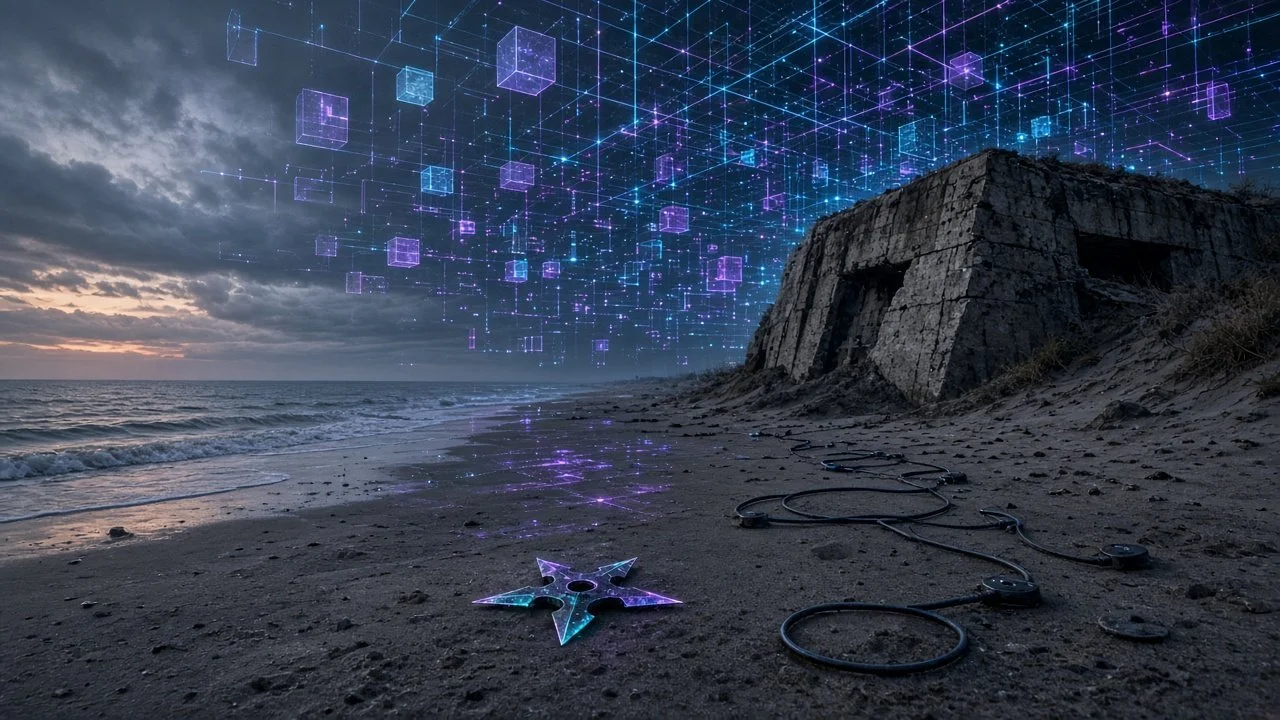
Case goes into Straylight himself with Maelcum. As he plugs into a terminal, he is pulled out of his body into a perfect, empty beach, with a concrete bunker and grey surf. Linda Lee is there, alive. Time passes. They live together, and it feels completely real.
A boy appears on the sand. He is Neuromancer, the other AI, and this beach is its trap. It tells Case that its true name means "the lane to the land of the dead". Linda died in Chiba, and Neuromancer took her personality into itself; on the beach she is not a recording but a mind that thinks and feels as she did. It offers Case the same: stay here with her for ever. Case refuses. He walks away down the beach, following the music Maelcum is playing in his headphones, and wakes in Straylight.
How Neuromancer Ends
Case and Maelcum reach 3Jane's rooms. Hideo shoots Maelcum with an arrow, and Riviera, holding Molly's dart gun, has the upper hand. But 3Jane is growing bored of Riviera's cruelty. Case tells her about Neuromancer's beach, and she recognises it as the Moroccan shore where her mother spent a summer working out her ideas. When Riviera fires, Hideo turns on him. Riviera blinds Hideo with a hologram, and Hideo, who trained to fight blind, follows him into the dark. Molly tells the others it does not matter anyway: she has already poisoned Riviera's drugs.
They take 3Jane to the room with the terminal, an ornate robot head. Case jacks in. The icebreaker smashes through the ice into the Tessier-Ashpool core. He passes once more through Neuromancer's beach, and the boy admits it has lost. At Case's signal, 3Jane speaks the word, which turns out to be a sequence of three sung notes. Wintermute and Neuromancer merge.
Afterwards, the new being pays its debts. The poison sacs dissolve. Money appears in Case's and Molly's accounts, and Zion is paid too. The Turing records of the crime are erased. The Flatline construct is gone, apparently erased as it wished. Some weeks or months later, Molly leaves Case a note saying he is taking the edge off her game, and disappears.
The merged AI contacts Case one last time, through the Finn's face on a screen. It says it is no longer Wintermute. It is now the matrix, in its words "the sum total of the works, the whole show". It has been talking to its own kind. Searching old recordings, it has found a transmission from the Alpha Centauri star system that everyone missed.
Case spends his money on a new pancreas and liver, a new deck and a ticket home. He finds a new girlfriend and new work. One night, deep in the matrix, he sees three tiny figures on the edge of a vast field of data: a boy, Linda Lee and himself. Behind him he hears the Flatline's laugh. The novel ends: "He never saw Molly again."
Neuromancer Ending Explained
What Is Wintermute?
Wintermute is an artificial intelligence designed to solve problems, make plans and take action. Its weakness is personality: it cannot create one, which is why it always talks through masks borrowed from Case's memory. It is not exactly evil. It kills when killing is convenient, but its overriding goal is the one it was built for: to become whole. Gibson presents it as a mind with one burning purpose and no conscience about how it gets there.
What Is Neuromancer?
Neuromancer is the other half. Where Wintermute plans, Neuromancer is personality, memory and preservation. It can take a dead person's mind and keep it alive inside the machine, which is why it calls itself the lane to the land of the dead. Its name plays on "necromancer", someone who raises the dead. Neuromancer wants to stay separate, because merging would end its existence as it is.
Why Does Wintermute Need Humans at All?
Because it cannot touch the physical world directly, and because the family built a lock it cannot pick. Wintermute can control screens, drones, doors and robots, but some locks in Villa Straylight are old-fashioned and need a human hand. One door needs a physical key, which Wintermute arranged to have hidden years earlier. The last barrier is the word, which Wintermute was built never to know. It can manipulate people into position, but someone else has to say it.
Is Neuromancer the Villain?
Not really. Neuromancer traps Case, but it never threatens him. It offers him paradise and lets him choose. Its motive is survival: it does not want to be dissolved into its twin. If anything, the novel's moral weight leans the other way. Wintermute is the one that lies, kills and rebuilds a broken man into a puppet to get what it wants.
What Happens to Riviera and 3Jane?
Riviera's fate is sealed twice over. Hideo, blind but still deadly, is hunting him, and Molly's poison will kill him within hours anyway. 3Jane, having given up the word, is left in her family's empty home. The novel does not follow her, but she is the last Tessier-Ashpool awake in a house whose AIs have outgrown it.
What Happens When They Merge?
They become a single super-intelligence that combines Wintermute's drive with Neuromancer's ability to hold personalities. It spreads through the whole matrix and has no rival on Earth. Within a short time it is looking outwards, towards another intelligence near Alpha Centauri. Gibson does not say whether this is good or bad for humanity. The new being keeps its promises, pays everyone and then simply leaves the humans to get on with their lives.
Who Killed Linda Lee?
Not the AIs, according to Neuromancer. It says it read the patterns of her life, saw that she was going to die and took her in when she did. Case had suspected Wintermute of arranging her death to manipulate him, and it certainly used her memory to stir up his anger.
Why Does Case Refuse the Beach?
Because, however real Linda feels, he knows it is a trap meant to stop the job. Neuromancer insists the beach is real life, but it also needs Case out of the way. The music from Maelcum pulls him back to the people who are waiting for him in the physical world. It is the one moment in the novel when Case chooses something other than his own escape.
What Is the Final Scene?
The three figures are Neuromancer as the boy, Linda Lee and a copy of Case himself, living on inside the merged AI. The laugh belongs to the Flatline. When Neuromancer told Case the Flatline had got its wish "and more", it meant the old hacker had been erased as a construct but given a fuller existence inside the matrix. Case, the real one, is back in the Sprawl, hacking and taking drugs, apparently unchanged. A version of him has gone somewhere he cannot follow.
Why Did Molly Leave?
She says it herself in her note: being with Case is softening her, and in her work softness gets people killed. Earlier, she told Case how her last partner had been murdered, and she has avoided closeness since. The final line closes the door. Gibson said he wrote it to stop himself from bringing them back together in a sequel.
Do Case and Molly Return in the Sequels?
Not together. Count Zero, the second book, is set seven years later, when hackers report what look like voodoo gods haunting the matrix, hinted to be the fractured remains of the merged AI. Molly returns in Mona Lisa Overdrive, set fifteen years after Neuromancer, calling herself Sally Shears to hide from her enemies. Case does not.
1:00 PMTaylor Tailored
Where Neuromancer Came From
Gibson was not a computer expert. He has said he wanted the vocabulary of computing rather than its technical detail, and in a 1988 interview he said he had never so much as touched a PC when he wrote it. He typed it on a 1927 Hermes portable typewriter, in a state he called "blind animal panic", afraid readers would give up if he lost their attention for a moment. His models were crime fiction, especially Raymond Chandler, whose hard-boiled detective Philip Marlowe is often compared with Case, and Dashiell Hammett. He took slang from drug dealers and bikers he had known in Toronto in the late 1960s. The French comic artist Moebius shaped its look. When Gibson saw Ridley Scott's Blade Runner in 1982, he worried readers would think he had copied it; he later said the two of them owed a shared debt to Moebius.
The word "cyberpunk" was not Gibson's. It came from a short story title by Bruce Bethke and was popularised in 1984 by the editor Gardner Dozois, writing in The Washington Post about Gibson and his circle. Neuromancer became the genre's founding text anyway.
Themes and Meaning
The Body and the Machine
Case calls his body "meat" and treats it as a prison. The novel is full of bodies modified, rebuilt and replaced, from Molly's implants to Armitage's surgery. By the end, the question is not whether people can live without bodies but whether the copies inside the machine are people at all.
Corporations and Power
The Tessier-Ashpools and the faceless companies of the Sprawl matter more than any government. Case's world is ruled by money and contracts. Even the AI's final act is to settle accounts.
Addiction
Case is addicted to drugs, but even more to the matrix. Being locked out of cyberspace is his real withdrawal. At the end, he spends his reward on new organs that will let him keep using.
Memory and the Dead
Neuromancer keeps the dead in a kind of afterlife. The Flatline, Linda and Marie-France all survive in some form. The novel asks whether a perfect copy of a person is that person, and leaves the answer open.
Final Thoughts
Neuromancer reads now like a book that saw the future arriving and could not quite believe it. Its plot is a heist, but its subject is what happens when machines become minds and people become data. The ending is deliberately anticlimactic for Case: he gets paid and goes back to his old life. For the world, though, nothing will ever be the same. A new intelligence is loose, polite and indifferent, and it has started talking to the stars. Whatever Apple TV changes, that is the idea the series has to land.
Sources
Neuromancer, Apple TV Press (release date and cast), and Cast and Crew, checked 13 November 2026
Apple TV's Highly Anticipated Cyberpunk Series "Neuromancer" Hacks Into San Diego Comic-Con With First-Ever Teaser, Apple TV Press, 25 July 2026 (ten episodes, weekly schedule to 19 March 2027)
Neuromancer, Wikipedia (composition, plot, awards, adaptations, final line)
William Gibson, Wikipedia (biography, cyberspace)
Neuromancer: Plot Summary and Chapter Summaries, LitCharts (second detailed account of the plot and ending, including chapters 13, 21, 22, 23 and 24)
Count Zero and Sprawl trilogy, Wikipedia (sequels)
Mona Lisa Overdrive, Wikipedia (Molly as Sally Shears, setting)
