The Workhouse, the Locket and the Secret Inheritance
A Workhouse Boy, a Locket at the Bottom of the River and the Secret a Stranger Called Monks Would Kill to Keep
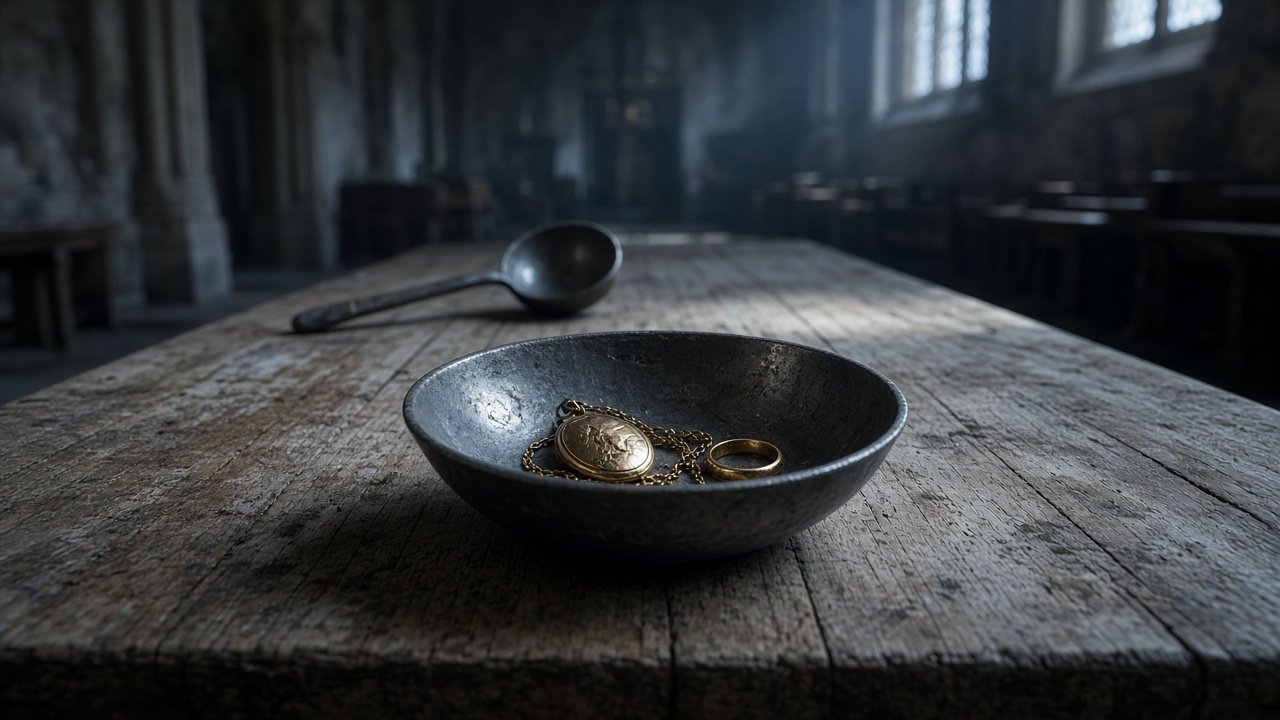
"Please, sir, I want some more." Nine-year-old Oliver Twist says it with a bowl in his hand, and the men who run his workhouse react as if he had started a riot. It is the most famous line Charles Dickens ever wrote, but the boy who asks for more is only the beginning. Oliver Twist is also a crime novel, a murder story and a mystery about who Oliver really is. Every December, when Dickens fills British television and the musical Oliver! fills theatres, readers come back with the same questions: what happens to Fagin, why Nancy has to die, and how a boy born in a workhouse turns out to have a family and a fortune. This guide sets out the essentials, then gives a clear spoiler warning, follows the story in order and explains the ending.
Key Terms for New Readers
Workhouse: a public institution where the destitute were housed and made to work in return for food and shelter. Families were split up, and the food was deliberately meagre.
Parish: the local area responsible for its poor. Oliver is a "parish boy", which means the parish paid for his upkeep.
Beadle: a minor parish official. Mr Bumble is the beadle, and he takes himself very seriously.
Gruel: a thin porridge of oats boiled in water. It is the workhouse boys' main food.
Fence: someone who buys and sells stolen goods. Fagin is a fence, as well as a trainer of child thieves.
Transportation: a sentence that shipped convicts to penal colonies, by this period mainly in Australia, often for life.
Newgate: London's main prison, next to the Old Bailey, the central criminal court. Condemned prisoners were held there before execution.
Pounds and guineas: British money. A guinea was a pound and one shilling. The fortunes in this novel run to thousands of pounds, a huge sum at the time.
The Characters You Need to Know
Oliver Twist: an orphan born in a workhouse, gentle and honest whatever happens to him.
Mr Bumble: the pompous parish beadle who names Oliver and later marries Mrs Corney, the workhouse matron.
Mr Sowerberry: an undertaker who takes Oliver as an apprentice.
Noah Claypole: Sowerberry's older apprentice, a bully and a coward.
The Artful Dodger (Jack Dawkins): a cocky young pickpocket who brings Oliver to London.
Charley Bates: another of Fagin's boys, always laughing.
Fagin: an old receiver of stolen goods who trains boys to steal.
Bill Sikes: a violent housebreaker, with a dog called Bull's-eye.
Nancy: a young woman raised in Fagin's gang, and Sikes's partner.
Mr Brownlow: a kind, elderly gentleman, and his friend Mr Grimwig, a contrarian who keeps offering to "eat my head".
Mrs Maylie and Rose Maylie: a wealthy widow and the gentle 17-year-old she has brought up as her niece.
Harry Maylie: Mrs Maylie's son, who loves Rose.
Monks: a sinister stranger with a secret interest in Oliver.
The Boy Who Asked for More
Oliver is born in a workhouse in an unnamed town about 70 miles from London. His mother, a young woman found lying in the street, kisses him and dies. Nobody knows her name. An old pauper nurse called Sally is the only witness, and she quietly takes something from the dead woman's body.
The baby is named by Mr Bumble, who boasts that he invents names in alphabetical order. The last foundling was Swubble, so this one is Twist, and the next will be Unwin. Oliver spends his first nine years at a "branch-workhouse", a baby farm run by Mrs Mann, who keeps most of the allowance meant for the children. Then he is taken back to the workhouse itself.
There the boys are slowly starving. They draw lots to decide who will ask for more, and Oliver loses. After supper he walks up to the master and says the famous line. The master hits him with the ladle, Bumble raises the alarm, and the board of guardians, the officials who run the workhouse, decide the boy will be hanged one day. They post a notice offering five pounds to anyone who will take him off their hands.
The Undertaker's Boy
After narrowly escaping an apprenticeship to a brutal chimney sweep, Oliver is sent to Mr Sowerberry, the undertaker. His sad face makes him a perfect "mute", a professional mourner who walks in front of children's funerals. Noah Claypole, the older apprentice, is jealous, and one day he insults Oliver's dead mother. Oliver, who has never fought back against anything, flies at him and knocks him down. He is beaten and locked up, and at dawn he runs away. A milestone tells him that London is 70 miles off, and he walks there.
Fagin's Den
Outside London, half starved, Oliver meets a swaggering boy in a man's coat: Jack Dawkins, the Artful Dodger. The Dodger feeds him and leads him through the slums of Saffron Hill, near Field Lane, to a filthy room where an old man is cooking sausages over a fire. This is Fagin.
Fagin is sly and endlessly polite, calling everyone "my dear", and gloats over a box of stolen jewellery when he thinks Oliver is asleep. He runs a school for thieves, teaching the boys to pick pockets through a game in which they lift handkerchiefs from his coat without his noticing. Oliver thinks it is a game, and Fagin does not correct him.
Caught
The first time Oliver goes out with the Dodger and Charley Bates, he watches them take a handkerchief from an old gentleman at a bookstall in Clerkenwell. Horrified, he runs. The crowd assumes he is the thief and chases him down. At a police office, the bullying magistrate Mr Fang is about to sentence him when the bookstall owner arrives to say the boy is innocent.
The old gentleman is Mr Brownlow, and he takes the feverish Oliver home. For the first time in his life, Oliver is cared for. In Brownlow's house hangs a portrait of a young woman, and Oliver cannot stop looking at it. Brownlow and his housekeeper notice that the boy's face is almost a copy of hers.
Taken Back
Fagin is terrified that Oliver will lead the police to him. He sends Nancy, posing as Oliver's distraught sister, and Bill Sikes to get him back. When Brownlow trusts Oliver to return some books and money to the bookseller, his friend Grimwig bets that the boy will run off. Oliver is snatched in the street and dragged back to Fagin, and Brownlow and Grimwig sit waiting for him in the dark with a watch on the table between them.
Back at the den, Fagin tries to beat Oliver, and Nancy, to everyone's surprise, defends him, screaming at Fagin that she was stealing for him when she was half Oliver's age.
The Burglary at Chertsey
Fagin lends Oliver to Sikes for a burglary at a large house at Chertsey, then a country town on the Thames west of London. Oliver is small enough to be pushed through a window and open the door from inside. He plans to wake the household instead, but the servants wake first. Shots are fired, Oliver is hit in the arm, and Sikes drags him away, then leaves him in a ditch.
Oliver crawls back to the only shelter he can see, which is the house he was meant to rob. It belongs to Mrs Maylie. She and Rose, along with the hot-tempered family doctor Mr Losberne, hear his story and decide to protect him. Rose later falls dangerously ill and recovers. Harry Maylie, her cousin by upbringing, asks her to marry him, but Rose refuses. There is a "stain" on her birth: she is an orphan of unknown parentage, and she will not damage his prospects in the world.
The Stranger Called Monks
Meanwhile a strange man has begun to haunt Fagin. He calls himself Monks. He is dark, nervous and prone to violent fits, and he wants Oliver turned into a criminal and, ideally, ruined or hanged. He is furious that Fagin let him slip.
Back at the workhouse, Old Sally is dying. She confesses to the matron, Mrs Corney, that she stole a gold locket and a ring from Oliver's mother. Mrs Corney finds the pawnbroker's ticket. Soon afterwards she marries Mr Bumble, and he finds out that marriage puts her firmly in charge. Monks seeks out the Bumbles, pays them for the locket, which contains two locks of hair and a wedding ring engraved with the name "Agnes", and drops it through a trapdoor into the river. The proof of Oliver's identity seems to be gone for good.
12:57 PMTaylor Tailored
Nancy's Choice
Nancy overhears Monks telling Fagin the truth: he is Oliver's half-brother, he has destroyed the evidence, and he wants Oliver ruined so that he can keep their father's money. Nancy drugs Sikes with laudanum, slips out and goes to a West End hotel to tell Rose Maylie everything.
Rose begs her to leave the gang and accept help. Nancy refuses. She says she cannot leave Sikes, and it is one of the most painful passages in the book: "I am drawn back to him through every suffering and ill usage; and I should be, I believe, if I knew that I was to die by his hand at last." She agrees to meet Rose again. "Every Sunday night, from eleven until the clock strikes twelve," she says, she will walk on London Bridge.
The Meeting on London Bridge
By now Noah Claypole has robbed his master and fled to London with Charlotte, the Sowerberrys' maid. Calling himself Morris Bolter, he falls in with Fagin. Fagin, who has noticed Nancy's restlessness, sets him to follow her.
On a Sunday night Nancy meets Rose and Mr Brownlow on the steps below London Bridge. Noah hides in the shadows and hears every word. Nancy describes Monks, including a broad red mark on his throat. Brownlow recognises the description. Nancy refuses, again, to betray Sikes or the others. She explains that they have kept faith with her, bad as they are, and that she will not turn on them. Brownlow offers her a safe home abroad, and she turns it down. Rose gives her a white handkerchief as a keepsake. Nancy goes back.
The Murder of Nancy
Noah reports to Fagin. Fagin waits up all night, consumed with rage, and when Sikes arrives before dawn he makes Noah repeat what he heard. He tells it so that Sikes hears only betrayal. Nancy had in fact refused to give Sikes up, but Fagin does not say so. As Sikes leaves, Fagin warns him only not to be "too violent for safety".
Sikes goes home and kills Nancy. Dickens shows her pleading for her life, telling Sikes she has been true to him and begging him to leave London with her and start again. Sikes strikes her with his pistol, so that a shot will not bring the neighbours, then with a heavy club. As she dies, she holds up Rose's white handkerchief, "Rose Maylie's own", and prays.
The Flight of Sikes
Sikes runs. He wanders the fields north of London, followed by his dog, and finds he cannot escape the memory of Nancy's eyes. He tries to drown Bull's-eye, who might give him away, but the dog escapes.
Sikes finally hides with Toby Crackit and others at Jacob's Island, a crumbling slum across the river in Bermondsey, surrounded by a muddy tidal ditch. Charley Bates, appalled by the murder, attacks him and shouts for help. A huge crowd gathers, led by Brownlow, who offers fifty pounds to the man who takes Sikes alive. Sikes climbs onto the roof with a rope, planning to lower himself into the ditch. As he slips the noose over his head to put it under his arms, he looks behind him, cries "The eyes again!", loses his balance and falls. The noose catches round his neck and hangs him. Bull's-eye leaps for his master's body, misses and is killed in the fall.
Who Oliver Really Is
At the same time Mr Brownlow has Monks seized and brought to his house, and forces the truth out of him. It all comes together.
Monks's real name is Edward Leeford. His father, Edwin Leeford, was Mr Brownlow's oldest friend. Forced into an unhappy marriage, Edwin separated from his wife and later fell in love with Agnes Fleming, the young daughter of a retired naval officer. He gave her the locket and the ring, promised to marry her, and then fell ill and died in Rome before he could. His estranged wife destroyed his will.
Under that will, Edwin left his wife and Monks an annuity of £800 a year each. The rest of his fortune was to be divided between Agnes and their child. If the child was a boy, he would inherit only if, while still a minor, he never "stained his name with any public act of dishonour, meanness, cowardice, or wrong". That is why Monks wanted Oliver turned into a thief: a criminal record would hand the money to him. The portrait in Mr Brownlow's house was of Agnes.
Agnes, pregnant and disgraced, ran away and died giving birth to Oliver in the workhouse. Her father fled in shame to Wales with his younger daughter, changed his name and died soon afterwards. The little girl was taken in by poor cottagers, and then adopted by Mrs Maylie. She is Rose. Rose Maylie is Oliver's aunt.
The Bumbles are confronted and lose their positions. Rose, now able to accept Harry, finds that he has given up his political ambitions to become a country clergyman, so there is no grand world left for her to embarrass. She says yes.
Fagin's Last Night Alive
Noah turns King's evidence, testifying against Fagin in return for a pardon, and Fagin is arrested. At his trial at the Old Bailey he hears the jury's verdict, "Guilty", and the crowd outside cheers the news that he will die on Monday.
The next-to-last chapter is called "Fagin's Last Night Alive", and Dickens writes it from inside the condemned man's head. In his cell at Newgate, Fagin counts the hours, remembers the men he has seen hanged, some of them through his own doing, and drives away the religious men of his own faith who come to pray with him. He sinks into terror and confusion.
Mr Brownlow brings Oliver to the cell, because Fagin has papers that prove Oliver's identity. Fagin whispers where they are: "in a canvas bag, in a hole a little way up the chimney in the top front-room". Oliver begs him, "Let me say a prayer," but Fagin is past hearing, and pleads with the boy to help him escape. They leave him screaming. Outside, the crowd is already gathering and the scaffold is being built.
How Oliver Twist Ends
The final chapter ties up every life. Rose and Harry marry in the village church where he is the new clergyman. When Monks's remaining property is divided, Oliver gives his half-brother a second chance: on Mr Brownlow's suggestion, each gets "little more than three thousand pounds", although the will entitled Oliver to all of it. Monks goes to America, squanders his share, returns to crime and dies in prison.
Mr Brownlow adopts Oliver as his son and moves within a mile of the parsonage. Mr Losberne and Mr Grimwig settle nearby. Noah becomes a paid informer. The Bumbles end as paupers in the same workhouse they once ruled. Charley Bates goes straight and becomes "the merriest young grazier in all Northamptonshire".
The novel's last image is a white marble tablet in the village church that bears a single word: "AGNES." There is no coffin beneath it. The narrator says he believes her spirit sometimes visits it, even though it is in a church and she was "weak and erring".
Oliver Twist Ending Explained
What Happens to Fagin at the End?
He is hanged. Strictly, the novel stops just before the execution: Fagin is sentenced to death at the Old Bailey, Oliver and Mr Brownlow visit him in the condemned cell at Newgate the night before, and the book leaves the crowd gathering at dawn. He is convicted with the help of Noah Claypole's evidence.
Dickens does not let readers enjoy it. "Fagin's Last Night Alive" is closer to horror than to triumph, and the old man's terror makes him pitiful. The chapter makes readers sit with a condemned man rather than cheer his end.
Why Does Fagin Tell Oliver Where the Papers Are?
The book does not fully explain it, and Fagin barely seems to know what he is doing by then. Brownlow has come for the papers Monks left with him, which prove Oliver's parentage. Fagin pulls Oliver close and whispers where they are hidden, but in the same breath he begs Oliver to smuggle him out, so it is not a confession of conscience. The best reading is that he is half mad with fear, clutching at the one person who might pity him.
Why Does Nancy Die?
Because she betrays Monks and Fagin to save Oliver, and Fagin makes Sikes believe she has betrayed him. The tragedy is in the gap. Nancy refused to hand over Sikes. Noah heard that. Fagin chose not to tell him.
On a deeper level, Dickens kills Nancy because she cannot be saved by kindness alone. Rose and Brownlow offer her a new life, and she turns it down out of loyalty to the man who will kill her. Dickens defended her in his 1841 preface against critics who found her unbelievable, insisting "IT IS TRUE" that such women exist. Nancy is the novel's proof that goodness can survive in the worst places, and its warning about what those places do to people. Her murder is also what destroys the gang. Sikes is hunted down because of it, Charley Bates turns honest because of it, and Fagin hangs because of it.
Who Is Oliver's Real Family?
His mother was Agnes Fleming, the daughter of a retired naval officer, and his father was Edwin Leeford, a gentleman of property and Mr Brownlow's old friend. They never married, so in the eyes of Victorian law Oliver was illegitimate. Monks is his older half-brother. Rose Maylie is Agnes's younger sister, which makes her Oliver's aunt, and Mr Brownlow becomes his adoptive father.
Why Did Monks Want Oliver to Become a Criminal?
Because of the will. Oliver could inherit only if he kept his name clean of any "public act of dishonour", so Monks needed him convicted. That is why Monks paid Fagin to keep Oliver in the gang, and why he would rather see Oliver ruined than simply dead.
What Happens to the Artful Dodger?
He is caught with a stolen silver snuff-box and, in one of the funniest scenes in the book, treats the court with outrageous contempt. He is committed for trial, and Fagin expects him to be transported for life. The last chapter says only that the chief remaining members of Fagin's gang died far from home.
Does Oliver Get a Happy Ending?
Yes, and a deliberately fairy-tale one: a home, a father, an aunt, a fortune and a quiet life in the country. Critics have long pointed out that Oliver is rescued by birth and luck as much as by goodness: he is a gentleman's son all along, and speaks perfect English despite his upbringing. Dickens wanted readers to see how a good child could survive the worst of England, but the plot quietly suggests that most children in Oliver's position, without a lost inheritance, would not.
12:57 PMTaylor Tailored
Fagin and Antisemitism: What Readers Should Know
Any honest account of Oliver Twist has to deal with Fagin. In the novel as first published, Dickens repeatedly calls him "the Jew", and Fagin is one of the most notorious antisemitic caricatures in English literature, a miserly, scheming criminal built on old stereotypes.
Dickens was challenged on it. In 1863 Eliza Davis, whose husband, the Jewish banker James Davis, had bought Dickens's London house, wrote to him that Jews regarded his portrayal of Fagin as a great wrong to their people. Dickens first defended himself, replying that Fagin was Jewish because "that class of criminal almost invariably was a Jew" at the time the story was set. Davis wrote back. In the edition of 1867, which was being reset as they corresponded, Dickens removed most of the references to Fagin as "the Jew" from the later chapters, and changed the title of the condemned-cell chapter from "The Jew's Last Night Alive" to "Fagin's Last Night Alive". Many modern editions, including the Project Gutenberg text, follow that revision, though the early chapters still use the label constantly. His later novel Our Mutual Friend includes Riah, a deliberately sympathetic Jewish character.
The caricature has followed the character into adaptations. David Lean's 1948 film gave Alec Guinness exaggerated prosthetic make-up, and its US release was delayed until 1951 after protests. The musical Oliver! softened Fagin into a comic rogue, and Ron Moody, who played him in London and in the 1968 film, was himself Jewish. None of this cancels the book's achievement, but it is part of how the book should be read.
The Book vs Oliver!
Lionel Bart's Oliver! opened in London in 1960, and the 1968 film directed by Carol Reed won six Academy Awards, including Best Picture. It changes the ending in important ways. Monks's plot is cut, so the mystery of Oliver's birth is much simpler. Fagin has no part in Nancy's death, and he is not arrested or hanged. The stage show ends with him wondering whether to go straight, while the film sends him off with the Dodger to start again. Nancy's murder is moved to London Bridge, and Sikes is shot rather than hanged.
The changes make a warmer family show but remove the book's sense of consequence. In Dickens, Fagin's choices kill Nancy, and he pays for them.
Themes and Meaning
Poverty and Institutions
The opening chapters are satire with a purpose. The board of guardians are well fed and convinced that the poor are poor through their own fault. Mr Bumble, who boasts of his position, ends as a pauper in his own workhouse. When told that the law presumes his wife acts under his direction, he replies with the novel's most quoted line about justice: "the law is a ass—a idiot".
Goodness That Cannot Be Corrupted
Oliver is not meant to be complex. He passes through the workhouse, the undertaker's shop and Fagin's den without becoming any of them, which is the point Dickens makes in his preface: he wanted to show "the principle of Good surviving through every adverse circumstance".
Crime Without Romance
Dickens set out to show thieves as they really were, not as dashing highwaymen. The Dodger is funny, but Sikes is brutal, Fagin is cowardly and Nancy's life is wretched. Crime in this novel leads to Newgate, the gallows or a rope over a ditch.
Family and Inheritance
Oliver's real story is a search for family. The book that begins with a boy who has no name ends with a single name on a church wall, his mother's.
Final Thoughts
Oliver Twist is remembered for a bowl of gruel, but it ends with a gravestone and a hanging. That is its power: Dickens begins with a social pamphlet and turns it into a thriller in which every kindness and every cruelty has a cost. Oliver is saved by a family he never knew he had. Nancy, who saves him, is not saved at all, and the novel never pretends otherwise. That is why the line Dickens gave her, about being drawn back to the man who would kill her, still lands harder than "Please, sir, I want some more."
Sources
Oliver Twist, Charles Dickens, Project Gutenberg #730 (quotations and plot details checked against the text)
Martin Freeman and Jim Broadbent star in a Dickensian Ghost Story for Christmas 2026 for BBC Arts, BBC Media Centre, 5 October 2026 (The Read with Caroline Quentin; December Dickens programming)
BBC Arts announces major new series on Charles Dickens for the National Year of Reading 2026, BBC Media Centre, 18 March 2026
The Tales of Charles Dickens, BBC (2007 Oliver Twist collection listing)
Oliver! at the Gielgud Theatre, Delfont Mackintosh Theatres (booking until 14 March 2027; Christmas schedule)
Letters 'caused rewrite of Fagin', BBC News, 22 December 2004 (Eliza Davis letters; 1867 revisions)
Eliza Davis's letters to Charles Dickens, eScholarship, University of California (Dickens's 10 July 1863 reply)
Is Fagin antisemitic?, The Jewish Chronicle (1867 reprint; Riah; the 1948 film)
Fagin, Wikipedia (portrayal, revisions, adaptations)
Oliver!, Wikipedia (musical history and changes; 1968 film)
Oliver Twist, 1861 James G. Gregory edition, with Dickens's preface, Internet Archive (preface quotations)
The Making of Oliver Twist, Simon Callow, editor's note, spbooks.com (preface; Nancy)
