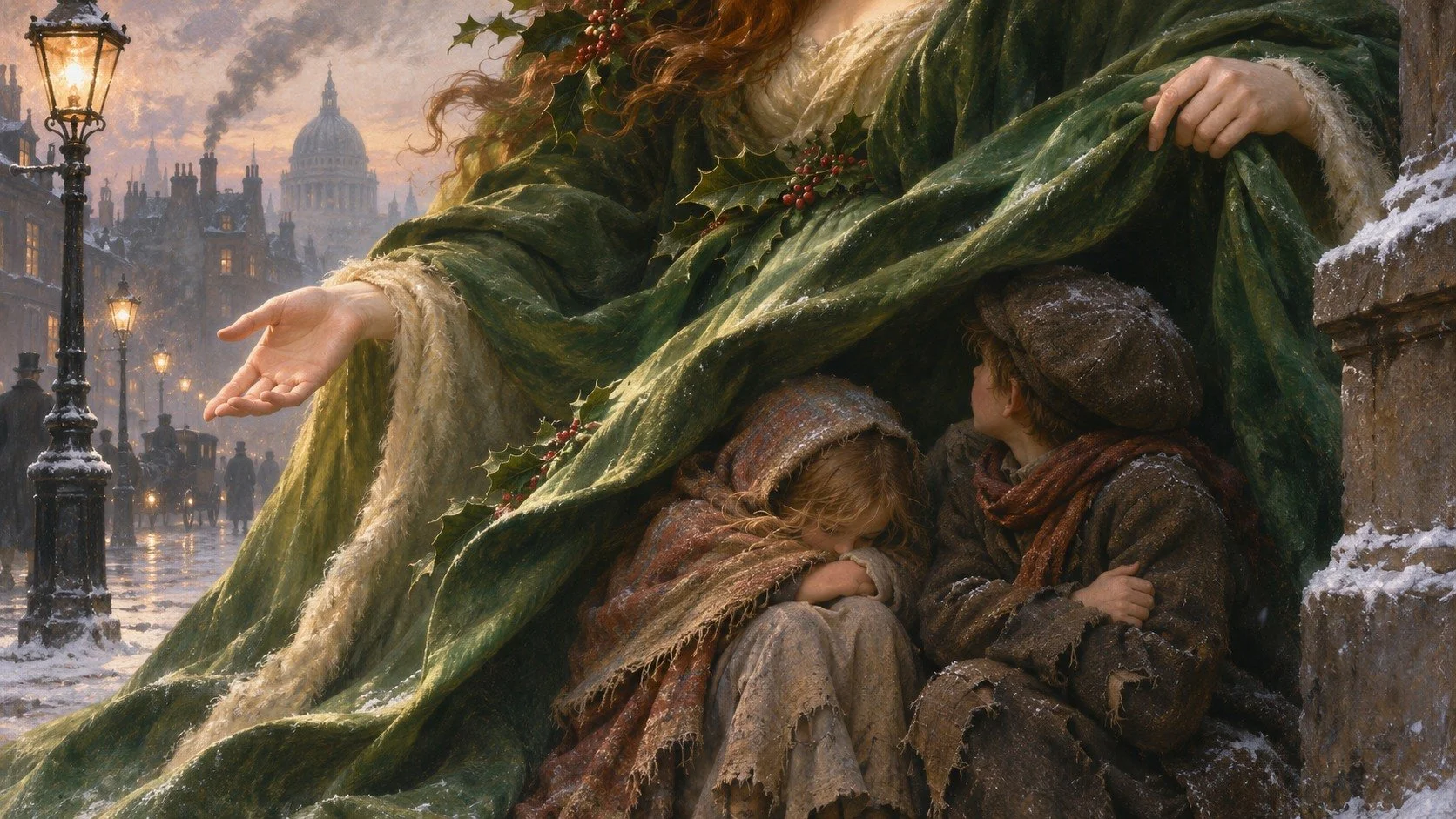
Stave Three, Ghost of Christmas Present, Tiny Tim, Scrooge
Why Does the Ghost of Christmas Present Have Children Under His Robe?
Near the end of Stave Three, Scrooge notices something projecting from beneath the Spirit’s garment. He cannot at first tell what kind of creature it belongs to. The Ghost opens his robe and reveals a boy and a girl. The boy is Ignorance. The girl is Want. They are the most frightening children in A Christmas Carol, though nothing in the scene suggests either child has done anything wrong.
Dickens places them beside the figure most closely associated with warmth and plenty. The Ghost of Christmas Present first appears surrounded by food, light and greenery. He can enter a poor home and make its hospitality visible to a man who would previously have measured the occasion by its expense. When he opens the robe, the reader discovers what else has accompanied this generous spirit through the night. The children have been close enough to touch throughout the celebration.
Spoilers follow for Staves Three to Five, including the way Scrooge responds to what the spirits show him.
What Do Their Names Mean?
Want here means deprivation, the condition of lacking the necessities of life. Modern readers often use the word to describe a desire for something extra. Dickens gives it the older force that survives when we say a family is in want. The girl represents what it means to grow up without enough food, shelter, care or resources to flourish. Her body supplies the evidence behind the abstract noun.
Ignorance includes the consequences of being denied knowledge and education. It also invites a question about who has failed to learn. Scrooge has money, business experience and a remarkable capacity to calculate what another person costs. He has learnt very little about how people whose labour supports his world actually live. In that sense the boy’s name describes something in the observer as well as a deprivation inflicted upon the observed.
The Ghost describes the children as belonging to humanity. The claim of kinship is uncomfortable because Scrooge’s first impulse is to ask whether they belong to the Spirit. That question would place responsibility safely inside the supernatural world. The reply returns it to the human beings who created the conditions the children embody. Scrooge has asked, in effect, where the responsible adult is. The answer includes him.
Why Reveal Them at the End of the Spirit's Visit?
Stave Three first teaches Scrooge how to look sympathetically. He visits the Cratchits, where a modest dinner occupies the family’s full attention and an ordinary household object or gesture can take on enormous importance. He sees his nephew Fred making room in conversation even for an absent uncle who has done little to merit affection. The visits widen his range of sympathy through particular voices, jokes and habits.
The two children arrive after those pleasures have done their work. It would have been easier to pity the Cratchits and stop there. An affectionate family can attract a wealthy observer’s generosity while leaving his larger view of poverty undisturbed. The children under the robe have no charming family history to tell, no festive meal to share and no opportunity to demonstrate gratitude. Scrooge must look at them without the inducements that helped him care for Tiny Tim.
The Spirit’s own time is nearly over. He ages as Christmas Day passes. Scrooge has become attached to a guide who cannot stay and explain indefinitely. The appearance of the children at the edge of midnight changes the pace of the lesson. There is just enough time to ask a question and receive an answer in a voice Scrooge ought to recognise. Then the visitor who could have answered another question is gone.
Why Is Ignorance the Greater Warning?
The Ghost warns Scrooge to beware of both, particularly the boy. A threat of doom is legible on his brow unless its inscription can be erased. The conditional matters. Dickens is presenting a future that people have helped write and can still alter. A prophecy of inevitable ruin would sit awkwardly inside a story in which one of the great dramatic questions is whether a person can change the ending.
There are several grounds for the greater warning. Denial of education can close opportunities long after a hungry child has been given one meal. A society that refuses to understand how poverty is produced may repeat the policies that intensify it. And ignorance among comfortable adults can prevent them from recognising the significance of either child. These meanings can coexist. The text gives readers a hierarchy of danger without offering a single policy prescription that exhausts its meaning.
There is a temptation to interpret the boy as a warning that poor children may become dangerous adults. Victorian anxieties about disorder certainly give the image some of its menace. But the Spirit’s assignment of responsibility complicates that reading. The child did not inscribe the warning on his own forehead. Scrooge and the reader are asked what sort of society produces the danger it then recoils from.
Why Do the Children Look So Frightening?
Dickens frustrates a familiar literary convention. A suffering child often appears beautiful enough to make sympathy effortless. Here Scrooge begins an attempt at the conventional compliment and cannot finish it. The words he might ordinarily use for children will not fit what he sees. His failed politeness is part of the scene’s moral action. For once he cannot speak acceptably and avoid the truth at the same time.
The children are also described through signs of premature age and animal-like appearance. Read carelessly, those details can sound as if the narrator shares a contemptuous view of the very people he wants us to help. Look closely at the direction of the transformation. An expected childhood has been damaged. The horror attaches to what has been done to children, and the reader’s recoil becomes part of the problem under examination.
Dickens uses the robe almost like a theatre curtain. The Spirit does not take Scrooge to another remote corner of the city. He uncovers what is present in the same field of vision as festive abundance. A staging that places the children at the other end of the theatre would create distance at exactly the moment Dickens chooses proximity. Scrooge must revise his understanding of the figure standing directly in front of him.
Why Does the Spirit Repeat Scrooge’s Words About Prisons and Workhouses?
When charitable visitors approach Scrooge early in the novella, he points to existing institutions. His questions about prisons and workhouses allow him to treat the payment of public costs as sufficient reason to refuse a personal appeal. The vocabulary makes him sound informed. He knows which institutions exist. He has made little effort to learn what it means for another person to depend on them.
At the sight of the children, Scrooge asks whether help or refuge is available. The Ghost returns his own questions. The words have scarcely changed. Their audience has. Scrooge hears the answer from the side of somebody who has seen a need and is asking for it to be met. An argument that once felt brisk and economical now sounds appallingly inadequate.
The device is sharper than an explanatory speech. If the Ghost simply announced that the old Scrooge was cruel, the new Scrooge could agree and move on. Hearing the old words forces him to recognise a continuity between the two men. He cannot claim to have been misunderstood. His words meant exactly what they appear to mean when somebody else says them back.
Why Put This Revelation Before the Ghost of Christmas Yet to Come?
The arrangement helps distinguish two kinds of fear. Ignorance and Want show Scrooge what already exists around him. The last spirit shows him a future he has reason to believe could follow if he continues as he is. A reader who confuses the two might imagine that all the suffering in the book is hypothetical and that Scrooge’s conversion makes it disappear. The children are encountered in the present tense. Their need survives his awakening.
The transition also changes who must supply the words. The Ghost of Christmas Present can identify the figures and return Scrooge’s own language to him. The final visitor is silent. Scrooge has to interpret gestures and ask questions whose implications he would formerly have avoided. By placing the children at the boundary, Dickens gives him a last explicit lesson before leaving him to work out the consequences.
There is a useful test for any reading of the scene. Try imagining Dickens had named the children Misfortune and Hunger. The names would still call for pity, but the question of what comfortable adults fail to understand would be much less urgent. Ignorance is a word Scrooge could apply to himself once he has learnt to see what his confident talk concealed. That possibility gives the boy a reach beyond the particular social conditions in which Dickens first placed him.
How Do They Differ From Tiny Tim?
Tiny Tim has a family, a voice and a particular place at the table. Readers learn how much he matters by seeing how others speak about him. Ignorance and Want have allegorical names, no individual histories and almost no independent action. Their anonymity lets Dickens move from the fate of one loved child to conditions that affect children Scrooge will never personally meet.
The contrast is also a test for the reader. It is easy to hope that Scrooge will give Bob Cratchit a raise because we have spent Christmas with Bob’s family. What do we think should happen to the children whose homes we have never entered? A benefactor choosing a favourite household can change a life. The Ghost’s warning makes it harder to mistake that gift for a comprehensive answer to deprivation.
By the final stave Scrooge gives money, improves Bob’s circumstances and becomes a lasting presence in Tiny Tim’s life. Dickens does not bring the allegorical children back to display clean faces and new clothes. That would offer a satisfaction the plot has not earned. Scrooge can change his conduct within a morning. The conditions embodied under the robe require more people to change, and to keep changing what they do.
That is why the moment can disturb a reader who knows the ending by heart. We know Scrooge will wake up. We know the turkey will arrive. We even know what happens to Tiny Tim. The fate of the other two children is still open when we close the book. In giving them names every generation can recognise, Dickens leaves the reader among the people responsible for what happens next.
Sources
The Project Gutenberg eBook of A Christmas Carol, by Charles Dickens — The full novella gives the wording and the surrounding visits.
A Christmas Carol (Dickens, 1843)/Stave 3 - Wikisource, the free online library — The third stave in an edition based on the 1843 publication.
School Radio — A performance adaptation provides another way to hear the Spirit’s warning.
Next Reads
Why Does Jacob Marley Wear Chains in A Christmas Carol? What Dickens Put on Them and Why — Explore another object that makes responsibility visible.
A Christmas Carol Summary — Place the children in the full sequence of the novella.
Ozymandias Explained: Why Shelley’s Fallen King Still Speaks to Us — Compare another writer’s warning about power.
