How Long Is Scrooge’s Invisible Chain?
Why Does a Ghost Drag His Office Through Scrooge’s Front Door?
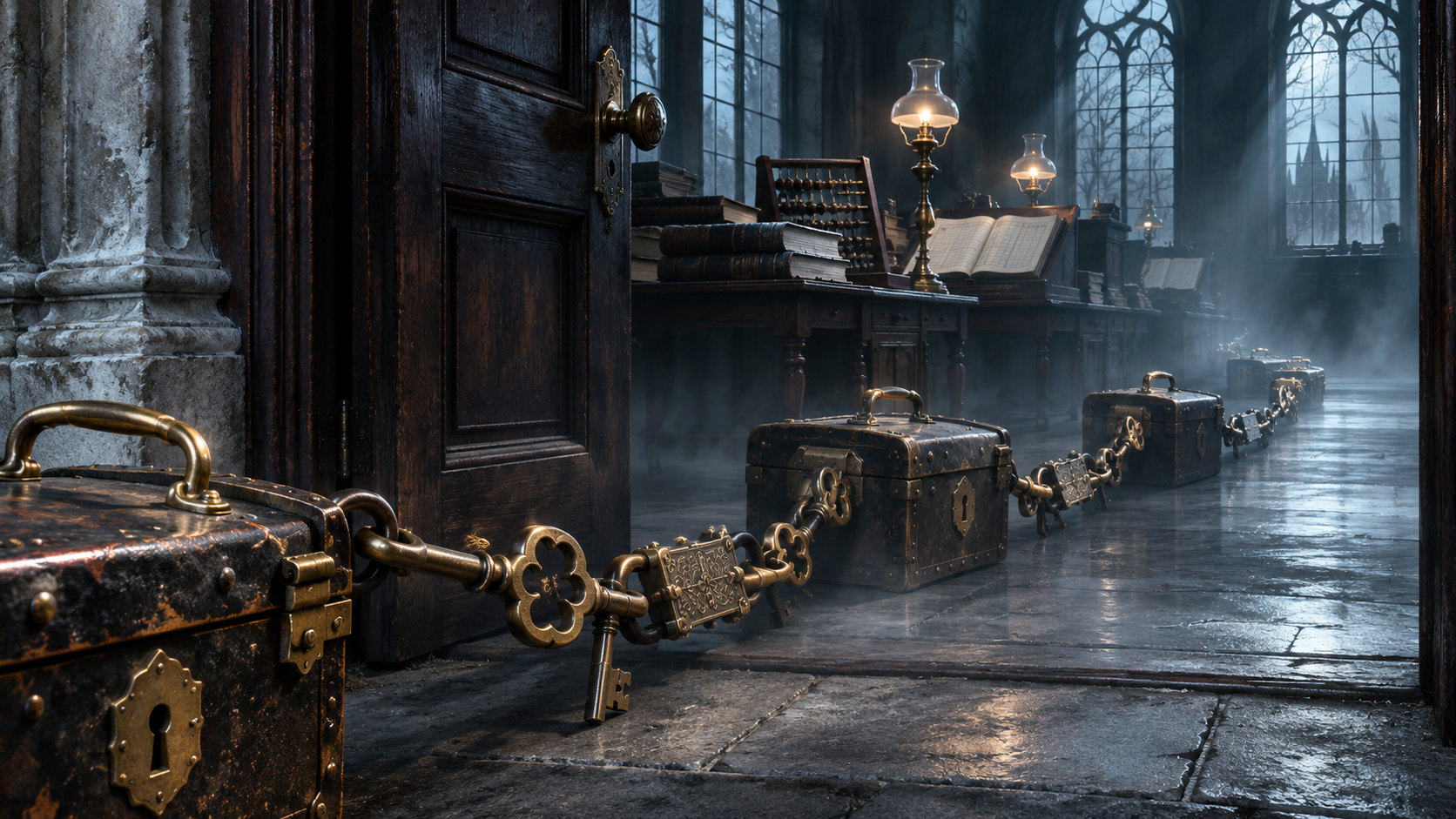
Look at what is hanging from Jacob Marley’s chain. There are cashboxes and keys, padlocks, ledgers, deeds and heavy purses. Charles Dickens could have fastened his ghost to an anonymous length of prison iron. Instead he equips Marley with objects a man of business might once have arranged within arm’s reach. Death has altered their position. The possessions that once moved at his direction now determine how he moves.
Marley says he made the chain himself during his lifetime. Each link was a choice, though apparently an ordinary enough choice to escape notice at the time. That is the terrible piece of information he brings to Ebenezer Scrooge on Christmas Eve. A chain need not announce itself while it is being made. A man can pick up a key, close his ledger and go home entirely satisfied with another productive day.
Why Does Dickens Insist That Marley Is Dead?
The opening of A Christmas Carol labours the point almost comically. Marley’s death was witnessed, certified and accepted. Scrooge knew it better than anybody. The narrator wants the reader to concede a fact on something like commercial terms before admitting an event that no commercial instrument could explain.
This gives the ghost a special kind of credibility for Scrooge. A stranger from heaven might preach about charity, and Scrooge could dismiss him as someone who had never had to meet a bill. Marley knows the counting house. He handled the same kinds of property, inhabited the same routines and once saw the world from much the same desk. The warning comes from the one man whose judgement Scrooge would previously have been prepared to trust.
The name over the business also survives. Scrooge has not troubled to remove Marley from the sign, and he answers to either name. That small comic detail does sinister work once the chain appears. It suggests that a stranger could confuse the partners without making much practical difference. For Scrooge the urgent question becomes whether he and Marley remain interchangeable after one of them has died.
What Is Each Object Doing on the Chain?
A cashbox protects money. A key grants or withholds access. A padlock makes a decision to exclude somebody physically effective. The first objects on Marley’s chain concern possession and control. Their useful qualities have survived the transformation. Iron still shuts and weighs. What has disappeared is the comfortable assumption that Marley is the person on the advantageous side of the lock.
Ledgers make a different contribution. A set of accounts preserves distinctions between sums owed, sums received and balances outstanding. It permits a merchant to know a great deal about another person without knowing how that person lives. The limitation belongs to the use Marley made of his books. Accounts can also reveal a shortfall that needs remedying or a worker who has been underpaid. The ghost’s error was allowing the account to exhaust his interest in the human being.
Deeds bring property rights into the procession. A piece of paper can settle who possesses land, who may occupy a building and who gets an income from it. A purse brings the list back to money carried close to the body. Seen separately, these objects look ordinary. Attached end to end, they amount to an entire account of what a life was for. Dickens makes the inventory do the work another writer might have assigned to a sermon.
Imagine replacing all six with gold coins. The result would signify wealth but lose an important distinction. A man can have little cash in his pocket while exercising power through contracts, credit and property. Marley’s chain represents the machinery through which he conducted his affairs. That is why Scrooge, prosperous but personally frugal, has every reason to be frightened by it.
Who Forged the Links?
Scrooge asks about the chain as if somebody must have placed it upon his partner as a punishment. Marley’s answer puts the agency back into his own hands. He forged it in life and wore it by choice. The image does not require a supernatural jailer to invent a suitable penalty after looking through his record. His record already has a shape.
Think about the verb forge. A chain is not ordinarily made in one spectacular gesture. Each link has to be formed, joined and closed. A habit can accumulate in the same manner. The occasion when a person refuses help may feel minor beside the occasions when wars or governments determine what happens to whole populations. Repeat that refusal for a working lifetime and it becomes a durable way of conducting oneself.
The frightening extension concerns Scrooge’s own chain. His partner has been dead seven years. Scrooge has continued working. An invisible object can therefore have become longer while the living man congratulated himself on the growth of quite different totals. The warning is recognisable to anyone who has once tried to change a settled habit. Every previous repetition makes the next one easier, until behaving differently starts to feel like breaking something.
Why Do We Hear Marley Before We Fully Understand Him?
The chain has a sound. Its approach turns the spaces below and around Scrooge into parts of the story. A distant disturbance may be explained away. Something heavy climbing nearer is harder to ignore. Long before the two men have agreed about the nature of the apparition, the building has started measuring the ghost’s progress for us.
When the ghost enters, Dickens makes him both transparent and burdened. Scrooge can see through a being who nonetheless drags a material weight. The contradiction is more unsettling than a neatly explained system of ghostly physics. The man is less substantial than the things to which he devoted himself. An office full of objects has acquired a permanence their owner failed to achieve.
Scrooge tries to make the encounter manageable through wit and a digestive explanation. A bodily disturbance after food would be a reassuringly private cause for an extraordinary sight. Dickens lets him be funny because humour is one of the ways people defend themselves against unwelcome knowledge. An audience can enjoy the evasion and still recognise the moment when it no longer works.
What Does Marley Regret About Being Unable To Help?
Marley describes a world of human activity in which he can move but no longer intervene as he wishes. One of the most painful sights outside Scrooge’s window is a spirit desperate to assist a woman and child. In life the act might have been simple. In death the desire remains and the power is gone. Dickens turns punishment into a failure of timing.
That detail changes how we understand the familiar idea that Marley cared too much about business. His tragedy is not that he owned a cashbox. It is that his cashbox gave him a capacity to act while he still had the choice, and he made too little use of it. Money, time, influence and attention can all become forms of assistance in a particular moment. Once the moment is past, the bare fact of having possessed them offers very little consolation.
The living Scrooge still has precisely what the dead man lacks. He can open a door, alter somebody’s pay, send food or sit down at a family table. These are unusually physical answers to a supernatural warning. The future spirits will give him reasons to act. Marley first has to make him understand the privilege contained in the word can.
Why Is Marley the First Visitor?
A warning about the future would have little force if Scrooge thought the visitor had misunderstood his past. Marley comes before the three spirits because he can establish a common language. He knows the discipline of business, the attraction of a narrowly balanced account and the ease with which a person who keeps every commercial promise can neglect obligations never entered into a book.
He is also evidence that feelings can change too late. A story in which Scrooge alone was selfish might offer the comfort of treating him as an eccentric. The appearance of his partner, followed by other burdened spirits, enlarges the diagnosis. A society can train large numbers of people to think in similar ways and then admire those who become exceptionally good at it.
The question Marley leaves behind is practical. If a person discovered the chain while there was still time, what would changing it look like? Scrooge receives no invoice specifying the precise sum necessary for redemption. He must learn to recognise human claims for himself. Dickens gives him encounters with particular people because an abstract decision to be generous costs rather less than a changed relationship with an employee or a nephew.
Why Does Scrooge Need To See the Spirits Outside His Window?
A single apparition could be understood as an oddity peculiar to one partnership. Open the window and the scale of the story changes. Other spirits are abroad, burdened by the things that mattered to them and distressed by needs they can see but can no longer meet. Scrooge’s room remains a private place. His window looks out upon a social condition.
Dickens also changes the direction of attention. Inside, Scrooge watches Marley. Outside, the phantoms are watching living people, and the audience sees suffering at a further remove. The living reader occupies the only position in this arrangement from which someone can close the book and actually help another person. A ghost story traditionally invites the reader to check the dark corners of the room. This one provides a reason to look through the window instead.
Consider the cashbox again after that glimpse outdoors. The thing that makes it important is no longer the sum inside it. It is the distance between the person holding the key and the person standing within sight of the house. Scrooge has seen both sides of the distance before the clock announces the next visitor.
What Should We Notice When the Chain Returns to the Stage?
The Old Vic’s 2026 London run of A Christmas Carol begins on 10 November. Every production has to decide how the audience will register Marley’s arrival. The original story gives an adapter a choice of weight, sound, distance and recognisable objects. A chain that can be heard before the ghost appears makes the audience share Scrooge’s wait. A clearly visible cashbox asks it to recognise the contents of an ordinary workplace.
The point survives even in a production that keeps the stage almost bare. A person has turned a lifetime of decisions into something he can scarcely carry. The next time you read the scene, try looking past the rattling iron to the item least likely to frighten anybody in daylight. A ledger belongs on a desk. A purse belongs in a pocket. Dickens hangs them on a dead man and makes a living one look again at what he intends to do tomorrow.
