The Real Case Behind Murder on the Orient Express
Twelve Stab Wounds, Thirteen Suspects and the Solution Poirot Decides to Keep to Himself
A train full of strangers is stuck in a snowdrift somewhere in the Balkans. In the night, an American millionaire is stabbed twelve times in his locked compartment, and nobody could have got on or off. Agatha Christie's Murder on the Orient Express has one of the most famous solutions in crime fiction, and one of the most argued about. Readers know there is a twist. What they often forget is that Hercule Poirot gives two answers, and that the ending turns on which one he lets the police hear. With the centenary of Christie's own disappearance on 3 December 2026, this guide sets out the background, then gives a clear spoiler warning, follows the case in the order Poirot uncovers it, and explains who killed Ratchett, why, and what Poirot decides to do about it.
Agatha Christie's Disappearance: The Centenary
On the evening of 3 December 1926, Christie left her home in Sunningdale. Her car was found the next morning at Newlands Corner in Surrey, above a chalk quarry. More than 1,000 police officers, thousands of volunteers and, for the first time in a British civilian search, aeroplanes joined the hunt. Eleven days later she was found at the Swan Hydropathic Hotel in Harrogate, Yorkshire, registered under the surname of her husband's lover.
Harrogate is marking the centenary with an exhibition, Agatha Christie: A Harrogate Mystery, at the Royal Pump Room Museum. Culture North Yorkshire, which runs the museum, lists it from Saturday 28 November 2026 to Sunday 6 June 2027, open Tuesday to Sunday.
The disappearance and this novel are connected by more than their author. Murder on the Orient Express grew out of the life Christie built after it: her first trip on the Orient Express, alone, in 1928, and the journeys to archaeological digs in the Middle East that followed.
Key Terms for New Readers
Wagon-Lits: the Compagnie Internationale des Wagons-Lits, the company that ran Europe's luxury sleeping-car trains, including the Orient Express.
The Calais coach: the through sleeping car that went all the way from Istanbul to Calais.
Closed circle: a mystery in which the killer must be one of a fixed group of people.
Conductor: the sleeping-car attendant, in a brown Wagon-Lits uniform, who looks after the passengers in one coach.
Yugoslavia: the kingdom in the Balkans, formed after the First World War, through which the train was travelling. The place where it stops is now in north-eastern Croatia.
The Characters You Need to Know
Hercule Poirot: the Belgian detective, travelling home to London.
Monsieur Bouc: Poirot's friend, a director of the Wagons-Lits company.
Dr Constantine: a Greek doctor travelling in the next coach.
Ratchett: a rich, elderly American with a pleasant manner and cold eyes.
Hector MacQueen: Ratchett's young American secretary.
Edward Masterman: Ratchett's English valet.
Mrs Hubbard: a loud, talkative American widow.
Mary Debenham: a calm young English governess.
Colonel Arbuthnot: a British army officer on leave from India.
Princess Dragomiroff: an elderly Russian aristocrat, ugly, imperious and very rich.
Hildegarde Schmidt: her German maid.
Count and Countess Andrenyi: a glamorous young Hungarian diplomat and his wife.
Greta Ohlsson: a Swedish missionary.
Antonio Foscarelli: an Italian-American car salesman.
Cyrus Hardman: an American who says he sells typewriter ribbons.
Pierre Michel: the French conductor of the Calais coach.
From Aleppo to Istanbul
The novel opens on a cold winter morning in Aleppo, in Syria, then under French rule. Poirot has just solved a delicate case for the French army and is boarding the Taurus Express to Istanbul. Only two other passengers share his carriage: Mary Debenham, a young English governess coming from Baghdad, and Colonel Arbuthnot, an officer coming from India. They behave as strangers. But Poirot overhears a snatch of private conversation in which Arbuthnot speaks to her with surprising familiarity and she tells him, in effect, not now, "When it's all over". Poirot files it away.
In Istanbul a telegram calls him back to London on urgent business. His old friend Monsieur Bouc, a director of the Wagons-Lits company, finds him a berth on the Orient Express. The Calais coach is strangely full for the time of year, and Poirot has to share a compartment the first night. Bouc remarks on the variety of the passengers, of every class and nationality, thrown together for three days.
The Man Who Wants Protecting
Among them is Ratchett, an elderly American who looks benevolent at first glance. Poirot does not like what he sees underneath. Ratchett approaches him and explains that he has received threatening letters. He offers Poirot a large fee to protect him.
Poirot refuses. He tells Ratchett, with unusual bluntness, that he does not like his face. It is the novel's first moral signal: Poirot will not work for this man, whatever he pays.
The next night Poirot moves into a first-class compartment next to Ratchett's, when Bouc transfers to another coach.
The Night in the Snow
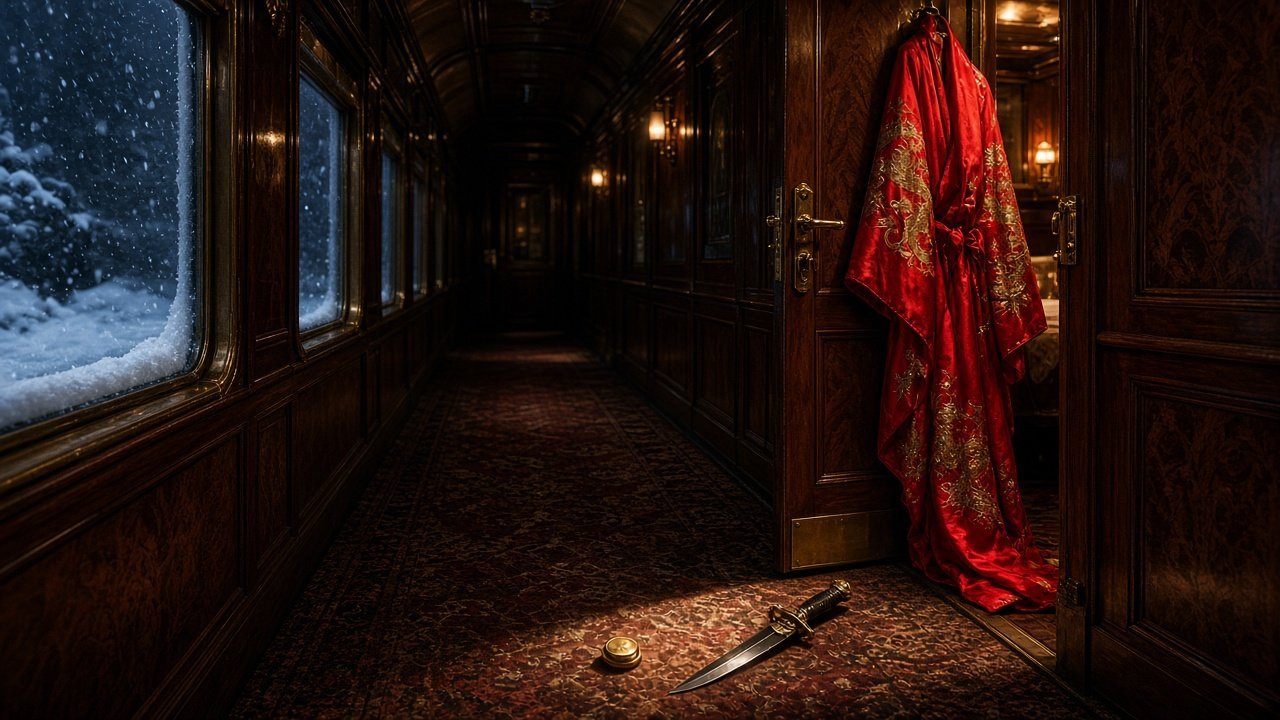
Poirot's night is broken by a series of disturbances. Shortly after midnight he hears a cry from Ratchett's compartment. The conductor knocks, and a voice from inside answers, in French, that it is nothing and the speaker was mistaken. Later, Mrs Hubbard rings for the conductor, insisting that a man has been in her compartment. The conductor tells Poirot that the train has stopped in a snowdrift beyond Vinkovci. Poirot hears a heavy thud against his door, and looks out to see a woman in a scarlet kimono walking away down the corridor.
In the morning the train is still stuck, somewhere between Vinkovci and Brod in what is now north-eastern Croatia. Ratchett is found dead in his bed. His door is locked and chained from the inside, and his window is open, but the snow outside shows no footprints.
The Body in Compartment Two
Dr Constantine examines the body. Ratchett has been stabbed twelve times, and the wounds make no sense together. Some are deep and some barely break the skin. Some seem to have been struck by a right-handed person and some by a left-handed one. A few appear to have been inflicted after he was already dead.
The compartment is full of clues, too many of them. There is a woman's fine handkerchief embroidered with the letter "H". There is a pipe cleaner. There is a dented pocket watch, stopped at a quarter past one. And there is a scrap of burned paper which Poirot manages to read: a fragment mentioning "little Daisy Armstrong".
Bouc asks Poirot to take the case. The Yugoslav police will eventually arrive, and he wants an answer to give them.
Who Was Daisy Armstrong?
The name unlocks Ratchett's identity. Years earlier in America, three-year-old Daisy Armstrong, the daughter of a wealthy British-American army officer, Colonel Armstrong, and his wife, Sonia, was kidnapped. The family paid a huge ransom, but Daisy was found dead. Sonia, who was expecting another baby, died after giving birth prematurely. Colonel Armstrong shot himself. The family's French nursemaid, Susanne, was suspected of helping the kidnappers. She took her own life, and was later shown to be innocent.
The gang's leader, a gangster named Cassetti, was arrested, but his money and influence let him escape justice, and he fled the country. Ratchett is Cassetti, living abroad under a new name.
Everyone Has an Alibi
Poirot interviews the passengers one at a time in the dining car. Each has a story, and each story is supported by someone else's.
MacQueen knows little about his employer's past. Masterman says he slept badly with toothache and saw nothing. Mrs Hubbard tells a long, comic story about the man in her compartment and later produces a button from a conductor's uniform. Princess Dragomiroff admits, without fuss, that she was the godmother of Daisy's mother, Sonia, and mentions Sonia's mother, the great American actress Linda Arden, and a younger sister who married and went abroad.
Hardman then drops his cover. He is not a salesman but a private detective. Ratchett had hired him to watch for a man who was coming to kill him: small, dark, with a high, womanish voice. Several passengers say they saw a small, dark man in a conductor's uniform in the corridor that night, and several saw the woman in the scarlet kimono. Nobody admits to owning one.
The Knife, the Uniform and the Kimono
The search turns up evidence at an almost absurd rate. Mrs Hubbard screams that she has found a bloodstained dagger in her sponge bag. A Wagon-Lits uniform with a button missing is stuffed into Hildegarde Schmidt's suitcase. The scarlet kimono is found folded neatly in Poirot's own luggage, which he takes as a deliberate act of defiance.
Poirot also notices a grease spot on Countess Andrenyi's passport, exactly over her first name, and a damp luggage label.
The Truth Comes Out One Passenger at a Time
Poirot starts confronting people. He tells the Countess that her name is not Elena but Helena, altered so that the "H" handkerchief would not point at her, and that she is Helena Goldenberg, Linda Arden's younger daughter and Daisy Armstrong's aunt. The Count admits he changed the passport to protect her. Princess Dragomiroff then calmly claims the handkerchief. Her first name is Natalia, and the letter is not an English "H" but the Russian Cyrillic letter for "N".
The admissions follow quickly. Mary Debenham was once governess in the Armstrong household. Antonio Foscarelli was the family's chauffeur. Greta Ohlsson was Daisy's nurse. Masterman was Colonel Armstrong's batman, his soldier-servant, in the war. Poirot guesses that Hildegarde Schmidt was the family cook.
By now Poirot sees the pattern. Almost every passenger in the coach is connected to the Armstrong tragedy. He asks for everyone to be gathered in the dining car.
12:55 PMTaylor Tailored
How Murder on the Orient Express Ends
Poirot offers two solutions, and asks Bouc and Dr Constantine to choose between them.
The first is simple. An enemy of Ratchett's, the small dark man Hardman described, boarded the train at Vinkovci, put on a Wagon-Lits uniform, stabbed Ratchett, and got off again just before the train left. On the way he dropped the uniform in a suitcase, and the button was lost in Mrs Hubbard's compartment.
The second solution is the truth. The full coach in winter was no coincidence. Twelve people connected to the Armstrong family arranged to be on the train with Cassetti, and each of them stabbed him in turn while he lay drugged, so that no one could ever say which blow killed him. They were a self-appointed jury of twelve, carrying out the sentence the courts had failed to pass. The false clues were planted to point to an outsider, and the passengers had given each other alibis, which is why every story was confirmed by someone else.
Pierre Michel, the conductor, was the father of Susanne, the nursemaid who killed herself. Hardman had been in love with Susanne. Colonel Arbuthnot was Colonel Armstrong's closest friend, and is in love with Mary Debenham. MacQueen's father had worked on the Armstrong case, and he had adored Sonia Armstrong. And Mrs Hubbard, the loud American widow, is Linda Arden, Sonia's mother and Daisy's grandmother, giving the performance of her career.
Before Poirot can name her, Mrs Hubbard confesses. She tells the story of the plan and of the years of grief behind it, and offers to take all the blame herself.
Bouc and Dr Constantine choose the first solution. Poirot agrees to give that account to the Yugoslav police, and withdraws from the case.
Murder on the Orient Express Ending Explained
Who Killed Ratchett?
Twelve people did, together. Each of them stabbed him once: MacQueen, Masterman, Mrs Hubbard (Linda Arden), Mary Debenham, Colonel Arbuthnot, Princess Dragomiroff, Hildegarde Schmidt, Greta Ohlsson, Antonio Foscarelli, Cyrus Hardman, Pierre Michel and Count Andrenyi. That is why the wounds looked as if they were inflicted by different people with different strengths. They were.
Who Did Not Stab Him?
Countess Andrenyi. She is the only one of the thirteen people in the coach connected to the case who did not take part. As Daisy's aunt she had the strongest motive and would have been the most obvious suspect, so her husband struck the blow in her place to keep the number at twelve.
Why Twelve?
Twelve is the number of jurors in an English or American criminal trial. Cassetti had been tried and got away with it. The conspirators saw themselves as the jury that should have convicted him, delivering the verdict and the sentence at the same time. Sharing the act also meant sharing the guilt, so that no single person was the murderer.
How Did Poirot Work It Out?
Several things never fitted. The coach was full in the off-season. The clues contradicted each other, as if planted by different hands. Every alibi was confirmed by someone the passenger supposedly did not know. The French voice from Ratchett's compartment could not have been Ratchett's, because he spoke no French. And when Poirot looked at the passengers, he saw the members of a single household: a governess, a nurse, a chauffeur, a cook, a valet, a godmother and a grandmother.
The key insight is that the Armstrong case had touched so many lives. If no single passenger could have done it, and the clues pointed everywhere at once, the only answer left was the one that seemed impossible. A line from the novel, quoted on Christie's official website, sums up his method: "The impossible could not have happened, therefore the impossible must be possible in spite of appearances."
Why Does Poirot Let Them Go?
Because he decides that justice has been done, even if the law would not agree. Ratchett was a child-killer who had escaped punishment, and the people who killed him were the ones he had destroyed. Poirot is a man of order who believes in the law, and he does not pretend the killing was lawful. But he allows his friends to choose the version that protects the conspirators, and he goes along with it.
Christie leaves the moral question open. She does not show any of the twelve punished, and she does not tell readers they were right. Later adaptations, especially David Suchet's 2010 version, make Poirot's decision much more painful than it is in the book.
Was It the Perfect Crime?
Very nearly. The plan was built for an ordinary investigation. The police would find an outsider's uniform, a button, a dagger and a story about a small dark stranger, and twelve respectable passengers who all vouched for each other. What the conspirators could not plan for was Hercule Poirot taking a last-minute berth in their coach, or the snowdrift that held the train still while he worked. When the book came out, the reviewer in The Guardian made the same point: the murder would have been perfect if Poirot had not been on the train, and had not overheard Mary Debenham and Colonel Arbuthnot on the way to Istanbul.
Why Does Mrs Hubbard Confess?
To protect the others. Linda Arden is the emotional centre of the plot: Daisy was her granddaughter and Sonia her daughter, and she lost both. Once Poirot has exposed the household, she drops the act and offers to take responsibility as the mastermind, so that the blame falls on her. It is the one moment in the book when the performance stops. Moved by the avengers rather than by their victim, Bouc and Dr Constantine then choose the first solution as the one the police will hear.
Was the Countess Guilty Too?
Not of the stabbing, but she was part of the plan. The Count altered her passport to hide her identity, and she lied to Poirot about her name. The conspiracy needed her silence, not her hand.
What Happens After the Ending?
The book stops at Poirot's decision. Christie never returns to the twelve, and the police who will eventually reach the train are never shown. Readers are left with twelve people travelling on towards Calais with a shared secret, and a detective who has agreed to keep it. The only glimpse of a future is Colonel Arbuthnot's love for Mary Debenham. In hindsight, the words Poirot overheard between them in Syria, about a time "When it's all over", read as a reference to the murder they were travelling to commit.
Was Ratchett a Real Person?
No, but his crime was inspired by a real one. On 1 March 1932, the 20-month-old son of the American aviator Charles Lindbergh and his wife, Anne Morrow Lindbergh, was taken from his cot at their home in New Jersey. A ransom was paid, but the baby's body was found that May. A maid in the household of Anne Lindbergh's mother, Violet Sharpe, was questioned repeatedly and took her own life, and was later found to have had an alibi. When Christie's novel appeared in January 1934, the case was unsolved. A German-born carpenter, Bruno Richard Hauptmann, was arrested in September 1934, convicted and executed in 1936, though his guilt is still debated.
The parallels are close: a famous father, a pregnant mother, a ransom paid for a child who was already dead, and a servant wrongly suspected. Christie took the outline of a real tragedy and imagined the justice that real life had not yet delivered.
Did Christie Cheat?
Some readers have thought so. The American crime writer Raymond Chandler mocked the solution in his 1944 essay The Simple Art of Murder, summarising it as Poirot deciding that nobody on the train could have done the murder alone, so everybody did it together. "Only a halfwit could guess it," he wrote, meaning that it was too absurd for any sensible reader to arrive at. But the clues are all there: the full coach, the twelve wounds, the planted evidence, and the many small slips in the interviews. The solution is outrageous, but it is fair.
Christie and the Real Orient Express
Christie loved the Orient Express. In late 1928, after her divorce, she took it alone to Istanbul and travelled on to Baghdad. In Iraq she became friends with the archaeologist Leonard Woolley and his wife, who invited her back to their excavations at Ur. On that second visit, in 1930, she met the young archaeologist Max Mallowan, and they married in Edinburgh that September.
Real journeys fed the novel. In February 1929 a blizzard near Çerkezköy in Turkey trapped the Orient Express for six days. In December 1931, Christie's own return journey from her husband's dig at Nineveh was halted for 24 hours when floods washed away sections of track. She described her fellow passengers in a letter to Max, and one of them, an American, helped inspire Mrs Hubbard. She also made careful notes about the layout of the carriages, and details such as the position of the door handles matter in Poirot's investigation.
The disappearance of 1926 is never mentioned in her autobiography, and she never explained the eleven days. But the woman who wrote Murder on the Orient Express a few years later was someone who knew what it meant to step onto a train and leave an old life behind.
Murder on the Orient Express on Screen
Sidney Lumet's 1974 film, with Albert Finney as Poirot and an all-star cast including Sean Connery, Lauren Bacall and Vanessa Redgrave, was a huge success. Ingrid Bergman won an Academy Award for her performance as Greta Ohlsson. A modernised 2001 American TV film starred Alfred Molina.
David Suchet's version for Agatha Christie's Poirot was first shown in the US in July 2010 and on ITV in the UK on Christmas Day 2010, with Jessica Chastain as Mary Debenham. It is much darker than the novel: the killers stab Ratchett together while he is awake, and Poirot is tormented by the choice to let them go.
Kenneth Branagh's 2017 film changes several characters. Arbuthnot becomes a doctor, Greta Ohlsson becomes a Spanish missionary called Pilar Estravados, and Foscarelli becomes Biniamino Marquez, but the solution stays the same. Branagh followed it with Death on the Nile (2022) and A Haunting in Venice (2023).
Poirot is also heading back to British television. The BBC's six-part series Hercule, starring Edward Bluemel as a young Poirot, is due on BBC One and BBC iPlayer, and on BritBox in North America, in 2027. It is based on three of Christie's early stories, not on this novel.
Themes and Meaning
Justice and the Law
The novel's real question is not who did it but whether they were right. The law failed the Armstrongs. Twelve people took its place. Christie lets Poirot, the great defender of order, step aside.
Grief
Every conspirator has lost something to Cassetti: a child, a sister, a daughter, a friend. The murder is cold, but its motive is grief, and Linda Arden's confession is the emotional climax of the book.
Performance
The passengers are acting from the moment they board. The loud American widow, the stiff colonel, the timid missionary and the haughty princess are all roles, and Christie trusts readers to see only the costumes, just as the passengers hope Poirot will.
A Small World
The train brings together people of every nationality, class and type. But the twist reveals that they are not strangers at all. Underneath the cosmopolitan surface is a single wounded household.
Final Thoughts
Murder on the Orient Express is remembered for its trick: everyone did it. But the ending that lasts is the quieter one, when the great detective, who has spent the whole book proving he can find the truth, decides that the truth is not what the police need to hear. Christie gives readers a perfect puzzle, then asks them the one question no clue can answer: whether twelve grieving people on a snowbound train were murderers, or the jury that should have sat years before.
Sources
Murder on the Orient Express, Wikipedia (publication history, plot, characters, Christie's journeys, reception, adaptations)
Murder on the Orient Express, Agatha Christie Limited, official site (plot summary, Lindbergh inspiration, Christie's 1928 trip, quotation, adaptations)
Murder on the Orient Express: Plot Summary, LitCharts
The Simple Art of Murder, Raymond Chandler (1944), text reproduced by The Thrilling Detective Web Site
Lindbergh kidnapping, Wikipedia (dates, Violet Sharpe, Hauptmann)
BBC Reveals Cast Joining Edward Bluemel in Forthcoming Series Hercule, BBC Media Centre, 4 August 2026
Agatha Christie, Wikipedia (the 1926 disappearance, the 1928 journey, Max Mallowan)
Harrogate Event to Mark 100th Anniversary of Agatha Christie Mystery, Harrogate Advertiser, 30 October 2026, updated 3 November 2026
Public Events, Culture North Yorkshire (Agatha Christie: A Harrogate Mystery, Royal Pump Room Museum, 28 November 2026 to 6 June 2027), checked 13 November 2026
Murder on the Orient Express (2017): Where to Watch, JustWatch UK, checked 13 November 2026
Murder on the Orient Express (2017): Where to Watch, JustWatch US, checked 13 November 2026
