Why Vonnegut Called It The Children’s Crusade
A War Story Two Veterans Can Barely Remember
Kurt Vonnegut goes to see an old army friend because he wants help remembering the war. Between them, the two men possess an extraordinary qualification for the task. Both were prisoners in Dresden when Allied aircraft bombed the city. Yet when they sit down together, neither can produce much that sounds like a story. The person with the clearest idea of what the book should be is in the kitchen, growing steadily angrier. Slaughterhouse-Five begins with this uncomfortable evening because there is something Vonnegut needs to settle before he can introduce Billy Pilgrim. He has to decide what sort of pleasure a reader ought to get from hearing how somebody survived.
A Promise in Mary O’Hare’s Kitchen
Vonnegut has spent years expecting the Dresden book to be easy. He was there, the subject is enormous and he has an incident in mind that seems to supply a perfect ending. He even tries plotting the story on the back of a length of wallpaper, drawing coloured lines for the people whose lives intersect. The diagram gives him an excellent view of where everybody goes. It does considerably less to explain what it felt like to be one of them. He hopes his old friend Bernard O’Hare can supply what the diagram lacks.
Mary O’Hare, Bernard’s wife, has reservations. She remembers how young the men were. She anticipates what will happen when someone turns their experience into entertainment. The soldiers will acquire the faces and physiques of grown-up film stars. Boys watching them will come away with an appetite for adventures of their own. While the veterans have been struggling to recall what happened, Mary has been thinking about the children who might inherit their account. There are children in the house that evening. The audience she means is close enough to hear.
Vonnegut promises her a book in which the soldiers will keep their youth, and gives it the alternative title The Children’s Crusade. He also tells us in advance how his book will begin and end. It is a curious bargain to make with a reader. We can know the destination without having the faintest idea what to make of it. That will shortly become Billy Pilgrim’s ordinary condition.
The promise to Mary changes the sort of protagonist Vonnegut can use. A gifted officer who makes terrible decisions under pressure would still offer a reader somebody important to impersonate. Billy is a chaplain’s assistant whose wartime preparation includes playing a portable organ. When his unit disintegrates during the Battle of the Bulge, he lacks the equipment, authority and inclination to take command. The war is going to happen to this young man almost irrespective of what he can bring himself to do.
Billy Pilgrim Cannot Keep an Appointment With the Present
Billy’s life initially arrives in the form of a brisk biography. He comes from Ilium, New York, survives the war, becomes an optometrist, marries and raises a family. A later plane crash and the claims he makes about an alien planet cause his daughter Barbara considerable alarm. Vonnegut hands us enough information to navigate an ordinary life story and then takes away the one thing such a story usually guarantees. Meeting Billy at a particular age tells us very little about how old he will be in the next paragraph.
Billy experiences different moments of his own life in an order he cannot control. A man standing behind enemy lines in Europe can find himself a child again or an established professional in America. From Billy’s point of view, these are places he actually goes. He occupies the body and circumstances that belong to him at the moment he reaches. There is no machine to build, destination to enter or reliable signal that a departure is imminent. Knowing that something dreadful happens does not give him a fresh opportunity to prevent it.
That last restriction distinguishes his predicament from the historical mission in Stephen King’s 11/22/63. King’s traveller can make a plan because his actions in an earlier year might change a later one. Billy can have knowledge without gaining that kind of power. He can also experience the reverse indignity. A man who has already run a business and raised children can still find himself back in the snow, entirely dependent on a boy he can barely stand.
That boy is Roland Weary. Behind German lines, Weary travels with Billy and two American scouts. Weary has acquired equipment, ideas about fighting and an elaborate private understanding of the group. In his version, he and the scouts make a formidable trio whose great misfortune is having to drag Billy along. The scouts have entered into no such friendship. When they leave the two stragglers, Weary directs his rage at Billy. The arrival of Germans interrupts his assault, and both young men become prisoners.
Weary matters because he has already made the mistake Mary O’Hare fears a reader might make. He has imagined a war story with himself in an enviable role. Every piece of contrary evidence becomes somebody else’s fault. Billy’s weakness gives Weary a chance to feel indispensable. The scouts’ departure makes him feel ridiculous. A boy first cast as the helpless beneficiary of his courage can become the villain of the whole adventure without doing anything in between.
A Photograph and a Promise on the Prison Train
Billy makes an undignified-looking captive. His improvised clothing sits awkwardly on his long frame, and a German photographer recognises that his appearance could serve a purpose. A picture can make the capture of an American soldier look like a satisfying military achievement. A viewer back home will have no way of knowing what was arranged for the camera or quite how little capturing this particular American required. Mary’s concern about attractive movie soldiers has a counterpart here. An unflattering image can make just as convenient a fiction.
The prisoners are packed into railway wagons. Time inside them passes through thirst, exhaustion and the negotiations required when there is scarcely room to lie down. A former hobo initially regards the conditions as well within the range of things he has endured. His assurances become harder to hear as the journey continues. Vonnegut allows this man a little history and a distinctive voice in very few words. His disappearance matters because, for a moment, we knew which voice in the dark was his.
Weary’s feet have been injured, and he dies during the transport. Before he dies, he identifies Billy as the person responsible for his suffering. Paul Lazzaro, another prisoner, takes up his grievance. Lazzaro believes in revenge pursued with patience. The surviving Billy therefore acquires an enemy who understands loyalty as an obligation to act on a dead man’s account, however poor that account might be. We saw the scouts walk away of their own accord. Nobody interested in avenging Weary asks for that part of the story.
Through Billy’s movements in time, we also see what awaits him in America. In Ilium he has a prosperous practice, a family and a recognisable position in the community. His profession contains one of Vonnegut’s quieter jokes. Patients come to Billy because he can determine what adjustment will bring the world into focus. The people who love him have no equivalent means of finding out what the world looks like through his eyes. They can observe an absence, an inappropriate response or a sudden fit of weeping. He may be decades away from the room in which they are trying to reach him.
The distance feels particularly acute when Billy attends a civic gathering and hears a speaker advocate devastating attacks on North Vietnam. A survivor of Dresden is sitting there with experience relevant to precisely this subject. Billy offers no challenge. His silence leaves an uncomfortable question hanging over the meeting. What route is supposed to carry knowledge from one war into the next if even a man who has lived through the consequences can sit through lunch without finding anything to say?
What the Tralfamadorians Teach Billy About Time
On the night of his daughter’s wedding, Billy says a flying saucer comes for him. Before he goes outside, he watches a war film and experiences it running backwards. The reversal is wonderfully practical. Damaged aircraft recover. Weapons gather destruction into themselves and carry it away. Material that took enormous ingenuity to make dangerous can travel back towards harmlessness. For a little while, the human capacity for organisation appears to have been put to the service of repairing everything it once destroyed.
The film is a small demonstration of something the book can do and Billy cannot. A writer can reverse the order in which the machinery operates. A reader can understand every step and even feel the pleasure of the repair. Somewhere beneath that pleasure sits our knowledge of which way the film ran when the events were real. By the time Billy steps outside, Vonnegut has given us a reason to want time travel more generous than curiosity about tomorrow.
The beings who take Billy to Tralfamadore perceive time in a way that makes his own displacements intelligible to him. They can apprehend different moments together. A person who is dead at one moment remains alive in others, each of which continues to exist. From their perspective, asking why a particular event had to happen involves a mistaken assumption that the moment was once open to an alternative. They advise Billy to direct his attention towards the more agreeable parts of the whole.
Billy’s displacements begin in his account of the war, years before the abduction. The aliens supply an explanation he finds persuasive. The novel never gives us a switch they fitted to him in 1967 that retrospectively caused his earlier experiences. Nor does living among them give him their mastery of perspective. They can recommend contemplating a pleasant moment. Billy is still liable to land in a prison wagon when he might very reasonably have preferred his wedding night.
On Tralfamadore he is exhibited in a zoo. His captors provide a furnished habitat so that spectators can observe a human being going about his business. They later bring him Montana Wildhack, a young film actress, as a companion. The two develop an intimate life together and have a child. There is tenderness in their relationship, especially when Montana trusts Billy enough to ask about experiences he finds difficult to discuss. There is also a disquieting condition attached to everything they share. Somebody else has decided who belongs in the enclosure, and the spectators consider looking in perfectly natural.
The attractions of the aliens’ philosophy are easiest to understand in the presence of someone Billy loves. If every moment endures, then separation can never deprive him completely of another person. Its political implications are considerably harder to stomach. The Tralfamadorians themselves foresee the destruction of the universe in an experiment conducted by one of their own. For them, knowing the outcome offers no reason to call off the experiment. The same belief that consoles a bereaved person can make the prospect of annihilation seem administratively settled.
How Science Fiction Gets Into Billy’s Hands
During an earlier stay in a veterans’ hospital, Billy meets Eliot Rosewater, a fellow patient who introduces him to the fiction of Kilgore Trout. Trout is an obscure science-fiction writer with an extraordinary supply of ideas. His work gives the two men ways of imagining realities large and strange enough to accommodate their experience. Billy has returned to a society in which a young veteran should be able to take up a profession, marry and become the next instalment in a family success story. Trout at least permits the possibility that the official description of the universe is missing something substantial.
The hospital also gives us a more ordinary measure of Billy’s withdrawal. His mother visits, and he finds her presence almost unbearable. She has invested care and effort in getting him this far. Simply seeing her confronts him with the obligation to be glad he is alive. His fiancée, Valencia Merble, can imagine a future for them and is willing to love him. To the person in the bed, even kindness can arrive as another expectation he lacks the strength to fulfil. Vonnegut is unusually sharp on the loneliness of being surrounded by people with excellent reasons to expect you to get better.
Trout’s stories later complicate Billy’s evidence for Tralfamadore. One of them involves humans displayed in an extraterrestrial zoo. Material associated with Montana also turns up in Billy’s earthly surroundings. A reader can put these pieces together and see how an imaginative world might have acquired its furnishings. Yet the narration repeatedly takes us to the planet and allows scenes there to unfold with the same matter-of-fact attention it gives to life in Ilium. There is no final investigation in which a doctor or an astronaut settles the question.
More depends on that uncertainty than deciding whether Billy has correctly identified a spacecraft. If his account is literally true within the novel, he has encountered intelligent beings whose wisdom offers comfort at a troubling price. If he has fashioned the account from reading and memory, it is worth asking why this particular invention helps. In either case, the zoo gives him an audience that welcomes his peculiarities, a language for surviving death and a relationship in which Dresden can occasionally be mentioned. Back home, his public efforts to explain himself largely convince Barbara that her father needs looking after.
The Address That Keeps the Prisoners Alive
In the wartime sequence, Billy reaches Dresden with a party of American prisoners. Among them is Edgar Derby, a middle-aged schoolteacher considerably older than many of the men around him. The city they enter still possesses streets and buildings capable of astonishing boys accustomed to the prison train. Even in a book that has told us from the beginning what happened to Dresden, the men get to see it standing. For a few pages, it has the ordinary privilege of being a place somebody can encounter for the first time.
Their accommodation is part of a slaughterhouse complex. The prisoners learn the address, Schlachthof-fünf, so they can give it if they get lost. The English title thus has a mundane use inside the story. It is the information a foreigner needs in order to be taken back to his quarters. Only later does the building’s construction acquire its dreadful significance. A place designed to handle animal carcasses has an underground space substantial enough to protect the people sent there.
Vonnegut gives Derby an opportunity to speak before the city is destroyed. Howard W. Campbell Jr., an American propagandist working for Nazi Germany, comes recruiting among the prisoners. He offers them the prospect of improved conditions if they will change sides and join a unit intended to fight the Soviet Union. Derby answers him angrily, defending the principles for which he believes the Americans are fighting. He makes his position clear before people who have material reasons to prefer Campbell’s offer.
It is worth letting Derby have the dignity of that moment. The book has been merciless towards Weary’s fantasies of gallantry. Here is a prisoner who understands what he is being asked and makes a public choice under pressure. He cannot control how his captors treat him afterwards. He can decide what answer Campbell gets in this room. For a novel so taken up with beings who regard choice as a provincial Earthling superstition, Slaughterhouse-Five pays remarkably close attention to the moments when a person does something decent of his own accord.
Billy’s own foretold death offers another test of the aliens’ doctrine. He describes a future in which he speaks publicly about time and is assassinated as a consequence of Lazzaro’s promise. For Billy, the occasion can be accepted because he can pass from the experience of dying to another part of his life. For the reader, it remains the eventual consequence of Weary blaming the wrong person in a railway wagon. Knowing how long a grievance will last gives us ample opportunity to see how little justification it ever had.
Why Four Singers Bring Dresden Back
At a wedding anniversary celebration in Ilium, a barbershop quartet performs for Billy and Valencia. Billy reacts so strongly that the people around him realise something is wrong. He has difficulty accounting for it himself. A book in which a sentence can carry him across decades now slows down for a much more familiar and laborious activity. Something in the room bothers him, and he has to work out what it resembles.
The sight of the four singers brings back four German guards outside the shelter after the bombing. It is the grouping and the expressions on their faces that make the connection. Billy is remembering this time. Vonnegut carefully distinguishes the act from one of his involuntary journeys. No one at the party can have predicted what four men opening their mouths to sing would call up for their host. Billy himself has been living with the image for years without knowing that an ordinary piece of anniversary entertainment could give him access to it.
When the bombing comes in February 1945, the prisoners and the guards with them take shelter underground at the slaughterhouse. They survive because of where they are. From below, they have sound and vibration to tell them that immense things are happening overhead, and almost no means of knowing their extent. When they emerge, the city whose appearance so impressed the arriving prisoners has become barely recognisable. The guards have no professional expression equal to the sight. Decades later, Billy finds its nearest likeness on the faces of men who have come to his house to sing.
That connection explains something peculiar about the amount of space Vonnegut gives the party. An account proceeding by public importance would devote pages to the raid and perhaps a line to the entertainment at an optometrist’s anniversary. Billy’s experience requires both scenes. Without the later one, that particular expression on the guards’ faces might remain inaccessible. Without the earlier one, a guest at the party would have every reason to think Billy had been taken ill during a song. Putting them together restores a piece of knowledge that everyone in the living room lacks.
Two Survivors in a Hospital Room
Years after the war, Billy survives an aircraft crash. Valencia, desperate to reach the hospital, has a road accident and continues driving her damaged car. Exhaust fumes overcome her, and she dies of carbon monoxide poisoning. There is a terrible disparity between how much she puts into reaching her husband and how little he can know of her journey. A person he has often treated as part of the settled furniture of his future spends the last hours of her life trying to get to him.
In hospital Billy shares a room with Bertram Copeland Rumfoord, who is working on a history of American air power. Rumfoord has an interest in Dresden and initially very little interest in the patient beside him. When Billy says he was there, the historian has to accommodate an awkward fact. Someone who looks incapable of contributing to the discussion possesses precisely the qualification with which Vonnegut began the book. He was underneath the city while the bombs were falling.
Their exchange produces no grand reconciliation of military history and personal experience. Rumfoord can explain why people defend the raid. Billy can attest that there were human beings at the receiving end. He does not suddenly become an eloquent spokesman for them. Nor does Rumfoord’s willingness eventually to hear him give the dead a greater presence in the room. Vonnegut leaves a peculiar sadness in the distance between the two beds. The researcher and the witness have come almost as close as two strangers can get, and there is still so little either knows how to ask of the other.
What Does the Bird Say at the End?
In the ruins, the surviving prisoners are put to work retrieving bodies. What initially looks like a task of discovery becomes an encounter with the sheer number of the dead and the conditions in which the work must be done. Edgar Derby takes a teapot, is tried for plundering and is executed. Vonnegut has let us know his fate long before reaching it. The institution capable of assigning an individual offence to Derby and an exact punishment to his act has no comparable proceeding for what the men have just witnessed across an entire city.
Derby’s execution was the episode the narrator thought might make his climax when he visited Bernard O’Hare. By the time the book reaches it, there is very little left to say about the teapot. We have already met the teacher who stood up to Campbell, seen what sort of authority his captors exercise and understood what counts as an offence among the ruins. A courtroom set piece might invite us to enjoy the perfection of the irony. The brief account leaves more space for the disproportion itself to register.
There is another encounter amid the destruction that reaches Billy more directly. He and other Americans have been using a horse-drawn wagon. Two Germans draw his attention to the condition of the horses, whose mouths and hooves have suffered while the men have been occupied with their own affairs. Billy looks properly and weeps. The people who point out the damage give him something the Tralfamadorians never do. They show him suffering that his own conduct helped cause and that somebody can still interrupt. He cannot give Dresden back its inhabitants. He can get down and look at what has happened to a horse.
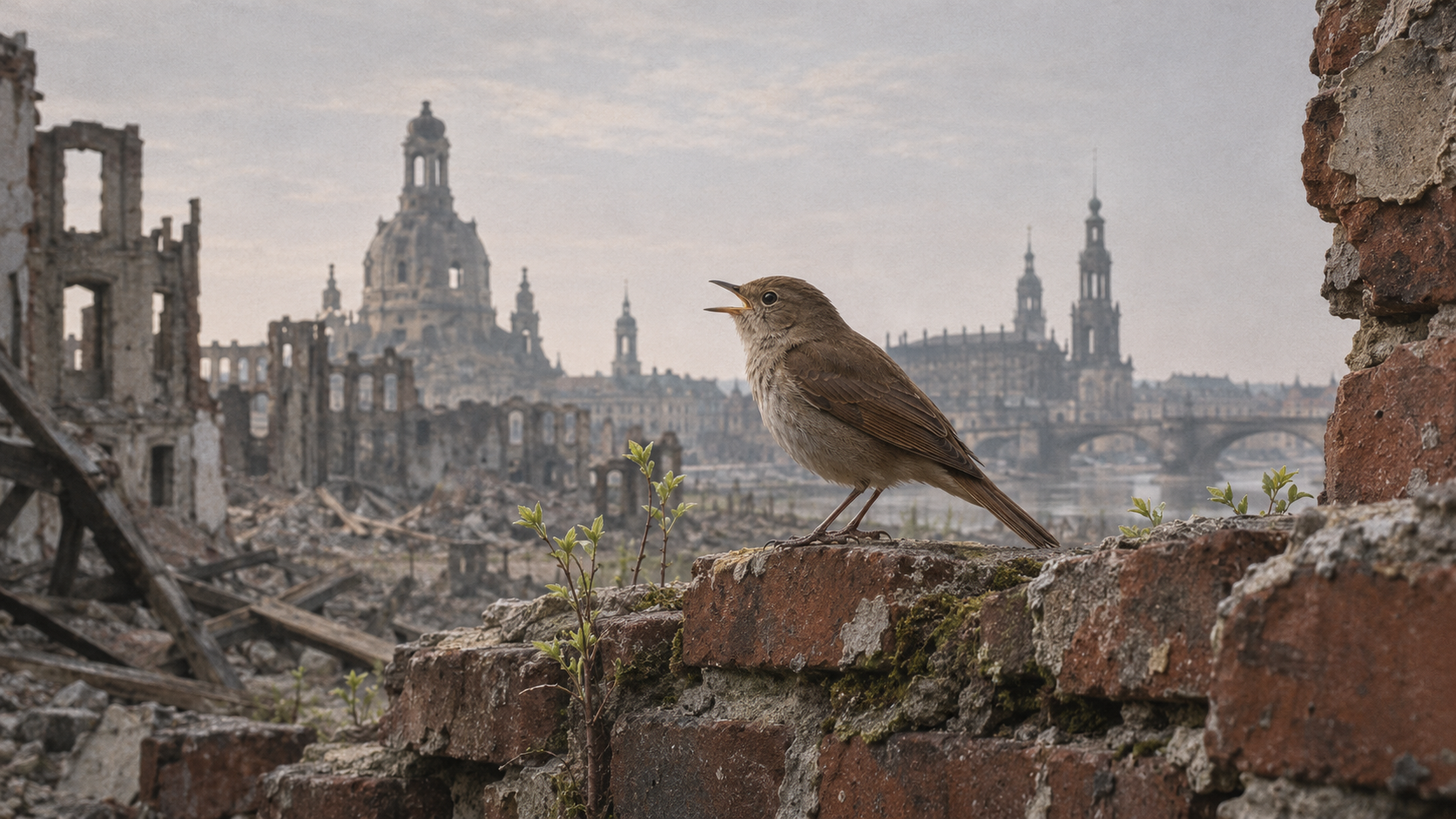
When the war ends, the prisoners find that their guards have gone. In the spring quiet, a bird addresses Billy with the sound Poo-tee-weet? That is where the novel stops. The bird is alive, the season has turned and the noise carries the inflection of a question. Nothing in the sound translates into a judgement about Dresden. A survivor looking for an explanation has been given something much smaller and stranger. There is a living creature beside him, making the noise its kind makes, on a morning he could reasonably have expected never to see.
The sound also returns us to Mary O’Hare’s kitchen. A conventional ending might have sent Billy home older, wiser and ready to explain what the fighting had made of him. Mary knew what the next generation could be sold under cover of a story like that. The bird leaves Billy standing among the consequences, with no stirring speech and no enviable part for a film star to play. After spending a whole book discovering how difficult it is to hear a witness, we finish by listening to something neither Billy nor the reader can turn into a war story.
Sources
Kurt Vonnegut, Slaughterhouse-Five — primary text for the novel’s sequence, Billy’s experiences and the final scene. comum.rcaap.pt
Penguin Random House, Slaughterhouse-Five — publisher’s description and opening excerpt, including Vonnegut’s early plan for the Dresden book. Penguin Random House Retail
SparkNotes, Slaughterhouse-Five Full Book Summary — independent cross-check of the wartime, family and Tralfamadore storylines. SparkNotes
