How Does a Birthday Party End With the Fellowship Broken by the River?
J. R. R. Tolkien's The Fellowship of the Ring begins with a birthday party and ends on the bank of a great river, with the company that set out to save the world already in pieces. In between, a hobbit who has never wanted adventure learns that the magic ring in his pocket is the most dangerous object in Middle-earth, and that the only way to defeat its maker is to carry it into his own land and destroy it there.
First published by George Allen & Unwin on 29 July 1954, The Fellowship of the Ring is the first of three volumes of The Lord of the Rings, a work Tolkien conceived as a single novel divided into six books. This summary explains what happens in Books One and Two, why each turn matters, who joins the Fellowship and why, and what the ending at Parth Galen actually decides. If you have come from our explainer on The Hobbit's ending, this is where Bilbo's lucky find stops being a curiosity and becomes a burden.
Spoiler warning: the following summary discusses the plot, major twists and ending of The Fellowship of the Ring. It does not reveal events from The Two Towers or The Return of the King.
The Short Answer: How The Fellowship of the Ring Ends
The book ends with the Fellowship broken. At Parth Galen, near the falls of Rauros, Boromir of Gondor tries to take the Ring from Frodo by force. Frodo escapes by putting the Ring on and vanishing, and in that moment he decides he must go on to Mordor alone, without endangering anyone else. Sam guesses what his master intends and refuses to be left behind. The two hobbits cross the river and head east towards the Shadow, while the rest of the company is scattered. The quest survives, but the plan to see it through together does not.
A Long-Expected Party and a Ring That Should Not Exist
The story opens in the Shire, the quiet farming country of the hobbits, where Bilbo Baggins is about to celebrate his 111th birthday. The date also marks the 33rd birthday of his cousin and heir, Frodo, whom Bilbo has brought up at Bag End. Bilbo has been a figure of gossip for decades: he once went off on an adventure with a wizard and a company of dwarves, came back rich, and has never seemed to age as he should.
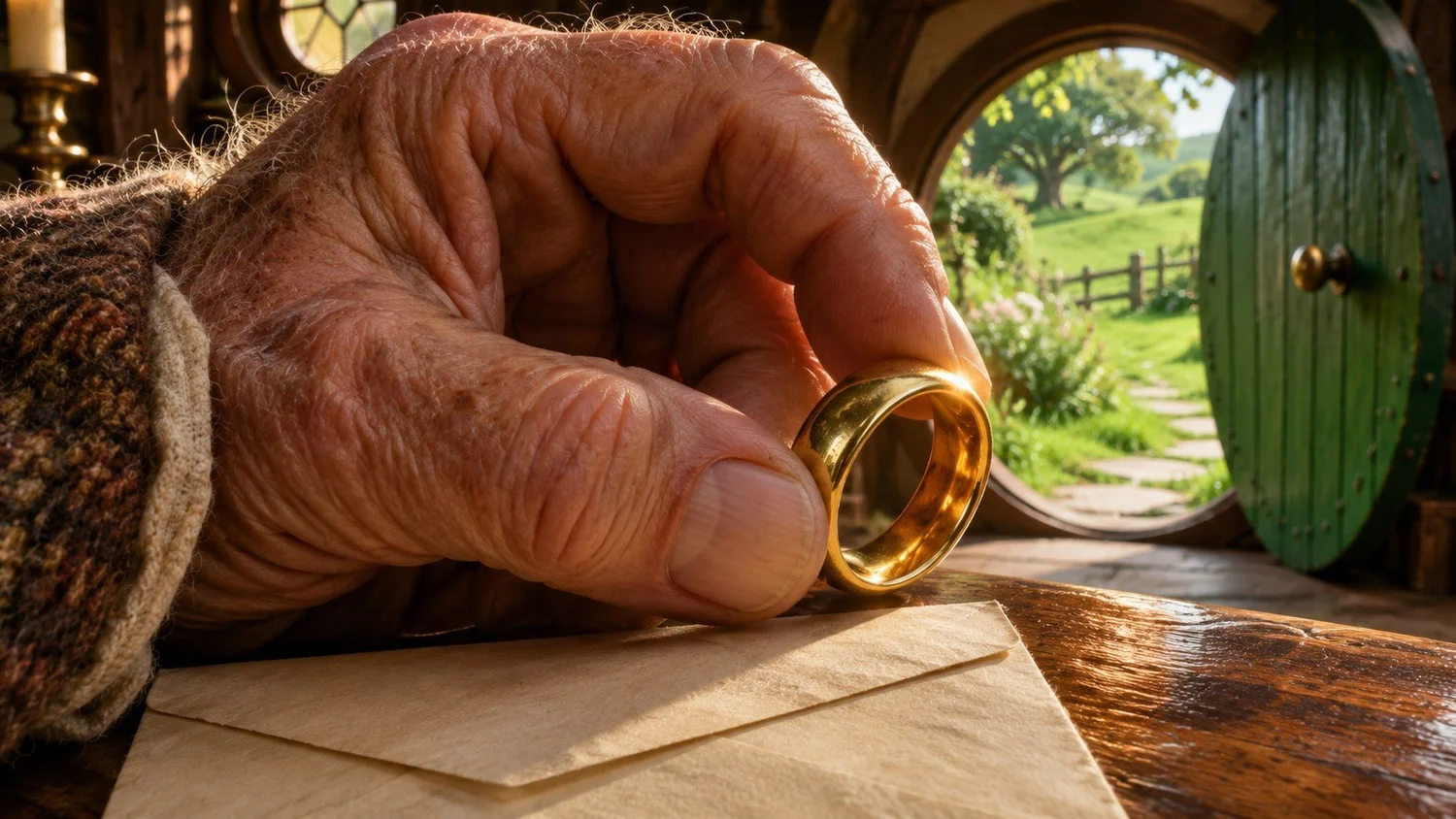
At the end of his speech, Bilbo disappears in front of the guests. The trick is not stagecraft. He has slipped on the magic ring he found long ago in the caves under the Misty Mountains, the ring that once belonged to Gollum. Bilbo then leaves the Shire for good, but handing over the ring proves harder than he expected. He argues with Gandalf, grows possessive, and calls the ring by the same word Gollum used for it. Only Gandalf's insistence makes him leave it behind for Frodo.
That small scene does a great deal of work. Tolkien shows the Ring's influence before he explains it. A cheerful, generous hobbit becomes secretive and defensive over a piece of gold, and the wizard who has known him for sixty years is suddenly worried. Gandalf suspects that this is no minor magic ring but one of the Rings of Power, and he warns Frodo to keep it hidden and not to use it.
The Shadow of the Past: Seventeen Years and a Terrible Answer
Gandalf then disappears for long stretches while he investigates. Seventeen years pass before he returns to Bag End with an answer, and the chapter in which he gives it, "The Shadow of the Past", is the moral and historical foundation of the whole work. Tolkien himself called it the crucial chapter.
Gandalf throws the Ring into Frodo's fire. When it is drawn out, it is cool to the touch, and lettering appears on it. The Ring is the One Ring, forged by the Dark Lord Sauron to rule the other Rings of Power and the peoples who wear them. Sauron lost it long ago, and now that he has returned to power in Mordor he is searching for it. Without it his strength is limited. With it, nothing in Middle-earth could stand against him.
Gandalf also explains how the Ring came from the river to Bilbo's pocket. It passed into the hands of Gollum, a creature who had once been a hobbit-like river-dweller, and slowly consumed him over hundreds of years. Gollum has since been captured and questioned in Mordor, which means Sauron now knows two dangerous words: Shire and Baggins.
Frodo's first reaction is one of the most human moments in the book. He wishes the Ring had never come to him, and he wishes that Bilbo had killed Gollum when he had the chance. Gandalf's reply, in paraphrase, is that pity stayed Bilbo's hand, that it was not a mistake, and that Gollum may yet have a part to play. It is a line that seems like a gentle rebuke here and becomes far more significant later. Frodo cannot destroy the Ring himself: it cannot be damaged by ordinary fire or force, and the only place it can be unmade is the fire of Mount Doom in Mordor, where it was forged. What Frodo can do is take it away from the Shire before Sauron's servants arrive. He agrees to go, and Sam Gamgee, Frodo's gardener, who has been caught eavesdropping under the window, is told he will go with him.
Leaving the Shire: Black Riders, Elves and a Conspiracy of Friends
Frodo plans his departure carefully. He sells Bag End to his unpleasant relatives, the Sackville-Bagginses, and spreads a cover story that he is moving to a small house at Crickhollow in Buckland, near the eastern border of the Shire. Gandalf promises to return in time for Frodo's birthday and travel with him. He does not come.
That absence matters. Frodo waits, then finally sets out on foot with Sam and his young cousin Pippin Took. Almost at once they are followed. A rider in black, mounted on a black horse, stops on the road and sniffs the air, searching for something he cannot see. Frodo feels a strong urge to put on the Ring, which is exactly what would reveal him. These are the Black Riders, and the book keeps their nature vague for now, which makes them more frightening.
The hobbits are saved first by a company of Elves led by Gildor Inglorion, whose singing drives a Rider away. Then they cut across country to avoid the road and reach the farm of Farmer Maggot, a gruff hobbit Frodo once feared as a boy, who turns out to be kind and practical. He gives them supper and a basket of mushrooms, and tells them that a Black Rider has already come to his door asking for Baggins.
At Crickhollow, Frodo plans to tell his friends a careful lie and slip away. Instead he finds that Merry Brandybuck and Pippin have known about the Ring for a long time, that Sam has been reporting to them, and that they have no intention of letting him go alone. The chapter title, "A Conspiracy Unmasked", is affectionate. This is the first of many moments in which Frodo's loneliness is answered by loyalty, and it establishes that friendship will be as important to the quest as courage.
The Old Forest and Tom Bombadil: The One Figure the Ring Cannot Touch
To avoid the road, the four hobbits enter the Old Forest, an ancient and hostile wood on the Shire's border. The paths shift. The trees seem to herd them. Merry and Pippin are swallowed by the trunk of Old Man Willow, a malevolent tree, and only the arrival of Tom Bombadil saves them. Tom sings the willow to sleep and takes the hobbits to his house, where they stay two nights with him and his wife, Goldberry.
Bombadil is one of the strangest figures in Tolkien's work. When Frodo asks who he is, Goldberry's reply is simply that he is. The Ring has no hold on him: he can see Frodo when Frodo wears it, put it on himself with no effect, and make it vanish and reappear like a conjuring trick before handing it back. Tolkien later wrote that even a mythical age needs some enigmas and that Tom is one, intentionally.
The episode can feel like a detour, but it does two useful things. It shows that the Ring's power is not absolute, which makes its effect on everyone else more telling, and it gives the hobbits a rhyme to summon Tom if they are ever in trouble. They need it almost immediately. Crossing the Barrow-downs in fog, they are captured by a barrow-wight and laid out in a tomb. Frodo, rather than putting on the Ring and running, finds the courage to attack the wight and calls for Tom, who frees them. From the barrow's treasure Tom gives each hobbit an ancient dagger, a gift that will matter more than any of them realise.
Bree, Strider and the Knife in the Dark
The hobbits reach Bree, a village where Men and hobbits live side by side, and take rooms at the Prancing Pony under the name Underhill. In the crowded common room, Frodo is persuaded to sing, falls off a table, and the Ring slips onto his finger. He vanishes in front of everyone. The careful secrecy of the journey so far collapses in a moment of embarrassment, which is exactly how the Ring tends to work in this book: it finds its way out at the worst possible time.
A weather-beaten Ranger called Strider has been watching them. He offers to guide them, and Frodo hesitates, unsure whether he is a friend or a spy. The matter is settled by the innkeeper, Barliman Butterbur, who suddenly remembers that Gandalf left a letter for Frodo months before. The letter vouches for Strider and gives his real name, Aragorn. That night, the hobbits' rooms are attacked, and their ponies are driven off.
Strider leads them into the wild country beyond Bree, through midge-infested marshes to Weathertop, an old watch-hill. There five of the Black Riders close in by night. Their leader, the Witch-king, stabs Frodo with a cursed blade. Frodo has put on the Ring, and in that state he sees the Riders as they really are, pale and terrible kings. The wound is not an ordinary one: a fragment of the blade is working its way towards Frodo's heart, and if it reaches it he will become a wraith himself, under Sauron's control.
Flight to the Ford: The Race to Rivendell
Strider treats the wound with athelas, a healing herb, but it can only slow the damage. The company hurries east towards Rivendell, the refuge of the half-elven lord Elrond. On the way they are met by the Elf Glorfindel, who has been sent to look for them, and he puts the failing Frodo on his white horse, Asfaloth.
At the Ford of Bruinen, the river crossing just short of Rivendell, the nine Black Riders catch up. Asfaloth carries Frodo across. The Riders command him to come back, and Frodo, barely conscious, defies them. Then the river rises in a flood, with shapes like white horses in the water, and sweeps the Riders away. Frodo collapses.
This is the climax of Book One, and its shape is typical of the novel. Frodo sets out, makes a clumsy and dangerous journey, nearly fails, and is saved by help he could not have planned. The pattern repeats so often that critics have noted it, but it is not just a storytelling habit. The book is built on the idea that no one, however brave, completes this task alone.
The Council of Elrond: Why Destruction Is the Only Answer
Frodo wakes in Rivendell after four days. Gandalf is there, and so is Bilbo, now old and living among the Elves. Elrond's healing has saved Frodo, though the wound will trouble him for the rest of his life. Bilbo gives Frodo his old sword, Sting, and a shirt of mithril mail, a small and practical act of love from one Ring-bearer to the next.
The long chapter "The Council of Elrond" is mostly a series of stories, and it is where the reader finally understands the scale of the danger. Gandalf explains why he never arrived in the Shire: he went for advice to Saruman, the head of his order, and found that Saruman had betrayed them, wanting the Ring for himself. Saruman held Gandalf prisoner, and Gandalf escaped. Gandalf also confirms that the Black Riders are the Nazgûl, the Ringwraiths, once kings of Men who accepted rings from Sauron and became his slaves.
Strider is revealed as Aragorn, heir of Isildur, the ancient king who cut the Ring from Sauron's hand long ago and refused to destroy it. Boromir, a proud warrior from the southern kingdom of Gondor, has travelled north because of a dream, and he argues that the Ring should be used as a weapon against Sauron. The Council rejects every alternative in turn. The Ring cannot be hidden forever. It cannot be sent over the sea. Giving it to Tom Bombadil would be pointless, because he might simply forget it. Using it would turn anyone who wields it into a new Dark Lord. The only answer is to take it into Mordor and destroy it in the fire of Mount Doom.
No one wants to say it, and then Frodo does. He offers to take the Ring, although he admits he does not know the way. The decision is not heroic bravado. It is a small person accepting a task because the alternative is to watch everyone else argue. Sam, who has crept into the meeting, insists on going with him.
The Fellowship is formed to match the nine Black Riders: Frodo, Sam, Merry and Pippin for the hobbits; Gandalf the wizard; Aragorn and Boromir for Men; Legolas, an Elf from Mirkwood; and Gimli, a Dwarf and son of Glóin, who travelled with Bilbo long ago. Elrond is careful to say that none of them is bound by oath beyond the Ring-bearer, and that they may turn aside if they choose. That freedom is important for what happens at the end.
South Through Snow and Darkness: Caradhras and Moria
The Fellowship leaves Rivendell in winter and heads south along the Misty Mountains. Their first attempt to cross, by the Redhorn Pass over the mountain Caradhras, is defeated by heavy snow. The weather feels deliberate, as though the mountain itself is against them, and they turn back exhausted.
Gandalf proposes the one route no one wants: under the mountains, through the Mines of Moria, the ruined Dwarf-kingdom of Khazad-dûm. Aragorn is reluctant, warning Gandalf that he in particular should beware if he goes there. At the hidden west gate, a creature from the dark lake outside attacks Frodo as Gandalf works out how to open the doors, and the company only just escapes inside before the gate is smashed shut behind them.
Moria is a long walk through darkness and silence. Gimli hopes to find Balin, a dwarf of Bilbo's old company, who led an expedition to reclaim the mines. Instead they find Balin's tomb, and a damaged record of the colony's last days ending in desperate fragments. The dwarves were trapped and killed by Orcs. The Fellowship is attacked in the same chamber, and Frodo is struck by a spear thrust that should have killed him. The mithril shirt Bilbo gave him saves his life.
Fleeing towards the east gate, the company reaches the narrow Bridge of Khazad-dûm, and something worse than Orcs follows them: a Balrog, a demon of fire and shadow from an ancient age. Gandalf stands on the bridge to hold it back and breaks the bridge beneath it. As the Balrog falls, it drags Gandalf down into the abyss with it. The survivors escape into daylight with their guide gone.
Gandalf's fall is the biggest blow in the book. He has been the one who understands the plan, the history and the danger. Without him the company must make decisions it is not equipped to make, and Aragorn, who never wanted to lead in this way, must take charge.
Lothlórien and the Mirror of Galadriel
Grieving, the company enters Lothlórien, the golden wood of the Elves ruled by Celeborn and Galadriel. The Elves are suspicious of a Dwarf in their land, and Gimli is allowed in only on terms. Over the following days, that hostility softens into something unexpected: Gimli becomes devoted to Galadriel, and his friendship with Legolas begins to grow, an ancient enmity between their peoples quietly undone by two individuals.
Galadriel tests each member of the company by looking into their hearts, and several of them feel they have been offered a choice between the quest and something they want. She then lets Frodo and Sam look into her Mirror, a basin of water that shows things that were, are, or may yet be. Sam sees the Shire being damaged and wants to go home. Frodo sees, among other things, a great Eye searching for him.
Frodo then offers Galadriel the Ring. It is a sincere offer, and the scene is one of the book's most important tests. Galadriel admits she has long imagined what she would do with it, and describes, briefly and terrifyingly, the beautiful and dreadful queen she would become. Then she refuses. She says she will diminish and go into the West, and remain herself. Where Boromir sees the Ring as a weapon for good, Galadriel understands that it would turn even good intentions into tyranny.
When the company leaves, the Elves give them grey cloaks, lembas, a waybread that sustains travellers, and boats to carry them down the Great River, Anduin. Galadriel gives each member a personal gift, and to Frodo she gives a phial containing light from a star, a light for dark places. It is the kind of gift that seems decorative when given and becomes essential later.
The Breaking of the Fellowship: The Ending Explained
The company travels south by boat for days. They are being followed. Gollum, the Ring's former owner, has been trailing them since Moria and is seen paddling on a log. Orcs shoot at them from the eastern bank. Eventually they reach the hills above the falls of Rauros, where the river becomes impassable and they must decide which way to go. East leads towards Mordor. West leads towards Gondor and its city, Minas Tirith, where Boromir wants the company to go.
Frodo asks for an hour alone to decide. Boromir follows him. At first he argues, reasonably, that the Ring could save Gondor. Then he grows angry and tries to take it by force. Frodo puts on the Ring and disappears. Boromir, left alone, comes to his senses and is overwhelmed with shame.
While invisible, Frodo climbs to the seat on Amon Hen, the Hill of Sight, and briefly sees war spreading across Middle-earth, and the Eye of Sauron seeking him. He feels two forces pulling at him, one urging him to take off the Ring and one urging him to keep it on, and in that moment he takes it off by his own choice. That small act of will is the heart of the ending. Frodo decides that the Ring is already corrupting his friends, and that if he stays, Boromir's failure will not be the last. He resolves to go to Mordor alone.
The rest of the company, learning what has happened, scatters in panic to search for him. Sam is the only one who thinks clearly. He realises Frodo will go for the boats and runs to the shore, arriving just as an empty boat pushes off. Sam wades in after it, though he cannot swim, and Frodo pulls him aboard. Frodo tries once to send him back and then gives up, grateful. The two of them cross the river and turn towards the mountains of Shadow.
The ending works because it is both a failure and a success. The Fellowship as a plan has failed: Gandalf is gone, Boromir has broken faith, and the company is scattered without knowing where Frodo has gone. But the purpose of the Fellowship survives in its two humblest members. The book that began with a party ends with two hobbits alone in a boat, which is a fair summary of how Tolkien sees heroism.
Frodo, Sam and Boromir: How the Characters Change
Frodo starts the story as a comfortable, curious gentleman-hobbit who has always half-wanted to see the world. By the end he has been wounded by a Ringwraith, has lost the wizard he relied on, and has had his life threatened by a friend. His final decision is shaped by everything that has happened: he chooses solitude because he now understands what the Ring does to the people around it. His growth is not into a warrior but into someone who can carry a terrible responsibility with clear eyes.
Sam's arc is quieter and just as important. He begins as a servant, curious about Elves and anxious about the world beyond Hobbiton. His loyalty is never in doubt, but in the final chapter he moves from following orders to making his own judgement. He understands Frodo better than Frodo understands himself, and his refusal to be left behind is the decisive act that keeps the quest alive.
Boromir is the book's most tragic figure. He is brave, honest about his motives and genuinely devoted to his city. His temptation is not greed but desperation: he believes the Ring could save his people, and that belief is exactly how the Ring works on good people. His attack on Frodo is a disaster, but his shame afterwards shows he has not been lost entirely. The question of what he does with that shame is left for the next volume.
Themes: The Pull of the Ring, Pity and the Weight of Deep Time
The Ring is the book's central idea, and Tolkien makes it frightening by keeping it specific. It does not simply make people evil. It works on what they already want. Bilbo wants to keep it because it is his. Boromir wants to use it for his people. Galadriel imagines how much good she could do with it. Each temptation is tailored, and the ones who resist do so by recognising that their desire, however noble, would be magnified into domination.
Pity is the other quiet thread. Gandalf's defence of Bilbo's mercy towards Gollum in "The Shadow of the Past" seems at first like a moral aside. By the end of the book, Gollum is following the company down the river, and the reader is left to wonder what role he will play. Tolkien plants the idea that mercy has consequences no one can calculate in advance.
The book is also full of the past. Old songs, ruined towers, barrows, and the long histories told at the Council of Elrond give Middle-earth a sense of enormous age. Critics have praised this feeling of deep time, and it has a narrative purpose: the hobbits keep discovering that their small journey is the latest chapter in a struggle that has gone on for thousands of years, and that earlier, mightier people have already failed at it.
Finally, there is the pattern of rest and danger. The hobbits keep returning to safe houses, from Bag End and Crickhollow to Bombadil's house, Rivendell and Lothlórien, and each refuge is followed by a harder road. That rhythm makes the end of the book feel especially exposed. For the first time, there is no next safe house in sight.
Why It Was Published as Three Books, and How Readers First Received It
Tolkien did not set out to write a trilogy. After the success of The Hobbit in 1937, his publisher asked for a sequel, and he began what he called a new Hobbit that December. The writing took more than a decade, squeezed around a full-time academic post, and the story grew into something far darker and larger than its predecessor. He finished the main narrative in 1948 and completed his revisions in 1949.
The decision to issue it as three volumes was commercial. Typesetting such a long book was expensive and sales were expected to be modest, so splitting it reduced the publisher's risk. Tolkien regarded the whole as one novel in six books, which is why The Fellowship of the Ring ends where it does: not at a natural climax, but at the moment the story divides into separate paths.
Early reactions were sharply divided. W. H. Auden, who had been Tolkien's student, was an enthusiastic champion, while C. S. Lewis praised its sense of history. The critic Edmund Wilson was scathing and dismissed the work in a famous 1956 review. Readers settled the argument in their own way: the work went on to sell well over a hundred million copies and became the foundation of modern fantasy.
What The Fellowship of the Ring Sets Up for The Two Towers
By the final page, Tolkien has split his story into separate threads that the next volume will follow in turn: Frodo and Sam heading for Mordor with the Ring; the rest of the company scattered near Rauros, with Boromir carrying his guilt; and Gollum somewhere behind them all. Gandalf is presumed dead. Saruman is an enemy. Sauron is searching, and the war Frodo glimpsed from Amon Hen is beginning.
The book's real achievement is to make that scale feel personal. By the time Frodo and Sam step out of the boat on the eastern shore, the reader understands exactly what they are walking towards, and why they would rather do it together than not at all.
Sources
- The Fellowship of the Ring – Wikipedia (publication details, plot, structure, reception)
- The Fellowship of the Ring – Tolkien Gateway (chapter-by-chapter synopsis)
- The Lord of the Rings – Wikipedia (writing history, structure and three-volume publication)
- Tom Bombadil – Wikipedia (Bombadil's role and Tolkien's "enigma" comment)
