What Happens When the Fellowship Splits Into Two Separate Wars?
The Two Towers is the volume of The Lord of the Rings in which the story splits in two and never quite feels safe again. In the west, three hunters chase a band of Orcs across the plains of Rohan to rescue two captured hobbits, and are drawn into a war against a traitor wizard. In the east, Frodo and Sam struggle towards Mordor with a guide who once owned the Ring and still wants it back.
Published by George Allen & Unwin on 11 November 1954, the second volume contains Books Three and Four of Tolkien's six-book novel. This summary explains what happens in each half, why Tolkien tells them separately, who the two towers of the title are, and why the book ends on one of the most famous cliffhangers in fantasy. It follows directly from our Fellowship of the Ring summary.
Spoiler warning: the following summary discusses the plot, major twists and ending of The Two Towers, and the ending of The Fellowship of the Ring. It does not reveal events from The Return of the King.
The Short Answer: How The Two Towers Ends
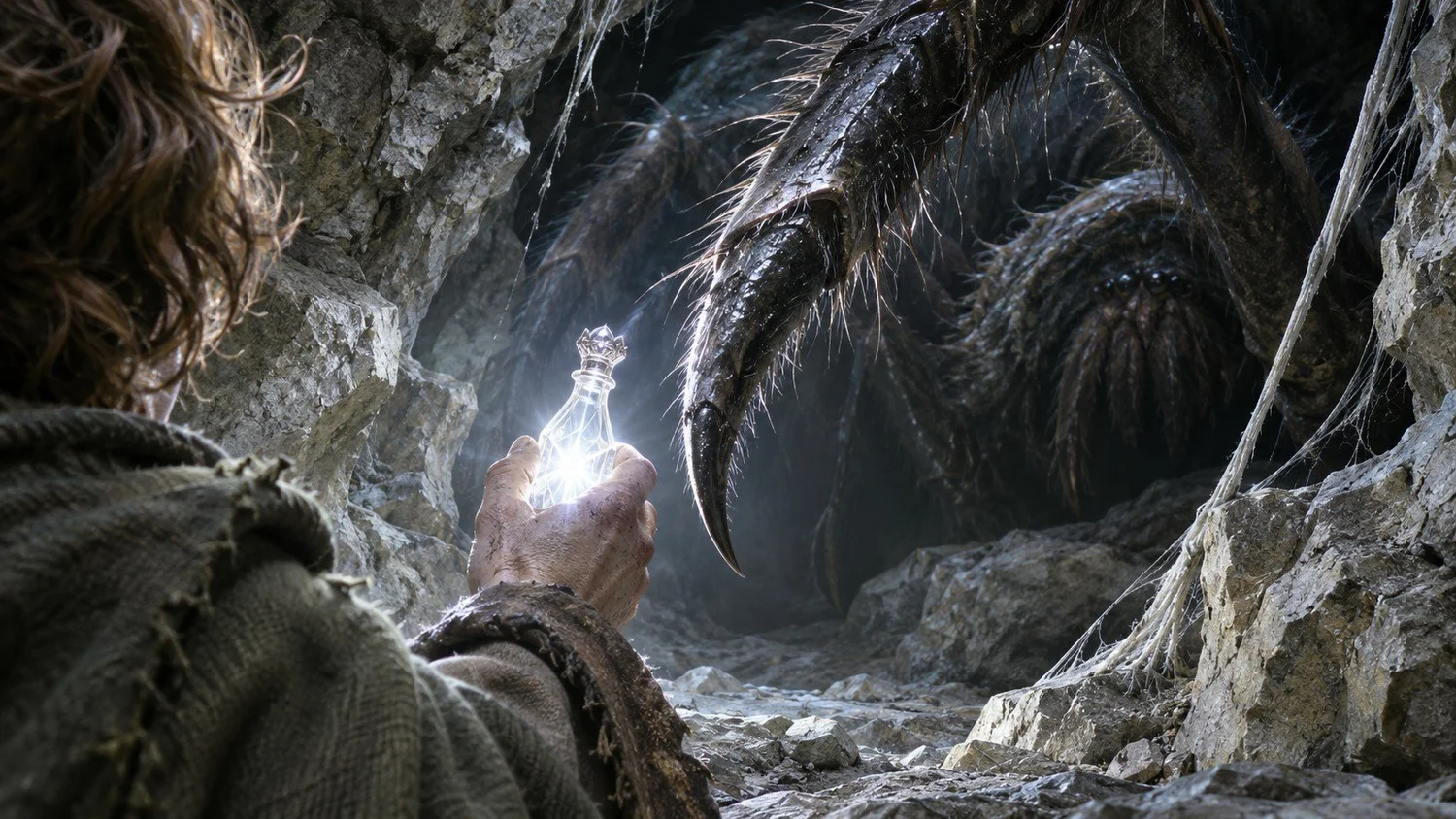
Gollum leads Frodo and Sam into the lair of Shelob, a monstrous spider, in the pass of Cirith Ungol on the border of Mordor. Shelob stings Frodo, and Sam, finding his master cold and unmoving, believes him dead. After agonising over what to do, Sam takes the Ring and decides to finish the quest alone. Moments later, Orcs carry Frodo's body away, and Sam, listening from hiding, learns that Frodo is not dead but paralysed and now a prisoner. The book ends with Sam outside a locked gate, holding the Ring, his master captured by the enemy.
How The Two Towers Is Built: Two Books, Two Journeys
The structure is the first thing to understand. The Fellowship of the Ring follows the company together. The Two Towers splits it. Book Three follows Aragorn, Legolas, Gimli, Merry and Pippin through the events in Rohan and around Isengard. Book Four then goes back in time and follows Frodo and Sam from the moment they left the company until the end of the volume.
Tolkien's method is interlacing: the narrative stays with one group and shows only what they can see, then leaves them, often at a moment of suspense. Readers share the characters' uncertainty. No one in Book Three knows what has happened to Frodo, and Frodo and Sam know nothing of the battles in the west. The effect is a book that feels much larger than its pages, because the reader always knows that something important is happening elsewhere.
The Departure of Boromir: Redemption at the Falls
Book Three opens moments after the end of the first volume. Aragorn, searching for Frodo, hears Boromir's horn and runs towards it. He finds Boromir sitting against a tree, pierced with arrows, surrounded by the bodies of Orcs he has killed. Boromir has died defending Merry and Pippin, who have been carried off.
Before he dies, Boromir confesses to Aragorn that he tried to take the Ring from Frodo, and he asks Aragorn to go to Minas Tirith and save his people. Aragorn tells him that he has not failed, and that few have gained such a victory. The scene redeems the man whose temptation broke the Fellowship. He has been unable to resist the Ring, but he has given his life for the two smallest members of the company, and that sacrifice is what the book chooses to remember.
The three survivors lay Boromir in a boat with his weapons and send him over the falls of Rauros. Then Aragorn faces a hard choice. He can follow Frodo and Sam east, or he can pursue the Orcs who have taken Merry and Pippin. He decides that Frodo's fate is no longer in his hands, and that he will not abandon the captives. The three hunters set off west across the plains.
The Riders of Rohan and the Fate of Merry and Pippin
Aragorn, Legolas and Gimli run for days across open country, tracking the Orcs. They find signs that the hobbits are still alive, including a brooch from an Elven cloak dropped deliberately as a clue. Then they meet a company of horsemen, the Riders of Rohan, led by Éomer, the nephew of King Théoden. Éomer is suspicious and tense: his land is under pressure from the wizard Saruman, and his king is not listening to good advice. He tells them his men have destroyed the Orc band, and that they saw no hobbits. He lends the hunters horses and asks them to bring the horses back.
The story then jumps back to show what happened to Merry and Pippin. Their captors are a mixed and quarrelling company: Uruk-hai, large and powerful Orcs sent by Saruman under the command of Uglúk, and Orcs from Mordor led by Grishnákh. Both sides want the hobbits alive, and both suspect them of carrying something precious. Grishnákh tries to steal them away in the dark to search them for the Ring himself, but he is killed by a Rider's arrow. In the confusion of the attack, the hobbits escape into the eaves of Fangorn Forest.
Treebeard and the Ents: The Forest Wakes Up
In Fangorn, Merry and Pippin meet Treebeard, the oldest of the Ents, giant shepherds of the trees who are slow, thoughtful and very hard to rouse. Treebeard speaks in a language so leisurely that saying anything important takes a long time, and he is careful not to take sides in the affairs of others. He has been a neighbour of Saruman's for many years, and he is beginning to realise that Saruman has been cutting down his trees to feed the fires of Isengard.
The hobbits' story tips the balance. Treebeard calls an Entmoot, a council of the Ents, in a valley called Derndingle. It lasts three days, which to the Ents is hasty. At the end of it, the Ents decide to march on Isengard. The scene is both funny and moving: these ancient beings are finally provoked into action, and the narrative suggests they may be marching to their last battle.
The Ents also carry a quiet sorrow. Treebeard tells the hobbits that the Entwives, the female Ents, were lost long ago, and that the Ents have no young. Their decision to go to war is made knowing they may not survive it. It is one of several places in the book where victory is shadowed by loss, and where the reader senses that whatever happens, the world that follows will be smaller.
The White Rider: Gandalf Returns
Aragorn, Legolas and Gimli follow the hobbits' trail into Fangorn and meet an old man in grey rags. They assume he is Saruman and prepare to attack. Then he throws off the rags and is revealed in white. It is Gandalf.
His story is brief but enormous. He fought the Balrog down through the depths of Moria and up to the peak of a mountain, where he killed it, and then he died. He was sent back, and he is now Gandalf the White, taking the place Saruman has forfeited as head of the wizards. He tells them that Merry and Pippin are safe with Treebeard, and that their own task now lies in Rohan. Some early readers compared this death and return to the Christian resurrection, and the book treats it with the same seriousness, as an event that changes what is possible.
The return of Gandalf also shifts the tone of Book Three. The company is no longer lost. It has a leader again, and Gandalf's plans quickly become the shape of the story.
The King of the Golden Hall: Théoden and Wormtongue
Gandalf leads the three companions to Edoras, the capital of Rohan, and its golden hall, Meduseld. King Théoden is old, bent and silent. His chief counsellor, Gríma, known as Wormtongue, has been whispering to him for years, persuading him that resistance is hopeless and that his loyal men are enemies. Gríma is secretly Saruman's spy.
Gandalf confronts Wormtongue and exposes him, and Théoden straightens and seems to wake from a long sickness. He draws his sword again and agrees to ride to war. Offered the chance to fight with his king or leave, Wormtongue flees to his master in Isengard. Théoden gives Gandalf the great horse Shadowfax, and leaves his niece, Éowyn, to govern his people while he rides out.
The chapter is a portrait of a recovery, and it matters because Rohan is the first people in the book to choose to fight. Its decision gives the war in the west its shape.
Helm's Deep: The Battle in the Night
Saruman's army attacks before Rohan can gather fully. Théoden and his men retreat to Helm's Deep, a fortress in a narrow valley guarded by a great wall and the stronghold of the Hornburg. Through a long night of rain, the defenders hold off wave after wave of Orcs and wild Men from the hills who serve Saruman. Saruman's forces use a blasting fire to break the wall. Aragorn and Éomer fight side by side, and Legolas and Gimli begin a friendly contest over who can kill more of the enemy, a light touch that underlines how close their friendship has become.
By dawn the situation is desperate. Théoden decides to ride out rather than wait to be overrun, and the riders charge down into the valley. Then the battle turns twice in quick succession. Gandalf appears on a ridge with reinforcements, and a forest that was not there the day before has filled the valley mouth. The fleeing Orcs run into the trees and never come out.
The trees are Huorns, half-wakened tree spirits that the Ents have sent. The moment is a perfect example of the book's interlaced structure. The reader, like the defenders, does not know where the forest has come from, and only later learns what the Ents have been doing.
Isengard Destroyed and the Voice of Saruman
When Gandalf, Théoden and the others ride to Isengard, they find Saruman's fortress in ruins. The Ents have torn down its walls and diverted a river to flood it, and Saruman is trapped in his tower, Orthanc. At the gate, sitting among the wreckage with food and pipe-weed, are Merry and Pippin, cheerfully welcoming the lords of Rohan. It is one of the few moments of comedy in a grim volume, and it reunites the company's two threads.
Gandalf then confronts Saruman. Saruman's real weapon is his voice, which can persuade almost anyone that he is reasonable and wise. He tries it on Théoden and nearly succeeds, then on Gandalf. When it fails, Gandalf breaks his staff and casts him out of the order of wizards. As the company turns to go, someone throws a heavy object from the tower at Gandalf. It is Wormtongue, and the object is a palantír, one of the ancient seeing-stones.
That night, Pippin cannot resist. He steals the stone from Gandalf and looks into it, and finds himself facing Sauron, who uses it to communicate with Saruman. Sauron sees a hobbit and leaps to the wrong conclusion: he believes Saruman has captured the Ring-bearer. Pippin's mistake is reckless, but it also shows Gandalf that Sauron is watching through the stones, and it draws the Enemy's eye in the wrong direction. Gandalf takes Pippin on Shadowfax and rides for Minas Tirith, where the war will come next.
The Two Towers of the Title
The title is ambiguous, and Tolkien himself was not happy with it. Several towers appear in the story, and he considered different pairs before settling on an interpretation. A note and his own cover design point to Orthanc, Saruman's tower in Isengard, and Minas Morgul, the stronghold of the Ringwraiths that Frodo and Sam pass in Book Four.
That pairing makes sense of the book's structure. Book Three is about the fall of Orthanc and the defeat of the treacherous wizard. Book Four moves towards Minas Morgul and the darkness beyond it. Each half has its own tower and its own kind of evil: one corrupted from within, one sent out from the Enemy's land.
The Taming of Sméagol: Frodo, Sam and Gollum
Book Four rewinds to the moment Frodo and Sam left the company. They are lost in the rocky hills of the Emyn Muil, unable to find a way down to the marshes that lie before Mordor, and they are being followed. One night they catch their pursuer: Gollum.
Sam wants to tie him up or worse, but Frodo remembers what Gandalf said about pity. He spares Gollum and makes him swear, on the Ring itself, to serve the Ring's master and guide them. Gollum agrees, and for a while he seems to change. Frodo addresses him by his old name, Sméagol, and the creature responds to the kindness. He leads them safely through the Dead Marshes, where the faces of the dead from an ancient battle glimmer in the pools.
But Sam overhears Gollum arguing with himself in two voices: Sméagol, who wants to keep his promise to the kind master, and Gollum, who wants the Precious back. The debate is darkly comic and deeply sad. It is the clearest picture in the book of what the Ring does to a soul over a long time, and it sets up the question that hangs over Book Four: which voice will win?
The Black Gate Is Closed: Ithilien and Faramir
Gollum leads Frodo and Sam to the Black Gate of Mordor. It is impossibly well guarded, and Frodo, desperate, considers walking straight in. Gollum persuades him to take another route he knows of, a secret path to the south through the mountains. Frodo agrees, knowing he may be trusting a traitor.
They pass into Ithilien, a land of herbs and woods that was once part of Gondor. Sam cooks a stew of rabbit and herbs, and the smoke gives them away. They are captured by Faramir, the captain of Gondor's rangers in the area and, it emerges, Boromir's younger brother. Faramir's men have witnessed a battle with soldiers from the south and a great beast called an oliphaunt, which delights Sam.
Faramir takes them blindfolded to Henneth Annûn, a hidden refuge behind a waterfall, and questions Frodo closely. He knows that Boromir is dead, having seen his body drifting in a boat. Frodo tells him only part of the truth, but Sam lets slip that they are carrying the Enemy's ring.
The scene is a mirror of Boromir's temptation. Faramir now has the Ring within his power, and he refuses it. He says, in effect, that he would not take it even if he found it lying on the road. Where Boromir saw a weapon, Faramir sees a danger. He spares Gollum, who has been caught at a forbidden pool, at Frodo's request, and he lets the hobbits go with provisions and a warning about the path Gollum intends to take.
The Stairs of Cirith Ungol: The Road Into Darkness
Gollum leads them through a dark land to a crossroads and on towards Minas Morgul, the tower of the Ringwraiths. They watch an army march out from the city towards Gondor, led by the Witch-king, the same Rider who stabbed Frodo on Weathertop. Frodo feels the weight of the Ring grow heavier with every step.
They climb a long, steep stair into the mountains, towards the pass of Cirith Ungol. On the stairs, Sam and Frodo talk about stories. Sam wonders whether they are in a tale, and whether anyone will ever tell it. Frodo laughs, for the first time in a long while. It is one of the most loved passages in the book, because it lets two exhausted hobbits imagine their ordeal as something that might one day be remembered.
Then comes the turning point for Gollum. He returns from scouting and finds Frodo asleep, his head in Sam's lap. For a moment he reaches out and touches Frodo's knee with something like tenderness. Sam wakes, sees Gollum creeping about, and speaks to him harshly. The moment passes, and Gollum's face hardens. Readers have long seen this as the point at which redemption becomes impossible, and the book frames it as a small, painful failure rather than a dramatic betrayal.
Shelob's Lair: The Ending Explained
Gollum leads them into a tunnel that stinks of something old and evil. It is the lair of Shelob, a giant spider who has lived in the mountains since ancient times and feeds on whatever comes her way. Gollum has led them to her on purpose, hoping to retrieve the Ring from whatever remains.
In the darkness, Frodo holds up the phial Galadriel gave him, and its star-light drives Shelob back. He cuts through her web with Sting and runs for the pass. But Shelob comes round another way and strikes him from behind with her sting. At the same moment, Gollum attacks Sam. Sam fights him off, then sees Frodo bound in Shelob's web. Taking up Sting and the phial, he attacks Shelob and wounds her badly, and she retreats.
Sam finds Frodo pale and still, and believes he is dead. The final chapter, "The Choices of Master Samwise", is devoted to what Sam does next. He grieves. He thinks of staying with the body. Then he reasons that the quest must not fail, and that if he does nothing the Ring will be found by the Enemy. He takes the Ring from Frodo's neck, along with Sting and the phial, and goes on alone.
Within minutes, Orcs arrive and carry Frodo's body off towards their tower. Sam, wearing the Ring to stay hidden, follows and overhears their talk. Shelob's poison does not kill. It paralyses. Frodo is alive and will wake as a prisoner. Sam realises he has made the wrong decision for the right reasons, and the book ends with him outside a gate that has been shut against him. The famous last line is a simple statement that Frodo was alive but taken by the enemy.
The ending is a cliffhanger in the literal sense, but it is also a test of Sam. Until this point he has been loyal and practical. Now he must choose between his master and the mission, and he chooses the mission, only to discover that loyalty to Frodo was still the answer. What he does with the Ring now is the question the final volume must answer.
Saruman: The Wizard Who Wanted the Ring for Himself
Saruman is the villain of Book Three, and he is a different kind of evil from Sauron. Sauron is distant, almost abstract: an Eye, a will, a darkness in the east. Saruman is close at hand, clever and persuasive. He was once the wisest of the wizards and the head of Gandalf's order, and his fall comes from a belief that he could use the Enemy's methods for better ends.
The book makes that corruption visible through industry and destruction. Isengard has become a place of furnaces and pits, and Treebeard's anger is stirred by trees felled and left to rot. Saruman's army mixes Orcs with Men and with the Uruk-hai, and he uses Wormtongue to weaken Rohan from inside its own hall rather than attacking it openly at first. His weapon of choice is not force but argument.
That is why the confrontation at Orthanc is staged as a battle of voices rather than swords. Saruman nearly talks Théoden into peace and nearly persuades the listeners that Gandalf is the unreasonable one. His defeat comes when people refuse to be charmed, and his downfall is completed when his own servant throws away one of his most precious tools in a fit of rage. Saruman is ruined as much by the hatred he has bred around him as by his enemies.
Legolas and Gimli: A Friendship Across an Old Feud
One of the quiet pleasures of Book Three is the friendship between Legolas the Elf and Gimli the Dwarf. Their peoples have distrusted each other for generations, and in Lothlórien Gimli was let in only reluctantly. By the time of Helm's Deep, the two are competing to see who can kill more of the enemy, comparing their tallies like rival sportsmen.
The contest is played for comedy, but it matters to the book's larger argument. Middle-earth's free peoples can only resist Sauron if they stop seeing each other as rivals. The friendship between an Elf and a Dwarf is a small, personal version of the alliance the West needs, and Tolkien lets it develop in jokes and shared danger rather than speeches. Gimli's awe at the caves behind Helm's Deep and Legolas's love of Fangorn's trees give each of them a reason to see the world through the other's eyes.
Sam's Choice: Why the Final Decision Matters
The closing chapter belongs entirely to Sam, and its title, "The Choices of Master Samwise", makes the point clear. Until now, Sam has been the follower: the gardener who went with his master, did the cooking, carried the rope and kept watch. He has never had to decide the fate of the quest himself.
When he believes Frodo is dead, he reasons carefully. If he stays with the body, the Orcs will find the Ring. If he goes back, the quest will have failed. If he goes on, he may still finish what Frodo started. Each option is painful, and he chooses the one that serves the purpose rather than his heart. It is a responsible decision, made in grief and in the dark, and it turns out to be wrong only because he lacked one piece of information.
That detail matters to the way the novel treats heroism. Sam is not punished for choosing the mission. His mistake comes from not knowing what Shelob's sting does, and as soon as he learns the truth he reverses course. The book suggests that good choices are made with incomplete knowledge, and that what counts is the willingness to keep choosing again when the facts change.
Themes: Temptation, Pity and Things Seen Only in Retrospect
The volume puts several characters in front of the same test. Boromir fails it, then redeems himself in death. Faramir passes it with apparent ease. Saruman has already failed it, and his fall is completed in the ruins of Isengard. Gollum has failed it so long ago that his whole personality has been consumed by it. Sam, at the end, briefly carries the Ring and does not yet understand what it will do to him.
Pity runs through Book Four. Frodo's mercy towards Gollum is what makes the journey possible at all, because no one else could have shown him the paths. Yet it is also what leads Frodo to Shelob. Tolkien does not pretend that mercy is safe or always rewarded. He simply suggests that it is right, and that its consequences cannot be calculated in advance.
The interlaced structure also makes a thematic point. Events that seem like coincidences in Book Three, such as a forest appearing at Helm's Deep or Wormtongue throwing a stone, turn out to be linked to choices made elsewhere. Critics have argued that in Tolkien everything is connected, and that the connections become visible only in retrospect. The reader experiences this as surprise; the characters experience it as hope.
Courage in this book is rarely glamorous. It is Théoden choosing to ride out at dawn, the Ents deciding to march although they may not return, and Sam picking up Sting to face a monster no one else would fight. The volume's most heroic acts are often done by people who expect to lose.
How Readers Received The Two Towers
Critics largely welcomed the second volume. Reviewers praised its excitement and moral warmth, and one called it a prose epic in praise of courage. Others felt some passages were too long. Edwin Muir singled out the Ents and the battle of Helm's Deep for praise.
Peter Jackson's 2002 film adaptation changed the shape of the story considerably. It moved Shelob's lair into the third film, so the film version of The Two Towers does not end on the book's cliffhanger. Readers coming to the novel from the film are often surprised by how much darker and stranger the book's final chapters are.
What The Two Towers Sets Up for The Return of the King
By the last page, every thread is at a crisis. Gandalf and Pippin are riding towards Minas Tirith, where war is coming. Aragorn and the Riders of Rohan face the question of what to do next, with Saruman defeated but Sauron's armies on the move. Merry is separated from Pippin for the first time. And on the border of Mordor, Frodo is a prisoner, and Sam, alone with the Ring, must find a way to rescue him.
Gollum's position is the most uncertain of all. He has betrayed the hobbits to Shelob and fled, and he still wants the Ring more than anything. Yet Frodo has twice spared his life, once in the Emyn Muil and once at the Forbidden Pool, and the book has repeatedly reminded readers of Gandalf's warning that Gollum may still have a part to play before the end. Whether that part is as a traitor, a guide or something else entirely is a question the volume deliberately leaves open, and it is one of the main reasons the last line lands so hard. The danger now is not only in Mordor but behind the hobbits on the road.
The book leaves its readers in exactly the place it leaves Sam: outside a closed door, knowing that the most important thing is on the other side.
Sources
- The Two Towers – Wikipedia (publication details, plot, title, themes and reception)
- The Two Towers – Tolkien Gateway (chapter-by-chapter synopsis)
- The Lord of the Rings – Wikipedia (structure and publication history)
