Why Does the Shire Still Need Saving After the Ring Is Destroyed?
The Return of the King is the volume in which Tolkien finally brings together everything The Lord of the Rings has been building towards: a siege, a king, a ride to war and the long walk of two hobbits into Mordor. It is also the volume that refuses to end where most adventure stories would. After the great battle and the destruction of the Ring, Tolkien sends his heroes home, and the hardest lesson of the book is waiting for them there.
Published by George Allen & Unwin on 20 October 1955, the third volume contains Books Five and Six of Tolkien's novel and the appendices. This summary explains what happens at Minas Tirith and the Pelennor Fields, how Sam rescues Frodo, what really happens at Mount Doom, why the Shire must be saved after the war is won, and why Frodo cannot stay. It follows our Two Towers summary.
Spoiler warning: the following summary discusses the plot and ending of The Return of the King and of the whole of The Lord of the Rings.
The Short Answer: How The Lord of the Rings Ends
Frodo reaches the Cracks of Doom inside Mount Doom, but at the last moment he cannot destroy the Ring and claims it for himself. Gollum attacks him, bites off his finger with the Ring on it, and in his triumph falls into the fire. The Ring is destroyed, Sauron's power collapses, and the armies of the West, gathered at the Black Gate as a desperate distraction, win. Aragorn is crowned king and marries Arwen. The hobbits go home to find the Shire taken over by Saruman, now called Sharkey, and they lead a rising to free it. Frodo, permanently wounded by his burden, cannot find peace in the Shire. He sails west from the Grey Havens with Bilbo and Gandalf, and Sam returns home to his family.
Minas Tirith: Pippin Enters the Steward's Service
Book Five begins with Gandalf and Pippin galloping on Shadowfax to Minas Tirith, the great white city of Gondor, built in seven levels against a mountain. Gondor has had no king for many centuries. It is ruled by a Steward, Denethor, the father of Boromir and Faramir. He is proud, intelligent and grief-stricken over Boromir's death.
Pippin, feeling guilty that Boromir died defending him, offers Denethor his service. The old lord accepts and makes him a soldier of the city. It is an impulsive gesture, and it places a hobbit at the centre of Gondor's government at the worst possible moment. Through Pippin's eyes, the reader sees the city preparing for war: beacons lit across the mountains, the people sent away, and a darkness rising out of Mordor that hides the sun.
Denethor is a man who believes he understands the situation better than anyone. He resents Gandalf's influence, and he treats Faramir, his surviving son, coldly, implying he would rather Faramir had died instead of Boromir. That bitterness matters, because it shapes the decisions Denethor makes when the city is surrounded.
The Paths of the Dead and the Muster of Rohan
While Gandalf and Pippin reach Gondor, Aragorn makes a decision of his own. Joined by a company of Rangers from the north, he decides to take the Paths of the Dead, a haunted road under the mountains between Rohan and Gondor. Legolas and Gimli go with him. The road is guarded by the Dead Men of Dunharrow, ghosts who broke an oath to Isildur long ago and cannot rest until they fulfil it. As Isildur's heir, Aragorn can summon them.
He does, and leads the army of the dead south. Gondor's southern coast is under attack from the Corsairs of Umbar, pirates allied with Sauron, and Aragorn unleashes the dead on their fleet. The Corsairs flee, and Aragorn releases the ghosts from their oath. He now has ships.
Meanwhile Théoden gathers the Riders of Rohan to answer Gondor's call. Merry, who has sworn service to Théoden, is told he is too small and must stay behind. A young rider calling himself Dernhelm quietly offers to take him along on his own horse. The great host rides east, guided through a dark forest by the Drúedain, a reclusive people led by Ghân-buri-Ghân, who show them a forgotten road that avoids the enemy.
The Siege of Gondor: The Gate Breaks
Sauron's army surrounds Minas Tirith. Faramir is brought back from a desperate fight in the outlying fortifications, gravely wounded and unconscious, and Denethor sinks into despair. Catapults hurl fire into the city. Then the leader of the Ringwraiths, the Witch-king, breaks the great gate with a battering ram and a spell, and rides through.
Gandalf alone stands in the gateway to face him. The two confront each other, and at the very moment it seems Gandalf must fight, a cock crows in the city, and from far away come the horns of Rohan. The Rohirrim have arrived. The Witch-king turns away to meet the new threat.
The timing is typical of Tolkien's method in this volume. Disaster arrives at the last possible moment, and so does help. But the help never feels mechanical, because the reader has followed Merry's journey with the riders and knows what it has cost to get there.
The Battle of the Pelennor Fields
The Riders of Rohan charge into the besiegers at dawn. Théoden leads them, transformed from the bent old man of Edoras into a king at the head of his people. For a while, the charge sweeps everything before it. Then the Witch-king comes down on a winged beast and strikes Théoden's horse, which falls and crushes the king.
Only two of Théoden's company stand between the dying king and the Witch-king: Merry, and the young rider Dernhelm. Dernhelm throws off the helmet and is revealed as Éowyn, Théoden's niece, who has ridden to war in disguise rather than wait at home. There was an old belief that the Lord of the Nazgûl could not be killed by the hand of a man, and the book makes much of the fact that his opponents are a woman and a hobbit. Merry stabs the Witch-king from behind with the dagger he took from the Barrow-downs, a blade forged long ago to fight this very enemy, and Éowyn drives her sword into the space where his face should be. The Witch-king is destroyed. Both Merry and Éowyn are struck down by the effort.
The battle turns again when a fleet of black ships appears on the river. Defenders despair, thinking the Corsairs have come. Then a royal standard unfurls on the leading ship: Aragorn has arrived with the soldiers of southern Gondor. The armies of Gondor and Rohan win the field, but at great cost. Théoden dies, naming Éomer as his heir.
The dagger from the barrow is one of the best examples of Tolkien's long patience as a storyteller. A gift given to hobbits in the first volume, almost as an afterthought, becomes the weapon that ends the most feared servant of Sauron.
The Pyre of Denethor
While the battle rages, Denethor makes his final choice. Convinced that all is lost, he orders a funeral pyre built for himself and Faramir, who he believes is dying. Pippin realises what is happening and runs for Gandalf. Gandalf arrives in time to save Faramir, but Denethor sets himself alight and dies.
The reason for his despair is revealed: Denethor has been using a palantír, a seeing-stone like the one Pippin looked into at Isengard. He has seen Sauron's might and been shown only what Sauron wished him to see. Unlike Saruman, he was not turned into a servant, but he was persuaded that there is no hope. His end is the book's clearest picture of how despair can be a weapon of the Enemy.
The Houses of Healing and the Last Debate
After the battle, Aragorn enters Minas Tirith quietly rather than as a conqueror, and goes to the Houses of Healing, where Faramir, Éowyn and Merry lie stricken by the shadow of the Nazgûl. An old woman of the city remembers a saying that the hands of a king are the hands of a healer. Aragorn uses kingsfoil, the same herb he used on Frodo at Weathertop, and they recover. It is the first sign to the people of Gondor that their king has returned.
Victory at the Pelennor has bought time, not safety. The captains of the West hold a council, the Last Debate, and agree that they cannot defeat Sauron by force. Their only hope is Frodo. So they decide to march on the Black Gate of Mordor with an army of about seven thousand men, knowing it is far too small, simply to draw Sauron's eye away from the land where the Ring-bearer may be. It is a plan that requires them to accept their likely deaths.
The Black Gate Opens
The army reaches the Black Gate. Out comes the Mouth of Sauron, an emissary who taunts them and displays Frodo's belongings, including Sam's sword and the mithril coat, as proof that the Ring-bearer has been captured. He offers humiliating terms. Gandalf refuses and takes the belongings back. The gate opens, and Sauron's armies pour out and surround the small force. Book Five ends with the battle beginning and Pippin, fighting beside the men of Gondor, losing consciousness beneath a fallen troll.
Tolkien leaves the reader in suspense here and goes back to Sam, which means that the moment of greatest despair in the west is the moment the story returns to the east.
The Tower of Cirith Ungol: Sam's Rescue
Book Six opens where The Two Towers ended. Sam is outside the Orc tower of Cirith Ungol, holding the Ring. Wearing it on the border of Mordor, he feels its temptation strongly for the first time, with visions of himself as a great warrior turning Mordor into a garden. He rejects it, in part because his common sense tells him that one small gardener's patch is all he really wants.
Inside the tower, the Orcs have fought among themselves over Frodo's mithril coat, and most of them are dead. Sam finds his way in and rescues Frodo, who has been stripped and beaten. When Sam gives back the Ring, Frodo snatches it and briefly sees Sam as a greedy creature trying to steal it. The moment passes, and Frodo is horrified at himself. It is a sign of how deeply the Ring has taken hold of him.
The Land of Shadow and Mount Doom
Disguised in Orc gear, Frodo and Sam begin the long march across Mordor. They are swept along with a column of Orcs for a time and escape in the confusion. The land is barren. There is almost no water. The Ring grows heavier and Frodo grows weaker with every mile. Sam rations their food and water, and eventually throws away almost everything they carry, including their cooking gear, so that they can travel light for the final climb.
On the slopes of Mount Doom, Frodo can no longer walk, and Sam carries him. Gollum, who has followed them through Mordor, attacks. Frodo throws him off, and Sam is left with Gollum at his mercy. He could kill him, and he wants to. But Sam has now carried the Ring himself, and he understands something of what it does. He spares Gollum.
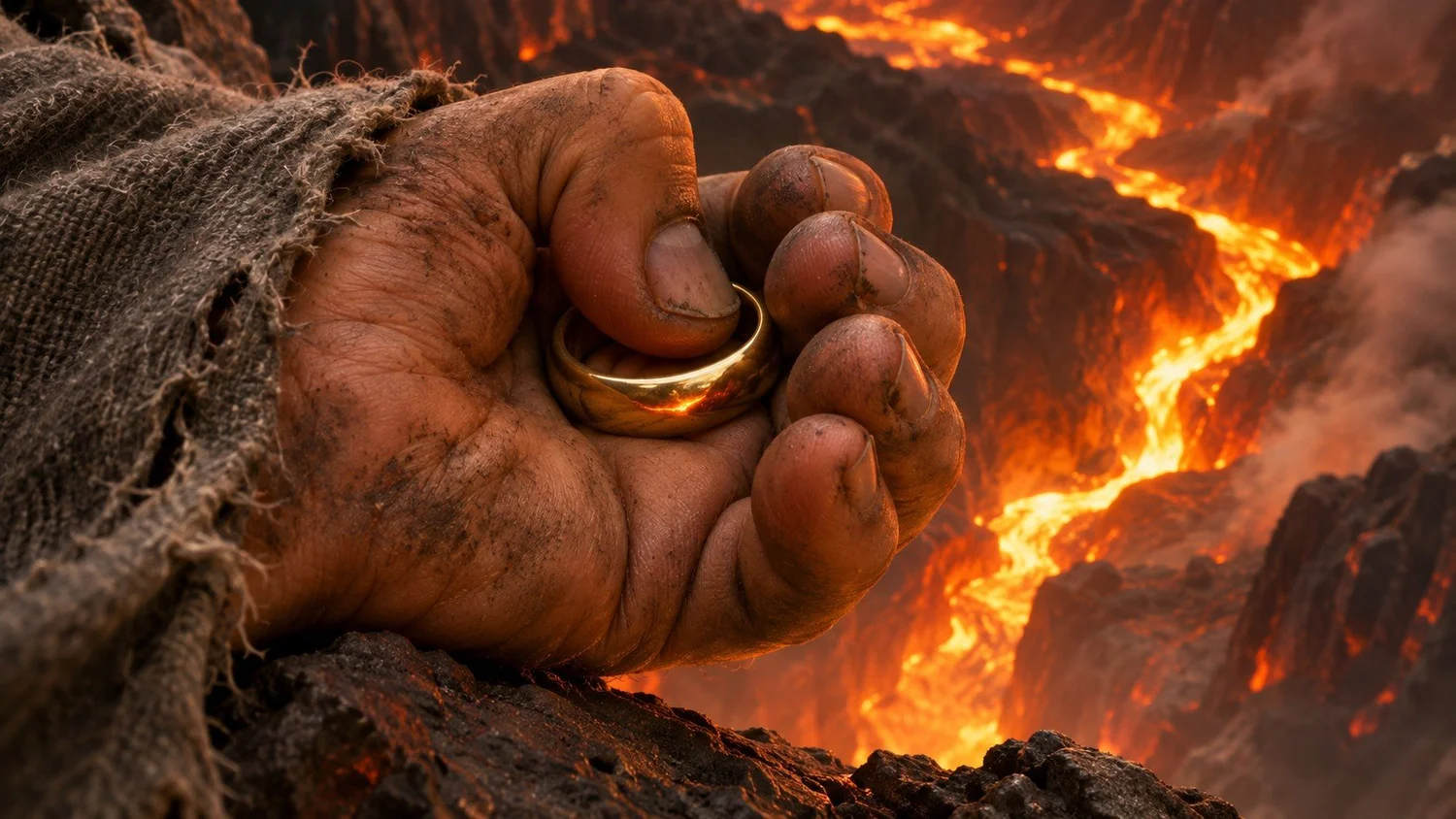
Frodo reaches the Cracks of Doom, the chamber where the Ring was forged. Standing at the edge, he says that he has come, but that he will not do what he came to do. He claims the Ring as his own and puts it on, vanishing. Sauron becomes aware of him at that instant, and the Nazgûl fly towards the mountain.
Then Gollum attacks again. He grapples with the invisible Frodo, bites off his finger with the Ring still on it, and dances with joy at having his Precious back. In his frenzy he steps too close to the edge and falls into the fire with it. The Ring is destroyed. Mordor shakes, the Dark Tower falls, and Sauron's power is broken.
Why Frodo Fails, and Why It Matters
The climax of The Lord of the Rings is not a moment of heroic triumph but a moment of failure. Frodo has carried the Ring to the only place it can be destroyed, and when he arrives he cannot let it go. No one, the book suggests, could have done so at that point. The Ring is at its strongest in the place where it was made, and Frodo has been worn down by months of its weight.
What saves the quest is the pity shown to Gollum, first by Bilbo long ago, then by Frodo in the Emyn Muil and at the Forbidden Pool, and finally by Sam on the slopes of the mountain. Each of them could have killed Gollum. None of them did. Gandalf's warning in the first volume, that Gollum might yet have a part to play, turns out to be the key to the whole story. The Ring is destroyed not by strength but by the consequences of mercy.
Tolkien had a word for this kind of ending. In his essay "On Fairy-Stories", based on a lecture of 1939, he described the eucatastrophe: a sudden turn of events that rescues the protagonist from an impending doom. The destruction of the Ring is often described as the best-known example of this in his work. Victory seems certain for Sauron, and then, through Gollum's greed and a single misstep, it is snatched away.
Frodo does not end the story as a conquering hero. He ends it maimed, missing a finger, and aware that he failed at the final moment. That honesty is part of what makes the book's ending so powerful. Its hero is the person who carried the burden as far as anyone could, not the one who overcame it alone.
The Field of Cormallen: Rescue and Reunion
As Mount Doom erupts, Frodo and Sam are stranded on a rock surrounded by rivers of fire, expecting to die. They are rescued by the Eagles, led by Gwaihir, who have flown to the battle at the Black Gate. Sam and Frodo wake in Ithilien, in a green field called Cormallen, to find Gandalf beside them.
They are honoured before the whole army. The joy of the scene is deliberate. After hundreds of pages of grimness, Tolkien allows his characters a great celebration, and Sam, overwhelmed, laughs and weeps at once.
The Steward and the King
Aragorn is crowned King of Gondor and Arnor at the gates of Minas Tirith. In a scene full of symbolism, the crown is brought to him by Frodo and placed on his head by Gandalf. Aragorn names Faramir Prince of Ithilien. Faramir and Éowyn, who met and fell in love in the Houses of Healing, are to marry. Éowyn, who rode to war because she could not bear to be left behind, chooses instead to become a healer.
A sapling of the White Tree, the symbol of the kings, is found on the mountain and planted in the city. Then Arwen, Elrond's daughter, arrives, and she and Aragorn are married. Their story is told in full in the appendices. It is the tale of an immortal Elf who chooses mortality to be with a Man, and Tolkien considered it essential to understanding the book.
Éowyn and Faramir: Two Survivors Who Choose to Heal
The quietest love story in the book belongs to Éowyn and Faramir, and it is one of its most carefully observed. Éowyn rode to war because she felt caged by her duties at home and drawn to glory. She hoped, in part, to die in battle. Faramir, overshadowed all his life by his brother and rejected by his father, has also been brought close to death. They meet in the Houses of Healing while the fate of the world is being decided far away, and neither of them can do anything but wait.
Their relationship grows out of that waiting. Éowyn gradually lets go of her longing for a glorious death, and Faramir offers her a companionship that does not depend on deeds. When she decides to become a healer, the change is presented as a choice for life rather than a retreat from courage. In a book full of battles, their story suggests that recovery can be its own kind of victory.
Many Partings and the Road Home
The company begins to scatter. Théoden's body is carried home to Rohan for burial, and Éomer becomes king. Galadriel and Celeborn depart, and the hobbits say goodbye to Treebeard and to Aragorn. They return to Rivendell to see Bilbo, now very old, and then begin the journey back to the Shire. At Bree, Barliman Butterbur tells them that the countryside has become dangerous, and that strange Men have caused trouble. Gandalf, who has travelled with them this far, leaves them. He tells them they no longer need him, and that they must settle the Shire's affairs themselves.
The Scouring of the Shire: The War Comes Home
When the hobbits reach the Shire, they find it transformed. The bridge is barred. The Shire is full of petty rules, enforced by hobbit "Shirriffs". New ugly buildings have replaced old ones, trees have been cut down, the inns are closed and goods are being taken away. At Bywater, the old mill has been replaced by a noisy machine that pollutes the water and air. A gang of human ruffians enforces the new order.
This time the hobbits do not need a wizard. Merry blows the horn of Rohan that Éowyn gave him, and Sam rallies Farmer Cotton and his sons. Pippin brings a hundred Tooks from their homeland. In the Battle of Bywater, the hobbits trap the ruffians in a lane between wagons and defeat them. Frodo does not fight, and insists that hobbits should not kill hobbits.
At Bag End they find the man behind it all: Saruman, now calling himself Sharkey, with Wormtongue at his heels. Saruman has lost almost all his power except his voice, and he admits he damaged the Shire out of spite. He tries to stab Frodo, but the blade breaks on Frodo's mithril coat. Frodo will not allow him to be killed and offers Wormtongue the chance to stay. Saruman reveals that Wormtongue murdered Lotho, the Sackville-Baggins who had first opened the door to him. Wormtongue cuts Saruman's throat and is shot by hobbit archers.
The chapter is one of the most debated in the book. Tolkien insisted it was not an allegory of post-war Britain and had been foreseen from the outset. Critics have read it as an environmental argument, a political satire, a coming of age for the hobbits and a deliberate anticlimax. Whatever the reading, its purpose in the story is clear: the hobbits have been changed by the war, and they come home able to save themselves. Peter Jackson left the chapter out of his film adaptation.
The Grey Havens: Why Frodo Leaves
The Shire recovers quickly. Sam uses the earth from Galadriel's box to replant the trees, and the following year is one of the most fruitful the Shire has ever known. Sam marries Rosie Cotton, and they have a daughter, Elanor. Merry and Pippin are hailed as heroes. Frodo is not.
He lives quietly, writes the history of their adventures, and is troubled on the anniversaries of his wounds. The knife of the Witch-king, the sting of Shelob and the loss of the Ring have left him unable to be at peace. He tells Sam that he tried to save the Shire, and it has been saved, but not for him.
Two years after his return, Frodo goes with Sam to the Grey Havens on the coast. There they meet Bilbo, Elrond, Galadriel and Gandalf. The Ring-bearers are to be allowed to sail west, over the sea, to a place where Frodo may be healed. Frodo leaves the record of their story for Sam to finish, and boards the ship. Merry and Pippin arrive in time to say goodbye.
The last scene belongs to Sam. He rides home, and his wife puts his daughter on his lap, and he says, simply, "Well, I'm back."
Aragorn: The King Who Had to Wait
Aragorn's arc reaches its completion in this volume, and Tolkien handles it with restraint. He has been a Ranger, a guide and a reluctant leader, and he has spent decades waiting for the right moment to claim his inheritance. When the moment comes, he does not march into Minas Tirith demanding a crown. He pitches his tents outside the walls after the battle and enters the city quietly to heal the wounded.
That choice says a great deal about what kind of king the book values. Denethor ruled through pride and knowledge, and was destroyed by despair. Aragorn earns recognition through acts of care: the healing in the Houses of Healing, the decision to march on the Black Gate to protect Frodo, and the willingness to risk everything for a plan he cannot control. His authority comes from service rather than from bloodline alone, although his bloodline is what allows him to command the dead.
His coronation also reverses an old failure. His ancestor Isildur took the Ring when he could have destroyed it, and the long decline of the kingdoms followed. Aragorn never takes the Ring, though he could have done so many times. The return of the king is possible only because the heir of Isildur refuses the temptation that ruined his house.
Sam Gamgee: The Hero Who Carries the Hero
Many readers come away from the final volume convinced that Sam is its true hero, and the text gives them plenty of evidence. He rescues Frodo from the tower. He keeps them both alive across Mordor by rationing every drop of water. He resists the Ring when it offers him greatness. And when Frodo can no longer stand, Sam carries him up the mountain on his back.
What makes Sam remarkable is that his strength is ordinary. He has no royal blood, no magic and no special destiny. His motivation is love for his master and a homesick longing for the Shire's gardens, and those simple loyalties prove more resistant to the Ring than the ambitions of wizards and kings. When the Ring tempts him with visions of power, it is his modest sense of his own size that saves him.
The ending honours that ordinariness. Sam is the one who goes home and stays home, raises a family and inherits the task of finishing the story. Frodo's sacrifice saved the Shire; Sam's life is what the Shire was saved for.
The Ending Explained: Victory, Loss and the Ordinary Life
The ending of The Lord of the Rings refuses to be purely triumphant. The Ring is destroyed, the king returns and the Shire is saved, but the book is just as concerned with what is lost. The Elves are leaving Middle-earth. Théoden, Boromir and many others are dead. Frodo has saved a world he can no longer live in.
Tolkien said that the central theme of his work was death and immortality, and the ending makes that concrete. Arwen gives up immortality. The Elves go into the West, where they will not die but will no longer be part of the world. Frodo is allowed to go with them because his wound cannot be healed in Middle-earth.
That is why the last word goes to Sam. He has carried Frodo up the mountain, he has borne the Ring briefly, and he has seen everything Frodo saw. But he returns to a family and a garden and a life that continues. The book ends not with a battle or a coronation but with a hobbit coming home, because the ordinary life the heroes fought for is the real reward.
The Appendices: The History Behind the Story
The third volume also contains extensive appendices, which many readers skip and some treasure. They give the history of the earlier Ages of Middle-earth, the histories of Gondor, Rohan and the Dwarves of Durin's line, and a chronology of events. They include genealogies of hobbit families, notes on calendars, writing systems and languages, and "The Tale of Aragorn and Arwen".
The appendices also provide closure for the surviving characters. They note that Sam gave the history, known as the Red Book of Westmarch, to his daughter Elanor, and record that Sam himself, and later Legolas and Gimli, eventually sailed over the sea. They let the reader know that the story did not end at the Grey Havens, but continued as history.
How The Return of the King Was Received
Peter Jackson's 2003 film adaptation of The Return of the King won 11 Academy Awards. The novel itself had already become one of the most influential works of the twentieth century. W. H. Auden called The Lord of the Rings a masterpiece, while the critic Edmund Wilson dismissed it. Readers have largely sided with Auden: the work has sold over 150 million copies and remains the foundation of modern fantasy.
The final volume's decision to continue after the climax divides some readers, and the Scouring of the Shire in particular has been described as one of literature's most famous anticlimaxes. But without it, the book would be a story about saving the world. With it, it becomes a story about what saving the world costs, and who has to pay.
Sources
- The Return of the King – Wikipedia (publication details, plot and appendices)
- The Return of the King – Tolkien Gateway (chapter-by-chapter synopsis and final line)
- The Scouring of the Shire – Wikipedia (chapter plot, Tolkien's statements and critical readings)
- Eucatastrophe – Wikipedia (Tolkien's term and the Mount Doom climax)
- The Lord of the Rings – Wikipedia (themes, reception, sales and films)
Next Reads
- The Fellowship of the Ring Summary: The Party, the Quest and the Breaking of the Fellowship Explained
- The Two Towers Summary: Helm's Deep, Shelob's Lair and the Cliffhanger Ending Explained
- The Hobbit Ending Explained: How Bilbo's Ring Leads to The Lord of the Rings
- Fëanor's Hammer, Mount Doom and the One Ring: The Rings of Power Explained
