Bilbo's Journey There and Back Again
A Hobbit Who Wanted Nothing More Than Second Breakfast, and the Ring He Put in His Pocket
J.R.R. Tolkien's The Hobbit begins as a children's story about a comfortable little person who is talked into an adventure he never wanted. It ends with a dead king, a dragon at the bottom of a lake, a war that almost nobody meant to fight and a hobbit who goes home poorer in reputation and richer in almost every other way. It also hides, in a dark chapter under a mountain, the object that would become the centre of The Lord of the Rings. With The Rings of Power season 3 now streaming and Sauron trying to forge that same ring on screen, it is a good moment to go back to where Tolkien's story of the Ring started. This guide covers the background first, then gives a clear spoiler warning, and follows Bilbo's journey in order before explaining the ending, Thorin's death, the Arkenstone and how the ring links it all to The Lord of the Rings.
Key Terms for New Readers
Hobbit: one of a small, comfortable, home-loving people, about half the height of a human, with hairy feet and no shoes.
Burglar: the role Gandalf assigns Bilbo. The dwarves need a quiet, sneaky expert to get inside the mountain.
The Lonely Mountain (Erebor): the dwarf kingdom that a dragon seized long before the story begins. Dale was the town of men beside it.
Durin's Day: the dwarves' new year, the first day of the last moon of autumn. It counts as Durin's Day only when that moon and the sun are in the sky together.
The Necromancer: a mysterious sorcerer in southern Mirkwood, the great forest the company must cross.
Dragon-sickness: the greed that gold can cause, especially dragon-hoarded gold.
The Characters You Need to Know
Bilbo Baggins: a respectable hobbit of about fifty, with a hidden adventurous streak from his mother's family, the Tooks.
Gandalf: a wizard who sets the adventure in motion and keeps disappearing.
Thorin Oakenshield: the proud dwarf leader, heir to the King under the Mountain.
The other twelve dwarves: Balin, Dwalin, Fili, Kili, Dori, Nori, Ori, Oin, Gloin, Bifur, Bofur and Bombur.
Elrond: the wise half-elven master of Rivendell.
Gollum: a slimy creature living on an island in an underground lake.
Beorn: a huge man who can take the shape of a bear.
The Elvenking: the ruler of the Wood-elves of Mirkwood.
Bard: a grim archer of Lake-town, descended from the lords of Dale.
Smaug: the dragon.
The Hobbit and The Rings of Power: What's on Screen Now
The Lord of the Rings: The Rings of Power season 3 premiered on Prime Video on 11 November 2026, releasing its first four episodes at once. It is the same day and the same service in the UK and the US. Episodes five and six arrive on 18 November and the last two on 25 November. The series is set in the Second Age, thousands of years before The Hobbit, and its new season follows Sauron's attempt to forge the One Ring in Mordor.
Several names in the show have long histories that reach Bilbo's story. Elrond, played by Robert Aramayo, is the same Elrond who welcomes the dwarves to Rivendell. The Stranger, played by Daniel Weyman, is now credited as Gandalf. The dwarves of Durin's line are Thorin's ancestors. And the ring Sauron is trying to make is the one that ends up in Bilbo's pocket.
On the big screen, Peter Jackson's three-part film adaptation came out between 2012 and 2014. The next Middle-earth film, The Lord of the Rings: The Hunt for Gollum, directed by and starring Andy Serkis, is due in cinemas in December 2027.
Spoiler warning: the following summary discusses the plot, major twists and ending of The Hobbit, and how its ring connects to The Lord of the Rings.
An Unexpected Party
"In a hole in the ground there lived a hobbit." Bilbo Baggins is smoking his pipe outside Bag End when Gandalf arrives and announces that he is looking for someone to share in an adventure. Bilbo politely gets rid of him. Gandalf scratches a secret mark on his green front door.
The next evening, thirteen dwarves arrive for tea, one or two at a time, and eat everything in the house. Their leader, Thorin Oakenshield, explains the mission. Long ago the dragon Smaug descended on the Lonely Mountain, killed or drove out the dwarves, destroyed the nearby town of Dale and has slept on their treasure ever since. Thorin's grandfather Thror was King under the Mountain. Thorin means to take back his inheritance.
Gandalf produces a map and a key. The map shows a secret side door into the mountain. Gandalf obtained it from Thorin's father, Thrain, in the dungeons of the Necromancer, though he says little about how. The dwarves need a burglar to get inside, and Gandalf has told them Bilbo is an expert. Bilbo, who is nothing of the sort, is offended by their doubts, and the Took side of him stirs. The next morning, he runs out of the house without even a pocket handkerchief.
The Road to the Misty Mountains
Trolls
The first trouble comes in the rain. Bilbo is sent to investigate a fire in the woods and finds three huge trolls, Bert, Tom and William, roasting mutton. His attempt to pick a troll's pocket goes badly, and the dwarves are captured one by one and stuffed into sacks. Gandalf saves them by throwing his voice, keeping the trolls arguing until dawn, when sunlight turns them to stone.
In the trolls' cave the company finds treasure and three ancient elvish blades. Gandalf takes one, Glamdring, and Thorin takes Orcrist. Bilbo gets a knife that is just the right size for a hobbit to use as a sword.
Rivendell
At Rivendell, Elrond examines the swords and the map. He spots hidden moon-letters, writing that can be read only by the light of a moon of the same shape and season as the night it was written. The letters reveal the secret: the door can be found by standing by the grey stone when a thrush knocks, as the last light of the setting sun on Durin's Day falls on the keyhole. It is a riddle about a precise moment in time, and without it the door could never be opened.
Goblins
Crossing the Misty Mountains, the company shelters in a cave during a storm. In the night, a crack opens at the back, and goblins drag them into tunnels beneath the mountain. Gandalf kills the Great Goblin with Glamdring and leads the dwarves away in the dark. In the panic, Bilbo is knocked down and left behind.
Riddles in the Dark
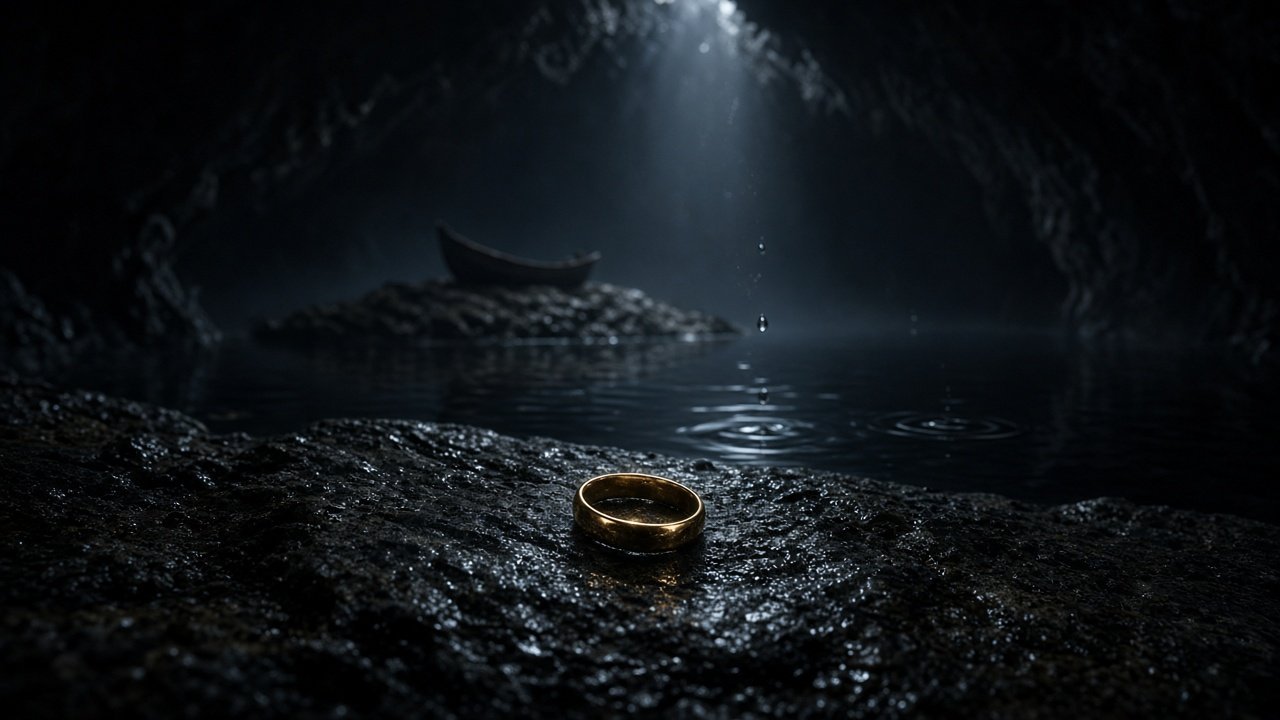
When Bilbo wakes, alone in the pitch black, his hand closes on a small metal ring lying on the tunnel floor. He puts it in his pocket, barely thinking about it. Then he walks down to an underground lake, where Gollum lives on a rocky island, catching fish and the occasional goblin.
Gollum is hungry, but unsure about the stranger with the sword, so he proposes a riddle game. If Bilbo loses, Gollum eats him. If Gollum loses, he will show Bilbo the way out. They swap riddles about mountains, wind, darkness and eggs. Running out of ideas, Bilbo puts his hand in his pocket, touches the ring and asks out loud, "What have I got in my pocket?" It is not a proper riddle, but Gollum accepts it, and fails his three guesses.
Gollum does not keep his promise. He paddles to his island to fetch his "precious", a magic ring that makes the wearer invisible, intending to sneak up on Bilbo and strangle him. The ring is gone. Gollum realises what Bilbo has in his pocket and comes after him in a rage. Running, Bilbo slips the ring on by accident, and Gollum rushes past without seeing him.
Bilbo follows him, invisible, to the goblins' back door. Gollum blocks the passage. Bilbo could kill him, but he stops. He feels pity for the wretched creature, alone in the dark, and leaps over him instead. Behind him, Gollum shrieks "Thief!" and curses the name Baggins. Bilbo squeezes through the door, losing his brass buttons, and out into the sunlight.
When he finds the dwarves, he decides not to tell them about the ring. He lets them think he slipped past the goblins by skill, and his reputation as a burglar rises.
Wolves, Eagles and a Bear
The company is chased by wargs, evil wolves, and trapped in fir trees, which the goblins set on fire. They are saved by the Lord of the Eagles, who carries them away. Gandalf then takes them to Beorn, a gruff skin-changer who hates goblins. He gets them in by a trick, introducing the dwarves to Beorn in pairs, so that the shock of thirteen guests arrives gradually.
At the edge of Mirkwood, Gandalf leaves. He has "pressing business away south", he says, and he warns them on no account to leave the forest path.
Mirkwood and the Wood-elves
Mirkwood is dark, airless and nearly endless. The food runs out. Bombur falls into an enchanted stream and sleeps for days. Seeing lights and feasting in the trees, the starving dwarves leave the path, and the elves' fires vanish each time they approach. In the confusion, they are lost.
Bilbo wakes to find a giant spider winding him in thread. He kills it alone, in the dark, with his little sword, and he feels "a different person, and much fiercer and bolder". He names the blade Sting. Then, using the ring and taunting the spiders with insulting songs, he frees the dwarves, who are hanging in bundles from the branches.
The Wood-elves capture them anyway, apart from Bilbo, who is wearing the ring. Thorin, who had been captured earlier, refuses to tell the Elvenking why they are travelling. The dwarves are locked in the king's halls. For weeks, Bilbo lives in the palace like a ghost, and eventually he steals the keys from a drunk guard. He packs the dwarves into empty barrels, which are floated down the river to Lake-town. Bilbo rides on top of one, soaked, cold and the only one not inside.
2:06 PMTaylor Tailored
The Lonely Mountain
Lake-town
Lake-town, also called Esgaroth, is a town of men built on stilts in the Long Lake. Thorin walks into the Master's feast and announces himself as the heir of the King under the Mountain. The townspeople remember old songs that the King would return and the rivers would run with gold, and the company is treated as heroes. The Master is happy to see them go, and doubtful about their chances.
The Secret Door
On the mountain, the company finds the hidden ledge, but not the door. They grow bitter and quarrel. Then, on Durin's Day, Bilbo sits by the grey stone as the sun sets, and a thrush cracks a snail against it. A last ray of light falls on the rock, a flake falls away, and the keyhole appears. Thorin's key fits.
The Bravest Thing Bilbo Does
The dwarves send their burglar in alone. Bilbo creeps down the long tunnel towards the red glow and the sound of the dragon's breathing. The narrator stops to say that going on at that moment was the bravest thing Bilbo ever did, and that the fights that came later were nothing compared to it.
Smaug lies asleep on a heap of gold and jewels. Bilbo steals a great two-handled cup. When Smaug wakes and finds it gone, he goes berserk, and nearly roasts the dwarves outside.
On a second visit, Bilbo wears the ring and talks to the dragon. He knows not to give his name, so he describes himself in riddles: he is the clue-finder, the web-cutter, Barrel-rider. Smaug is vain and clever, and he tries to turn Bilbo against the dwarves, asking how he will ever get his share of the treasure home. Bilbo flatters him into showing off his armour of embedded gems, and spots a bare patch on the left side of his chest.
Back outside, Bilbo tells the dwarves about the gap. An old thrush is listening.
The Death of Smaug
Smaug has guessed that the men of the Lake helped the dwarves. He flies to Lake-town to destroy it. As the town burns, Bard, a descendant of the old lord of Dale, keeps shooting with a handful of archers. As his last arrow is about to fly, the thrush lands on his shoulder and tells him where the gap is. Bard can understand it because of his ancestry. He fires his black arrow, an heirloom of his family, into the bare patch. The dragon crashes down on the burning town and dies in the lake.
How The Hobbit Ends
The Arkenstone
With Smaug gone, Thorin and the dwarves move into the mountain. Thorin is looking for one treasure above all: the Arkenstone, the Heart of the Mountain, a great white gem that belonged to his grandfather. He does not know that Bilbo has already found it in the hoard and hidden it.
The survivors of Lake-town, led by Bard, march on the mountain with the Elvenking's army. Bard asks Thorin for a fair share of the treasure, to rebuild the town Smaug destroyed and to repay what was taken from Dale. Thorin, in the grip of dragon-sickness, refuses to bargain under threat. He fortifies the gate and sends word to his cousin Dáin in the Iron Hills to bring an army.
Bilbo sees that a war is coming over gold. One night, he slips out wearing the ring, walks into the enemy camp and gives the Arkenstone to Bard and the Elvenking, so they can trade it for a fair settlement. An old man in a cloak, who turns out to be Gandalf, tells him he did well.
The next day, Bard shows Thorin the stone. Thorin learns how they came by it, and grabs Bilbo, ready to throw him off the wall, until Gandalf reveals himself. Thorin lets Bilbo go, grudgingly agrees to pay one-fourteenth of the treasure, Bilbo's share, in return for the Arkenstone, and sends him away, calling him a traitor.
The Battle of Five Armies
Dáin's army arrives, and dwarves, elves and men are about to fight when Gandalf shouts a warning: goblins and wolves are coming. Bolg, the son of the goblin Azog, has gathered a great army from the north. The three sides join against them, and the Battle of Five Armies is fought on the slopes of the mountain, with goblins and wolves on one side and elves, men and dwarves on the other.
At the darkest moment, Thorin bursts out of the gate and charges. The eagles arrive. Beorn arrives in bear form and kills Bolg. Bilbo, who has spent the battle wearing the ring, sees the eagles, cries out, and is knocked unconscious by a falling stone. He misses the end of the battle.
Thorin's Death
Bilbo wakes and is carried to Thorin, who is dying of many wounds. Thorin asks his forgiveness and takes back his words at the gate. His last words to Bilbo are the heart of the book: "There is more in you of good than you know, child of the kindly West." If more people valued "food and cheer and song above hoarded gold", he says, "it would be a merrier world." Bilbo goes away and weeps.
Fili and Kili, the sons of Thorin's sister, have died defending him. Thorin is buried deep in the mountain with the Arkenstone on his chest. The Elvenking lays Orcrist on his tomb. Dáin becomes King under the Mountain, and he gives Bard the promised share.
Going Home
Bilbo refuses his full share. He takes only two small chests, one of gold and one of silver, which a strong pony can carry. He gives the Elvenking a necklace of silver and pearls, and is named an elf-friend. He travels home with Gandalf, and on the way he learns where the wizard went in Mirkwood: a council of wizards has driven the Necromancer from his fortress in the south of the forest.
Bilbo reaches Bag End to find that he has been declared "Presumed Dead" and that his belongings are being auctioned. His cousins, the Sackville-Bagginses, are measuring his rooms for their own furniture. He has to buy back many of his own spoons. He loses his respectable reputation, and he does not mind at all. He keeps the ring secret and uses it chiefly to avoid unwelcome visitors.
Years later, Gandalf and Balin visit. Dale has been rebuilt and the valley is prosperous. The old Master of Lake-town took the gold Bard gave the town, ran away and starved in the wilderness. When Bilbo marvels that the old prophecies came true, Gandalf reminds him that he is "only quite a little fellow in a wide world after all". "Thank goodness!" says Bilbo, laughing, and hands him the tobacco jar.
The Hobbit Ending Explained
Why Does Thorin Die?
In the story, Thorin dies leading the charge that turns the battle. In the book's moral logic, he dies because the gold has already taken him. Tolkien makes his greed a kind of enchantment, the spell of the dragon's hoard, which leads Thorin to betray his friends, refuse the people of Lake-town and choose war over a fair deal. His charge redeems him as a warrior, and his last words redeem him as a person. Only when he is leaving the gold does he see what it cost.
Why Does Bilbo Give Away the Arkenstone?
Because he is the only one who can see past the treasure. Bilbo does not steal the stone for himself. He gives it away as a bargaining chip to stop a war over gold. It is the most important act of the book, and the least heroic-looking: it involves sneaking, not fighting, and makes the person he admires most call him a traitor.
It does not stop the battle, but it does change how the battle ends. Because of Bilbo's bargain, Dáin keeps Thorin's promise and pays Bard, and the dwarves, elves and men end up as friends.
Why Does Bilbo Take So Little Treasure?
Because he does not need it, and has seen what it does to people. Thorin is undone by it, and the Master of Lake-town dies of it. Bilbo takes what a pony can carry and spends most of it on presents. It is the opposite of dragon-sickness, and it is why he is the one character who comes out of the story better than he went in.
What Is the Ring?
In The Hobbit, it is simply a magic ring that makes the wearer invisible. In The Lord of the Rings, Tolkien reveals that it is the One Ring, forged by Sauron to control the other Rings of Power. That is why it seems to reach out to Bilbo in the dark, and why Gollum cannot let it go.
Tolkien changed The Hobbit to fit. In the first edition of 1937, Gollum bets the ring in the riddle game and the two part on friendly terms. In the second edition of 1951, he rewrote Riddles in the Dark into the version now read: Gollum's ring is his "precious", he never means to give it up, and the meeting ends in fury. In The Lord of the Rings, Tolkien explains the old version as a lie Bilbo told, under the influence of the ring.
Why Does It Matter That Bilbo Spared Gollum?
It is the smallest scene in the book with the biggest consequences. Bilbo spares Gollum out of pity, when killing him would have been easy. In The Lord of the Rings, Gandalf describes that pity as the reason Bilbo was so little harmed by the ring. Gollum survives to follow it, and to play his part in its fate.
Who Is the Necromancer?
In The Hobbit, he is a background menace: Gandalf's "pressing business" in the south of Mirkwood, and the dungeon where Gandalf found Thorin's father. In The Lord of the Rings, Tolkien makes clear that the Necromancer was Sauron, slowly recovering his strength. So, while Bilbo is fighting spiders, the Dark Lord of The Rings of Power is just a few days' march away. Driving him out of Mirkwood only sends him back to Mordor.
What Happens to Bard and Lake-town?
Bard gets the reward the dwarves first refused him. With Dáin's payment he rebuilds Dale, the town of his ancestors, and, as Balin later tells Bilbo, men gather to him from far and wide. Lake-town is rebuilt too and becomes more prosperous than ever, under a new and wiser Master. The old Master's fate is the book's final warning: he catches the same dragon-sickness as Thorin, steals the gold Bard gave the town and dies alone in the wilderness. The prophecy that the rivers would run with gold comes true, but not in the way anyone expected, and not because anyone hoarded it.
Is the Ending Happy?
Mostly. The dragon is dead, Dale is rebuilt and the three peoples are at peace. But Thorin, Fili and Kili are dead, and Bilbo has lost his good name in the Shire. Tolkien ends on a joke rather than a triumph. Bilbo was important, but he was only a small part of a larger story, and he is glad of it.
Is The Hobbit a Children's Book?
Yes. Tolkien wrote it for children and it was published as one, with a narrator who talks directly to young readers. But it is not soft. It has a dragon that destroys a town, a war and the death of a major character. It is often read aloud to children long before they are ready for The Lord of the Rings. The Lord of the Rings, written later for the same readers once they had grown up, is darker and much longer.
Book vs Films
Peter Jackson's three films, An Unexpected Journey, The Desolation of Smaug and The Battle of the Five Armies, expanded a 300-page book into nearly eight hours of cinema. They add Legolas, who is not in the novel, and a new elf, Tauriel, whose romance with Kili is the films' invention. Azog, who is already dead in the book, becomes a major villain who hunts Thorin. The films also show Gandalf's council confronting the Necromancer, which the book only mentions.
The biggest change is the ending. In the films, Thorin dies fighting Azog on a frozen waterfall. In the book, he dies after the battle, and his reconciliation with Bilbo happens in a tent. If you only know the films, the book's version is simpler and, for many readers, more moving.
Themes and Meaning
Home and Adventure
The subtitle, There and Back Again, says it all. Bilbo's journey matters because he comes home. Tolkien values ordinary comforts: food, a fire, a kettle. He simply shows that a person can love those things and still find courage.
Greed
Smaug, Thorin and the Master are all destroyed by gold. Bilbo, who gives it away, is saved. It is the book's plainest lesson, spoken by a dying king.
Courage Without Glory
Bilbo's greatest moments are a walk down a tunnel, a refusal to kill and a quiet betrayal for the sake of peace. He misses the end of the battle. Tolkien, who had fought in the First World War, gives his real heroism to the small, unseen choices.
Luck and Providence
Bilbo is lucky again and again: the ring on the tunnel floor, the thrush, the falling stone. Gandalf's final question hints that it was not luck. Something larger was at work, and Bilbo was part of it.
Final Thoughts
The Hobbit is easy to underrate as the cosy prequel to a greater book. Read on its own, it is a tight, funny and finally sad story about a small person who outgrows a comfortable life without losing what was good in it. Its ending, a dying king's regret and a hobbit's laughter, is one of the best in children's literature. And if The Rings of Power has you thinking about where the Ring goes next, the answer starts here, in a tunnel, with a hobbit who did not know what he had in his pocket.
Sources
The Hobbit, Wikipedia (publication date, print run, US edition, sales estimates, the 1951 revision of Riddles in the Dark)
The Hobbit Chapter 18: The Return Journey, American Literature (chapter summary; Thorin's last words corroborated)
The Hobbit Chapter 19: The Last Stage, American Literature (the Necromancer, the auction and the closing lines)
The Hobbit: Thorin Quotes, SparkNotes (Thorin's last words corroborated)
How to Watch The Rings of Power Season 3, Amazon, updated 11 November 2026 (release pattern, 18 and 25 November episodes, cast, story)
The Rings of Power Season 3 Review, Decider, 11 November 2026 (premiere date, Second Age setting)
Rings of Power Season 3 Premiere Review, Fandom Pulse (four-episode premiere on 11 November; the Stranger credited as Gandalf)
Tove Jansson's Illustrations for The Hobbit Capture the 'Ecstatic Truth' of Childhood, The Conversation, 13 November 2026 (the new Jansson edition)
The Lord of the Rings: The Hunt for Gollum Release Date: December 2027, Variety (film release window)
