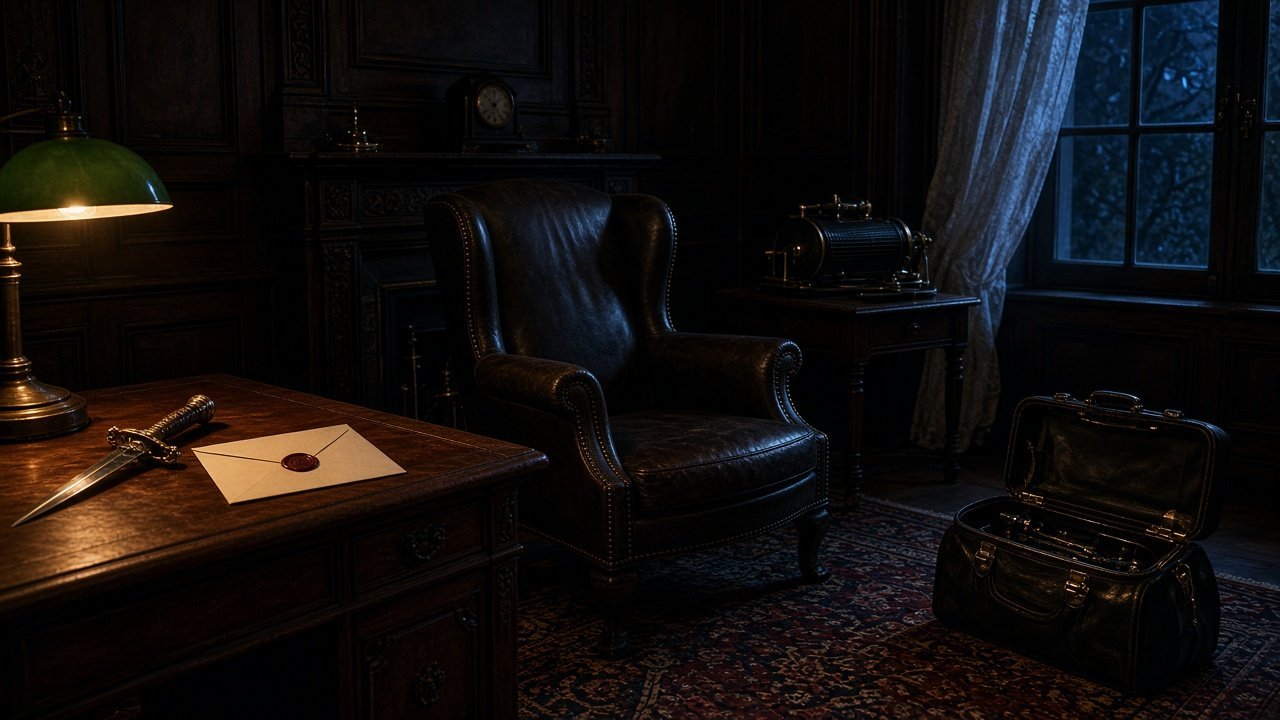
Every word the narrator writes is true. He just leaves out ten minutes. We explain The Murder of Roger Ackroyd.
The Village Doctor Who Helps Poirot Solve a Murder, and the Ten Minutes He Leaves Out
In 1926, Agatha Christie published a detective novel with a solution so outrageous that some readers accused her of cheating. The Murder of Roger Ackroyd made her famous. Six months later, on 3 December 1926, she vanished from her home, setting off one of the biggest manhunts Britain had ever seen. A hundred years on, the centenary of that disappearance has sent readers back to the book that came just before it. This guide gives the background first, then a clear spoiler warning, and follows the case in the order Poirot uncovers it, before explaining the twist, how the murder was done, whether Christie really cheated and how the novel connects to her own mystery.
The Agatha Christie Disappearance Centenary
On the evening of 3 December 1926, Christie left her home, Styles, in Sunningdale, Berkshire. Her car was found the next morning at Newlands Corner in Surrey, above a chalk quarry. More than 1,000 police officers, thousands of volunteers and, for the first time in a civilian search, aeroplanes joined the hunt. Eleven days later, on 14 December, she was found at the Swan Hydropathic Hotel in Harrogate, Yorkshire, registered under the surname of her husband's lover.
Harrogate is marking the centenary with an exhibition, Agatha Christie: A Harrogate Mystery, at the Royal Pump Room Museum. It opens on Saturday 28 November 2026. Culture North Yorkshire, which runs the museum, lists it until Sunday 6 June 2027, open Tuesday to Sunday. The hotel where she was found, now the Old Swan, still stands. In Reading, the Royal Berkshire Archives is running a free exhibition on her life and legacy, including the only known surviving copy of the missing person poster produced by Wokingham police in 1926.
Key Terms for New Readers
Unreliable narrator: a storyteller whose account cannot be fully trusted, because they are mistaken, biased or hiding something.
Dictaphone: an early voice-recording machine used in offices to dictate letters.
Veronal: a barbiturate sleeping drug, widely prescribed in the 1920s and dangerous in overdose.
Blackmail: demanding money in return for keeping someone's secret.
The Watson role: the detective's companion, named after Sherlock Holmes's friend Dr Watson, who tells the story and usually knows less than the detective.
The Characters You Need to Know
Dr James Sheppard: the narrator, the village doctor in King's Abbot.
Caroline Sheppard: his unmarried older sister, the best-informed gossip in the village.
Roger Ackroyd: a rich widower and businessman, the owner of Fernly Park.
Mrs Ferrars: a wealthy widow whose husband died a year earlier.
Ralph Paton: Ackroyd's charming, debt-ridden stepson.
Flora Ackroyd: Ackroyd's niece, engaged to Ralph.
Mrs Cecil Ackroyd: Flora's mother, Ackroyd's sister-in-law, always short of money.
Major Hector Blunt: a big-game hunter and old friend of Ackroyd.
Geoffrey Raymond: Ackroyd's secretary.
Parker: the butler.
Miss Russell: the housekeeper.
Ursula Bourne: the parlourmaid.
Hercule Poirot: the new neighbour, who has retired to the village to grow vegetable marrows.
Spoiler warning: the following summary discusses the plot, the killer's identity and the ending. The novel also deals with suicide.
A Death in King's Abbot
The story opens on Friday 17 September, when Dr Sheppard is called to the home of Mrs Ferrars. She has died of an overdose of veronal. Caroline, who learns everything in King's Abbot before anyone else, announces her theory at breakfast: Mrs Ferrars poisoned her husband a year ago and has killed herself out of remorse.
The village also has a mysterious new resident. The man next door, who has taken a house called The Larches, is said to be interested only in growing vegetable marrows. Caroline cannot find out anything about him. Sheppard decides he must be a retired hairdresser, because of his moustache. Their first meeting comes when the man, in a fit of frustration, throws a marrow over the garden wall and it lands at Sheppard's feet.
That same day, Roger Ackroyd asks Sheppard to dinner at Fernly Park. He is clearly agitated, and he says he needs to talk to him.
Dinner at Fernly Park
The other guests at dinner are the household: Mrs Ackroyd, Flora, Major Blunt and Geoffrey Raymond. Before dinner, Flora tells Sheppard that she is engaged to Ralph Paton, though it is not yet public. Sheppard notices that the silver table in the drawing room, a glass-topped case of curios, contains an ornate dagger.
After dinner, in the study, Ackroyd tells Sheppard a terrible secret. He and Mrs Ferrars had planned to marry. The day before she died, she confessed to him that she had poisoned her husband, and that someone had found out and had been blackmailing her ever since. She promised to tell him the blackmailer's name within 24 hours.
Parker the butler then brings in the evening post. Among it is a letter from Mrs Ferrars, posted just before she died. Ackroyd begins to read, then stops. He insists on reading the rest alone. Sheppard urges him to at least read the blackmailer's name, but Ackroyd is stubborn. In Sheppard's words: "It was just on ten minutes to nine when I left him, the letter still unread." Outside the study door, Sheppard nearly bumps into Parker.
Murder
Back at home, Sheppard takes a telephone call. He tells Caroline that it was Parker, saying Ackroyd has been found murdered. He hurries back to Fernly. Parker is astonished: he made no call, and nothing is wrong, as far as he knows. But the study door is locked from the inside, and no one answers. Sheppard and Parker break it down.
Ackroyd is dead in his chair, stabbed in the neck with the dagger from the silver table. Sheppard sends Parker to telephone the police and, as he writes, "I did what little had to be done." The letter from Mrs Ferrars is gone. The study window is open, and there are footprints on the sill.
Two people say they heard Ackroyd alive after Sheppard left. Raymond heard him talking to someone at half past nine, and the voice seemed to be asking for money. Flora says she said goodnight to her uncle at about a quarter to ten. So, it seems, the murderer struck later.
The obvious suspect is Ralph Paton. He has been staying at the village inn, he is in debt, and he has vanished. The footprints match a pair of his shoes.
Poirot Comes Out of Retirement
Flora refuses to believe Ralph is guilty. She goes to the man next door. He is Hercule Poirot, the famous detective, who retired to King's Abbot to grow marrows. Flora persuades him to take the case, and Poirot asks Sheppard to help him. Sheppard becomes his assistant, his Watson, and begins writing an account of the investigation.
Poirot finds the clues the police miss. Parker mentions that an armchair in the study had been pulled out from the wall when he first saw the body, and was later pushed back. In the summer house, Poirot finds a scrap of starched white cambric and a goose quill. In the goldfish pond, he finds a wedding ring, engraved "From R., March 13th".
Everyone Has a Secret
Poirot's method is to find out what each person is hiding. At a meeting round a table, he tells them all that each of them is keeping something from him. One by one, their secrets come out.
Flora never saw her uncle at a quarter to ten. She had gone to his bedroom to take some money, which had gone missing, and she invented the goodnight to cover herself.
The goose quill was used for heroin. Miss Russell, the housekeeper, had a son born outside marriage, Charles Kent, a drug user, who came to Fernly that night to ask her for money. Their meeting in the summer house explains one mysterious visitor.
Ursula Bourne, the parlourmaid, comes from a respectable family that has fallen on hard times. She is also Ralph Paton's secret wife. They married in March, but Ralph, who relied on his stepfather to pay his debts, dared not tell him. When Ackroyd insisted that Ralph marry Flora, Ralph agreed to a fake engagement. That night, Ralph and Ursula met secretly in the summer house, and quarrelled. The wedding ring in the pond was hers.
Mrs Ackroyd, who is always short of money, admits that she left the silver table open. She had been eyeing a piece of old silver she hoped to take to London to have valued, and fled when she heard footsteps. Major Blunt, it turns out, is in love with Flora, and she with him. Raymond admits he was badly hard up, and that the £500 Ackroyd left him in his will came in the nick of time.
Each secret explains a piece of the night. None of them explains the murder. And through all of it, Poirot keeps pointing out one thing: Ralph Paton cannot be found.
The Mah Jong Evening
In one of the novel's best scenes, Caroline holds a Mah Jong party, a game that was fashionable in the 1920s. Over the tiles, Caroline and her friends trade theories about where Ralph might be hiding. Caroline is sure he is in Cranchester, the nearest town. The gossip is played for comedy, but Poirot later admits that Caroline helped him find Ralph.
How The Murder of Roger Ackroyd Ends
Poirot gathers everyone at his house: Mrs Ackroyd, Flora, Blunt, Raymond, Ursula, Parker and Miss Russell. He announces that Ursula is Mrs Ralph Paton. Then, to everyone's surprise, Ralph himself walks into the room. Poirot reveals that Sheppard had hidden Ralph, the night of the murder, in a nursing home near Cranchester. Poirot found him by asking Caroline which homes her brother sent patients to.
Sheppard confesses, embarrassed, that he was protecting a friend. Ralph explains that he left the summer house before ten and wandered the lanes without an alibi. Poirot tells the group that the only way to clear Ralph is for the real murderer to confess, and that he will give the truth to Inspector Raglan in the morning.
When the others have gone, Poirot asks Sheppard to stay behind. Then he tells him calmly that he knows Sheppard killed Roger Ackroyd.
He explains the whole thing. Sheppard was the blackmailer. As Mrs Ferrars's doctor, he was the one person who knew how her husband really died. He invented a legacy to explain the £20,000 he had taken from her, then lost most of it in speculation. When she killed herself, he knew her letter would name him.
So Sheppard came to dinner prepared. While Ackroyd was reading the letter, Sheppard stabbed him with the dagger from the silver table. He then went out through the front door at ten minutes to nine, ran round to the summer house, put on a pair of Ralph's shoes he had brought in his bag, climbed in through the window to leave footprints, locked the study door from the inside, went back out, changed shoes again and hurried down the drive. He reached the lodge gates at nine. Poirot noticed that a walk of five minutes had taken him ten.
The voice Raymond heard at half past nine was not Ackroyd's. It was Ackroyd's own voice, recorded on a Dictaphone. Ackroyd had bought the machine and, two days before the murder, handed it to Sheppard to fix. Sheppard altered it so that it would start playing at half past nine, on the principle of an alarm clock, and left it on a table by the window, with the armchair pulled out to hide it from the door. A salesman from the Dictaphone Company had called at Fernly, Poirot made inquiries, and the company confirmed that Ackroyd had bought a machine. None was ever found among his things.
The telephone call was real. Sheppard had asked a patient, a steward on an American liner, to telephone him from the station that evening with a reply to a note. Only Sheppard knew what was said. He used the call as his excuse to rush back to Fernly, where, after the body was found, he slipped the Dictaphone into his medical bag and pushed the chair back. Parker was the one person who noticed the chair had moved.
Poirot offers Sheppard a choice. For his sister's sake, he could avoid a trial by taking an overdose of a sleeping drug. He also asks him to finish his manuscript, this time without leaving anything out.
The last chapter, Apologia, is Sheppard's confession, written at five in the morning. He admits he had meant his account to be published one day as the story of one of Poirot's failures. He points out, with some pride, how carefully he wrote it: every word was true. He only left out the ten minutes. His one fear is that Caroline will find out. Without pity for Mrs Ferrars or for himself, he chooses the drug that killed her: "So let it be veronal." His last line is a final, almost comic regret: that Hercule Poirot ever retired to the village to grow vegetable marrows.
2:08 PMTaylor Tailored
The Murder of Roger Ackroyd Ending Explained
Who Killed Roger Ackroyd?
Dr James Sheppard, the narrator. He was Mrs Ferrars's blackmailer, and he killed Ackroyd to stop him reading her letter and learning his name.
How Did Sheppard Do It?
Through careful timing. He killed Ackroyd before he left the study at ten minutes to nine, and then used the window, Ralph's shoes, a locked door and a timed Dictaphone to make it look as though the murder happened after half past nine, when he was at home with an alibi. The fake telephone call gave him a reason to return and remove the machine.
Did Christie Cheat?
This is the question that made the book notorious, and Christie's defence is in the text itself. Sheppard never lies to the reader. He leaves things out. Two sentences carry the trick. "It was just on ten minutes to nine when I left him, the letter still unread" is true: he stabbed Ackroyd and only then left. "I did what little had to be done" is true: what he did was hide the Dictaphone and move the chair back.
In his confession, Sheppard points out that if he had put a row of stars after the first sentence, readers might have wondered what happened in those ten minutes. The clues are all there: the chair, the timing of the walk to the gates, the telephone call that only he heard, the black bag he carries everywhere. Critics have argued about it ever since. The crime writer and critic Robert Barnard admired the solution but called the rest "a fairly conventional Christie". The American critic Edmund Wilson, who disliked detective fiction altogether, used the book for the title of a famous 1945 attack on the genre: "Who Cares Who Killed Roger Ackroyd?" But the case for Christie is strong. Every clue Poirot uses is on the page, and nothing Sheppard writes is false.
Why Is the Twist So Famous?
Because it breaks a rule readers did not know they relied on. In detective fiction, the Watson figure is the reader's stand-in: honest, a little slow and always on the detective's side. Christie made the Watson the murderer. Laura Thompson, one of Christie's biographers, calls it "the supreme, the ultimate detective novel".
Christie wrote in her autobiography that the basic idea came from her brother-in-law, James Watts, who suggested a story in which the criminal was a Dr Watson character. In March 1924, Lord Louis Mountbatten, later the last Viceroy of India, also wrote to her with a similar idea. She took the premise, but built her own plot. She also dedicated the book to her sister Madge, Watts's wife, known in the family as Punkie, "who likes an orthodox detective story".
Why Does Poirot Let Sheppard Kill Himself?
Poirot is not letting a murderer escape justice. He tells Sheppard plainly that the truth will go to the police in the morning, and that Ralph must be cleared. What he offers is a way to spare Caroline the public trial and hanging. It reflects the period: in 1926, murder carried the death penalty in England, and a doctor's trial would have ruined his sister's life too. Many readers find it one of the darkest endings in Christie.
Did Caroline Know?
The book says no. Sheppard writes that his greatest fear was that Caroline would guess, and he remembers, uneasily, that she once spoke of his "strain of weakness". He trusts Poirot and Inspector Raglan to manage things between them so that she never knows. Some readers think Caroline, who knows everything else in the village, must have suspected. Christie later acknowledged Caroline as a possible forerunner of her own village sleuth, Miss Marple.
Was It Really Sheppard?
In 1998 the French literary scholar Pierre Bayard published Who Killed Roger Ackroyd?, (originally published in French as Qui a tué Roger Ackroyd?), arguing that the real killer was Caroline, and that Christie subconsciously knew it. It is a provocative reading, not the book's solution, but it shows how thoroughly Christie taught readers to distrust a narrator.
Why Did Mrs Ferrars Kill Herself?
Because she could no longer live with what she had done, or with what Sheppard was doing to her. She had poisoned her husband, Ashley Ferrars, a heavy drinker for many years, and for a year she paid her blackmailer to stay silent. Her letter to Ackroyd was a final confession and an attempt to name the man who had bled her dry. It is the event that starts the whole story, and it is mirrored at the end, when Sheppard chooses the same way out.
Who Was the Stranger at the Gates?
On his way home at nine o'clock, Sheppard meets a stranger outside the gates of Fernly Park who asks the way to the house. He is Charles Kent, Miss Russell's son. He went to the summer house to ask his mother for money, and left behind the goose quill. He is a red herring, but an important one: he explains a set of footsteps in the grounds that has nothing to do with the murder.
What Happens to Everyone Else?
Ralph is cleared and reunited with Ursula. Flora and Major Blunt are free to admit their feelings. Miss Russell's secret stays largely private. The ending of the novel belongs entirely to Sheppard, alone with his manuscript.
The Book on Stage and Screen
The Murder of Roger Ackroyd was the first of Christie's works to be adapted. Alibi, a stage version by Michael Morton, opened in London on 15 May 1928, with Charles Laughton as Poirot. It was filmed in 1931, with Austin Trevor in the role, but that film is now considered lost.
Orson Welles adapted it for American radio in 1939, playing both Poirot and Sheppard, which is perhaps the neatest piece of casting in the novel's history. BBC Radio 4 broadcast a version with John Moffatt as Poirot on Christmas Eve 1987.
For most viewers, the best-known version is the 2000 episode of Agatha Christie's Poirot, starring David Suchet, first shown on ITV in the UK on 2 January 2000. Japanese television made a three-hour version, The Murder of Kuroido, in 2018. A new stage version by Mark Shanahan premiered at the Alley Theatre in Houston, Texas, in 2023.
The twist is hard to film, because the trick depends on a written account. On screen, the audience can see what the camera shows, and a first-person narration has to be invented. That is one reason many readers insist the book has to be read before it is watched.
The Book and Christie's Own Mystery
The Murder of Roger Ackroyd was published in June 1926, two months after Christie's mother died, and as her marriage to Archie Christie was breaking down. In August he asked for a divorce. In December she disappeared.
Christie never explained the eleven days. Her autobiography does not mention them. Two doctors at the time diagnosed genuine memory loss. Her biographer Janet Morgan believes she was in a fugue state, a kind of dissociative amnesia. Another writer, Jared Cade, argues that she planned it to embarrass her husband. Laura Thompson suggests a breakdown in which Christie knew what she was doing but could not control it.
There is no evidence that the novel caused the disappearance. But the timing helps explain why the two are remembered together. Christie had just become the most talked-about crime writer in Britain, so when she vanished the papers already knew her name. And readers of Ackroyd had just learned the lesson she would later seem to embody: the person telling the story may not be telling you everything.
Themes and Meaning
The Unreliable Narrator
The book's great subject is narration itself. It asks how much you trust a voice that seems reasonable, educated and kind. Sheppard is all three, and a blackmailer and murderer.
Village Secrets
King's Abbot looks like a sleepy English village, but almost everyone in it is hiding something: money, a marriage, a son, a drug habit. Christie's point is that respectability is a performance, and that a detective's real job is to strip it away.
Money and Ruin
Every secret in the novel is about money: Ralph's debts, Flora's theft, Raymond's bills, Mrs Ackroyd's snooping and Sheppard's blackmail. Christie shows a genteel world in which keeping up appearances costs more than people can afford.
Order and Mercy
Poirot believes in the truth above everything. But his final choice shows that he also understands people. He insists on justice, and still finds a way to protect the one innocent person who would suffer most from it.
Final Thoughts
A hundred years on, The Murder of Roger Ackroyd still works because the trick is not a cheap twist but a perfectly built piece of misdirection hidden in plain sight. Read it once for the shock and a second time for the craft: almost every scene means something different once you know who is speaking. And with the centenary of Christie's disappearance on 3 December, there is no better time to look again at the book that made the woman behind the mystery a household name.
Sources
The Murder of Roger Ackroyd, Agatha Christie, Project Gutenberg #69087 (US edition; quotations and plot details checked against the text)
The Murder of Roger Ackroyd, Wikipedia (publication history, CWA vote, Laura Thompson quotation, the origin of the idea, Pierre Bayard, Caroline and Miss Marple)
Agatha Christie, Wikipedia (the 1926 disappearance, the search, Harrogate, the competing explanations)
Harrogate Event to Mark 100th Anniversary of Agatha Christie Mystery, Harrogate Advertiser, 30 October 2026, updated 3 November 2026 (the exhibition, the Old Swan Hotel, the 11 days)
Public Events, Culture North Yorkshire (Agatha Christie: A Harrogate Mystery, Royal Pump Room Museum, 28 November 2026 to 6 June 2027)
Agatha Christie's 100-Year Mystery: New Exhibition Reveals Her Life and Legacy, Round & About, 26 October 2026 (the Royal Berkshire Archives exhibition)
