Who Denounced Charles Darnay? A Tale of Two Cities Explained
A Drunk Lawyer Who Looks Exactly Like Another Man, and the Day That Likeness Becomes a Plan
Charles Dickens built A Tale of Two Cities around a coincidence that seems almost too neat: two men, one a decent French exile and the other a brilliant, self-loathing English lawyer, who look so alike that a court cannot tell them apart. The novel spends hundreds of pages on revolution, revenge and a doctor who was buried alive in the Bastille, but readers remember it for what that likeness finally makes possible, and for some of the most famous last words in English fiction. Kit Harington's four-part adaptation has brought the story back. It has already aired in the US and is due on the BBC in the UK. This guide sets out the background first, then gives a clear spoiler warning, and follows the story in the order its characters discover it, before explaining the ending, Sydney Carton's last words and what the new series changes.
Key Terms for New Readers
The Bastille: a royal fortress-prison in Paris, where people could be held without trial. Its storming on 14 July 1789 became the symbol of the Revolution.
Émigré: a French aristocrat who fled abroad during the Revolution. The new government treated returning émigrés as traitors.
Jacques: the code name the revolutionaries in the novel use for one another.
Tellson's: the old-fashioned London bank, with a Paris branch, that employs Jarvis Lorry and links the two cities.
Resurrection man: Victorian slang for a body-snatcher, someone who dug up fresh corpses to sell to anatomists.
The Old Bailey: London's main criminal court.
The Characters You Need to Know
Doctor Alexandre Manette: a French physician released after almost 18 years in the Bastille.
Lucie Manette: his daughter, raised in England, who believed he was dead. Dickens calls her the golden thread that binds the family together.
Charles Darnay: a French aristocrat living in England as a tutor, who has given up his family name.
Sydney Carton: a gifted, heavy-drinking barrister who does the real work behind a more successful lawyer.
Mr Stryver: that more successful lawyer, loud and pushy.
Jarvis Lorry: an elderly, kind-hearted clerk at Tellson's Bank.
Miss Pross: Lucie's fiercely loyal companion and former governess.
Jerry Cruncher: a porter and messenger for Tellson's, with a secret night job.
Ernest and Thérèse Defarge: the owners of a wine shop in the poor Paris district of Saint Antoine, and leaders of the coming revolution.
John Barsad: a spy.
A Tale of Two Cities (2026): UK and US Release, Cast and Where to Watch
The new series was created and written by Daniel West, the writer of Gunpowder, and directed by Richard Clark. Kit Harington plays Sydney Carton and is also an executive producer. François Civil plays Charles Darnay and Mirren Mack plays Lucie Manette, with Sharon Duncan-Brewster, Guillaume Gallienne as Lucie's father and Roxane Duran as Thérèse Defarge.
In the US, the four episodes premiered on MGM+, a subscription streaming service, on Sunday 6 September 2026, and the finale aired on Sunday 4 October, so American viewers can watch the whole series now. In the UK, the series is coming to BBC One and BBC iPlayer. The BBC said on 5 October 2026 that the drama is part of the Dickens programming coming to the BBC this winter, alongside a season it says is set to air in December. As of 13 November 2026, the BBC had not announced a transmission date.
Spoiler warning: the following summary discusses the plot, major twists and ending of the novel, and the ending of the 2026 series.
Recalled to Life: The Prisoner Who Makes Shoes
The story begins on a muddy night in November 1775, on the Dover road. Jerry Cruncher rides after the mail coach with a message for Jarvis Lorry, and Lorry sends back a strange reply: "Recalled to Life." Lorry is on his way to meet Lucie Manette, a young woman "of not more than seventeen" who has been raised in England as an orphan. In a Dover hotel he tells her, as gently as a banker can, that her father is not dead. Doctor Manette has been released from a secret imprisonment in Paris, and Lorry is going to bring him home.
In Paris, the Defarges have been sheltering the doctor in a garret above their wine shop. Dickens introduces the district with a scene that works as a warning: a cask of wine breaks in the street, the starving crowd scoops it from the stones, and one man dips his finger in the dregs and writes "BLOOD" on a wall. Madame Defarge sits behind the counter, knitting.
Upstairs, the doctor is bent over a shoemaker's bench. When Lorry asks his name, he answers only "One Hundred and Five, North Tower", the number of his old cell. He learned to make shoes in the Bastille to stop his mind breaking, and now he cannot stop. Lucie's touch and her golden hair, which reminds him of his lost wife, begin to reach him, and Lorry takes them both to London.
The Golden Thread: A Trial and a Double
The Old Bailey, 1780
Five years later, Charles Darnay is on trial for his life at the Old Bailey, accused of spying for France about the British forces being sent to fight in America. The case rests on two witnesses, Barsad and Roger Cly, and on an identification: a witness swears he saw Darnay at a particular place on a particular night. Darnay's barrister, Mr Stryver, does not seem to be getting anywhere. Then his colleague, a scruffy man lounging with his eyes on the ceiling, passes him a note. Stryver asks the witness to look from the prisoner to that colleague. The two men are so alike that the identification collapses, and Darnay is acquitted.
The colleague is Sydney Carton. That night, after dinner with Darnay, he stands in front of a mirror and speaks to himself with brutal honesty. He resents Darnay, he admits, because the man "shows you what you have fallen away from, and what you might have been!" Then he adds a line that readers only notice on a second reading: "Change places with him".
We soon learn why Carton is so bitter. Dickens calls him the jackal to Stryver's lion. Every night Carton wraps wet towels round his head, drinks, and boils down Stryver's cases so that Stryver can shine in court the next day. He has more talent than anyone around him, and he has decided it is too late to use it.
The Marquis and the Child
Across the Channel, Dickens shows the cruelty that will produce the Revolution. Darnay's uncle, the Marquis St Evrémonde, drives his carriage so fast through the Paris streets that it kills a small child. He tosses the father, Gaspard, a coin, and someone throws it back. At his country château that night he meets his nephew. We learn that Darnay is the heir to the Evrémonde estates and that "Darnay" is an anglicised version of his mother's maiden name. He tells his uncle he has renounced the family's property and its methods. The Marquis is unmoved. By morning he is dead in his bed, stabbed, with a note attached to the knife: "Drive him fast to his tomb. This, from Jacques." Gaspard is later caught and hanged.
Two Men Love Lucie
Back in London, Lucie has become the centre of a small, loving household in Soho, run by Miss Pross. Darnay falls in love with her, and so does Carton. Darnay asks the doctor's blessing and starts to explain who he really is. The doctor stops him in alarm, and asks him to keep his real name secret until the morning of the wedding.
Carton's confession to Lucie is one of the most important scenes in the novel. He tells her he knows she cannot love him and that he will not change, but that she has stirred something he thought was gone. Then he makes her a promise: "For you, and for any dear to you, I would do anything." He tells her to remember, when she has a child of her own, that "there is a man who would give his life, to keep a life you love beside you!" Lucie weeps for him, and keeps the secret.
Darnay and Lucie marry. On the wedding morning, Darnay tells the doctor who he really is, and the shock sends the doctor back to his shoemaker's bench for nine days. Lorry and Miss Pross nurse him back, and afterwards they secretly chop the bench to pieces. Lucie is never told.
Knitting in Saint Antoine
Meanwhile, the Defarges are preparing. Madame Defarge is knitting a register: the names of aristocrats and informers marked for vengeance, stitched in a code only she can read. When Barsad, now working as a spy for the French police, visits the wine shop and mentions that Lucie Manette is to marry the Marquis's nephew, Madame Defarge adds the name.
Dickens also plants a comic subplot that will matter later. Jerry Cruncher, it turns out, is a resurrection man. One night his son follows him to a churchyard and watches him dig up the coffin of Roger Cly, the spy from Darnay's trial. Jerry finds it empty.
The years pass. Lucie and Charles have a daughter, little Lucie, and a son who dies young. Carton visits rarely, but little Lucie adores him. In July 1789 the storm finally breaks: Saint Antoine rises, the Bastille falls, and Defarge goes straight to cell One Hundred and Five, North Tower, and searches it. Revenge spreads to the countryside, and the Evrémonde château is burned.
Drawn Back to Paris
In 1792 a letter reaches Tellson's from Gabelle, the Evrémonde family's old steward. He has been imprisoned in Paris for working for an émigré, and begs the new Marquis to come and save him. Darnay feels he owes Gabelle a debt, and he believes that, as a man who gave up his title, he can explain himself. He leaves without telling Lucie, writing letters to her and to the doctor. Dickens calls the chapter Drawn to the Loadstone Rock, after the magnetic rock of legend that pulled ships to their doom.
2:05 PMTaylor Tailored
The Track of a Storm: Saved, Then Condemned
A Prisoner of La Force
Darnay is arrested as soon as he enters France, under a new law against returning émigrés, and is locked in La Force prison. Lucie, her daughter, the doctor and Miss Pross follow him to Paris, where Lorry is already looking after Tellson's French business.
For the first time, Doctor Manette is powerful. As a former prisoner of the Bastille, he is a hero to the revolutionaries, and he uses that standing to protect his son-in-law. Darnay spends a year and three months in prison, but he is finally brought before the Revolutionary Tribunal, and the doctor's testimony wins him an acquittal. The crowd carries him home in triumph.
That same evening, soldiers come to the door and arrest him again. He has been denounced by Ernest and Thérèse Defarge, and by one other. When the doctor asks who, the answer is: "You will be answered to-morrow."
Miss Pross Meets Her Brother
In a Paris shop, Miss Pross suddenly screams and throws her arms round a man. He is her long-lost brother Solomon, who stole her savings years ago. Carton has also arrived in Paris, and he recognises the man as John Barsad, the spy from the Old Bailey. Barsad, once an informer for the British government, is now a spy for the revolutionaries inside their prisons.
Carton plays what Dickens calls "a hand at cards". He threatens to expose Barsad's past, and Jerry Cruncher supplies the trump: Roger Cly's coffin was empty, so Cly faked his death and is alive and working in Paris too. Barsad is trapped, and Carton bargains privately for one service: access to a prisoner.
The Doctor's Letter
At Darnay's second trial, the third accuser is revealed. Defarge produces a paper he found hidden in the chimney of cell One Hundred and Five on the day the Bastille fell. Doctor Manette wrote it there, in soot, charcoal and his own blood, "during the last month of the year, 1767".
The letter explains everything. In December 1757 the doctor was taken by two aristocratic brothers, the Marquis St Evrémonde and his twin, to treat a dying young peasant woman and her younger brother, who had been stabbed. The elder brother had abused the young woman. Her family had already been destroyed by the brothers; her brother died after challenging one of them. The doctor refused to keep quiet and wrote to the Minister. Soon afterwards he was seized and locked in the Bastille without trial, and never heard what happened to his wife.
Darnay's mother had visited the doctor once, hoping to make amends to the dead woman's surviving sister. But the letter ends with a curse: "them and their descendants, to the last of their race," the doctor writes, "I denounce to Heaven and to earth." Darnay is that descendant. Hearing the doctor's own words, the court condemns him to die within 24 hours.
Then the last secret comes out. Madame Defarge tells her husband that she was raised by fishermen, and that the peasant family destroyed by the Evrémondes was hers. The dying woman was her sister. She wants the whole line exterminated, which means Lucie and little Lucie too.
How A Tale of Two Cities Ends
Carton has stopped drinking. The night before the second trial, he quietly bought some small packets from a chemist. Now, in the Defarges' wine shop, he overhears Madame Defarge planning to denounce Lucie, the child and the doctor. He goes to Lorry with a plan and his own travel papers. The family must leave Paris the next afternoon at two o'clock, with a seat kept for Carton, whatever happens. Lorry has to promise to obey exactly.
The doctor is no help. Broken by the verdict, he wanders the house looking for his shoemaker's bench.
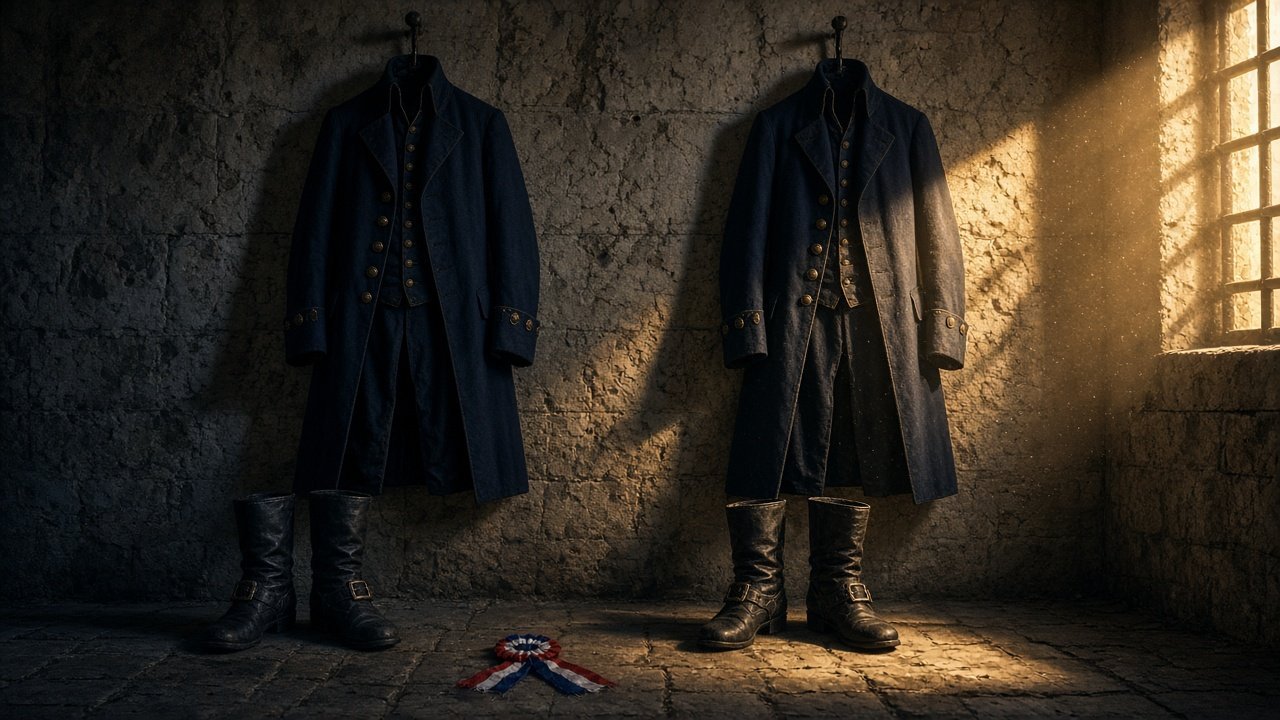
The next day, Barsad lets Carton into Darnay's cell. Carton orders Darnay to change his boots and coat and to write a letter at his dictation. The words are the ones Carton spoke to Lucie years earlier. As Darnay writes, Carton holds a drugged cloth to his face, and Darnay collapses. Carton puts on Darnay's clothes, and Barsad carries the unconscious Darnay out as "Carton", who has supposedly fainted at saying goodbye to his friend. Darnay wakes up in the carriage, with Carton's papers.
In the room of the condemned, a young seamstress, accused of a plot she knows nothing about, realises that this "Evrémonde" is someone else. She asks to hold his hand on the cart, and he agrees.
At the same moment, Madame Defarge goes to Lucie's lodgings, with a pistol and a knife, and finds Miss Pross alone. Each speaks her own language and neither understands the other's words, but they understand each other perfectly. Miss Pross wrestles her, the pistol goes off, and Madame Defarge falls dead. The shot leaves Miss Pross permanently deaf.
The carriage leaves Paris. Carton and the seamstress ride to the guillotine. She kisses him and goes first. He is counted the twenty-third, as the knitting women count the heads. Through the last pages, words from the burial service, which he first heard read at his father's grave, keep returning to him: "I am the Resurrection and the Life."
Dickens tells us that people said his was "the peacefullest man's face ever beheld there". If Carton had spoken his thoughts, the narrator says, they would have been a vision of the future: the Revolution's leaders dying by the same blade; Paris "a beautiful city" rising from the abyss; Lucie and Charles happy in England; and Lucie's son, named after him, growing into a just judge who brings his own child to this spot to tell Carton's story. The novel ends with the lines everyone knows.
A Tale of Two Cities Ending Explained
Why Does Sydney Carton Take Darnay's Place?
The simplest answer is that he promised Lucie he would. Years earlier he told her he would give his life "to keep a life you love beside you". In Paris, that promise becomes literal. Carton is the only person who has the face, the papers and the nerve to save Darnay, and he knows there is no legal escape left once the doctor's letter has been read.
But the sacrifice is not just about love for Lucie. It is about Carton's view of himself. From his first night, at the mirror, he has believed his life is wasted. In Paris he stops drinking, thinks clearly and acts quickly for the first time in the book. He is no longer the jackal doing someone else's work. Dying for the people he loves is, in his own eyes, the one way to turn a wasted life into a meaningful one.
It also protects the people Madame Defarge is hunting. Carton overhears her plan to denounce Lucie and the child. His swap gets the whole family out of Paris before she can act.
What Were Sydney Carton's Last Words?
Strictly, he does not say any. This is one of the most misunderstood details in the novel. Dickens writes: "If he had given any utterance to his, and they were prophetic, they would have been these." The famous speech is presented as what Carton might have said, not a record of something he said aloud.
The thoughts end with the most famous closing sentence in Dickens: "It is a far, far better thing that I do, than I have ever done; it is a far, far better rest that I go to than I have ever known." It is better than anything he has done because, for once, his talent has saved someone. It is a better rest because the man who once could not sleep without drink finally has peace.
The words he really does keep repeating are from the burial service, "I am the Resurrection and the Life". They tie his death to the novel's oldest idea. Doctor Manette was "recalled to life" from the Bastille. Jerry Cruncher is a fake resurrection man. Carton gives Darnay a real second life, and in his vision he lives on through Lucie's son, who carries his name.
Why Do Carton and Darnay Look Alike?
Dickens never explains it, and it does not need explaining. The likeness is set up at the Old Bailey as a legal trick and paid off at the guillotine as a sacrifice. The two men are mirror images: one has the character Carton could have had, and the other has the gifts Darnay lacks. Carton's mirror speech, "Change places with him", foreshadows exactly what happens. Some critics also connect the double to Dickens himself, who wrote the novel as his marriage was collapsing.
What Happens to Madame Defarge?
She dies by her own pistol. Miss Pross holds her round the waist, Madame Defarge reaches for the gun, Miss Pross strikes at it, and it fires. Dickens does not make it a duel. He makes it a struggle between hatred and love, and love, he says, is "always so much stronger than hate". The cost is that Miss Pross never hears again.
Madame Defarge is not simply a villain. Her family really was destroyed by the Evrémondes, and the doctor's letter proves it. Dickens's point is that justified anger, once it becomes a list of names to be wiped out, turns into the same cruelty it was aimed at.
Does Darnay Survive?
Yes. He wakes in the carriage, using Carton's papers, and escapes with Lucie, their daughter, the doctor and Lorry. Miss Pross and Jerry follow in a separate carriage. Carton's vision describes the family living out their lives in England, and naming a son after him.
Who Denounced Charles Darnay?
The Defarges, and Doctor Manette. The doctor did not do it knowingly. He wrote his curse on the Evrémonde family in 1767, long before his daughter married one of them, and Defarge found it in the ruins of the Bastille. That is the novel's bitterest irony: the doctor's influence saves Darnay at the first trial, and his own words condemn Darnay at the second.
Who Is the Seamstress?
She is a poor young woman condemned with Carton, never named. She matters because she is the only person who sees through the disguise and keeps the secret. Her presence also reminds the reader that the Terror is killing innocent working people as well as aristocrats.
Is the Ending Happy or Sad?
Both, and deliberately so. Carton dies, but the Darnays live, and the final vision imagines Paris itself healing. Dickens ends on peace rather than horror. Many readers find that the most devastating thing about it: Carton is calmer at the guillotine than he ever was alive.
What the BBC Series Changes
The new series keeps the essential ending. Carton swaps places with Darnay and goes to the guillotine, and TV Insider reports that the finale, titled Resurrection Man, uses the "far, far better thing" line. Some of the route there is different, based on recaps of the US broadcast.
Lucie is far more active. In the BBC's own synopsis, she is the one who enlists Carton to defend Darnay, hoping Darnay will lead her to her father in Paris. Harington told Collider that the team felt Lucie needed to be "modernized from the book" and Darnay "fleshed out" so that her choice between the two men felt real. In the novel, Carton is simply Stryver's assistant at the trial.
Miss Pross is now Hester Pross, played by Sharon Duncan-Brewster. Indiatimes describes Hester shooting Thérèse Defarge during a struggle for the gun, and Pop Creep's recap also has Hester killing her to protect Lucie and her unborn child. In the novel, the pistol goes off while Miss Pross is striking at it.
Lucie is pregnant in the finale. In the book, the Darnays already have a daughter when they reach Paris. In the series, Harington says, it is the news of Lucie's pregnancy that makes Carton's decision "clear as day". That shifts the emphasis from Carton's old promise to the unborn child.
Several recaps describe different details of the prison swap, so it is worth watching the finale itself before relying on any one account. If you have only seen the series, the biggest thing the book adds is the doctor's full letter, Barsad's blackmail, the seamstress and Carton's long night walk through Paris before the second trial.
Themes and Meaning
Resurrection
Almost every major character is brought back from some kind of death. Manette returns from the Bastille, Darnay is saved twice, Cly fakes his own funeral, and Carton gives up his life to give a meaning to it. Dickens takes a Christian idea and gives it a very human form: a man can be redeemed by one act.
Revolution and Revenge
Dickens is not on the side of the old aristocracy. The Marquis's carriage, the dead child and the doctor's letter show exactly why the people rose up. But he is horrified by what follows. The new tribunals are as arbitrary as the old ones, and Madame Defarge's register turns justice into extermination. Carton's vision imagines "new oppressors" dying by the same blade as the old.
Doubles
The novel is built on pairs: two cities, two trials, two men with one face, two women fighting in a Paris apartment. Dickens uses the doubling to ask whether a person is fixed by birth and habit, or can change places with a better self.
Love as Loyalty
Lucie is the "golden thread", the bond that holds a damaged family together. The novel's strongest love stories are not only romantic: Lorry's devotion to the Manettes, Miss Pross's loyalty to Lucie and Carton's love for a family that is not his own.
Final Thoughts
A Tale of Two Cities can feel slow at first, with its long descriptions and coincidences. But everything Dickens sets up in the first half, from the empty coffin to the mirror speech to the doctor's hidden letter, pays off in the last hundred pages. Its ending lasts because it is so simple: a man who believed he was worthless decides what his life is for. Whether you meet Sydney Carton through Kit Harington or on the page, the final lines land just as hard.
Sources
A Tale of Two Cities, Charles Dickens, Project Gutenberg #98 (all quotations and plot details checked against the text)
A Tale of Two Cities, Wikipedia (serialisation in All the Year Round, sources including Carlyle and The Frozen Deep)
A Tale of Two Cities (2026 TV series), Wikipedia (creator, director, cast, Hester Pross, US premiere on MGM+)
Martin Freeman and Jim Broadbent Star in a Dickensian Ghost Story for Christmas 2026, BBC Media Centre, 5 October 2026
Kit Harington, François Civil and Mirren Mack Feature in A Tale of Two Cities First Look Images, BBC Media Centre, 24 March 2026
Kit Harington Details 'Horrific' Final Scene in 'Tale of Two Cities', TV Insider
Kit Harington Addresses the Devastating 'A Tale of Two Cities' Finale, Collider
A Tale of Two Cities Season 1 Finale Recap and Ending Explained, Indiatimes, 5 October 2026
A Tale of Two Cities Season 1 Recap, Pop Creep, 6 October 2026
