The Story Behind the Parties Across the Bay
A Millionaire Needs to Borrow a Cottage
Jay Gatsby owns a house big enough to entertain half of New York, yet the invitation he most wants must come from the man who rents the little place next door. Nick Carraway has something a fortune cannot buy on Long Island in the summer of 1922. He can ask his cousin Daisy to tea without anyone wondering what he wants from her. F. Scott Fitzgerald builds The Great Gatsby around the distance between those two houses and the stretch of water separating them from Daisy’s. It takes an evening to cross the bay. Getting back to the point where Gatsby believes his life went wrong is another undertaking altogether.
Dinner on the Other Side of the Bay
Nick comes east from the American Midwest to learn the bond business. He has served in the war, returned to a home that feels small and persuaded his father to support him while he gets started. Family money buys him time to find out whether he can make money. In this respect he has more in common with the wealthy people he describes than his modest rented house might suggest. Even his sense of independence rests on someone else’s willingness to pay for an experiment.
His cottage stands in West Egg beside an enormous imitation European mansion. Across the bay in East Egg live his cousin Daisy Buchanan and her husband Tom, whom Nick knew at Yale. West Egg can afford architecture every bit as extravagant as anything on the opposite shore. What its residents cannot buy is the authority to decide which extravagance counts as vulgar. Tom can keep polo ponies and move them across the country. An equivalent display by a newcomer would give him material for a joke.
At dinner Nick meets Jordan Baker, a competitive golfer. Daisy and Jordan initially seem to float in a room filled with moving air. Tom shuts the windows and the women settle back down. The small domestic action establishes who can alter the conditions of an evening without consulting anybody else. Then a telephone rings. A woman Tom is seeing in New York has called him at home, and the elaborate arrangements of the Buchanan household suddenly revolve around somebody nobody has invited to dinner.
Jordan supplies the explanation. Daisy later tells Nick about the birth of her daughter and her hope that the girl will grow up beautiful and sufficiently foolish to be happy. It is an unsettling wish from a woman alert to every humiliation at her own table. Daisy can describe with considerable precision what a perceptive woman stands to lose. She can also turn the disclosure into an intimate performance that leaves Nick wondering how firmly she believes what she has said. He goes home having witnessed a marriage in trouble without learning what either partner means to do about it.
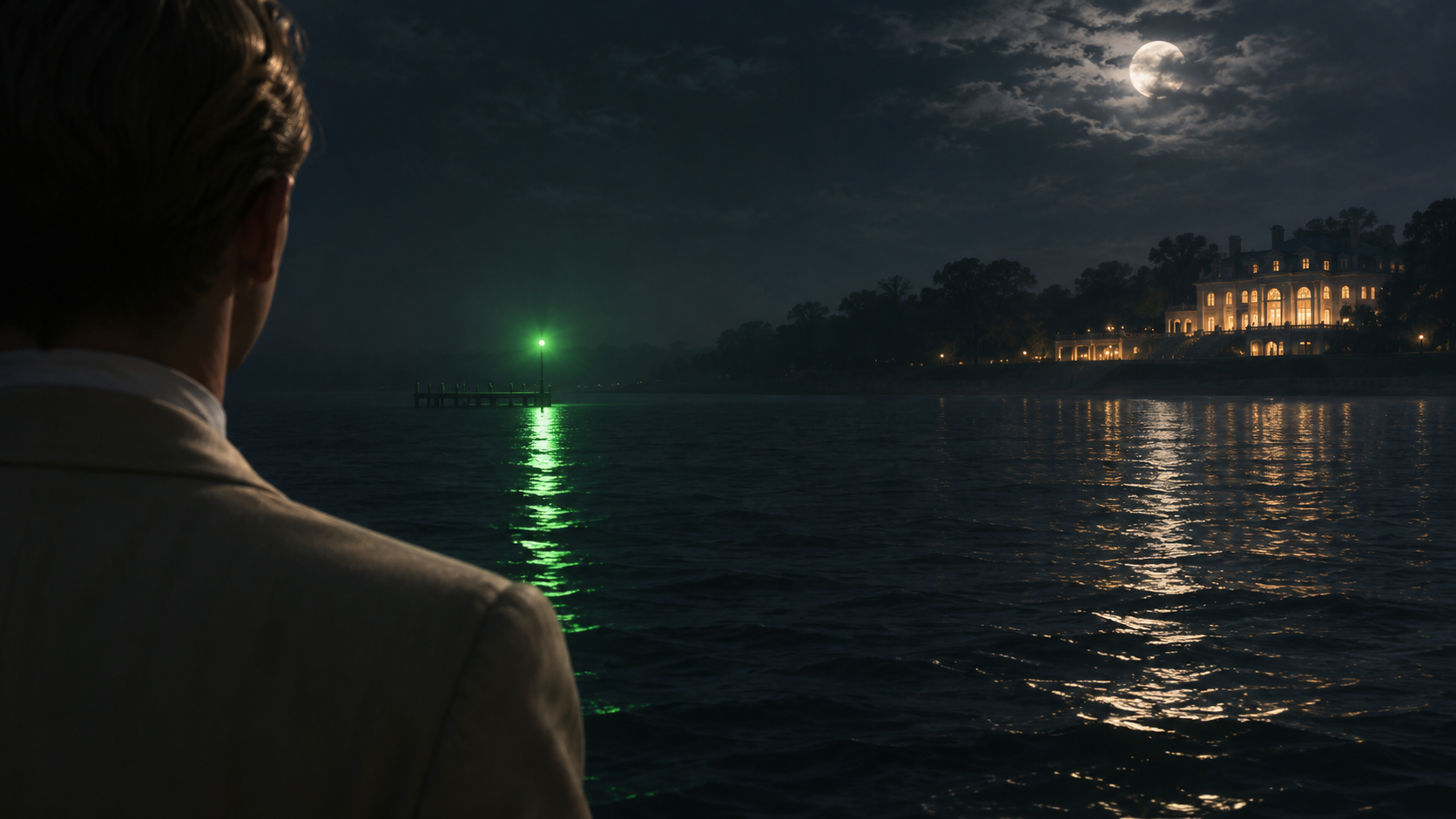
That night a man stands outside the mansion next door, stretching his arms towards the water. Nick can just distinguish a green light across the bay. He looks again and his neighbour has gone. Fitzgerald lets us see the gesture from the position of someone too far away to interpret it. For the moment the light tells us more about the effort involved in looking across dark water than about the person doing the looking.
Who Gets to Leave the Valley of Ashes?
Tom takes Nick into New York and insists on stopping at a garage beside the railway. The district between Long Island and the city accumulates the waste of the prosperity visible at either end of the journey. Above it hangs an old advertisement showing a pair of enormous eyes behind spectacles. The doctor once had something to sell. His painted eyes have outlasted their immediate commercial purpose and acquired a view of people who have little reason to look up.
George Wilson runs the garage. He hopes to buy a used car from Tom, repair it and sell it on. Tom can keep him attentive simply by allowing the possibility of a deal to remain open. George’s wife Myrtle is the woman who telephoned during dinner. Tom arranges for her to join him in the city while her husband is still hoping to do business with him. The affair depends partly on money, but also on the ease with which Tom can occupy two quite different positions in the same conversation.
In the Manhattan flat he keeps for their meetings, Myrtle changes her dress and the way she speaks. Guests arrive. She discusses purchases, gives orders and revisits the mistake she believes she made in marrying George. Cloth matters to her understanding of class. One grievance concerns the good suit George wore to their wedding, which she afterwards discovered he had borrowed. A man had appeared to possess something that might tell her what life with him would be like. The owner eventually came to collect it.
Her mistake with Tom is more painful. The flat and its furnishings suggest that she has entered into possession of a life. When she keeps saying Daisy’s name, he breaks her nose. No earlier agreement has established a rule about the name. Tom invents the boundary and enforces it as soon as Myrtle acts on a version of their relationship he dislikes. Across the bay he puts up with a mistress interrupting his wife’s dinner. Here he refuses his mistress even the liberty of mentioning his wife.
Nick drinks heavily and admits to a fragmentary memory of the occasion. It is worth keeping track of when he can give a continuous account and when an experience comes down to disconnected images. Like the outsider who narrates The Secret History, he benefits from access to a group about which he will later deliver a judgement. He stays for much more of Tom’s afternoon than any family obligation requires.
An Invitation to Gatsby’s House
At weekends Gatsby’s gardens fill with strangers. Food arrives in quantities large enough to make the next day’s refuse an index of the night’s pleasure. An orchestra provides music and cars carry guests between the station and the house. Nick is almost unusual in possessing a written invitation. Many guests simply turn up, consume what their host provides and circulate stories about how he acquired the means to provide it.
One man in the library has inspected the shelves and discovered that the volumes are real. He is impressed precisely because he expected a theatrical imitation. The uncut pages complicate his discovery. Gatsby has bought actual books in order to possess a room whose appearance matters more to him than the words inside them. Yet he has taken the trouble to supply a degree of authenticity almost nobody will ever test. The comic encounter prepares us for a man whose inventions contain inconvenient pieces of truth.
Nick falls into conversation with a stranger who recognises his division from wartime service. Only after Nick confides that he has yet to meet his host does the stranger identify himself as Gatsby. He turns out to be accessible, sober and interested in his guest. While everyone else enjoys the freedom to behave badly under cover of a crowd, the host must remain alert to what happens in it. Nick is especially struck by the quality of his smile. For a moment, Gatsby can make another person feel understood on that person’s own terms.
Afterwards, a car lands in a ditch outside the house. Its occupants and the people offering directions take a surprisingly long time to acknowledge that a missing wheel has changed the problem. There is genuine comedy in the spectacle, and something disquieting in how quickly a party whose organisation looked effortless produces a practical difficulty for which nobody feels particularly responsible. The roads between these houses will matter as much as the houses themselves.
Nick also begins seeing Jordan. When he challenges her careless driving, she relies on the good sense of other road users to keep clear of her. It sounds plausible for as long as one imagines a road containing precisely one careless person. Nick likes her enough to continue the relationship. He stores up the remark for his account of a summer during which his own conduct is considerably easier to defend when he describes somebody else first.
What Gatsby Wants From Nick
On a drive to Manhattan, Gatsby gives Nick a neat account of a wealthy upbringing, an Oxford education, European adventures and military distinction. Nick begins to doubt him almost as soon as he starts speaking. Then Gatsby produces a decoration and a photograph from Oxford. The objects establish that some remarkable parts of his account have a basis in fact. They cannot authenticate every claim that surrounds them. Nick’s response catches how tempting it is to accept an entire story once a storyteller survives one unexpected test.
Lunch introduces Meyer Wolfsheim, whom Gatsby credits with fixing the 1919 World Series. His friendship with Gatsby opens a less respectable route to money and influence than the one described in the car. Fitzgerald also draws on antisemitic caricature in his portrayal of Wolfsheim. The effect is particularly ugly because Tom’s racial prejudices have already been exposed to ridicule, while the description of Wolfsheim invites readers to recognise a stereotype as evidence of criminality. A reader has good reason to distinguish Gatsby’s compromising associations from the ethnic signals the narration attaches to them.
Jordan now explains what Gatsby has been working towards. In Louisville during the war, Daisy fell in love with a young officer. Jordan remembers seeing them together. Before Daisy’s subsequent wedding to Tom, Jordan found her drunk and holding a letter, ready to call the marriage off. The next day the wedding went ahead. Jordan witnessed the crisis. She cannot say precisely what Daisy felt when she eventually put on Tom’s pearls and went through with the ceremony.
The officer was Gatsby. He bought the West Egg house because Daisy lives across the water. For all the strangers who have passed through his parties, he still needs an introduction delicate enough to seem accidental. He wants Nick to invite Daisy over and allow him to drop in. At once the geography of the opening changes. A light that looked insignificant from Nick’s lawn marks the far end of a distance Gatsby has spent years trying to close. His wealth has enabled him to choose the exact spot from which to feel her absence.
Tea, a Clock and a Pile of Shirts
The arrangements for tea threaten to overwhelm Nick’s cottage. Gatsby sends someone to cut the grass and an abundance of flowers arrives. When Daisy finally appears, her would-be host loses his nerve. He goes outside and comes to the door as though arriving independently. For a few minutes the most gifted impresario on Long Island has difficulty getting through the formalities of a call. His elbow dislodges a clock and he catches it before it falls.
The clock is funny before it is symbolic. There are three people in a small room, two desperately trying to make the occasion seem natural and one wishing he could escape. Nick eventually gives them time alone. On his return the conversation has acquired an ease no amount of expenditure on flowers could produce. Daisy has had an opportunity to respond without somebody watching to see whether Gatsby’s plan works.
The visit continues next door. Gatsby shows Daisy his possessions and throws out a succession of beautiful shirts. She cries into them. The explanation she offers concerns their beauty, which leaves a great deal unaccounted for. Clothes have made the years of separation tangible. She can handle the proof of what the young officer has become, although nobody can show her what those same years would have been like had she waited for him. The shirts allow her to express grief without specifying exactly what she regrets.
Gatsby points out the light on her dock. Now that Daisy stands beside him, Nick senses that the light has lost some of its extraordinary value. A distant point can carry whatever significance an observer gives it. A woman in the same room has her own memories and can contradict a cherished account. Gatsby experiences the reunion as a moment of extraordinary fulfilment. Its success also removes the convenient distance that has allowed him to imagine the next stage entirely by himself.
The Past Daisy Is Asked to Confirm
Nick interrupts the summer’s events to disclose the history behind Gatsby’s name. He was born James Gatz to poor farmers. As a young man he spotted the yacht of the wealthy Dan Cody, rowed out and warned him about the danger of rough water. The encounter opened a place for him aboard the vessel. He learned the habits of wealth at close quarters, although the money Cody intended him to inherit never reached him. Long before he met Daisy, he had begun constructing a version of himself to whom such opportunities might belong.
The timing of this disclosure changes its meaning. Had Nick begun with the boy on the shore, the mansion could have looked like the destination of an enterprising young man’s ascent. By the time we hear about Cody, we have watched the owner of the mansion nearly knock over a clock in somebody else’s cottage. His achievement is considerable. The particular social confidence he envies remains beyond anything he can accomplish through years of solitary effort.
Tom accompanies Daisy to one of the parties. Gatsby wants her to recognise the scale of the life he can offer. Much of the entertainment displeases her. Her reaction leaves him facing a difficulty he can scarcely afford to admit. He has modelled an entire household around an idea of what would impress her, using the standards available to somebody who had to learn how the rich lived. Daisy has grown up with the privilege of finding an expensive display faintly embarrassing.
When Gatsby speaks to Nick afterwards, the full extent of his demand emerges. Leaving Tom would settle the practical question of whom Daisy will live with. Gatsby also wants her to say she never loved her husband. He imagines the two of them returning to Louisville and beginning again at the point their story broke off. Nick thinks of the intervening years as something that has happened to two people. Gatsby treats them as an error one truthful sentence from Daisy can correct.
A Change of Cars on the Way to Manhattan
On a fiercely hot day at the Buchanans’ house, Gatsby meets Daisy’s small daughter. The child has hardly featured in his account of the future. Here she is, requiring adult attention and bearing a family resemblance, evidence that Daisy’s marriage has produced a life to which other people have claims. During the same visit Tom catches the intimacy in the way Daisy addresses Gatsby. A look and a tone of voice tell him more than a direct accusation from Nick could have done.
The group sets off for Manhattan in two cars. Tom takes Gatsby’s conspicuous yellow car with Nick and Jordan. Gatsby drives Daisy in Tom’s coupé. At the garage George tells Tom that he means to take Myrtle west. He knows something is wrong in his marriage, although he has yet to identify the other man. Myrtle sees Tom in the yellow car and watches Jordan, whom she appears to take for his wife. Remember who has been seen in which vehicle. The witnesses on this road will know far less than the people travelling together.
In a suite at the Plaza Hotel, Tom presses Gatsby about Oxford. There is a straightforward explanation for the photograph. Gatsby attended for a short period under an arrangement for officers after the war. Tom’s next line of attack proves more damaging. He describes Gatsby’s involvement with Wolfsheim and the sale of alcohol through drugstores. The origins of the money matter to Daisy because Gatsby has asked her to stake her future on its security. Tom’s own inherited wealth comes under no equivalent inspection.
Gatsby asks Daisy for the declaration that will make their past come right. She tries to give it, then admits she once loved Tom as well. Gatsby can offer her an alternative to her present marriage. He cannot give her an honest answer to a question about her feelings by telling her in advance what it must be. Once she refuses his version of her history, Tom grows confident enough to send the two of them home together in Gatsby’s car.
What Happens on the Road Home?
Myrtle runs out towards the yellow car as it passes the garage. It strikes and kills her, then continues down the road. Earlier she saw Tom driving it. That sighting makes a possible explanation for her action, although Myrtle leaves no account of what she thought she saw. Tom arrives afterwards in the coupé and finds George devastated. He makes sure George understands that the yellow car he drove earlier belongs to somebody else.
Back on Long Island, Nick finds Gatsby keeping watch outside Daisy’s house. Gatsby tells him Daisy was at the wheel. He intends to take responsibility and wants to be near in case Tom hurts her. Nick looks through a window and sees the married couple sitting together with food between them, absorbed in conversation. He cannot hear what they say. Their physical ease suggests an intimacy that has survived the hotel confrontation, while the man outside waits for a signal he has no reason to expect.
The following morning Gatsby gives Nick a fuller account of his early courtship. His uniform had allowed him to enter Daisy’s world without immediately disclosing his poverty. She had understood him to possess a security he could not offer. His ambition since then has been to make that early impression true. There is tenderness in his recollection of the house and its rooms, alongside an assumption that a later fortune can retrospectively change the circumstances in which she first trusted him.
George, meanwhile, tries to turn fragments into an explanation for Myrtle’s death. He has discovered the affair and connects her lover with the car. He speaks of divine judgement while looking towards the billboard above the garage. To George the staring eyes can express an authority beyond the reach of human lies. The reader has seen the faded advertisement and knows its commercial origin. Even a desperate conviction that someone sees everything cannot supply the one piece of information George needs, the identity of the driver.
Who Answers for Gatsby at the End?
Gatsby goes to use the swimming pool he has scarcely enjoyed all summer. George reaches the estate, shoots him and takes his own life. Nick helps find the bodies. The fatal identification has attached to the legal owner of the car. The distinctions between who owned it, who drove it that afternoon, who drove it that evening and who was having an affair with Myrtle are available to the reader only because Nick has put several different accounts together.
Organising the funeral confronts Nick with a quieter problem of identification. Who among the people who knew Gatsby will acknowledge a connection that now involves a small inconvenience? One former guest telephones about shoes he left behind. Wolfsheim expresses affection but declines to attend. Daisy and Tom have gone away. Gatsby’s father does come, bringing an entirely different measure of his son’s achievement. A childhood schedule of exercise, study and self-improvement shows how much private work preceded the public man his guests thought had appeared from nowhere.
The man who inspected the library turns up at the cemetery too. The detail gives the funeral an unexpected generosity. Someone who once tested whether Gatsby’s books were genuine goes to the trouble of appearing when the hospitality has stopped. Nick’s loyalty also costs him something, although writing the account gives him a privilege Gatsby never had. He gets to decide which incidents will survive as evidence and how generously each person’s failures should be read.
Later Tom admits that he told the armed George who owned the car. Tom maintains that Gatsby ran Myrtle down. Nick knows Gatsby identified Daisy as the driver, but the novel never establishes exactly what Daisy told her husband. Tom’s disclosure helps explain how George reached the right address with the wrong conclusion. Declaring that Tom knowingly sent him after an innocent driver would remove an uncertainty Fitzgerald carefully preserves. His willingness to hand over Gatsby’s identity and then leave others to deal with the consequences is damaging enough.
Nick returns to the Midwest. Before he leaves, he imagines the island as it might have appeared to European sailors and remembers Gatsby looking towards the green light. The movement from a private lawn to an imagined beginning for America gives the last page its sweep. It also reveals something about beginnings as Nick imagines them. An inhabited continent can look new to someone arriving by water, just as Daisy’s life can look available for a fresh start to a man standing on the opposite shore.
The little light endures because it occupies two places at once. It marks a real house where a woman has made choices, loved imperfectly and accepted protection. From Gatsby’s lawn it can also mark the place where everything he has worked for might finally acquire meaning. He knew exactly where to stand to see it. The one view his magnificent house could never give him was the view from Daisy’s side of the water.
Sources
The Great Gatsby — F. Scott Fitzgerald. Original novel, including Nick’s account of the two journeys and Tom’s final disclosure.
The Great Gatsby — Cambridge Edition, Introduction. Publication history and the 1925 text.
The Great Gatsby — Full Book Summary. Independent plot cross-check.
