The Open Door at the Heart of Kafka’s The Trial
The Prisoner Is Free to Go to Work
On his thirtieth birthday, Josef K. rings for breakfast and admits a stranger into his bedroom. Within minutes he has been placed under arrest. He wants to see some identification, learn the charge and establish who has authorised these men to interfere with his morning. He has another practical concern. As a senior employee at a bank, he is expected at work. To his surprise, the officers see no difficulty there. He can dress, go to the bank and conduct his business as usual. Franz Kafka builds The Trial around the peculiar freedom contained in that permission. Josef K. can leave the building whenever he likes. What he cannot do is leave as a man who has never been arrested.
What Has Josef K. Been Accused Of?
Josef K. never learns the charge. The novel opens with the suggestion that somebody must have spoken falsely about him. It sounds like the beginning of a mystery in which identifying a malicious neighbour or a jealous colleague might explain everything. Yet nobody comes forward as his accuser. The suggestion gives us the shape of the explanation K. wants. It supplies no evidence that the explanation is true.
The two warders, Franz and Willem, have eaten his breakfast. They take an interest in his underclothes and advise him about the disadvantages of consigning possessions to official storage. These details give the arrest a grubby plausibility. K. might doubt that a legitimate institution would operate in this fashion; he can certainly understand what two men might gain from persuading him to hand over a decent shirt. A minor abuse he knows how to recognise encourages him to think that the larger problem ought to be equally easy to expose.
He produces identity papers. The warders have little interest in them. He would like to compare documents with the men who have entered his home, but they maintain that their position requires no such exchange. Each appeal K. makes assumes a common rule to which both parties can refer. The warders already have what they need from the encounter. Whether K. considers himself properly arrested makes no difference to their instructions.
An inspector receives him in a room rented by another lodger, Fräulein Bürstner. Three junior employees from K.’s bank are there too. Their presence is among the morning’s most effective humiliations. K. has authority over these young men at work. Now they can watch him ask strangers for permission to dress and explanations he cannot obtain. When the meeting ends, they are available to accompany him to the bank. Nobody has to circulate an official announcement for his arrest to travel with him.
That evening, K. waits up to explain the intrusion to Fräulein Bürstner. She has returned tired and has little appetite for a lengthy account. K. becomes absorbed in reconstructing the inspector’s performance and delivers his demonstration loudly enough to disturb another lodger. Before they part, he kisses her repeatedly. The man who objected so eloquently to strangers borrowing another person’s room has assumed considerable liberties there himself. It gives us an early reason to question his assessment of his own conduct. It gives us no reason to imagine that the court is entitled to arrest him.
The First Hearing Takes Place Among the Washing
A telephone call directs K. to attend an inquiry on Sunday. Holding it outside working hours supposedly accommodates his employment. The address takes him to a crowded residential district. He has no courtroom number and no precise appointment time. Once inside the tenement, he works his way from door to door asking for a fictitious carpenter named Lanz. He invents the carpenter because he would rather appear to be running an ordinary errand than ask a succession of strangers where an accused man is meant to report.
Families are eating, dressing and attending to the morning’s work. The surroundings offer almost none of the guidance a public building usually supplies. An imposing entrance, a sign or a clerk at a desk would at least acknowledge that a visitor has the right to know where to go. Here the difficulty of finding the hearing feels like K.’s own social embarrassment. By the time a woman finally directs him through a door, he has already spent a considerable part of his Sunday solving a problem the people summoning him could have settled in a sentence.
The room is crowded. An examining magistrate consults his notebook and takes K. to be a house painter. To K., the mistake is an opportunity. If the official cannot establish his profession, what confidence can anyone place in the proceedings? He delivers a forceful account of the arrest, moving from the warders’ behaviour to the larger organisation that employs them. Parts of the audience seem sympathetic. He begins to think he knows how to handle the room.
His strategy depends on there being an audience separate from the court. Looking more closely, K. notices the badges the listeners wear. The opposing groups whose approval and hostility he thought he could distinguish belong to the same organisation. What seemed an opportunity to appeal over the magistrate’s head has allowed him to explain his position to a room full of its employees. He leaves defiantly. The magistrate tells him that his conduct has cost him the advantages an interrogation ordinarily offers a defendant. K. has still heard nothing that would allow him to judge whether those advantages exist.
The following Sunday he returns without being summoned. It is the first substantial victory the court wins over him. Nobody has threatened to punish him for staying home. He has a good professional reason for going back: an intelligent man who handled a meeting badly wants another chance at it. The apartment is there, although the audience has gone. He has kept an appointment the court never made.
Who Owns the Rooms Above the City?
The woman who admitted K. lives there with her husband, a court usher. They have the use of the premises on the understanding that their domestic arrangements can be cleared away for hearings. When K. examines the magistrate’s books, he finds an obscene illustration in one and a lurid novel among them. He has been eager to see the texts behind official authority. The first volumes he actually gets his hands on tell him something about the tastes of the officials and nothing about the law.
The woman offers to help him. Her position is uncomfortable. A law student pursues her, and the favour of more senior men can affect the livelihood she shares with her husband. K. imagines taking her away, partly out of desire and partly for the satisfaction of depriving court officials of something they consider theirs. When the student carries her off to the magistrate, K. can see the coercion in the arrangement more readily than he can see the possessiveness in his proposed rescue.
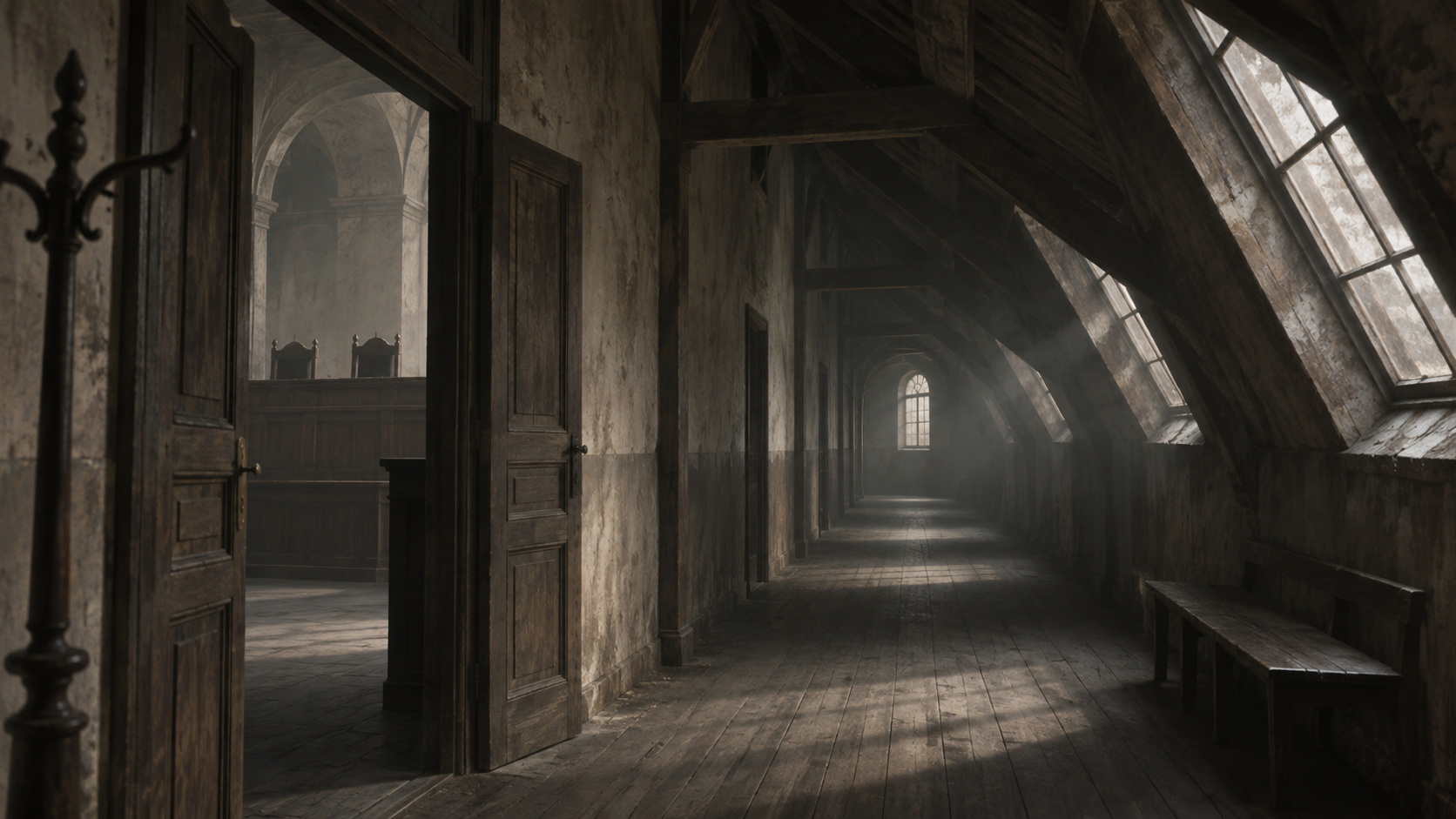
Her husband then shows K. the court offices in the attic. Here are accused men sitting patiently on benches, bending awkwardly and attempting to assess the status of every person who passes. K. approaches one as if his own ease might reassure him. Instead, the encounter frightens the man. The difference between the two defendants seems considerable until the atmosphere in the offices makes K. ill. He becomes dizzy, loses his bearings and has to accept physical assistance from people who work there.
At the exit, fresh air restores him with startling speed. The employees who have helped him have the opposite difficulty with the outside air. Kafka gives the institution a climate to which its inhabitants have become bodily accustomed. An official who can breathe quite comfortably at his desk may be a poor judge of what it costs a stranger to stand before him. K. himself only understood the posture of the men on the benches once he had trouble staying upright.
Calling the court secret would explain too little. It occupies family rooms, employs neighbours and receives a stream of visitors. Plenty of people know how to find it. What remains hidden is the connection between all this activity and any judgement a defendant could understand. In Orwell’s 1984, power makes itself visible through public slogans and the face of Big Brother. K. gets so close to the people administering his case that he can inspect their reading material. He would probably welcome a public statement of what they believe they are doing.
What Is Behind the Bank’s Storeroom Door?
One evening at the bank, K. hears sounds behind a door ordinarily associated with discarded office supplies. Inside, he finds Franz and Willem with a man appointed to flog them. The warders say the punishment follows K.’s complaints at the hearing. For the first time, something he said in court appears to have produced a definite official response. It is almost the opposite of the one he intended. He wanted an inquiry into the organisation. The organisation has found two low-ranking men to punish.
The warders have their explanations ready. They plead poor wages, custom and the damage the punishment will do to their prospects. The man carrying it out has an explanation equally well suited to his position. This is the work he has been given. K. tries to bargain with him. The conversation has returned K. to the practical reasoning of the arresting officers themselves: somebody wants something, money might help, and perhaps official business can be adjusted if the parties arrive at an understanding.
When Franz cries out, K. becomes alarmed that junior bank staff will investigate. He goes out and reassures them. He would genuinely like to prevent the flogging. He would also like nobody at work to discover him in a storeroom after hours discussing a punishment connected to his own case. Given the chance to call in witnesses, he helps keep the encounter private. The bank is the institution in which he has standing, and protecting that standing has become one of the court’s most useful means of influencing him.
The next day K. opens the door again. The men and the scene appear just as before. He shuts it and demands that the attendants clear out the storeroom. Kafka supplies no dependable mechanism for this recurrence. It might feel like a guilty memory given physical form, but K. encounters it as something waiting behind an actual door. The peculiar horror is that his first visit appears to have made no difference to what he finds on the second. The easiest action available to a senior bank employee is to order someone else to tidy the place.
A Lawyer With Excellent Connections
News reaches K.’s family. His uncle comes to town in considerable agitation and takes him to see an old acquaintance, the lawyer Huld. The uncle sees a danger K. has underestimated. A case can attach itself to a family name long before anyone knows enough to decide whether the accused has done something wrong. In his eyes, getting a lawyer is already overdue.
Huld receives them from his sickbed. A senior court official is present in the darkened room, and the lawyer already knows something about the proceedings. To the uncle, these facts recommend him. He has access. To K., they ought also to raise a practical question. If the prosecution can discuss his affairs in places he cannot enter, how will he ever know which information his own lawyer has acquired, which information he has supplied and whose interests an informal conversation has served?
Leni, who looks after Huld, draws K. away while the older men are talking. She urges him to confess and offers her assistance. K. is attracted to her. His uncle is furious that he has left a meeting involving precisely the people whose goodwill he needs. Both men’s responses make sense on their own assumptions. The uncle thinks qualified men in a bedroom are conducting the real business. K. has already discovered that women who know the habits of officials can possess knowledge unavailable through formal channels. The difficulty is judging whether useful knowledge about an official can accomplish anything for his case.
As the months pass, Huld describes the importance of preliminary petitions, delicate contacts and careful approaches. Legal representation has a precarious place in this court. Lawyers depend heavily on unofficial dealings with staff. The written charge remains inaccessible to the defendant and his representatives, making it difficult to know what a first submission should answer. Whenever K. wants a sign of progress, Huld can explain another reason progress would be difficult to see. A sincerely conscientious lawyer in such a system might sound very much like a man who had done nothing.
K. considers preparing his own defence. Without an allegation to narrow the scope, he would have to recall the significant events of his life, explain his reasons for acting and consider how each decision might appear to an unfriendly observer. The labour would be enormous, and the effort to remember would itself produce more material to investigate. In Crime and Punishment, the reader knows the decisive act before the investigator can prove it. K. must imagine himself under investigation for practically everything he can remember doing.
The Painter Explains the Three Possible Outcomes
At the bank, the strain becomes visible. Work requires decisions, attention to clients and the ability to sit through a meeting without mentally drafting a legal petition. A manufacturer who does business there notices K.’s preoccupation and gives him an introduction to Titorelli, a painter who supplies portraits to judges. After consultations with a lawyer have failed to clarify his position, K. goes to see what an artist can tell him.
Titorelli’s knowledge comes partly through his father, who painted judges before him. The portraits obey conventions handed down with the occupation. A relatively junior judge can appear in a pose suggesting far greater eminence. K. studies the figure of Justice in one picture and discovers how easily the image can be made to suggest victory or pursuit. The artist’s professional skill consists in giving a particular customer the appearance of an authority that exceeds his office. It is a promising qualification for explaining the distance between what the court offers on paper and what anybody can obtain.
Titorelli describes three outcomes. The first is a genuine, final acquittal. In his account, it would dispose of the accusation and the proceedings altogether. The judges he knows lack the authority to grant it. Stories of such acquittals exist, but when K. presses him for something nearer to a precedent, the painter cannot offer one he has witnessed. K. has found an insider willing to describe the court’s limits. One of those limits is the reach of the insider’s own knowledge.
The second possibility is an apparent acquittal. Here Titorelli can do practical work. He can prepare a declaration supporting K.’s innocence and take it round to judges he knows for signatures. Their support might persuade the judge dealing with the case to release him. The file, however, remains active within the court. Another official can pick it up, inspect the accusation and have K. arrested again. A second apparent acquittal might then be pursued with much the same expenditure of influence as the first.
The third is indefinite postponement. Rather than secure a favourable decision, the defendant and his helpers maintain contact with the relevant officials and keep the proceedings at an early stage. It requires regular attention. There may be hearings and other formal activity because a case cannot simply be put aside and forgotten. The advantage, if the arrangement holds, is that the danger will not come any nearer. The price is accepting the danger as a permanent appointment.
These alternatives finally answer a practical question K. has been asking since his birthday. Can he do one thing which, if properly done, will make the business end? The one remedy that meets that requirement lies beyond the experience of the man explaining it. The two remedies Titorelli can actually assist with would require K. to organise his life around the court. An apparent acquittal buys intervals; postponement buys continuity. Either arrangement would give the painter reason to remain useful.
The studio is stifling. Girls crowd outside, listening and peering in. K. buys some nearly identical landscapes as he prepares to leave, having come in search of an individual solution and acquired several versions of the same view. A second exit beyond the bed leads directly into more court offices. K. thought he was visiting a private tradesman whose acquaintance with the judges might provide a way around the institution. He has spent the whole interview one door away from it.
The Defendant Who Has Done Everything Asked of Him
Determined to recover some control, K. goes to dismiss Huld. There he meets Block, a businessman whose case has lasted for years. Block employs several lawyers, conceals the extent of his efforts from each of them and spends time at Huld’s home in the hope of catching a favourable opportunity. Business once supplied the organising purpose of his day. Now legal attendance is his occupation, and the business must survive on whatever attention is left over.
Block has accumulated the sort of knowledge K. once hoped to obtain. He knows who is worth approaching, what defendants say in waiting rooms and how a lawyer might react to an apparent slight. He also reports the superstitions that thrive among the accused, including the belief that the shape of a defendant’s lips can foretell the outcome. When reliable information is unavailable, there is no natural limit to the supply of signs. The person who has spent the longest waiting may acquire the largest stock of beliefs without learning anything that brings him nearer a decision.
Huld has Block brought before him and treats the grown man with calculated condescension. Block kneels and searches for signs of encouragement. Even the privilege of learning what a judge may have said about him depends on the lawyer’s willingness to speak. K. has arrived intending to judge his lawyer’s performance. Huld gives him an opportunity to observe how an experienced defendant behaves towards that lawyer instead.
It is tempting to see Block as a warning about weakness of character. Yet the particular behaviour that humiliates him has a practical history. If a meeting has occasionally been granted to a man willing to wait all night, waiting becomes rational. If a favourable word can be withdrawn when a lawyer feels slighted, gratitude becomes prudent. Repeat such decisions for several years and the result looks like a personality. K. can see the degradation clearly in someone else. He still cannot say which single encounter Block ought to have skipped without risking whatever chance he had left.
What Does the Parable Before the Law Mean?
A bank assignment takes K. to the cathedral. He is supposed to show an Italian business visitor around, an errand that has required preparation and given him fresh cause to worry about rivals taking over his work while he is away. The visitor fails to appear. In the dark building, a priest calls K. by name. K. can still walk on as if he has not heard. He turns back. The priest identifies himself as the prison chaplain.
The chaplain knows about the case and believes it is going badly. Their conversation turns to K.’s understanding of the court. To explain the possibility of deception, the priest tells him a story commonly published on its own as Before the Law. A man from the country comes to a doorway and asks to enter the Law. A doorkeeper says he cannot admit him at present. The door is open. The doorkeeper also describes more powerful guardians further inside.
The man decides to wait. The doorkeeper gives him a place to sit, occasionally questions him and accepts the gifts he offers. Years pass. Near death, the man asks why nobody else has sought admission through a door to something everybody is supposed to need. Only then does the keeper tell him that this entrance was meant exclusively for him and that he will now close it.
K.’s first response is that the doorkeeper deceived the man. There is a strong case for that reading. Had the man been told at the outset that the entrance belonged to him alone, he might have understood his situation differently. The keeper supplied alarming information about further doors while withholding the one fact that made this door unlike any other. A person can tell a series of literal truths and still shape another person’s conduct through what he leaves unsaid.
The priest takes K. through other readings. The keeper said admission was impossible for the present; the man supplied the decision to wait for the rest of his life. The keeper himself may understand very little about the interior he guards. He also occupies a post from which he cannot freely depart, whereas the visitor initially has a choice about whether to remain. The man who seems to control access may spend his whole working existence at the outermost edge of the thing to which he claims a special relation.
None of this establishes that the countryman could safely have pushed past him. An open doorway does not neutralise a credible threat. Nor does the fact that an entrance belongs to one person prove that the person can use it successfully. The parable leaves its reader with a more exact and more uncomfortable problem. At what point could the man have tested whether admission was possible without first obtaining the permission he came to seek?
K. would like the priest to settle which interpretation is correct. The priest’s willingness to supply ever more interpretations begins to resemble the lawyer’s detailed accounts of procedure. Both men can keep an intelligent listener engaged for as long as he has questions. A genuine difference remains. The priest has given K. a story small enough to hold in his head. K. can see the keeper, the visitor, the stool and the door all at once. He has never been able to see his own case from such a position.
What Happens to Josef K. at the End?
On the evening before his thirty-first birthday, two men in formal clothes come for K. A year has passed since the warders interrupted his breakfast. There has been no public trial at which an accusation was read, evidence tested and punishment pronounced. The two men do not fill in the missing stages. They take him between them and walk with him through the city.
At moments K. resists their direction. At others he adjusts his pace to theirs. He sees a woman who resembles Fräulein Bürstner and finds himself reconsidering the usefulness of making a final display of resistance. The resemblance reaches back to the first night, when he stayed awake to explain his behaviour to a woman who had barely been involved. His wish to conduct himself properly before an observer has outlasted his confidence about what proper conduct would mean.
They reach a quarry. The men remove some of his clothing, position him against a stone and pass a knife between them. K. understands that he is apparently expected to take it and carry out the act himself. He does not take it. In a distant window he sees a figure leaning out, arms extended. He wonders about help and about the judge he has never seen. Nothing identifies the person at the window or establishes what that person can make out in the dark.
One man holds K. while the other drives the knife into his heart. The men themselves kill him. His final comparison, “Like a dog!”, names the degradation of dying under their close inspection. The narration leaves us with the possibility that the shame of what has occurred will survive him. Even now, the book has supplied no charge that would explain his death as the punishment for a particular offence.
Why does K. go so far with his executioners? Exhaustion is part of the answer. So is a habit cultivated through the whole year. He has repeatedly entered rooms because leaving might hurt his prospects, preserved appearances because exposure might damage his career, and listened to advice because a man who declined help might later be blamed for his own predicament. At the quarry, he is still trying to infer what is expected of him from the behaviour of officials who make no attempt to justify themselves. His final refusal to take the knife leaves the responsibility for the physical act visibly in their hands.
It would give the court too much credit to conclude that K.’s unpleasant habits secretly validate its judgement. He is vain about his position, capable of cruelty to subordinates and presumptuous with women. We know these things because the novel lets us accompany him through situations in which his behaviour can be observed. The court never demonstrates comparable knowledge or explains how any of it warrants what happens. To assemble an indictment for it after his death would be to perform one last piece of work on its behalf.
On the first morning, K. goes looking for papers that will establish who he is. He believes that if he supplies his identity and the officials supply their authority, a conversation conducted on equal terms can begin. At the quarry, one question from that bedroom remains unanswered. Who, exactly, is doing this to him? The men are near enough for him to see their faces as he dies. For a year he has been able to get that close to the people who exercise power over him, and never once close enough to make them answer.
Sources
The Trial — Franz Kafka, translated by David Wyllie. English text used for the encounters, the painter’s three outcomes, the cathedral dialogue and the final scene. www.gutenberg.org
The Trial: Full Book Summary — SparkNotes. Supporting guide to the characters and progression of K.’s case. SparkNotes
The Deconstruction and Reification of Law in Franz Kafka’s “Before the Law” and The Trial — USC Interdisciplinary Law Journal. Scholarly context for the manuscript, Max Brod’s editorial arrangement and the parable’s relationship to the novel. gould.usc.edu
