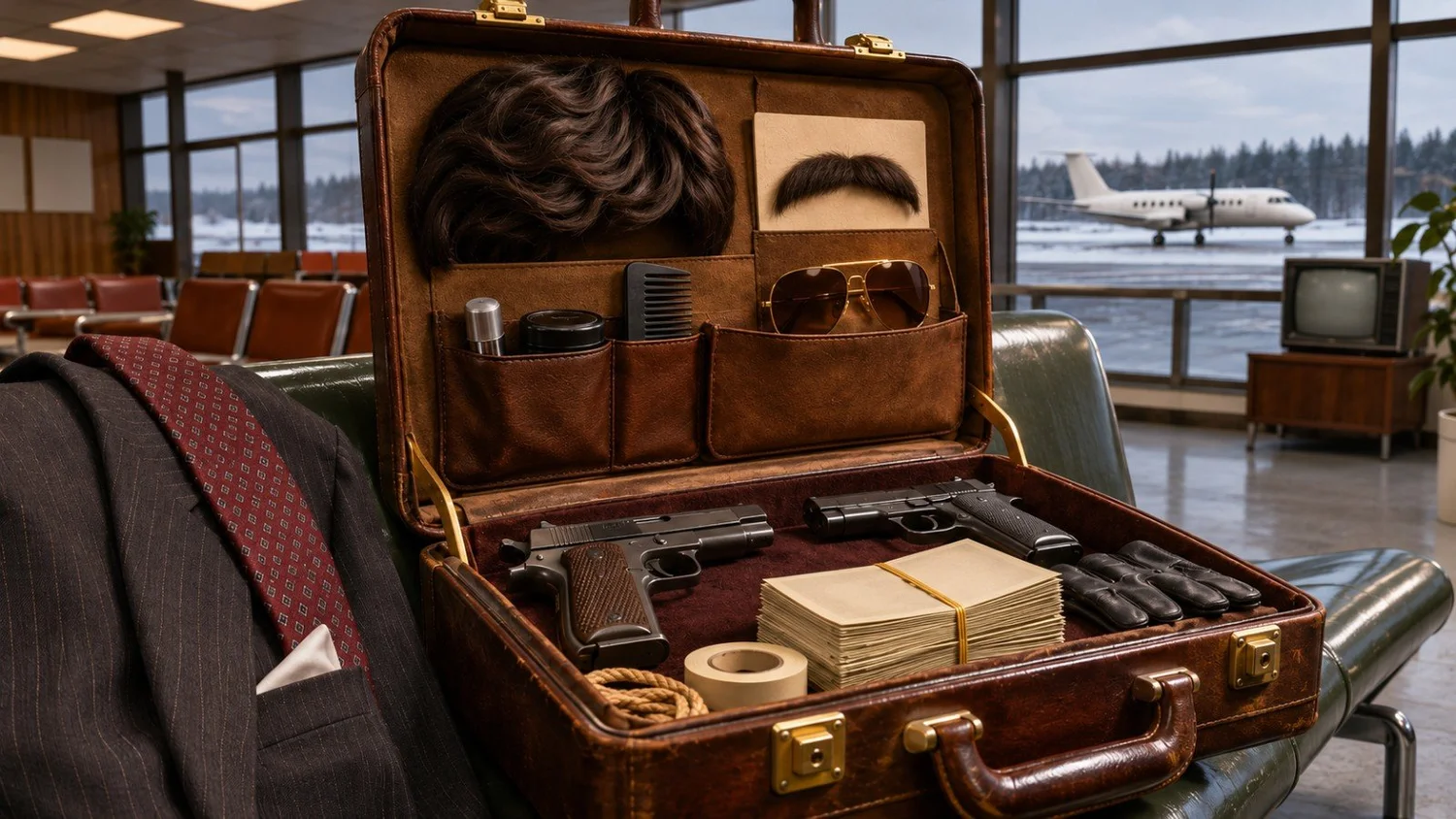
He Flew First Class to Rob Banks, With the Guns Packed in His Checked Luggage
Yes, Bandit is a true story, and the most outlandish part of it is real. Gilbert Galvan Jr, an American prison escapee living in Ontario under the name Robert Whiteman, flew across Canada on scheduled Air Canada flights in the mid-1980s, robbed banks and jewellery stores in city after city, and flew home to a wife who believed he was a travelling businessman. His handguns went in his checked bags, which were not X-rayed on domestic flights. His disguises went in his suit bag. By the time police caught up with him in 1987 he had committed 59 armed robberies, a run still described as a Canadian record. Josh Duhamel's charming rogue is a recognisable portrait of the man. What the 2022 film changes is mostly the people around him: his wife, his fence and the detective who hunted him.
Spoiler warning: the rest of this article explains how Galvan was caught, what happened to him afterwards and how Bandit ends.
The Film in Brief: What Bandit Is and Where It Comes From
Bandit is a 2022 Canadian biographical crime film directed by Allan Ungar and written by Kraig Wenman. It runs 126 minutes and stars Josh Duhamel as Galvan, Elisha Cuthbert as his partner Andrea, Mel Gibson as the Ottawa fixer Tommy Kay and Nestor Carbonell as the detective John Snydes. Wenman's screenplay draws on interviews and accounts from The Flying Bandit, the 1996 true crime book by Robert Knuckle and Ed Arnold. Arnold was the journalist who broke the story, and History vs Hollywood credits him with the "Flying Bandit" nickname.
The film opened in North American cinemas and on digital platforms on 23 September 2022. In the UK it arrived as an Amazon Original on Prime Video in February 2023, and it has since had long second lives on other streaming services, including Netflix, where it reached number one on the film chart in several countries. That steady streaming afterlife is why the same question keeps coming back: how much of this actually happened?
The short answer is that the method, the scale and the arrest are documented. The romance and several of the supporting characters have been rearranged for drama.
Who Was Gilbert Galvan Jr?
Gilbert William Galvan Jr was born in Los Angeles in about 1957. By his own and others' accounts he had a criminal record in the United States long before he reached Canada. History vs Hollywood, summarising US records and Canadian coverage of the case, lists offences going back to his late teens, including armed robbery and attempted robbery. Wikipedia's account, drawing on contemporary Canadian newspaper reports, also records that he had embezzled from Western Union.
In 1984 he escaped from custody in St Joseph County, Michigan, and made his way across the border into Ontario. There he became Robert Lee Whiteman. The new identity was thin: police later found that Whiteman had no social insurance number and no birth certificate, only a trail of credit-card receipts in his name.
While staying at a men's hostel in Ottawa he met Janice, a woman from Pembroke, a small town in the Ottawa Valley about 90 minutes north-west of the capital. They married in Bermuda and settled in Pembroke to be near her family. They had two children, and Janice was pregnant again when he was arrested. He told her he worked as a travelling business consultant. In Canadian coverage later summarised by History vs Hollywood, she is said to have believed he couriered stocks and bonds for a Calgary-based firm.
The film keeps the outline of this but gives the wife a different name, Andrea Hudson, and moves their first meeting to a church-run boarding house where she works. In the film Galvan also takes an honest job selling ice lollies under a bought identity before the business folds. Those details are the screenplay's version of a man who arrived with nothing and found that the only skill he trusted was crime.
How the Flying Bandit Actually Worked
The commute
The detail that gives the case its nickname is true. Galvan flew from the small Pembroke airport to Toronto Pearson and then connected to Air Canada flights across the country. Because his bags were transferred to the onward domestic flight without being screened, he could check in his handguns at one end and collect them at the other. He reportedly built up around 160,000 Aeroplan frequent-flyer miles in the process.
George Snyder, the Ontario Provincial Police officer who led much of the investigation, later described him as a man who travelled first class and dressed impeccably. In Snyder's account, anyone watching would simply have seen a businessman with an attaché case walking towards a bank.
The robbery
The method was simple and repeatable. Galvan wore a disguise, carried a weapon, passed a note to a teller and left. He robbed in every Canadian province except Prince Edward Island and Newfoundland. Accounts of the case say he often wore work clothes and a facial disguise over his suit, stripped them off after the robbery and was sometimes bold enough to walk back towards the bank in his suit to ask the police what had happened.
He never fired his gun during any of the robberies. That fact matters to how the film presents him, as a gentleman thief, but it does not change what the robberies were. They were armed hold-ups, and tellers faced a gun each time.
The money
The takings varied enormously. His first robbery reportedly produced $600. Across the spree, Canadian reports summarised by Wikipedia put the cash at $251,333 and the jewellery at more than $2 million. The biggest single haul came from a Birks jewellery store in Vancouver, where he and an accomplice took about $1.2 million in jewellery. History vs Hollywood describes it as the biggest armed robbery the city had then seen.
Much of that value was never recovered. After Galvan's guilty pleas in 1988, the Ottawa Citizen reported that police could not find the stolen cash and jewels.
Was Mel Gibson's Tommy Kay a Real Person?
Yes, with a name change. Mel Gibson's Tommy Kay is based on Tommy Craig, an Ottawa fence known as "the Fat Man". According to accounts gathered by History vs Hollywood from CBC coverage, Craig and his associates drove Chrysler Fifth Avenues, which earned them the nickname the Chrysler Gang, and he habitually wore jewellery worth a small fortune. "If you're gonna sell it, you gotta flash it," he is quoted as saying.
Galvan sought Craig out, and the two became close friends who travelled together. Craig never admitted on the record that they were partners in crime. Asked directly by CBC, he laughed the question away. The film is far less coy: Tommy finances Galvan's early work and fences what he steals.
The friendship matters because it decides the story's ending. After his arrest, Galvan was offered a lighter sentence in exchange for testimony against his associates. He refused. Craig later described what that refusal meant to him: had Galvan signed, the police would have charged Craig with fencing the jewellery, and Galvan himself might have served far less time. That loyalty is the emotional payoff of the film's last act, and it is supported by the real Craig's own account.
Was Detective John Snydes Real?
Nestor Carbonell's John Snydes is based on George Snyder of the Ontario Provincial Police. The film turns him into a driven, slightly rumpled lawman fighting his own bureaucracy for the money to run a surveillance operation. That operation has a name in the film, Project Cafe, aimed first at Tommy rather than at the robber.
The real investigation did start sideways. Wikipedia's account, based on Canadian newspaper reports from 1988, says a long-running Ottawa-area investigation into stolen goods came across a man named Robert Whiteman selling jewellery. Officers then found that he had no social insurance number or birth certificate. By comparing his credit-card receipts with airline records, they matched his trips to robberies, and that led to surveillance of the house in Pembroke.
Snyder's later verdict on his quarry was a professional one. Quoted in CBC coverage, he called Galvan the best bank robber he had ever seen.
What Bandit Changes About His Wife
This is the biggest liberty the film takes. In Bandit, Andrea discovers the lie while the robberies are still going on. Instead of leaving, she is intrigued, and she even rides along on one job and watches from the car. The pair agree that he will stop once there is enough money for a bar on a beach.
None of that happened, according to the real participants. Galvan said in later interviews that his wife learnt the truth only after his arrest. He described her as stunned and at first convinced that the police had made a mistake. The closest she came to finding out beforehand was an occasion when she reached into his trouser pocket for taxi money and pulled out a money clip holding eighteen $1,000 notes. He told her it was two pay cheques and a bonus, and she told him to put it in the bank.
When she visited him after the arrest, Galvan later recalled, she sat down and told him that his name was not Robert Whiteman and that he was not even Canadian. He agreed that both statements were true. They divorced several years later, and accounts of the case say she continued to bring the children to visit him in prison.
The film keeps that confrontation but changes its meaning. The real Janice did not know. The fictional Andrea did, and her performance of shock is a deliberate act to protect herself and the children.
How Was the Flying Bandit Caught?
Two threads came together. The first was the stolen-goods investigation into Tommy Craig's circle in Ottawa, which put "Robert Whiteman" on police radar. The second was physical evidence. After the Vancouver jewellery robbery, Galvan and his accomplice left behind a gun, and Canadian reports said police traced it to a break-in in Ottawa. History vs Hollywood's summary of CBC reporting puts it slightly differently, saying the partner left disguises and a sawed-off shotgun that led back to the fence. Both accounts agree that a mistake at a robbery scene pointed police back to Ottawa and to the fence's associates.
Once officers lined up Whiteman's business trips against the robbery dates, the pattern was hard to miss. On 12 June 1987, according to Snyder's account to CBC, Galvan flew to London, Ontario, robbed a bank of about $22,000 and chartered a plane back to Pembroke. His pregnant wife and their child were waiting at the airport. So were the police.
Snyder described two tactical officers walking past Galvan, one on each side, then taking him to the ground. His briefcase held the cash, two guns, a wig, false skin and a removable moustache. Galvan later said he had been planning to confess everything to his wife and move with her to the Turks and Caicos Islands.
Bandit Ending Explained
The film opens near the end of the story and loops back to it. After a final robbery, Galvan, now known to the audience as Robert, returns to Pembroke. Snydes and his partner have tracked him by following Tommy to his house, and they arrest him at the airport.
The key scene that follows is the prison visit. Galvan understands that if Andrea is seen as an accomplice, she could be charged and the children taken into care. When she arrives, she plays the betrayed wife who never knew her husband's real name. They both know the room is being watched. The scene is the film's invention, but it is built on a real line: the real Janice's discovery that he was neither Robert Whiteman nor Canadian.
Galvan is then sentenced to 20 years after pleading guilty to the robbery charges. Tommy is called in because of their association, and Galvan refuses to give the police anything on him. Closing captions then describe what became of the main characters. High on Films' recap reports that these include Tommy's later imprisonment in a separate operation and an anecdote about Snydes dating a bank teller. The recap also describes a clip of the real Galvan saying he came out of prison broke, a claim it treats with some suspicion because most of the money was never recovered.
What the ending means
The ending is designed to leave the audience half on Galvan's side. He is caught, but he never fired a shot, he keeps his word to his friend and he protects his family. That is the film's argument, and it rests on documented facts: the refusal to testify and the absence of gunfire are both supported by the record.
What the ending leaves out is just as revealing. The real Galvan said later that his only motive was money. Quoted by CBC, he said he understood the difference between right and wrong and did it "for money, period". The film prefers Duhamel's reading. The actor met Galvan before filming and said Galvan had told him he wanted to build a life and a family, and saw robbing banks as his only option. Both things can be true. The film simply chooses the more sympathetic one.
What Happened to Gilbert Galvan After Prison?
This is where the real story stops resembling a feel-good caper. Galvan pleaded guilty in 1988 to 59 armed robberies and 17 related charges and was sentenced to 20 years. He began his sentence at Collins Bay Penitentiary in Kingston, Ontario. In 1994 he was deported to serve time in a Wisconsin prison, and he was released in 1998.
He did not stay out of trouble. In December 2000 and again in April 2001 he robbed a bank in McHenry, Illinois, and he received a 15-year federal sentence. He was released in December 2014. In May 2015, US reports described him trying to leave a supermarket in Barrington, Illinois, with a trolley of alcohol, and he was later jailed for 50 days for retail theft.
That later record complicates the film's tidy epilogue. Galvan was not a reformed legend looking back on a youthful adventure. He was a career offender who went back to robbing banks within a few years of release.
He did become part of the film's afterlife. Galvan met Duhamel and the cast, visited the set and, according to History vs Hollywood, appears in the background of the bar scenes. The screenwriter has said Galvan enjoys the notoriety.
How Accurate Is Bandit Overall?
Accurate
- A US prison escapee living in Ontario as Robert Whiteman, married to a local woman who did not know his real name.
- Flying around Canada on Air Canada, with guns in checked luggage and disguises in a suit bag.
- Disguises worn over business suits, notes passed to tellers and no shots fired.
- A close friendship with an Ottawa fence, and Galvan's refusal to testify against him.
- The arrest at Pembroke Airport with cash, guns and disguises in his briefcase.
- Guilty pleas to 59 robberies and a 20-year sentence.
Changed or invented
- The wife's name and her knowledge. The real Janice did not know about the robberies, and she never joined him on one.
- Character names. Tommy Craig becomes Tommy Kay, George Snyder becomes John Snydes and Janice becomes Andrea.
- Galvan's early Canadian jobs and the first meeting with his wife, which are dramatised.
- The setting. Filming had been planned for Vancouver and Ottawa, but most of the production moved to Georgia during the Covid pandemic, with Valdosta standing in for Canadian streets and extra filming in Ottawa in September 2021.
- The hunt itself, which the film condenses into a duel between one detective and one thief.
Why the Story Still Works on Screen
Bandit is part of a long line of films about likeable robbers, and it knows it. Ungar uses freeze-frames and on-screen notes to tell viewers that the least plausible moments really happened. The production was rushed: Ungar has said the shooting schedule was cut from 32 days to 21. Carbonell tore his Achilles tendon during a chase sequence and kept working in a walking boot. Critics broadly liked the result. Rotten Tomatoes' critics' consensus says the film does not always capture the strangeness of its real story but calls the lead performance Duhamel's best.
The appeal is the gap between the man and the method. Most of us picture bank robbers as desperate or violent. Galvan's real story offers a man in a good suit with a first-class ticket, a frequent-flyer account and a briefcase. It is a heist built around an ordinary commute, which is exactly why it feels so modern.
Conclusion
Bandit is true in the ways that matter most to its premise. Gilbert Galvan Jr really did escape to Canada, take a false name, fly across the country with guns in his checked luggage and rob 59 banks and jewellery stores before police caught him at his home-town airport in 1987. The film's liberties lie in the people around him, above all his wife, who in reality knew nothing until the day of his arrest. Its gentle epilogue also stops before the record turns bleaker. If the film makes you like him, the real story asks you to remember that his victims were bank tellers facing a gun, and that the Flying Bandit went back to robbing banks after prison.
Sources
- Gilbert Galvan, Wikipedia (citing the Globe and Mail, Montreal Gazette, Ottawa Citizen, The Province, Daily Herald and Chicago Tribune)
- Bandit (film), Wikipedia: production, release and reception
- Bandit vs the True Story of Gilbert Galvan, History vs Hollywood (quoting CBC News interviews with Galvan, Tommy Craig and George Snyder)
- Bandit (2022) Movie Ending, Explained, High on Films
- Bandit, Rotten Tomatoes
Next Reads
- Compliance True Story: What Really Happened in the McDonald's Strip-Search Hoax
- Facing El Chapo True Story: What Really Happened When Two Police Officers Captured the World's Most Wanted Drug Lord
- Richard Jewell: The True Story, the FBI Investigation and What the Film Changes
- Collision Course Explained: The Robbery, the Timelines and the Ending
- The Strange World Cup Heist That Exposed Football's Hidden Vulnerability
