The Radio and the Tunnels
Every Road Leads Back Before the Monsters Arrive
A family travelling by road encounters a fallen tree, takes another route and arrives in a small town. Leaving should require nothing more complicated than choosing the correct direction. In From, that ordinary assumption fails before the visitors understand what happens after dark.
Created by John Griffin, the series begins with a community whose residents have already learned to survive conditions they cannot explain. The first season, originally released in 2022, follows the Matthews family into that fragile arrangement while Sheriff Boyd Stevens tries to preserve it. Houses, meals and routines make the place look habitable. Each evening reveals how much effort is required to maintain that appearance.
The Town’s First Lesson Is About Windows
The opening establishes the danger through a breach of domestic protection. A creature outside a house persuades a child to open a window, leading to the deaths of the child and her mother. Its apparent familiarity matters as much as its eventual violence. The threat can speak, wait and exploit a person’s desire to trust.
That encounter supplies a practical rule before the larger mystery has a name. People must be inside after dark, and the boundary of the shelter must remain secure. Knowing that something dangerous is outside is not enough if someone can be persuaded to let it in.
Boyd’s evening bell turns the rule into a public routine. The town cannot rely on everybody remembering danger with equal seriousness at every moment. A repeated signal helps coordinate action across houses, making survival a collective practice rather than an individual expression of courage.
The death also exposes the difference between a protective arrangement and a guarantee. Residents have methods that work under certain conditions. Those methods do not prevent grief, negligence or manipulation from interfering with the conditions.
Frank, the husband and father who was absent when the attack occurred, becomes the subject of a punishment dilemma. Boyd’s authority depends partly on maintaining rules, yet enforcing a rule through fatal exposure makes him responsible for another death. The town’s improvised justice has no secure institution beyond the people living with the consequences.
This early conflict prevents Boyd from becoming simply the person who knows the answers. He knows more than newcomers, but must also decide how much harshness survival permits. His methods are continually tested against the lives they are supposed to preserve.
The Matthews Family Cannot Drive Away
Jim and Tabitha Matthews arrive with their children, Julie and Ethan, in a recreational vehicle. They encounter the obstruction that diverts their journey and then discover that driving through the town does not lead away from it. The road returns them to the same place.
The loop establishes a spatial problem rather than an ordinary navigation error. Taking another pass through the road system produces more evidence of the trap. Repetition strips the adults of the reassurance that persistence with a familiar action will eventually work.
A collision involving another arriving vehicle makes the situation more urgent. Ethan is injured, and the family cannot simply abandon the damaged RV before nightfall. Boyd and the medical student Kristi help keep him alive while the other family members seek shelter.
This sequence is important because the rules must operate somewhere other than an established house. A talisman is used to protect the enclosed vehicle. Boyd is applying what he knows to a situation with immediate consequences, rather than demonstrating a completely mapped supernatural technology.
The RV also keeps the family’s earlier problems inside the new crisis. Jim and Tabitha’s marriage is already strained, and the death of their younger child, Thomas, remains part of their grief. Arrival does not turn them into uncomplicated representatives of a happy outside world.
Their children respond differently. Julie is old enough to resent being managed and to seek distance from family conflict. Ethan approaches the place through stories, patterns and the possibility of a quest. Neither response gives complete knowledge, but both affect what the children notice and whom they trust.
The town subsequently requires newcomers to choose between living in its houses and joining Colony House. Julie’s choice to live at Colony House makes the family’s separation visible within a community where leaving altogether is impossible. Even inside confinement, people still make decisions about how close to one another they can bear to remain.
What the Talismans Actually Establish in Season 1
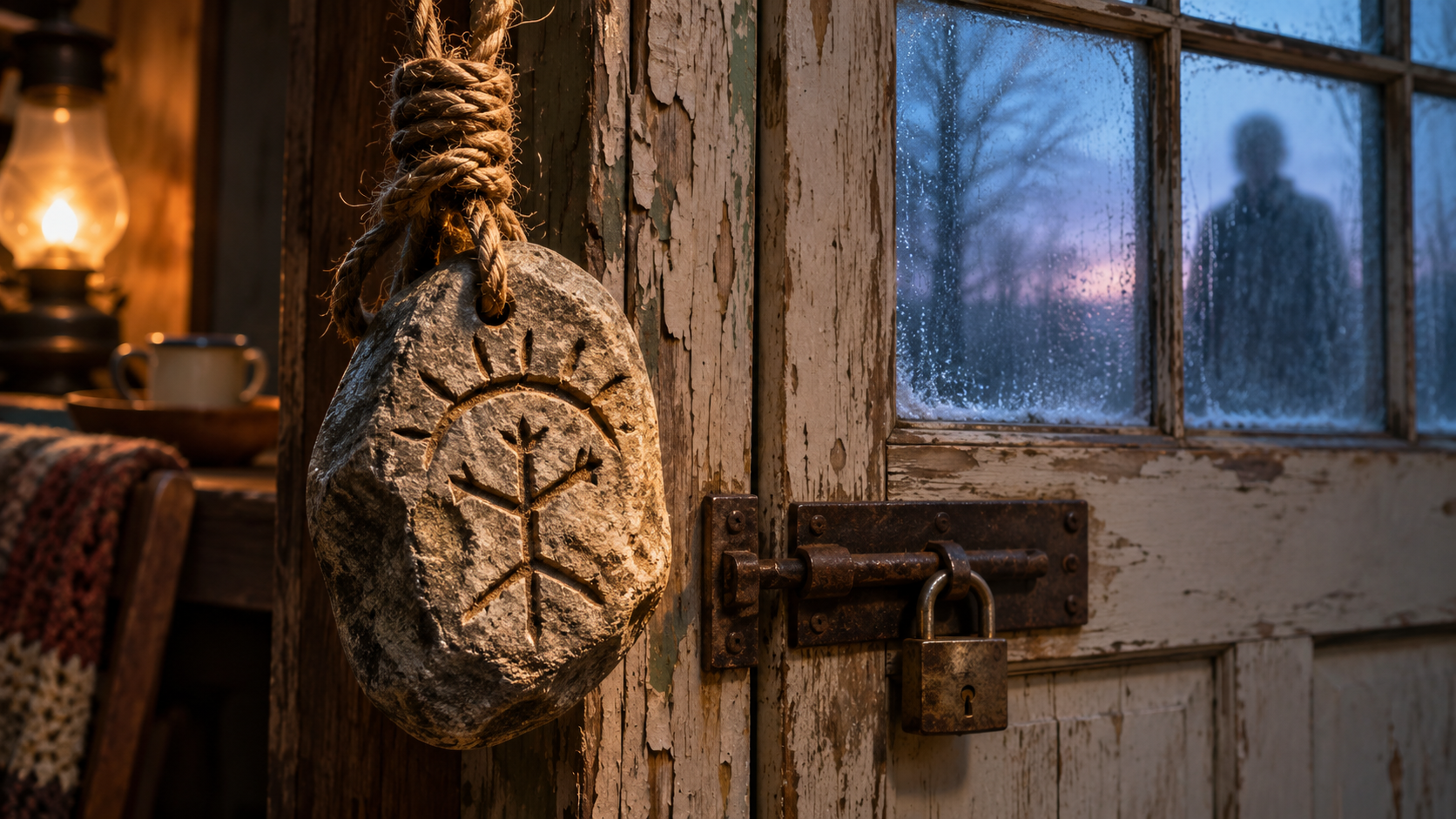
The carved talismans protect enclosed spaces against the creatures when used within the conditions the residents have discovered. They make a stable night-time routine possible. Before Boyd found them, hiding and hoping not to be discovered offered a much less secure form of survival.
Their effectiveness is observable, while their origin remains unexplained. That distinction is essential. A person can know that a particular action has repeatedly worked without understanding the mechanism that makes it work or every circumstance in which it might fail.
The stones should not be treated as portable invulnerability. Holding one does not establish that somebody can walk safely among the creatures outdoors. The protection is associated with a boundary and the space within it, rather than demonstrated as a personal force field.
Openings remain vulnerable to human decisions. A window or door can be opened from inside, admitting a creature into a place that previously offered shelter. The stones therefore make trust within the household part of its security.
This gives the supernatural rule a social consequence. Residents are protecting themselves partly by depending on other people’s judgement. Someone else’s loneliness, panic or disbelief can become dangerous to everyone sharing the same space.
The talismans also change what a home means. Shelter becomes a maintained condition, not a property that a building possesses automatically. Doors, windows and daily habits matter because they keep a boundary intact.
Season 1 does not translate every symbol on the stones into a reliable explanation. Connections between markings, visions and the wider setting invite investigation, but a visual resemblance is not sufficient proof of a common origin. The series leaves room between noticing a pattern and demonstrating what it means.
That restraint helps distinguish useful explanation from theory. The audience can describe the talismans’ observed role without pretending that the first season has revealed who made them or why they affect the creatures.
Colony House Offers Freedom at a Shared Cost
Donna leads Colony House, whose communal way of living differs from the more regulated arrangements in town. The divide is partly about how to use a life that may never return to its previous course. People can organise themselves around endurance, pleasure, order or a mixture of all three.
Julie finds an appeal in the house’s openness and in relationships beyond her parents. Ellis, Boyd’s son, lives there with Fatima. Their presence makes Colony House more than an alternative accommodation block: it contains attachments and possibilities that the younger residents have built within captivity.
The arrangement also creates a particular vulnerability. Many people share a building and depend on one another to respect its protective boundary. A single private decision can produce a public catastrophe.
Kevin’s contact with a creature at a window provides that opening. He interprets the apparent relationship as something exceptional and admits her. Once inside, the creature allows the attack to spread, and the house’s confidence in its collective security collapses.
The breach does not prove that the talismans have stopped working. It demonstrates that their protection can be bypassed through an opening made by somebody inside. Keeping that distinction clear preserves the causal logic of the attack.
Kevin’s error is also more specific than simply forgetting a rule. He treats a personal connection as a reason the established rule might not apply. The creature’s ability to sustain that impression is part of its hunting method.
The resulting deaths damage the whole community, including people who made no such decision. This is one of the season’s clearest examples of unequal control over shared danger. Residents can follow every instruction available to them and still suffer because another person controls a window.
Donna’s role becomes harder after the attack. Offering people a life worth living has to coexist with protecting them from the ways their needs can be exploited. The programme does not provide a painless formula for balancing those obligations.
Sara’s Voices Make a Different Kind of Promise
Sara hears voices that claim to offer a route out of the town through violence. She acts on those instructions, killing Tobey and exposing the clinic to the creatures. Her later attempt to kill Ethan ends instead with the death of her brother, Nathan, when he intervenes.
The voices’ promise is crucial to understanding her actions, but it is not evidence that fulfilling the demand would have freed anyone. The instruction supplies its own claimed justification. Sara’s belief in it does not independently confirm the bargain.
Her story introduces a threat that can operate through a resident rather than simply wait outside after dark. The danger is not confined to the visible creatures or to the hours when their attacks occur. A person who appears to be helping the community can be acting under a harmful interpretation of what will save it.
Father Khatri becomes interested in the information the voices seem able to provide. His response creates another difficult question: can knowledge from a dangerous source be useful without granting that source moral authority? Investigating the phenomenon is not the same as endorsing its demands.
Boyd eventually takes Sara into the forest because her connection may offer information unavailable through ordinary exploration. That decision is a gamble made against uncertainty. Her usefulness does not cancel the deaths she caused, and the deaths do not automatically explain the source of what she hears.
The town has no comfortable category for her. Treating her solely as a monster would conceal the way she has been manipulated. Treating her solely as a victim would erase the people harmed by her choices.
Her involvement also exposes how easily a promised escape can reorder judgement. When the whole community wants a way home, a demand presented as the final obstacle to freedom can acquire disproportionate power. The series asks viewers to examine the demand’s evidence rather than accept its promised reward.
Boyd’s Confidence Has a History of Loss
Boyd’s authority develops from practical action. After arriving with his wife, Abby, and their son, Ellis, he helps organise resources and explores beyond the immediate settlement. His discovery of the talismans changes what the residents can survive.
The same period contains a devastating failure of understanding within his family. Abby comes to believe that the place is a nightmare from which death will wake its inhabitants. She begins shooting people, and Boyd kills her when she threatens Ellis.
Her belief is not confirmed by the narrative. Season 1 does not establish that being killed returns someone to ordinary life. Abby’s interpretation leads to real deaths within the world the characters inhabit, and the article cannot convert her conviction into an explanation of the town.
The incident explains the strain between Boyd and Ellis. Boyd’s work for the wider community took him away while Abby’s condition deteriorated. His success in finding protection is therefore inseparable from the personal loss awaiting him when he returned.
This creates a difficult double view of his leadership. The town has reason to value what he achieved. Ellis has reason to remember what the family lost. Neither perspective becomes meaningless simply because the other is also true.
Boyd’s later exploration is consequently more than the next sensible stage of an investigation. It returns him to the activity associated with both his greatest contribution and his worst personal memory. He must leave people behind again without knowing what will happen during his absence.
His willingness to continue is courageous, but the programme does not present courage as immunity from error. He can make a defensible choice with incomplete information and still produce consequences he cannot control. That uncertainty gives his leadership more substance than a simple sequence of successful commands.
Victor and Jade Notice Different Pieces of the Pattern
Victor has survived in the town since childhood. His drawings and memories preserve experiences that other residents do not share. He is therefore an important source of knowledge, but not a convenient database that can answer any question on demand.
His relationship with Ethan allows information to move through a different kind of conversation. Ethan is more willing than many adults to take seriously the strange features of Victor’s experience. That openness can uncover useful observations, even when it also requires adult caution.
Victor demonstrates the faraway trees, whose hollow interiors can transport a person or object elsewhere. The ability establishes that the forest’s geography is not ordinary. It does not establish that entering any such tree will produce a safe or chosen destination.
Jade approaches the place through another form of confidence. Initially inclined to interpret events as a constructed experience, he has to abandon the idea that intellectual certainty alone will let him stand outside the danger. His visions and encounters with a recurring symbol then give him a more personal problem to investigate.
The season does not fully explain that symbol. Images and records connect it to the town’s history, but the meaning remains unsettled. Recognising recurrence is a useful discovery; assigning a final cause would go beyond the first season.
Victor and Jade therefore illustrate different limits of knowledge. Victor has extensive experience without a simple explanatory language. Jade has a strong desire for explanation without sufficient control over the experiences confronting him.
The community’s challenge is not only collecting clues. It is making room for information that arrives through people whose manner, memory or assumptions may be difficult to trust. Dismissing a person can mean losing an observation; accepting every observation as a theory can be equally dangerous.
Survival Includes the Lives People Keep Building
Kenny’s feelings for Kristi and her continuing attachment to the person she left outside the town show how captivity complicates ordinary commitment. Time passes for the residents, but they do not know whether the lives from which they vanished remain available.
A new relationship can therefore feel like both a beginning and an admission that the previous life may not return. Neither response is simply irrational. Holding on preserves continuity; moving forward makes the present more than an extended waiting room.
Ellis and Fatima offer another version of that problem through their decision to imagine a future together. Their commitment does not require an answer about the town’s origin. It establishes something they can choose within conditions they did not choose.
These relationships give the escape projects their human stakes. The residents are not merely solving a puzzle because puzzles demand solutions. They are deciding which promises can still be made, and to whom, while the duration of their confinement remains unknown.
The Radio Tower Turns Hope into a Collective Project
Jim’s engineering background and Jade’s technical initiative help turn the idea of a radio into a practical communal effort. A transmitter offers a different route out of helplessness. Instead of physically finding an exit, the residents might reach someone beyond the town.
Colony House provides height for the equipment, and the community contributes materials and labour. This is a significant change after the attack. A damaged shared space becomes the site of another cooperative attempt, even though the confidence required to work together has been shaken.
The electricity presents an additional mystery. Appliances function, but the system does not behave like a normal power supply. Tabitha begins investigating where the wires lead, while the radio project attempts to use the available electricity rather than explain its origin first.
Those approaches are complementary. Jim and Jade ask what can be made to work. Tabitha asks what the existing arrangement conceals. A successful device could provide contact without revealing the town’s construction; understanding the wiring could expose something without producing an immediate escape.
The tower also creates an unusually clear shared objective. People who disagree about the town’s meaning can still understand the work required to assemble equipment. Cooperation does not demand that they first settle every metaphysical question.
At the same time, the project concentrates hope into a particular outcome. If a voice answers, the residents may be inclined to treat that contact as evidence that the outside world has been reached. The finale will test that assumption.
The important achievement before the transmission is therefore limited but real. They have made a coordinated attempt using the resources available to them. Whether that attempt reaches the kind of listener they want remains unknown.
Boyd and Sara Travel Beyond the Familiar Forest
While the radio project develops, Boyd and Sara move deeper into the forest. They encounter a tree hung with bottles containing pieces of paper, including a date from the nineteenth century. The objects suggest a history beyond the residents’ present experience.
A date written on paper is evidence that somebody placed a date there. It is not, by itself, proof that every surrounding event occurred in that year. The series invites connections across time while withholding the chain of evidence needed to establish them.
The forest also interferes with the practical assumptions of exploration. The tent in which Boyd and Sara shelter is moved by an unseen force. They emerge into an area filled with spiderwebs, where Boyd is injured after approaching an apparition associated with Abby.
His physical deterioration makes continued travel more urgent and less controlled. He cannot investigate every phenomenon at leisure. The exploration becomes an attempt to keep moving while Sara must make decisions for someone increasingly unable to act normally.
A lighthouse becomes visible, adding a constructed landmark to a landscape that has resisted ordinary mapping. Its presence is a discovery, not yet a route home. Seeing a structure does not establish who built it, who uses it or how it connects to the town.
The Boy in White directs Sara towards a faraway tree. Following that guidance offers an immediate way out of their present location, but its destination is uncertain. The decision is made under pressure, with the known danger behind them competing against an unknown danger ahead.
What Happens at the End of From Season 1?
The radio works well enough for Jim to hear a voice. The speaker knows his name and warns that Tabitha should not be digging. Instead of providing straightforward rescue, the contact reveals knowledge of events inside the town.
That knowledge changes the meaning of the transmission. Jim has established that somebody can answer. He has not established that the speaker is outside the trap, friendly, human or responsible for its creation. Each of those possibilities requires evidence that Season 1 does not provide.
Tabitha’s digging breaks through into underground tunnels. Victor meets her there and explains that this is where the creatures sleep. The discovery supplies a location for the threat during daylight, but does not establish a safe method of destroying it.
Boyd enters the faraway tree and emerges inside a narrow stone shaft from which he cannot simply walk away. The tree has transported him successfully in one sense while placing him in a new predicament. The season ends before showing how that predicament will be resolved.
A bus then arrives in town. Its arrival introduces new people into an environment whose residents are already managing several crises. It is another entrance into the trap, rather than evidence that a dependable exit has opened.
The finale therefore advances three investigations without completing any of them. Communication produces an informed but threatening voice. Excavation reveals the creatures’ underground space. Exploration demonstrates another destination while leaving Boyd trapped.
This is not an ending in which the whole season turns out to have been a dream, a simulation or a confirmed afterlife. Those explanations remain theories at this point. The series has supplied phenomena that an eventual explanation must account for, rather than naming the explanation itself.
What the First Season Answers and What It Leaves Open
By the final episode, viewers can explain how the residents survive many nights, how a protected house can be breached, why Boyd carries particular guilt and what several investigations have uncovered. Those are meaningful answers even though the origin of the town remains unknown.
The strongest uncertainty concerns coordination. The voice knows about Tabitha, the forest contains structures and objects with history, and the creatures exploit human behaviour. These observations suggest that the characters are dealing with more than an ordinary collection of accidents. They do not identify a single controlling intelligence.
The season is most effective when its rules create choices before its mythology provides explanations. Residents must decide whom to trust, which risk to take and how to treat people who have caused harm. Waiting for complete knowledge is not an available way to live.
From ends its first season with the community knowing more and feeling less secure. The discoveries have enlarged the problem faster than they have supplied a solution. What remains dependable is the work of maintaining shelter, sharing information and helping the next person understand the danger before night falls.
Sources
List of From episodes — Wikipedia: Season 1 chronology and episode credits, used only within that season’s scope.
From Season 1 ending — The Cinemaholic: corroboration of the radio message, tunnels and Boyd’s position.
From plot and season recaps — The Direct: corroborating Season 1 finale account; later-season material is excluded.
From Season 1 recap — Blizzplanet: episode-level reference for arrival and the community’s rules.
Next Reads
Insidious Explained: Dalton, the Further and the Ending: supernatural boundaries, rescue and the difference between apparent and complete safety.
Looper Explained: The Timelines, Rainmaker and Meaning of the Ending: another guide that separates observed fictional rules from unanswered causal questions.
