Why Moving House Does Not Help
Moving House Cannot End This Family’s Nightmare
The Lambert family’s new home becomes frightening for reasons they cannot explain, but their most urgent concern is a child who will not wake up. James Wan’s Insidious, written by Leigh Whannell, follows parents Josh and Renai as they try to understand their son Dalton’s condition while disturbing events spread through their household. The original film premiered in 2010 and reached cinemas in 2011. It begins with the recognisable anxieties of a family settling into unfamiliar rooms, then steadily changes the terms of the danger. A locked door, a different address and an adult’s reassurance each offer less protection than expected. The central problem is finding out what has happened to Dalton before the family’s efforts to help him become another source of risk.
Dalton Does Not Wake Up
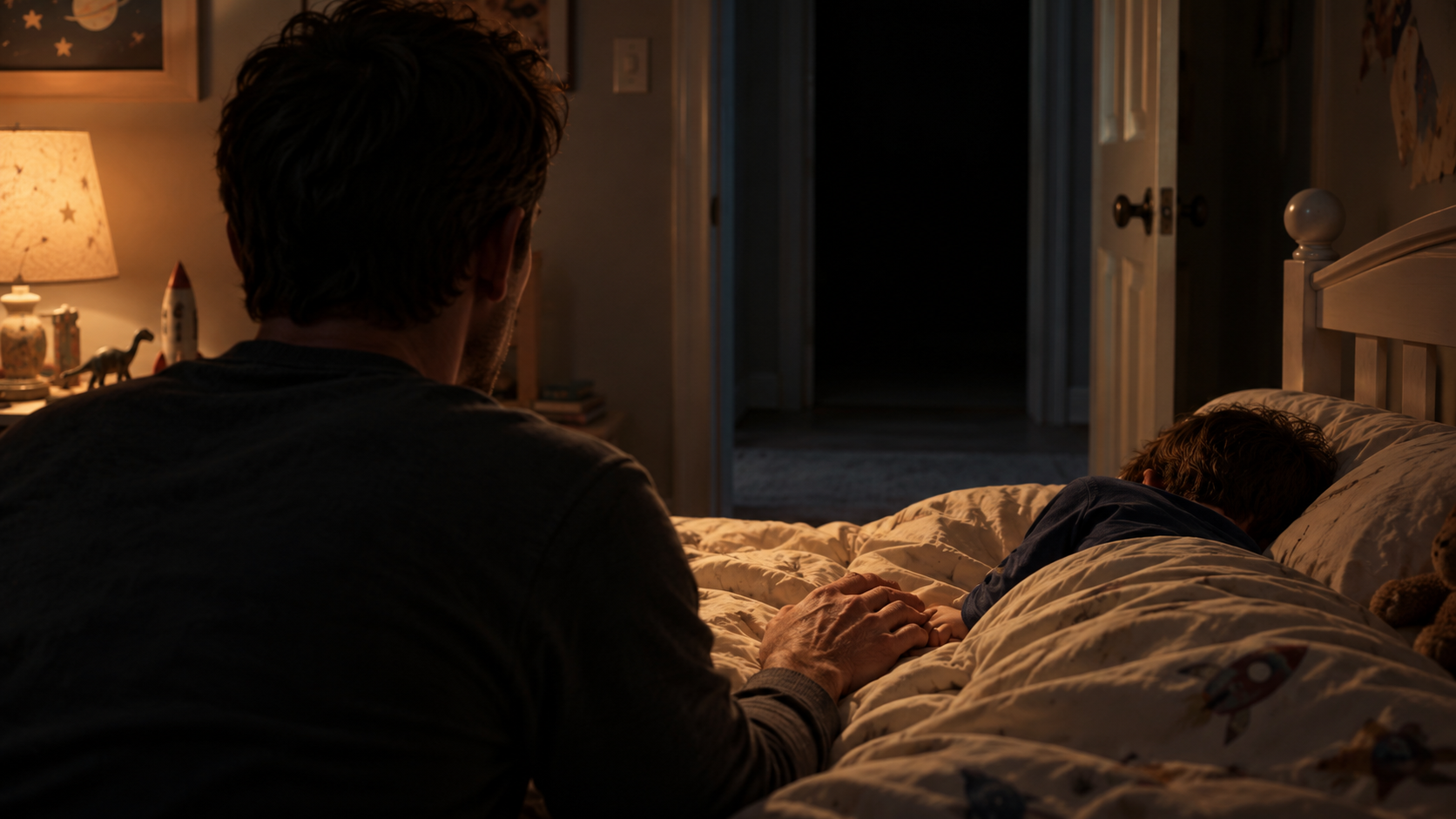
Josh and Renai move into a house with their children, Dalton, Foster and their baby daughter. Dalton explores the attic, falls from a ladder and is frightened by something there. The following morning, he cannot be woken. Medical attention does not provide an adequate explanation for his unresponsive state.
The fall offers an immediate possible cause, but the film refuses to let that explanation settle the matter. Dalton’s body remains present while his familiar responsiveness disappears. His parents must care for a child whose condition they can observe but cannot understand.
This establishes a different kind of fear from an immediate attack. The family lives with uncertainty over time, bringing Dalton home without the recovery they hoped for. Routine continues around a crisis that has no clear timetable or obvious solution.
Renai’s experience of the house becomes increasingly disturbing. Sounds, apparitions and signs of an intruder interfere with the ordinary work of caring for her children. A baby monitor, intended to help her detect a child’s needs, becomes a channel for frightening voices.
The choice of that device makes the disturbance particularly invasive. Renai is listening because she is responsible for somebody vulnerable. The same attention that should reassure her instead exposes her to something she cannot identify or control.
Josh spends time away at work and does not share every encounter. The resulting imbalance strains the relationship: Renai must describe experiences that have already frightened her, while he can respond from a position of distance. They occupy the same family crisis without possessing the same evidence.
Foster’s place in the family adds another pressure. Dalton’s condition naturally draws the adults’ attention, yet the other children still inhabit the same threatening environment. The haunting does not arrive at a time when parenting can be suspended so that the mystery receives undivided attention. Fear has to coexist with the ordinary demands of a household.
That is part of why Renai’s situation feels exhausting before the supernatural explanation appears. She is asked to maintain normality around a child who has stopped responding, while discovering reasons not to trust the normal surroundings. Josh’s distance from some of those encounters allows the same home to seem more manageable from his perspective than it does from hers.
The house therefore becomes associated with both danger and isolation. Renai cannot simply stop paying attention to it, because her children remain there. Her fear is inseparable from the obligation to continue using the rooms in which frightening things happen.
The Move That Tests Their Explanation
Renai eventually insists that the family leave. Insidious allows the Lamberts to make the decision viewers often demand of people in haunted-house films: they move out rather than endlessly defend their right to remain. The decision is reasonable according to the explanation they currently possess.
When the disturbances continue at the next property, the move becomes evidence. The family has changed the location without removing the condition that attracts the haunting. Their failure to escape is informative even though it does not make them safer.
This is a clean narrative reversal because it changes the question. Looking for something uniquely wrong with the first house can no longer account for the events. The family must consider what they have brought with them, including the child whose unexplained condition has remained constant.
Josh’s mother Lorraine also becomes involved. She describes a disturbing dream connected with Dalton and sees a red-faced figure behind Josh. Her experience gives the haunting another witness and brings the danger into a conversation between adults rather than leaving it confined to Renai’s isolated encounters.
The appearance behind Josh is effective because its placement violates the arrangement of an ordinary exchange. The threatening presence occupies the space around a familiar face. A person can be talking about danger while standing close to something they do not know is there.
Lorraine contacts Elise Rainier, a medium she already knows. Elise arrives with her assistants, Specs and Tucker, bringing a combination of technical equipment, experience and an approach the family has not previously tried.
The assistants’ bickering changes the texture of the film without making the threat disappear. They are people doing a job, with professional habits and personal friction. Their presence introduces the possibility that the haunting can be investigated systematically, even if their methods sit outside the explanations the Lamberts initially accept.
Elise Explains the Further
Elise identifies Dalton as an astral traveller. Within the film’s supernatural rules, his consciousness can leave his physical body while he sleeps. He has mistaken these journeys for dreams and travelled so far that he cannot return unaided.
The place holding him is the Further, a dark realm occupied by spirits. Dalton’s unoccupied body attracts beings that want access to the living world. The apparently comatose child is therefore both a missing person and a possible point of entry.
This explanation connects the medical mystery with the haunting. The threatening figures are not incidental occupants of an unlucky house. Their attention follows Dalton because the opportunity they seek moves with his body.
Elise’s account also changes what rescue requires. Waking Dalton cannot be reduced to improving the conditions around his bed. Someone must reach the consciousness that has become separated from it, while those remaining behind must protect the body to which he needs to return.
Josh initially rejects Elise’s claims. His scepticism is understandable in the face of an extraordinary explanation, but Dalton’s drawings give him a reason to reconsider. Material created by his son begins to correspond with the account he has dismissed.
The drawings matter because they come from Dalton’s experience before the adults have agreed on an explanation. They are not evidence Josh has produced through wanting Elise to be right. They allow the child’s perspective to enter a discussion otherwise dominated by people speaking over his unresponsive body.
The Further works as a story mechanism without requiring the viewer to treat astral projection as established reality. The film supplies its own rules and asks whether the rescue follows them. Confusing those fictional rules with a medical account of coma would obscure the kind of story being told.
Its most consequential rule is that absence creates vulnerability. A traveller gains freedom from the body’s ordinary limits but leaves something behind that others can occupy. The gift and the danger are two consequences of the same separation.
The History Josh Cannot Remember
An attempt to communicate through a séance demonstrates how aggressively the spirits can interfere. Elise then reveals that Dalton’s ability is not unique within the family. Josh possessed it as a child, and Lorraine previously sought Elise’s help when a spirit began pursuing him.
Photographs from Josh’s childhood record an old woman appearing progressively closer to him. The threat was visible in images that seemed to preserve ordinary family moments. Something associated with memory and reassurance becomes a record of an approach the child could not safely manage.
Elise helped suppress Josh’s awareness of his ability. His lack of recollection therefore has a specific history; it is not evidence that the earlier experiences never happened. The adult who initially resists the supernatural account has been protected partly by being unable to remember why it might be true.
Lorraine’s disclosure complicates her protective role. She has acted to help her son, but the consequence is that he enters fatherhood without knowledge that could explain his own child’s vulnerability. Protection from a frightening memory and preparation for a future danger are not automatically the same achievement.
The photographs also introduce a particular way of knowing. Josh’s memory cannot confirm what Lorraine describes, but the images preserve something beyond that memory. The film has already shown adults struggling to share experiences; here, an object allows the past to become visible to someone who cannot recall it.
Because Josh shares Dalton’s ability, he can attempt the journey his son cannot complete alone. The solution requires him to resume a capacity that was previously suppressed for his safety. The family cannot solve the present crisis simply by repeating the earlier strategy of forgetting.
This gives Josh’s role a meaningful change. He has been physically absent from some of Renai’s experiences and doubtful about their explanation. Now helping requires a different kind of departure: he must leave his body deliberately, with the family depending on his return.
Elise’s guidance does not make the journey risk-free. Her knowledge is enough to propose a rescue, but the story has established that travelling itself creates exposure. Josh is taking on Dalton’s vulnerability in order to reach him.
A Father Enters the Further
Under Elise’s guidance, Josh enters a trance and separates from his body. He moves through the Further with a light, encountering spaces that resemble familiar domestic settings without offering their usual security. The destination is connected to home but emptied of ordinary guarantees about time, identity and safety.
That resemblance prevents the supernatural realm from becoming simply an unrelated fantasy landscape. Josh recognises elements of the world from which he has come, yet their inhabitants and atmosphere make recognition unreliable. A house-shaped space need not obey the expectations attached to a house.
The journey also changes the film’s direction of attention. Earlier, frightening figures intrude into the family’s rooms; now Josh enters the environment from which those figures come. The rescue takes him across the boundary the haunting has been violating.
Dalton is held by the red-faced demon, whose lair gives the earlier glimpses a concrete centre. The demon is one of the beings seeking possession, and its captivity of Dalton prevents him from simply finding his way back.
The use of Tiny Tim’s recording of “Tiptoe Through the Tulips” creates an incongruous sound within that threat. The song’s lightness does not reassure because the setting has changed what its presence means. It belongs to the demon’s environment, making an apparently harmless recording part of the space Josh must enter.
Josh frees Dalton and attempts to lead him home. At the same time, the people beside their physical bodies face escalating supernatural activity. The rescue therefore has two connected fronts: escape within the Further and resistance to intrusion in the living world.
The practical difficulty is timing. Reaching Dalton is only the first requirement. Father and son must return before the vacant bodies become a lasting foothold for something else. The family’s hope depends on a reunion between consciousness and body that none of the people waiting can perform on their behalf.
As they flee, Josh encounters the old woman from his childhood. This is a different threat from the red-faced demon holding Dalton. Keeping the two separate is essential to understanding the ending: the rescue has drawn Josh back into a danger specifically attached to his own history.
What Happens at the End of Insidious?
Josh confronts the old woman and orders her away. Father and son appear to wake, the invading spirits disappear and Dalton is able to rejoin his family. The immediate rescue succeeds: the child returns to his body.
The apparent success conceals a different outcome for Josh. While helping Elise afterwards, he attracts her attention through signs that something is wrong. She photographs him, and he reacts with murderous anger, strangling her.
Renai discovers Elise’s body and examines the camera. The image shows the old woman in Josh’s place. The photograph confirms possession: the body that has returned to the household is no longer safely under Josh’s control.
The final appearance of Josh behind Renai turns the evidence into an immediate threat. She has just learned that the familiar person approaching her cannot be trusted in the way she assumed. The film stops without showing what happens next between them.
Elise is dead, Dalton has returned, and Josh is possessed. Those are the central outcomes established by the original film. It does not establish that Josh himself has been permanently destroyed, nor does it resolve how he could be recovered.
A brief post-credits image of the old woman extinguishing a candle reinforces the threat. It does not show a separate rescue, provide a new explanation or settle the family’s future. The relevant uncertainty remains the situation inside the Lambert household.
The final photograph completes the function introduced by Josh’s childhood pictures. Images reveal the spirit’s proximity when ordinary perception is inadequate. Earlier photographs showed something getting closer; the final one shows the difference between external appearance and the presence occupying that appearance.
The old woman’s victory also explains why defeating or escaping the demon would not have been enough. The film’s dangers are not all extensions of a single antagonist. The family can succeed against the immediate obstacle to Dalton’s return while another entity exploits the same journey.
Why the Rescue Does Not Make Everyone Safe
The ending is built from the rule Elise has already explained: a traveller’s body can become available to spirits. Josh takes the same risk that has endangered Dalton, and his connection with the old woman gives that risk a specific pursuer. The twist intensifies an established mechanism rather than introducing a new supernatural power at the last moment.
Its cruelty lies in allowing a genuine success. Dalton’s awakening is not a dream or a false report that must be cancelled. The family has recovered the child it set out to save, but that recovery does not guarantee that every person involved has returned unchanged.
Josh’s confrontation can look like the decisive act of courage the story has been preparing. He faces a childhood fear instead of continuing to avoid it. Yet emotional resolve does not automatically control the practical mechanics of possession. The film separates standing up to a threat from ensuring that the threat has actually been defeated.
That separation prevents the climax from becoming a simple lesson that fear alone gives evil its power. Josh is brave enough to enter the Further and rescue Dalton. His bravery has real value, even though it does not provide complete knowledge of what happens during the return.
The red-faced demon and the old woman also organise attention differently. The demon becomes the visible centre of Dalton’s captivity, giving Josh an immediate destination and an obstacle he can act against. The old woman returns through a personal history that seems secondary to the rescue until the last moments. Concentrating on the more spectacular danger leaves room for the more intimate one to succeed.
The title suits that movement. The final threat has advanced through a process the family mistakes for recovery, entering the household under the appearance of the person who has just helped save it. Its success depends on being accepted before it is recognised.
Elise’s death removes the person best equipped to identify the problem at the very moment she recognises it. The family loses both a helper and a source of explanation. Renai receives the crucial evidence, but she has no opportunity within this film to turn that evidence into a plan.
The change also sharpens Renai’s position. Earlier, she has to persuade Josh that danger exists around them. In the final scene, the danger appears through Josh himself, leaving no reassuring separation between the person she would normally turn to and the presence she needs help confronting.
The film’s final movement may feel less restrained than its opening domestic disturbances. Once the Further is named and entered, uncertainty gives way to a more elaborate supernatural geography. That change is a trade-off: the story gains a rescue mechanism and loses some of the early fear produced by not knowing what occupies the room.
For the ending to work, however, the explanation needs to be clear enough to mislead in a particular way. We must understand the possibility of possession, concentrate on Dalton as its likely victim and then recognise that the same condition has applied to Josh. The final image changes the target of an established fear.
Insidious leaves its family with a recovered child and a corrupted homecoming. The most reassuring event in the film—Josh opening his eyes after the rescue—turns out to be insufficient evidence that he is back. By making a photograph reveal what an embrace or a familiar voice cannot, the ending locates its horror inside recognition itself. Renai can see her husband standing before her, while knowing that seeing him is no longer enough.
Sources
Insidious — Sony Pictures — Official credits, premiere and theatrical-release distinction, premise and supernatural setup.
Insidious — Time Out — Contemporary review corroborating the move from domestic haunting to the astral-rescue story.
Insidious Ending, Explained — The Cinemaholic — Account of the rescue, photograph, Elise’s death and post-credits image; its speculation about later events is not adopted.
Insidious (film) — Wikipedia — Secondary chronology and ending account, checked against the official record and detailed explanation.
