A New Home and an Old Mystery
A New Home With Nowhere to Hide
A house should give a family somewhere to begin again. In Within, the rooms that promise that fresh start become increasingly difficult to trust. Philip Claydon’s 2016 horror film follows widower John Alexander, his teenage daughter Hannah and his new wife Melanie as they settle into a property with an uncomfortable history. Ordinary household disturbances acquire a threatening pattern, while disagreements about what deserves attention leave Hannah struggling to make herself heard. The film uses a familiar domestic question to sustain its mystery: how much can you really know about the place where you sleep? Its tension grows through the difference between owning a building, understanding its past and recognising what is happening inside it.
Moving In and Losing Confidence
John brings his family into the house expecting the move to help them establish a shared life. Hannah is already in trouble over a party and drinking, which gives her father an easy explanation for behaviour he considers unreliable. Clearing belongings left behind by the previous occupants becomes part of her adjustment to the property.
This arrangement gives Hannah access to the house’s history while placing her in a weak position when she questions it. She is the person expected to sort through the evidence of earlier lives, but she does not control the decision to remain. John can treat the work as a chore even as the material she encounters begins to undermine his confidence in the purchase.
Small irregularities accumulate. Food and drink seem to have been disturbed; things are no longer where they should be. The family’s cat reacts uneasily. None of these incidents, taken alone, tells Hannah what she is facing, and that uncertainty allows more reassuring explanations to survive.
Domestic horror benefits from this scale. A missing item is rarely enough to justify abandoning a home, yet repeated discrepancies make everyday activity demanding. Eating, sleeping and walking into another room start to require an assessment of whether somebody has already been there.
The household also has to negotiate its relationships. Melanie is Hannah’s stepmother, but the film does not simply make her another adult enemy. Their developing alliance becomes important because Hannah needs somebody who can take her experiences seriously without reducing them to another disciplinary problem.
John’s wish for a new beginning is understandable. What damages his judgement is the growing need to defend that beginning against evidence. Once the house represents his ability to provide for the family, admitting that it might be unsafe threatens more than the value of a property.
The Neighbour Who Attracts Suspicion
Ray, the neighbour and locksmith, offers a more recognisable source of unease. His attention towards Hannah crosses boundaries, and his access to locks makes him an obvious person to consider when privacy seems to be failing. The family can imagine an intruder more easily when somebody nearby already behaves invasively.
Ray’s conduct gives the mystery a suspect whose unpleasantness has an independent basis. The film does not need to make Hannah irrational for disliking him. Her judgement that he is a threat can be reasonable even if it does not explain everything occurring in the house.
That separation is useful in a story built around suspicion. A person can be guilty of one violation without being responsible for every disturbance. Treating all disturbing behaviour as the work of a single culprit offers psychological relief: identify that person, remove their access and the household should become safe again.
Changing locks fits that expectation. It is a practical response to the possibility of someone entering from outside. Its apparent clarity also discourages a harder question about whether the family has correctly understood the boundary being crossed.
Hannah’s vulnerability is particularly uncomfortable because the threat reaches into spaces where she should be able to stop performing for other people. A bedroom is supposed to permit privacy from parents, neighbours and strangers alike. The possibility of observation makes even that limited independence uncertain.
Meanwhile, glimpses of a concealed presence begin to give the audience more information than the family possesses. The suspense therefore changes its emphasis. We are no longer dependent solely on deciding whether Hannah’s anxiety is justified; we must watch her move through rooms whose dangers she cannot yet locate.
What the House’s History Conceals
Hannah learns that the property was associated with a family’s violent deaths. The accepted account blames a father who killed members of his household and then hanged himself. This history makes a haunting seem plausible within the film’s genre, even before anything supernatural has been established.
John’s response creates a further breach of trust: he already knew about the killings. He had not given Hannah and Melanie the information they would have needed to judge the move for themselves. For him, the past is something he has decided they can live with; for them, discovering it means reassessing his assurances.
Knowing that a tragedy happened is different from knowing whether its explanation was correct. The house comes with a story that appears to have reached its conclusion. A dead perpetrator, dead victims and the passage of years make the danger seem historical rather than active.
Hannah’s investigation challenges that apparent closure. Old material, including a family photograph, suggests that the familiar account may leave somebody out. Her boyfriend Tommy helps her notice evidence that cannot be comfortably fitted into the version already circulating.
The film gives objects left behind a double purpose. They are debris to the new owners, who want to make the house their own, but they also preserve information that has outlasted the people expected to explain it. Clearing the property becomes an investigation almost by accident.
This is also why the title matters before its full explanation arrives. “Within” directs attention towards an interior that the family assumes it understands. The relevant history is not simply attached to the address; it has been built into their daily surroundings.
Hannah’s search does not turn her into an investigator with unlimited resources. She is assembling fragments while still subject to parental rules and ordinary teenage obligations. The restrictions help explain why knowledge arrives unevenly, although they cannot make every delay in the family’s response convincing.
When Being Believed Becomes Urgent
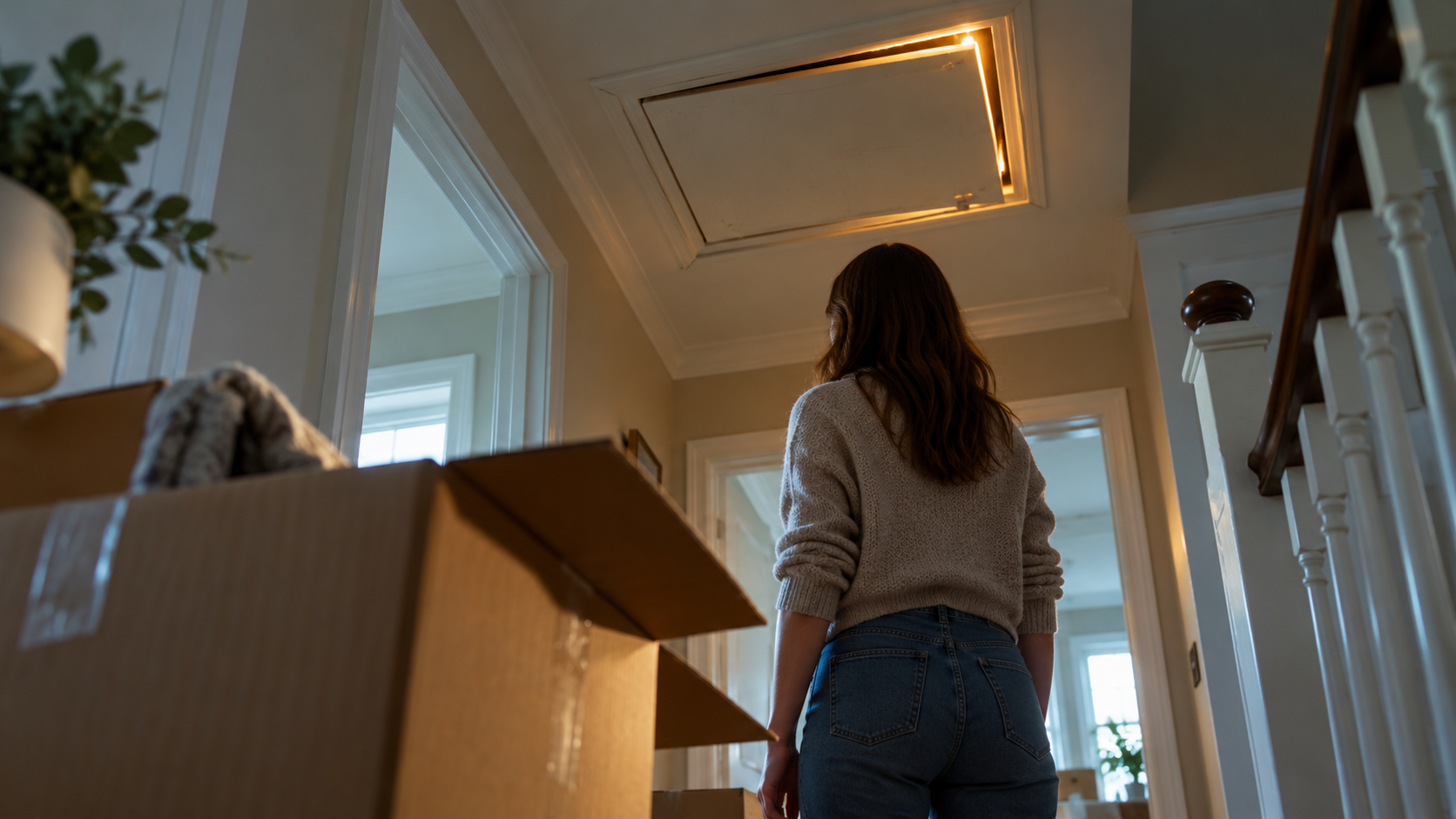
Disturbances near the attic and concealed parts of the house make Hannah’s fear increasingly specific. She encounters signs of a presence where the family expects empty space. John continues to resist her interpretation, while Melanie becomes more willing to acknowledge that something is wrong.
The disagreement is no longer merely about whether the property has a grim reputation. It concerns whose account of a present event can alter the household’s decisions. Hannah can discover something disturbing without gaining the authority to act on it.
Her previous drinking gives John a ready explanation for later confusion or impairment. This becomes especially dangerous when an outside agent can produce symptoms that resemble the behaviour he already expects. A familiar story about his daughter competes with unfamiliar evidence about the house, and the familiar story is easier for him to accept.
The concealed intruder also tampers with Hannah’s drink. When the resulting impairment is read as another episode of drinking, a previous disciplinary dispute becomes useful to the attacker. He does not need to persuade John directly; the father supplies an explanation that hides what has been done to his daughter.
This is more precise than a general warning about parents failing to listen. The household has an established expectation about one person, and an intruder can exploit it. Hannah’s behaviour is treated as evidence against her credibility when it should prompt a new question about its cause. The incident shows how danger can borrow the appearance of an existing problem, particularly when the person responsible for responding has already decided that he understands it. Neither Hannah’s earlier mistake nor John’s frustration makes the later interpretation reliable.
The film makes that failure causal. Dismissing a report changes what happens next: the family stays, an incident is not investigated properly, or a warning loses urgency. Disbelief is more than an unkind attitude when the disbelieving person controls the practical response.
Recorded images further complicate the family’s sense of privacy. Material showing them at their most vulnerable makes it harder to explain the disturbances as harmless mistakes. Yet proof that somebody has observed them still does not establish the observer’s identity or route of access.
Ray remains a powerful distraction because his behaviour fits part of the evidence. His presence encourages the household to concentrate on a visible suspect rather than reconsider the building itself. The narrative uses that concentration to keep two different kinds of intrusion entangled.
There is a limit to the strength of this device. Once danger becomes difficult to dismiss, continued attachment to the house can feel like the plot protecting its setting. John’s financial and emotional investment explains reluctance, but it does not automatically make every decision to remain persuasive. The film’s suspense sometimes depends on that gap.
Understanding the Hidden Space
The investigation eventually identifies David, a son from the earlier family who has been absent from the account Hannah first hears. He survived and has remained concealed inside the property. The apparent haunting has a physical explanation: somebody has been living in the spaces the new household cannot readily see.
The revelation also revises the earlier murders. David killed his family and arranged events so that responsibility appeared to rest with his father. His continued presence makes the old explanation actively dangerous, because it has encouraged later occupants to believe the killer is already dead.
The film associates David with agoraphobia and a history of disturbed behaviour. These details belong to its fictional characterisation; they are not a sound explanation of real people with agoraphobia. His violence is established through his actions. A diagnostic label does not supply a convincing motive on its own.
Once David is identified, several apparently disconnected disturbances acquire a common mechanism. Food can disappear because another person eats it. Objects can move because somebody can reach them. Locked doors can fail to protect the family because their assumption about where the intruder begins is wrong.
The wall spaces turn the house into two overlapping environments. Hannah occupies the rooms intended for residents, while David uses routes that allow him to observe and approach those rooms. Their proximity is more troubling than the distance of a conventional attacker outside a window: the family has already brought its private life within his reach.
Ray’s eventual fate confirms that he is not the controlling presence in this arrangement. His own predatory behaviour does not protect him from David. By allowing one threatening man to fall victim to another, the film prevents the simpler explanation from absorbing the larger danger.
Tommy is also caught in David’s reach. His involvement raises the stakes for Hannah because the danger no longer concerns only the people who have chosen to live there. Visiting the house is enough to become part of the situation, and the family does not immediately understand what has happened to him.
What Happens at the End of Within?
After David attacks, the family calls for help. Police shoot a figure they take to be the attacker, and the apparent removal of the threat creates a brief expectation of safety. The crucial mistake is one of identification: the person shot is Tommy, who has been held captive, rather than David.
This error explains why the film’s final attack is possible. The family does not knowingly welcome the killer back or discover that a defeated supernatural being can regenerate. David has never been removed. The authorities’ response has produced confidence without establishing that the right person was stopped.
The family remains at the property while preparing to leave. Hannah’s attempt to locate Tommy leads her towards his phone and back into David’s concealed territory. She is seized and restrained within the house, now experiencing directly the spaces from which he has been observing them.
Hannah manages to free herself, but escaping the restraints does not produce an open route to safety. Melanie is killed. John tries to help his daughter, is injured during the struggle around the attic and is killed as well. The protective family structure collapses through a series of failed attempts to get Hannah out.
Hannah reaches towards the front of the house and fights back, injuring David with broken glass. The film nevertheless denies her a clear escape: he drags her back and attacks her as the action gives way to the ordinary exterior. There is no rescue or confirmed surviving future for her.
The ending strongly implies that Hannah is killed. It is more precise to describe the fatal implication of the attack than to invent a later discovery of her body or a police account that the film does not provide. Its final emphasis is the restoration of outward quiet while violence remains hidden inside.
That outward normality completes the film’s treatment of appearances. A house can look undisturbed after an emergency without being safe, just as it can look empty before a family moves in without being unoccupied. The final exterior makes the gap visible without explaining away the practical horrors that produced it.
Why the Ending Refuses a Fresh Start
The final reversal depends on a particularly cruel misuse of reassurance. Calling the police is the sensible escalation the family should want, yet the response becomes another reason to lower their guard because the supposed attacker has been misidentified. The film turns a resolution into a new vulnerability through a specific mistake rather than an unexplained resurrection.
Tommy’s role makes that mistake more than a mechanical twist. The person Hannah wants to find is the person whose removal helps persuade the household that the danger has ended. Her personal connection draws her towards evidence that the official explanation has failed.
John’s last actions also complicate his earlier behaviour. His attempts to save Hannah show that his refusal to believe her cannot simply be equated with an absence of love. He cares about her, but care expressed through control and certainty has not given her the protection she needs. Courage arrives after a series of missed opportunities to reassess the situation.
Melanie’s death prevents the growing alliance between the two women from becoming an easy solution. Recognition is necessary, but the film allows it to come too late to guarantee survival. Their shared understanding changes the emotional relationships without changing the house’s physical advantages for David.
The story is most effective when its explanation alters the meaning of ordinary household details. Its weaker element is the burden placed on convenience: hidden movement, missed evidence and mistaken identification must all align to preserve the killer’s advantage. Understanding the mechanism does not require treating every part of it as equally plausible.
Within ultimately makes possession of a home feel disturbingly shallow. John can buy the address, replace its locks and bring his family through the door without gaining control over its interior. Hannah comes closest to understanding what that ownership conceals, but understanding arrives inside a space already arranged against her. The ending leaves the building standing as an ordinary home, with none of its outward stability reflecting what has happened to the people who entered it.
Sources
Within — Netflix — Official listing used to confirm the film’s identity, year and principal cast.
Within: Film Review — Scream — Contemporary review supporting the family setup, neighbour and house investigation.
Within (2016) Explained — Average Movie Reviews — Detailed account used to check the concealed occupant, police misidentification and final sequence.
Within Synopsis and Review — Synopsis and Reviews — Additional plot account used to compare the explanation and ending.
Within (film) — Wikipedia — Secondary credits and plot reference, cross-checked against the accounts above.
