The Wizard, the Grimmerie and the Finale
Two Roommates Learn Who Gets Called Good
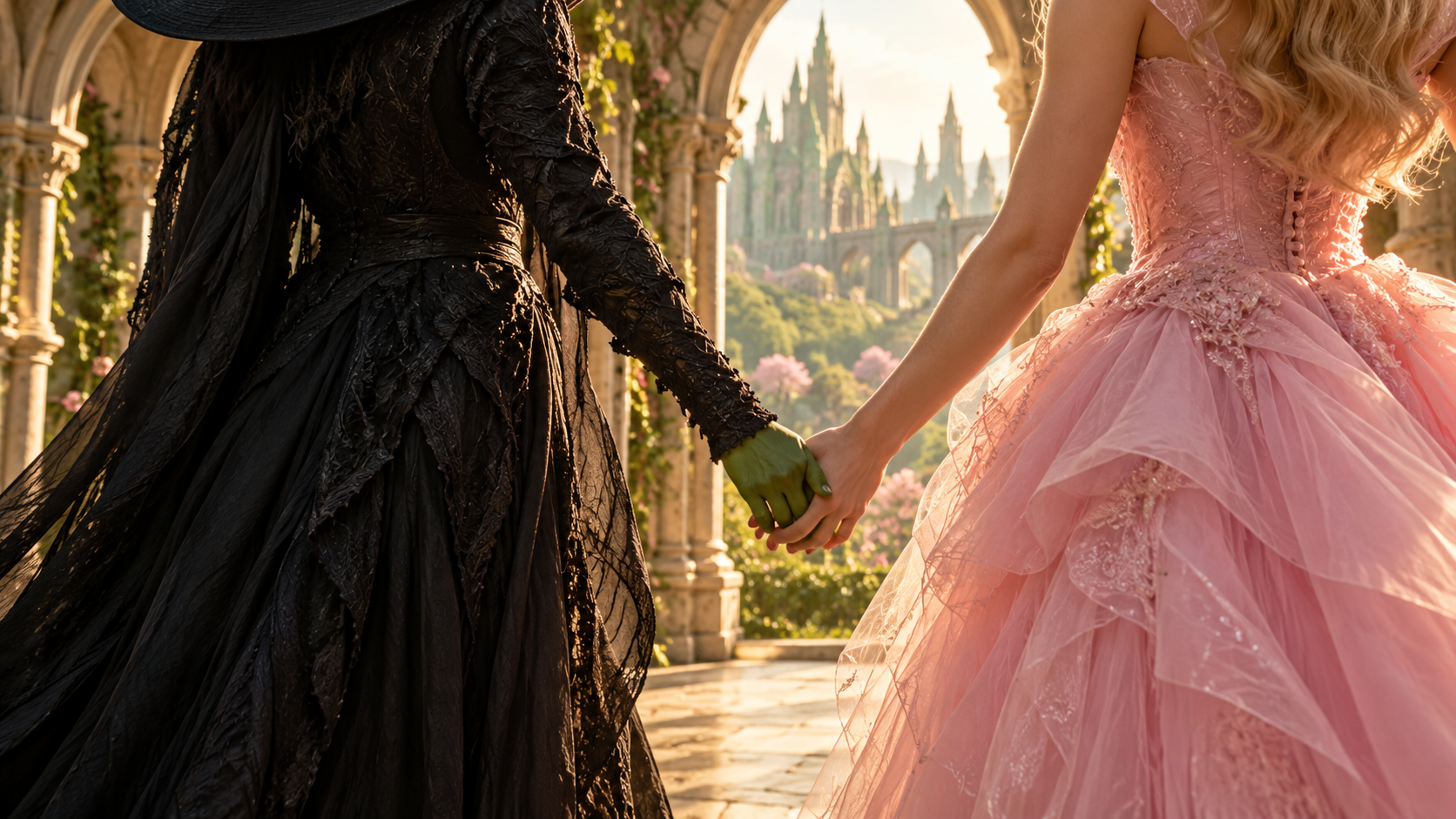
Elphaba arrives at university with a reputation she has never chosen. Galinda arrives expecting admiration to open doors. Jon M. Chu’s 2024 film Wicked brings these young women together in a version of Oz where appearance, popularity and magical ability do not carry the same kind of power. Cynthia Erivo and Ariana Grande play students whose initially hostile relationship becomes central to the choices ahead of them. Adapted from the stage musical, this first film follows their time at Shiz and their journey towards the Wizard. Its conflict grows from a deceptively ordinary problem: belonging can feel like a reward until acceptance requires overlooking what is happening to somebody else. Friendship offers both women a way to see beyond the roles already prepared for them.
The Reputation Before the Person
Wicked begins after the reported death of the Wicked Witch of the West. The people of Munchkinland celebrate, while Glinda joins a public occasion shaped by certainty about who deserved hatred. A question about whether she knew the witch opens the way into the earlier story.
The film therefore announces a future reputation before showing the person who acquires it. The central mystery is not simply whether Elphaba will become associated with wickedness. It is how the audience should judge a label that the crowd already treats as settled truth.
“No One Mourns the Wicked” gives that certainty a collective form. Celebration allows the community to demonstrate agreement, and the figure being condemned is absent from the discussion. Glinda’s position is more complicated because she possesses memories that cannot fit neatly into the public account.
Elphaba’s childhood introduces the conditions under which that account can later take hold. Her green skin marks her as different from birth, and her father treats that difference as a source of shame. She grows up carrying responsibility for her younger sister Nessarose while receiving little of the approval she wants.
The father’s rejection does not establish that Elphaba has done something wrong. It establishes how quickly appearance can be treated as a verdict. The film asks the audience to encounter the child beneath an image that other people have already interpreted for her.
Dulcibear, an Animal who helps care for Elphaba, also matters to the story’s later concerns. Animals in Oz can speak and participate in society. Their status is part of Elphaba’s ordinary experience of care, making their treatment more than a distant political issue when she encounters it at Shiz.
An Unexpected Place at Shiz
Elphaba accompanies Nessarose to university rather than arriving with an established place of her own. When staff handle her sister without properly respecting her wishes, Elphaba’s emotional response produces a display of magic. Madame Morrible recognises an ability worth cultivating and offers her individual instruction.
The event gives Elphaba access through the very power that has made her seem troublesome. Something previously associated with embarrassment becomes a possible route to recognition. Morrible’s approval is compelling because it appears to reinterpret Elphaba’s difference as promise.
Galinda wants that recognition for herself. Socially assured and accustomed to being noticed, she finds that charm does not automatically secure Morrible’s attention. Becoming Elphaba’s roommate makes the comparison impossible to avoid.
“What Is This Feeling?” turns their mutual irritation into an escalating social performance. Galinda’s hostility can draw support from others, while Elphaba has less control over the group’s response. Their dislike is reciprocal, but their ability to make that dislike socially consequential is unequal.
Elphaba’s ambition takes shape in “The Wizard and I”. She imagines that the Wizard could recognise her ability and transform the terms on which other people see her. Her hopes include the possibility of no longer being marked by green skin.
That wish reveals the cost of rejection. She has not yet reached a position from which being different feels sufficient in itself. Acceptance appears to require intervention from the most admired person in Oz, and perhaps a physical change that would make admiration easier for everyone else.
Morrible’s mentorship gives that fantasy an apparently practical route. Training, institutional approval and a future meeting with the Wizard become connected steps. Elphaba’s desire to help others develops alongside a much more private desire to be welcomed.
A Classroom Reveals a Wider Problem
Doctor Dillamond, a talking goat and history teacher, introduces Elphaba to the worsening treatment of Animals. Hostility appears inside the university, and reports that Animals are losing speech make the danger more serious than ordinary prejudice between individuals.
The use of a teacher is significant. Dillamond possesses knowledge and a recognised role, yet neither guarantees that he will remain entitled to speak. The institution can benefit from what he knows while becoming willing to remove him from the position through which he shares it.
Elphaba initially believes the Wizard could correct the injustice if he understood it. This belief allows her admiration for authority to coexist with resistance to what she sees locally. She does not yet need to choose between her personal ambition and her concern for the Animals because she assumes both point towards the same powerful helper.
Fiyero’s arrival introduces an apparently different response to the world. “Dancing Through Life” presents ease, pleasure and avoidance as a philosophy attractive to students facing expectations. His charm depends partly on making seriousness look unnecessary.
That attitude contrasts with Elphaba’s inability to ignore what hurts people around her. Yet the film leaves room for Fiyero to become more than the philosophy he performs. His behaviour will matter more than the role of carefree prince that first makes him appealing.
For Galinda, the arrival also creates a romantic opportunity. Boq’s interest in her becomes an inconvenience she redirects towards Nessarose. What looks like a kind invitation to an excluded young woman is entangled with Galinda’s desire to pursue someone else.
Nessarose experiences the attention as meaningful. The gap between her understanding and Boq’s motive gives the arrangement consequences beyond Galinda’s immediate social success. Other people begin making emotional commitments on the basis of a story that has not been honestly shared.
The Dance That Changes Their Friendship
Galinda gives Elphaba a pointed black hat as a joke, expecting it to make her conspicuous at the Ozdust Ballroom. Elphaba, meanwhile, believes Galinda has helped Nessarose and persuades Morrible to allow her roommate into sorcery lessons. One woman has arranged humiliation while the other has offered something genuinely valuable.
Learning of Elphaba’s generosity changes how Galinda sees the scene she has created. Elphaba arrives wearing the hat and dances alone under the attention of the crowd. Galinda joins her, making a public choice to stand beside the person others have been encouraged to ridicule.
The gesture works because it uses the kind of power Galinda actually possesses. She cannot match Elphaba’s magic, but she can change the social meaning of joining her. The person who helped establish the joke becomes the person capable of interrupting it.
An apology in private would not have addressed the same harm. The humiliation happens before an audience, and Galinda’s participation changes the audience’s position. She gives up some of the safety that comes from being aligned with the people laughing.
Elphaba’s willingness to dance alone also prevents the moment from belonging entirely to Galinda’s generosity. She does not wait motionless for the popular student to authorise her presence. Galinda responds to something Elphaba is already doing, and the friendship begins through participation rather than rescue from complete helplessness.
Their movements temporarily make room for a relationship outside the university’s usual rankings. The dance cannot abolish those rankings, but it changes what the women know about each other. Elphaba sees someone willing to interrupt her own social advantage; Galinda sees that the person she has mocked can act with dignity even when the room offers no encouragement.
The friendship grows through that change, but “Popular” shows that Galinda’s assumptions survive it. Her offer to improve Elphaba’s presentation is affectionate and funny, while still treating social success as something produced by the right gestures, clothes and manner.
Elphaba receives companionship without fully sharing the theory behind it. A makeover can help someone navigate an unfair environment; it cannot establish that the environment was right to reject her before the makeover. The song lets warmth and limitation exist together.
The hat also acquires a new history. A visual sign associated with the Wicked Witch begins as an attempted insult that Elphaba wears into a moment of connection. The film gives an iconic object a personal past rather than allowing its familiar appearance to settle its meaning.
Acting When the Lesson Becomes Cruel
Dillamond is removed from his classroom, and a replacement introduces a caged lion cub as part of a system designed to prevent Animals from developing speech. Elphaba is confronted with an immediate demonstration of the harm she has been hearing about.
She uses magic to put the class to sleep, with Fiyero remaining awake, and the two remove the cub. Their action interrupts the lesson rather than accepting its authority. The university’s ability to present cruelty as education no longer determines how Elphaba responds.
The cage makes the political problem concrete. It is a device for shaping what another being can become, and its defenders treat that restriction as an orderly procedure. Elphaba’s intervention is disruptive because the normal operation of the room has become the means of harm.
Fiyero’s participation revises his earlier performance of indifference. He can act with care when confronted by a specific need. Elphaba sees a capacity that his carefree social identity has obscured, and their connection begins to exceed the assumptions attached to his relationship with Galinda.
“I’m Not That Girl” gives Elphaba space to articulate desire without treating it as a claim on him. Her expectation of exclusion extends into romance: she can recognise intimacy while assuming it will not become a future available to her.
Galinda later adopts the name Glinda, associated with Dillamond’s pronunciation. The gesture suggests solidarity, but it also takes place within her concern for how Fiyero sees her. The film allows an expression of support to be sincere, socially useful and incomplete at the same time.
Elphaba’s response to the Animals has involved practical risk. Glinda’s gesture changes a public name. Both are visible, but their consequences differ, preparing the later conflict over what meaningful opposition will require.
The Emerald City and the Promise of Approval
Morrible secures an invitation for Elphaba to meet the Wizard. Elphaba asks Glinda to accompany her, bringing the friendship into the fulfilment of a hope that began as deeply personal. The journey appears to offer recognition without requiring her to leave her friend behind.
“One Short Day” presents the Emerald City as a place capable of making that hope feel reasonable. Its spectacle offers evidence of importance before the women have tested the character of the person at its centre. Admiration arrives through architecture, performance and shared excitement.
Public stories about the Wizard and the Grimmerie, a book of magic, also help explain his status. Authority is supported by an account of special knowledge. The city does not simply display power; it supplies a story about why that power deserves trust.
When Elphaba and Glinda meet the Wizard, his personal warmth makes the encounter seem less intimidating than the public image. He invites participation and offers the possibility of belonging. For someone repeatedly rejected, kindness from a powerful figure can feel like proof that the imagined future is finally becoming real.
Morrible’s presence strengthens that impression. The teacher who recognised Elphaba’s talent appears to have delivered on her promise. The movement from classroom to palace seems to confirm that the institutional path has been leading somewhere worthwhile.
Elphaba is asked to read from the Grimmerie. Her ability is real, and the spell causes the Wizard’s monkeys to grow wings painfully. What seemed to be a demonstration of talent becomes participation in an act whose purpose has been withheld from her.
The Wizard and Morrible welcome the result because flying monkeys can serve their surveillance of the Animals. Elphaba discovers that the authority she hoped would stop the oppression is involved in directing it. The Wizard has no comparable magical ability and needs her power to extend his own.
The revelation is not that every form of magic in Oz is fraudulent. Elphaba’s spell has a painfully real effect, and Morrible has recognised genuine ability. The deception concerns the Wizard’s claim to authority and the purpose for which the women have been encouraged to trust him. Actual power can be recruited into maintaining a false public image.
That distinction makes Elphaba’s culpability troubling without making her knowingly complicit from the beginning. She performs the spell before she understands its intended use. Once she learns the purpose, however, continuing would require a different decision. The scene marks the point at which innocence about the arrangement becomes unavailable to her.
Her decision now has a cost the earlier dream did not include. She can obtain recognition by allowing her gift to be used against beings she wants to protect. Refusing means surrendering the future that has helped her endure rejection.
What Happens at the End of Wicked?
Elphaba refuses to cooperate, takes the Grimmerie and flees with Glinda. Morrible responds by publicly presenting her as dangerous and wicked. The official account turns Elphaba’s resistance into the reason other people should fear her.
An attempted escape in the Wizard’s balloon fails, and Elphaba uses the spell to make a broom fly. “Defying Gravity” develops around the choice between returning to the authorities on their terms and accepting a future outside their approval.
Glinda wants Elphaba to apologise and recover the opportunity that is being lost. Elphaba instead asks Glinda to come with her. Their disagreement is painful because the friendship remains real: neither woman’s decision can be reduced to discovering that she never cared about the other.
Glinda stays. Elphaba takes responsibility as guards close in and escapes into the air. Her flight is a practical departure from the palace and a visible refusal to let its judgement define the limits of her life.
The sequence briefly connects Elphaba with the image of her younger self. The adult does not gain freedom by erasing the rejected child from her history. She carries that child’s need for protection into the act of saving herself.
The wider reaction shows that the escape has consequences beyond the two friends. News spreads, familiar lives are disrupted and Elphaba becomes the subject of a public story she does not control. Her command of the broom cannot give her equal command of what Oz is told.
The 2024 film ends at this break. Elphaba has escaped, Glinda remains behind, and the Wizard’s rule has not been overthrown. The film does not complete the later events announced by its opening frame, so the crowd’s earlier report should not be treated as a death shown in this finale.
“Defying Gravity” therefore closes a stage of the story rather than settling every relationship. Elphaba has made her decision and demonstrated that she can act on it. The consequences of being publicly named wicked remain ahead of her. Flying gives her a route out of immediate captivity, but it does not free the Animals already under the Wizard’s control or bring their wider persecution to an end.
What Their Separate Choices Mean
Elphaba’s final position reverses the ambition expressed in “The Wizard and I”. She initially wants the Wizard’s recognition to change how the world sees her. At the end, preserving her own judgement requires rejecting his recognition even though the world’s view becomes worse.
The reversal gives the songs a narrative relationship. The first imagines freedom through acceptance; the last acts on freedom without it. Her magical development is inseparable from the discovery that the authority promising to validate her ability cannot be trusted to decide how it should be used.
Glinda’s decision remains morally uncomfortable without making her affection false. She has already shown that she can oppose a crowd when she understands the harm it is doing to a friend. The palace presents a much larger demand: relinquishing access, status and the possibility of influence rather than temporarily risking popularity.
Staying does not prove that every future act she takes will serve the Wizard, but it does leave her inside the system Elphaba has rejected. The film ends before she can demonstrate what she will do with that position. Hope about future influence cannot erase the choice visible in the present.
The treatment of the Animals is the point on which the friendship’s differences become politically consequential. A private bond can survive disagreement, but affection alone cannot settle what to do when institutions are harming others. The two women must choose actions that extend beyond how they feel about each other.
The musical form helps distinguish the places where these decisions are made. A private wish such as “The Wizard and I” gives access to a future Elphaba is imagining, while a communal number such as “No One Mourns the Wicked” shows an interpretation being rehearsed together. Both make feeling audible, but one belongs to a person’s hope and the other helps organise a group’s response.
“Defying Gravity” draws those scales together. An intensely personal decision becomes a public event witnessed and reported by others. Elphaba can finally act with conviction, yet the meaning of that action immediately becomes contested. The song’s force comes partly from this mismatch between the freedom she experiences and the condemnation spreading below her.
The opening celebration acquires a sharper meaning after Morrible’s broadcast. We have now seen one process through which a reputation is manufactured: an influential speaker converts refusal into menace, then distributes that interpretation widely. The crowd’s confidence becomes evidence of how successfully a story has circulated, not proof that it is accurate.
Wicked’s first film ends with Elphaba gaining the power to leave while losing the hope that being understood will make leaving unnecessary. Glinda remains close enough to care and far enough away to choose differently. The broom, hat and green skin now belong to a person whose actions the audience can judge for itself. Oz may call her wicked, but the film has supplied the history that makes accepting that verdict impossible without question.
Sources
Wicked — Universal Pictures At Home — Official 2024 film identity, director, cast and premise.
Wicked 2024 Movie Spoilers and Full Plot Summary — The Direct — Account of the Shiz relationships, Animals, palace discovery and final escape.
Wicked (2024 film) — Wikipedia — Secondary sequence and adaptation reference, cross-checked against the other accounts.
Wicked Explained: Emerald City Scene, Part 2 Plans and More — Los Angeles Times — Reporting used narrowly to verify the younger-self image during the finale.
Are You Holding Space for the Wicked: Part One Finale? — Elle — Additional account of the final choice and the first film’s stopping point; no song lyrics are reproduced.
