Hereditary Explained: Paimon, the Cult, Charlie and the Ending
The Cult’s Plan Was Hidden in Plain Sight
A Mother’s Death Leaves Her Family With Unanswered Questions
Annie Graham does not know how to mourn her mother. Their relationship was difficult, her mother kept secrets, and the people attending the funeral seem to know someone Annie never fully understood. Back home, Annie’s husband and children respond differently to the loss, leaving her caught between grief, resentment and an uneasy sense of obligation.
Written and directed by Ari Aster, Hereditary (2018) begins with this recognisable family discomfort before pushing it towards supernatural horror. Its unsettling power comes from the connection between those two experiences: the fear that something is wrong inside your family, and the fear that you cannot protect yourself from it. Understanding the film means following how the Grahams’ private tensions become entangled with a history they do not yet understand.
Annie Struggles With What Her Mother Left Behind
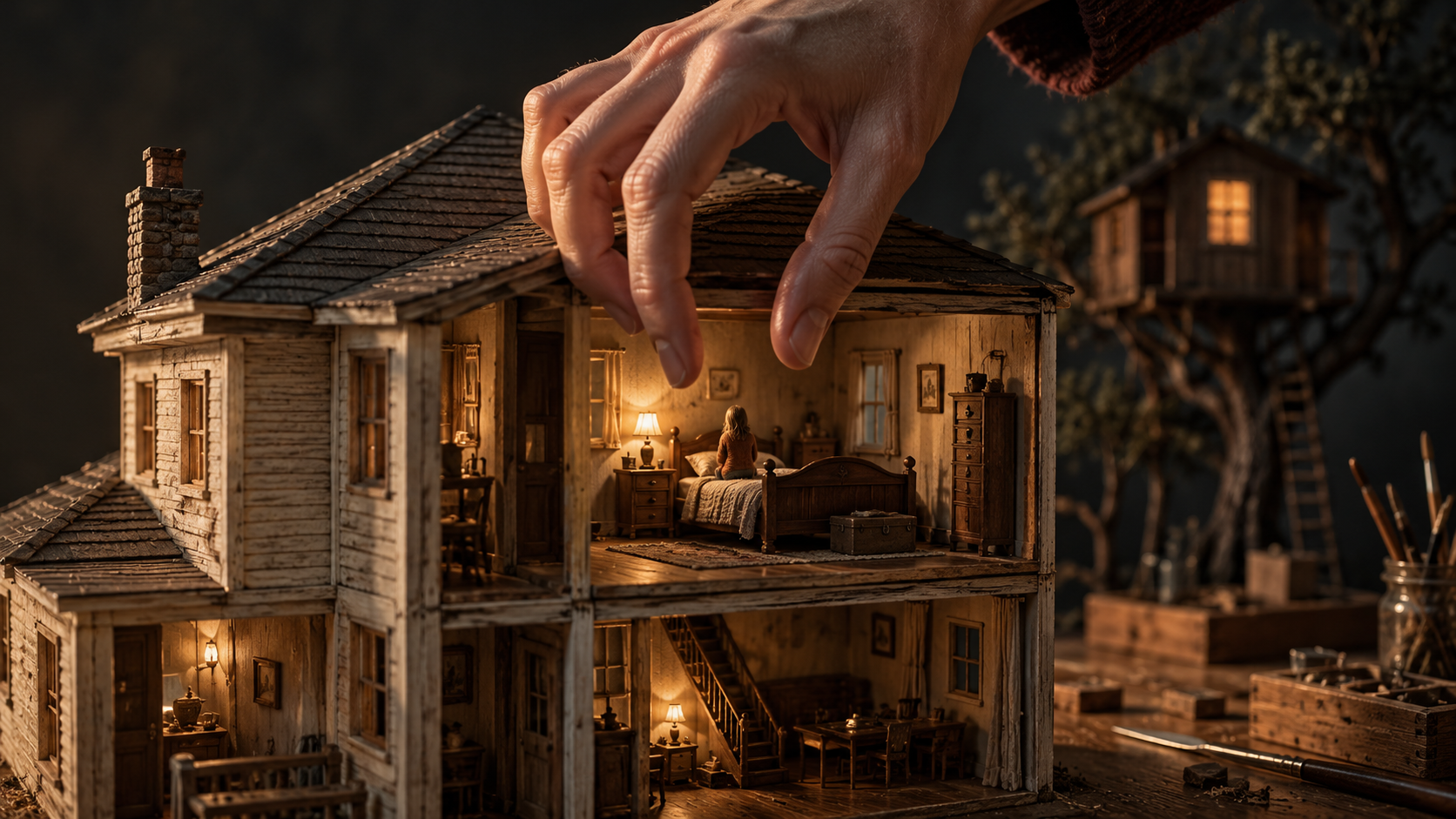
Annie, played by Toni Collette, makes miniature recreations of domestic spaces and personal experiences. Her work turns life into something she can arrange, inspect and display. Her own household resists that order.
Her husband Steve tries to keep things steady. Their teenage son Peter is withdrawn and interested in friends, parties and getting high. Their younger daughter Charlie seems more comfortable making strange objects than connecting with other people.
Charlie had a particularly close relationship with her grandmother, Ellen. Annie’s feelings are more complicated. Ellen was secretive and controlling, and her influence did not disappear when she died.
At a bereavement support group, Annie describes a family history marked by psychiatric diagnoses and disturbing deaths. Her brother died by suicide after accusing their mother of putting people inside him. Annie presents this as part of an established history of illness. At this stage, the audience has no clear reason to understand it differently.
The film’s opening camera movement establishes another source of unease. It approaches a miniature bedroom until that space becomes Peter’s actual room. The transition makes the family appear like figures inside a model.
Annie can manipulate the occupants of her artwork. Within the house itself, nobody seems able to organise their feelings, let alone control what happens next. The visual resemblance makes ordinary domestic life feel exposed to observation.
Peter Takes Charlie Somewhere She Does Not Belong
Peter wants to attend a party. He presents it to Annie as a relatively innocent school gathering, and she insists that he take Charlie with him.
Neither sibling welcomes the arrangement. Peter wants freedom from family responsibility, while Charlie has little interest in the social world he is entering. Once there, Peter leaves her to pursue his own evening.
Charlie eats chocolate cake containing nuts, triggering a severe allergic reaction. Peter realises she is struggling to breathe and drives her towards hospital.
As she gasps for air, Charlie puts her head outside the car window. Peter swerves around a dead animal in the road. Her head strikes a utility pole, killing her.
The accident is sudden enough to feel almost impossible to process. The film then stays with Peter’s paralysis. He does not immediately become a person capable of responding to an emergency. He sits inside the aftermath, unable to make it comprehensible.
He eventually drives home, leaves Charlie’s body in the car and goes to bed.
Annie discovers what happened the following morning. Her screams reach Peter while he lies motionless, waiting for the truth he already knows to become everyone else’s reality.
That delay is central to the sequence. The impact lasts an instant; the anticipation of discovery stretches on. Horror becomes the experience of knowing that the next ordinary action will expose an irreversible catastrophe.
Grief Turns the Family Against Itself
Charlie’s death destroys whatever balance remained in the house.
Peter carries guilt, shock and fear. Annie’s grief becomes inseparable from anger towards him. Steve tries to preserve the family through practical care, but his attempts cannot make the others experience their loss in the same way.
At dinner, resentment becomes explicit. Annie attacks Peter’s apparent unwillingness to acknowledge what happened. Peter points towards her own responsibility in making Charlie attend the party.
Both arguments contain something emotionally understandable. Neither offers a way forward.
Annie needs her son to recognise the scale of the loss. Peter needs some reassurance that he has not become permanently hateful to his mother. Their conversation makes each need harder to meet.
Collette’s performance makes Annie’s anguish physically uncomfortable. Grief appears in her breathing, posture and sudden changes of expression. Alex Wolff gives Peter an increasingly frightened stillness, as though any movement might provoke another disaster.
Annie also recreates the accident in miniature. For her, representing an experience may offer a way to examine it. To Steve, the model is an intolerable object inside a household already struggling to survive.
The disagreement reveals the limits of Annie’s art. Recreating an event does not reverse it or make it manageable for everybody else. Her miniature fixes the catastrophe in place while the family remains trapped in its consequences.
Joan Offers Annie a Way to Reach Charlie
Annie finds an apparently sympathetic listener in Joan, another bereaved woman.
Joan offers something Annie cannot easily obtain at home: attention without immediate accusation, discomfort or withdrawal. She also claims that contact with the dead is possible.
At Joan’s apartment, Annie witnesses a séance that appears to establish communication with Joan’s deceased grandson. The experience changes what she considers believable.
For a grieving mother, the promise is immense. If the dead can answer, Charlie may be reachable. Annie’s desperation gives Joan’s instructions an authority that ordinary reassurance could never possess.
Annie follows those instructions and conducts a séance with Steve and Peter. Objects move, and a childlike voice emerges through her. Steve interrupts the episode by throwing water over her.
Annie understands the encounter as evidence that Charlie remains present. Peter experiences it as another frightening violation of home.
The distinction matters. The same event can appear to Annie as a reunion and to her son as an invasion. Her wish to help the family leads her into actions that make Peter feel less safe.
Joan’s manner makes this development especially disturbing. She approaches Annie through recognisable gestures of care. The apparent solution arrives through a relationship that seems emotionally safer than Annie’s existing ones, making her willingness to trust it painfully plausible.
Peter Begins to Fear His Own Home
As disturbing experiences accumulate, Peter becomes increasingly vulnerable.
Charlie’s clicking sound returns, carrying associations that Peter cannot escape. A small, recognisable noise becomes enough to bring the accident back into the present.
His relationship with Annie also contains an older source of fear. Annie describes a sleepwalking episode during which she found herself beside her children with paint thinner and a lit match. She insists that she did not consciously intend to harm them.
For Peter, however, an absence of conscious intention cannot guarantee safety.
The film exploits that difference. Annie can experience herself as a mother horrified by her own behaviour while Peter remembers being endangered by her. Love and fear occupy the same relationship.
A nightmare confrontation also brings Annie’s ambivalence about motherhood to the surface. Because the sequence belongs to the film’s unstable dream imagery, it should not be treated as a straightforward record of a waking conversation. Its force comes from exposing feelings that already trouble the household.
Steve increasingly sees Annie’s conduct through the possibility of psychological crisis. Given the family history and her behaviour, his concern is understandable.
The audience remains caught between explanations. Grief, guilt and sleep disturbance can account for aspects of what the characters experience. Yet the film keeps introducing details that resist those accounts. The uncertainty makes every attempt to help feel potentially inadequate.
Ellen’s Past Changes the Meaning of Annie’s Discoveries
Annie eventually finds evidence that connects Joan to Ellen.
Photographs show her mother participating in a ritual community, honoured as Queen Leigh. Joan appears within that same circle. The woman who seemed to enter Annie’s life through shared grief already belonged to her mother’s hidden world.
Annie also discovers material concerning Paimon, a demonic king associated with promises of knowledge and riches. The instructions indicate a preference for a male host.
Then she finds Ellen’s headless corpse in the attic.
Together, these discoveries transform the story. Ellen’s secrecy has concealed an organised occult project, and Joan’s friendship has directed Annie towards participation.
The information also changes the significance of Annie’s family history. Her brother’s accusation about their mother putting people inside him now suggests an earlier attempt at possession. That implication is strong, although the film never shows his experiences directly.
Likewise, Ellen’s attachment to Charlie becomes more troubling. Annie had restricted her mother’s access to Peter but allowed her a greater role with Charlie. What looked like an uneven family relationship now belongs to a larger pattern.
Importantly, the conspiracy does not make the Grahams’ emotions false. Their resentment, guilt and bereavement remain real. The new information reveals people exploiting those feelings, giving the supernatural threat a precise human method: trust is cultivated, grief is redirected, and existing fractures are widened.
Annie Tries to Break the Connection
Annie suspects that Charlie’s sketchbook is connected to the force threatening Peter.
When she puts it into the fire, her clothing begins to burn. Removing the book stops the burning. She concludes that destroying it will require her own death.
That apparent rule shapes her next decision. Annie believes she can protect Peter by sacrificing herself.
Meanwhile, Joan confronts Peter outside school, calling for him to be expelled from his body. In class, an unseen force takes control of him and drives his face into his desk.
The threat now concerns bodily autonomy as much as fear. Peter cannot rely on his own movements belonging to him.
At home, Annie asks Steve to burn the sketchbook. He refuses, believing that she is seriously unwell. She throws it into the fireplace herself.
Steve catches fire instead.
The reversal destroys Annie’s understanding of how to resist. Her earlier experience supplied a connection between the book and her body, but it did not establish a dependable law she could use to bargain with the force.
The film leaves the exact mechanics unexplained. What matters is the consequence: Annie acts on the belief that she can save her child through self-sacrifice, and her action kills her husband. Her expression then changes as possession takes hold. The family’s last attempt to intervene has become another stage of its destruction.
The Attic and Treehouse Bring the Ritual Together
Peter wakes after dark and discovers Steve’s burned body.
The house has become openly hostile. Naked cult members occupy its spaces, and Annie moves through it with an unnatural physical freedom. The home’s familiar layout now offers concealment to the people and forces controlling it.
Peter flees into the attic. There, he sees his possessed mother suspended above him, cutting through her neck with wire.
He jumps from the window.
After he lands, a light enters his body. He rises and makes Charlie’s clicking sound, then approaches the treehouse.
Inside, a ritual gathering awaits. Charlie’s severed head sits upon an effigy. Annie’s and Ellen’s headless bodies are positioned in worship. Joan transfers a crown to Peter and addresses him first as Charlie, then as Paimon.
Her explanation establishes the cult’s achievement: the entity previously associated with Charlie has been transferred into the male body it wanted. The congregation welcomes its king. These central events are corroborated by detailed accounts of the released ending and interviews with the filmmakers.
Peter’s apparent return to life therefore offers no reassuring recovery. The body remains, but the person who spent the film terrified inside it has been displaced.
The treehouse completes the film’s movement from family space to ritual display. A place associated with Charlie becomes the setting in which the family’s bodies are arranged to celebrate the destruction of its surviving identity.
Paimon, Charlie and the Cult’s Plan Explained
The crucial distinction is that Charlie is already connected to Paimon before the séance.
The filmmakers have explained that the character we know as Charlie is Paimon living within that childhood identity, without fully understanding what she is. The ritual transfers that presence into Peter; it does not simply bring Charlie’s ordinary human ghost back to comfort her family.
This explains Joan’s use of Charlie’s name. She addresses the identity familiar to the newly installed entity before explaining its demonic status.
Ellen and her followers have sought a suitable male host. Charlie’s death releases Paimon from her body, while the subsequent attacks dismantle Peter’s security and resistance.
The marked utility pole connects the apparent accident to the conspiracy. Aster has confirmed that Charlie’s death was designed by the cult. However, the film does not show every practical step behind it. Claims identifying precisely who prepared the cake or arranged each circumstance exceed what the released story establishes.
The recurring decapitations link Charlie, Ellen and Annie to the final arrangement. They form a deliberate ritual pattern, but the film supplies no complete handbook explaining why every individual act is required.
Similarly, Peter’s fall marks the final transition without offering a clinical explanation of his death or a detailed map of where his consciousness goes. The decisive point is possession: the figure being crowned is no longer Peter acting freely.
The cult’s success is clear even where its procedures remain partly hidden.
What the Ending Says About Inheritance and Control
Hereditary ultimately presents its supernatural conspiracy as real within the story. Aster has explicitly rejected an explanation in which the ending is merely a dream or delusion. Its psychological meanings continue to operate alongside that literal outcome.
The title gathers several kinds of inheritance together. Annie receives a history of damaged relationships and frightening family experiences. Her children inherit the consequences of decisions made before they could understand or resist them. Ellen treats that family continuity as a resource for her own project.
The miniatures sharpen the idea. Annie’s art offers control over representations, while the cult exercises control over actual people. By the final scene, bodies have been placed into an arrangement resembling the static displays seen throughout her work.
The visual connection suggests a terrible difference between understanding a pattern and escaping it. Annie discovers enough to recognise the conspiracy, but recognition arrives too late to give her effective power.
That also explains why the ending feels so emotionally wrong. The cult experiences fulfilment. Its gestures resemble welcome, reassurance and celebration. From the family’s perspective, those same gestures complete an annihilation.
Joan’s calmness is especially cruel because it makes the ceremony sound like a correction. She treats the destruction of Peter’s identity as the successful delivery of something long promised.
The film’s last horror lies in that ownership. The Grahams experience their lives as intimate, painful and irreplaceable. Ellen’s community regards those lives as materials to be used. The ending resolves the ritual while leaving the family no future from which to understand what was done to them.
Sources
A24 — Hereditary: Official credits, release information and premise.
Film Comment — Interview With Ari Aster: The film’s domestic drama, visual artifice and conspiracy structure.
GameSpot — Hereditary’s Ending Explained by Those Who Made the Movie: Filmmaker and cast explanations of Charlie, Paimon and the literal ending.
