How Did a Car Thief End Up Running One of the Dictatorship's Torture Centres?
Netflix's Gordon opens with a bank robbery and ends in a clandestine prison. That arc is not a screenwriter's invention. Aníbal Gordon, the man Rodrigo de la Serna plays, really was a career criminal from a small town in Buenos Aires province who became a paid operative of Argentina's state intelligence service, was linked to the far-right death squad known as the Triple A, and in 1976 led the civilian gang that ran Automotores Orletti, a secret detention and torture centre in a Buenos Aires garage.
The short answer to "is Gordon a true story?" is yes, with an important qualification. The seven-episode series is adapted from two books by the Argentine journalist and historian Marcelo Larraquy, and Netflix bills it as "inspired by real events", not as a documentary reconstruction. Some characters are real, some are composites or inventions, and the pacing and conversations are drama. What follows separates the documented record, much of it established in Argentine federal courts, from what the series adds.
This explainer covers events that the series depicts, including its final episodes. If you want to watch without knowing where Gordon's story goes, come back later.
What Is Netflix's Gordon?
Gordon is an Argentine Netflix original limited series released worldwide on Wednesday 18 November 2026. Netflix describes it as a thriller "inspired by real events" about a criminal "who went from committing robberies to actively participating in the violent years of Argentina in the 1970s".
- Creators: Pablo Trapero (The Clan, El bonaerense) is showrunner and co-director with Pablo Fendrik. Trapero co-wrote the scripts with Marcos Osorio Vidal, working with Larraquy.
- Source books: Larraquy's novels Gordon (Sudamericana, 2025) and Gordon, el aniquilador (Planeta, 2026), which he describes as non-fiction novels built on his research.
- Cast: Rodrigo de la Serna (Palermo in Money Heist) as Aníbal Gordon, with Matías Recalt, Camila Peralta, Matías Mayer, Fiorella Bottaioli and Agustín Pardella.
- Length: seven episodes, about five hours in total. The film site Otros Cines lists them as "Chorro" (thief), "Granada", "Espía" (spy), "AAA", "Pibe", "Piba" and "Vampiro".
- Production: made by Adrián Suar and Diego Andrasnik's Preludio Producciones and filmed in 2025 in Buenos Aires and Río Negro province.
It is also not an easy watch. Diego Batlle, reviewing it for Otros Cines, called it captivating but so harsh and dark that sensitive viewers would struggle within minutes, and predicted it would provoke political argument in Argentina. Trapero is no stranger to that: The Clan (2015) told the story of the Puccio family kidnapping ring, which English-language accounts of Gordon's life also connect to him.
Who Was the Real Aníbal Gordon?
Gordon was born around 1930 in Colón, a town in the north of Buenos Aires province, and died in prison in Buenos Aires on 13 September 1987, of lung cancer, aged about 57. The broad outline of his life is consistent across Spanish- and English-language reference accounts and the material cited by Argentine prosecutors.
The thief
His police record began in the early 1950s. Spanish-language accounts date his first arrest to 1951, for car theft in San Isidro, and his record lists armed robbery and other offences through to the early 1970s. The biggest job attributed to him is the February 1971 robbery of the Banco de Río Negro branch in the centre of Bariloche, the heist that opens episode one with a long Steadicam sequence. Reported figures for that robbery vary and have not been independently confirmed, so treat any precise sum with caution.
The informer in Devoto prison
In 1972 Gordon was held in Villa Devoto prison in Buenos Aires. According to Spanish-language accounts of his life (Spanish Wikipedia, citing Infobae), he was placed in the wing for political prisoners from armed left-wing groups such as Montoneros and the ERP rather than with ordinary criminals. He walked out on 25 May 1973, when the newly elected Peronist government of Héctor Cámpora freed prisoners in the episode known as the "Devotazo". The series makes his time in Devoto central, presenting him as an informer for the intelligence service planted among the guerrillas. That he was working with the state at this time is consistent with the record; the precise detail of what he did inside is dramatised.
The spy
Gordon was never a career officer. Prosecutors and reference sources describe him as an "inorgánico" of the SIDE, Argentina's State Intelligence Secretariat, from roughly 1968 to 1984: an off-the-books operative paid by the service but not on its formal staff. Federal prosecutors in the Operation Condor trial cited a 1974 police file from the Buenos Aires provincial intelligence archive showing that, by March 1974, Gordon was leading a SIDE team in an operation in Quilmes.
Was Gordon Part of the Triple A?
This is where the series and the record need the most care. The Triple A, or Argentine Anticommunist Alliance, was a far-right paramilitary group that killed left-wing activists, lawyers, academics and dissident Peronists between 1973 and 1976, under the constitutional Peronist governments that preceded the coup. It is widely linked to José López Rega, the social welfare minister and Perón's close adviser.
The evidence points firmly to Gordon's involvement:
- Argentine federal prosecutors, in their closing arguments in the Operation Condor trial, described Gordon as "a significant figure" in the Triple A who, while it was at its height in 1974, was operating on behalf of the SIDE.
- In October 1986 he was sentenced to 16 years in prison for his part in the 1974 murders of Silvio Frondizi, a Marxist academic and brother of former president Arturo Frondizi, and Rodolfo Ortega Peña, a left-wing Peronist lawyer and congressman, according to the Spanish-language account drawing on Infobae's reporting. Both killings were claimed by or attributed to the Triple A.
- Gordon himself always denied belonging to the Triple A, according to Clarín's 1999 profile as summarised in English-language reference sources.
One discrepancy is worth flagging. Some English-language summaries say he was also convicted of the September 1973 murder of the trade union leader José Ignacio Rucci. We did not find that in the Spanish-language sources or the court material read for this article, and responsibility for Rucci's killing has long been attributed to Montoneros. The series dramatises Rucci's murder in episode four as part of the collapse of order in 1973, but that does not mean Gordon was convicted of it.
What Happened at Automotores Orletti?
The final episodes take Gordon into the heart of the military dictatorship that seized power on 24 March 1976. Here the documentary record is at its strongest, because the centre has been the subject of several federal trials.
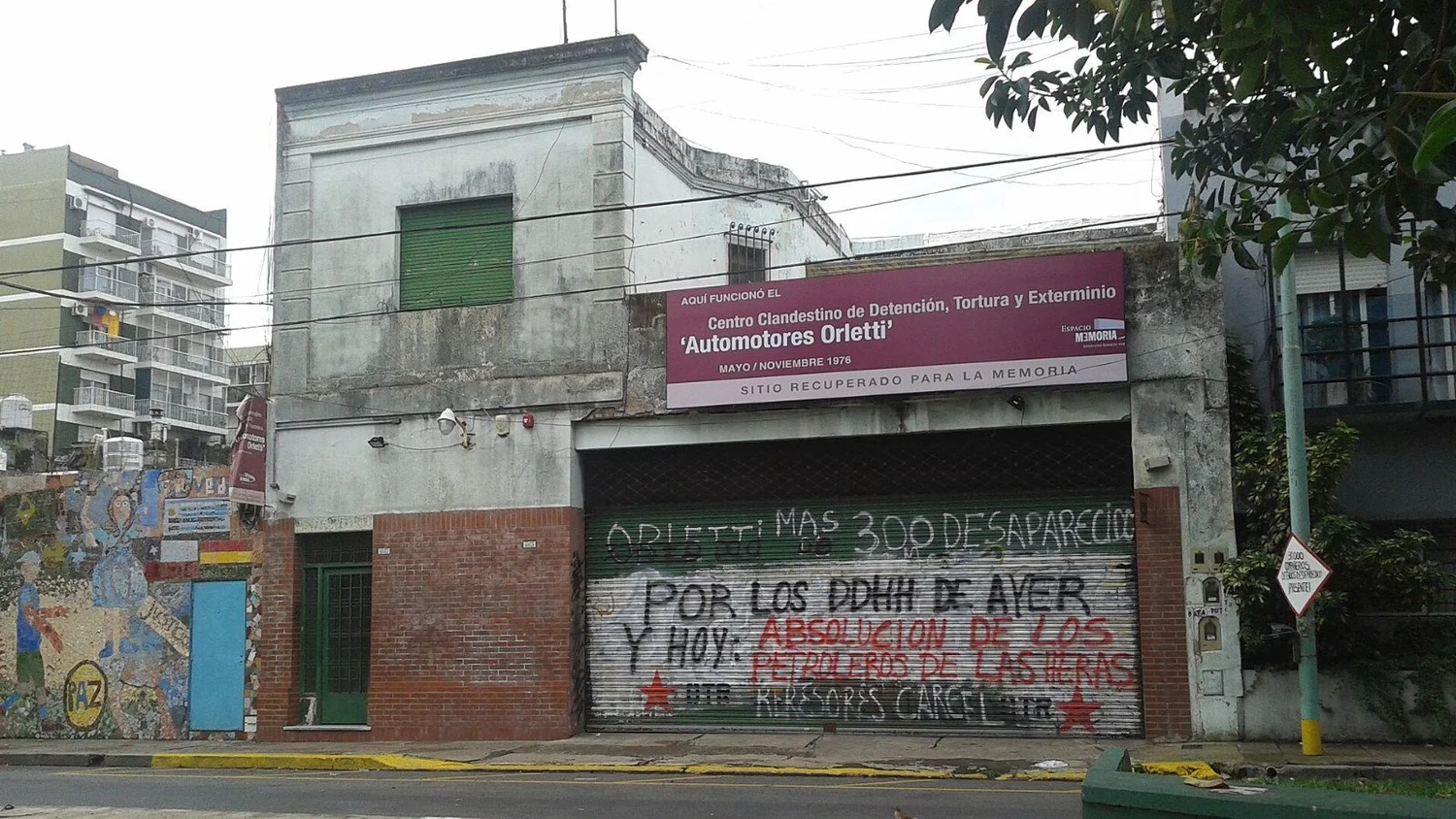
Automotores Orletti was a former car repair workshop at Venancio Flores 3519/21 in the Floresta district of Buenos Aires. Prosecutors say it was SIDE's base "OT 1.8" and that it operated as a clandestine detention centre from 11 May 1976, the date the tenants took possession under the rental contract. Handwriting analysis of that contract showed it was signed by two SIDE officers, Eduardo Ruffo and Juan Rodríguez, and by Aníbal Gordon under a false name, "Silva".
The prosecutors' account, drawn from survivors' testimony and the court's earlier judgment, sets out what happened there:
- The "Gordon gang": the civilian, off-the-books personnel at the base were led by Gordon, who used nicknames including "El Jova", "El Viejo" and "El Coronel". Survivors identified members of what prosecutors call "the Gordon gang" from photographs and line-ups.
- Operation Condor: Orletti mainly held people from foreign political organisations, especially from Uruguay, Chile and Bolivia, and was used by security officers from those countries working alongside Gordon's group. That made it a key site of Operation Condor, the coordinated repression by South American military regimes.
- Torture: survivors described systematic torture, including electric shocks and near-drowning. Several survivors testified that a portrait of Hitler hung in the room Gordon used as an office, and prosecutors described the group's ideology as far right and antisemitic.
- Theft: prosecutors said Gordon's men also used their power to enrich themselves, going as far as forging documents to take their victims' property.
- Victims: at least two heavily pregnant women and six young children were held there. Some prisoners were secretly flown to Uruguay, some were released, and others were murdered. The remains of five prisoners, including Marcelo Gelman, son of the poet Juan Gelman, were found in metal drums that had been thrown into the Luján river; prosecutors say the drums were filled with lime. Página/12 reported the case from the 2011 trial.
The centre closed abruptly after 3 November 1976, when two prisoners, José Ramón Morales and Graciela Vidaillac, escaped while the guards slept. With its location exposed, the base was shut down.
Was Gordon Ever Tried for Orletti?
No. Gordon was arrested in January 1984, in the hills of Córdoba province, shortly after Argentina returned to democracy. He was first held over the August 1983 kidnapping of Guillermo Patricio Kelly, and the Frondizi and Ortega Peña conviction followed in 1986. He died in prison the following year, long before the Orletti cases reached court.
When they did, the court found for the victims. On 31 March 2011, Federal Oral Court No 1 in Buenos Aires convicted four men for crimes at Orletti: Eduardo Cabanillas, a former army general who headed the base, was sentenced to life imprisonment, including for five murders; the SIDE agents Eduardo Ruffo and Honorio Martínez Ruiz and the army intelligence agent Raúl Guglielminetti received long prison terms. The court found that 65 people had been illegally detained there. Página/12's report of the verdict names Gordon, "already dead", among the direct perpetrators beneath Cabanillas in the chain of command.
So the series' portrait of Gordon in charge at Orletti is grounded in court findings, even though he himself was never convicted for it.
What Happened After 1976?
Gordon's career did not end with Orletti. Spanish-language accounts, drawing on later court cases, say that his group moved to another SIDE base in the Nueva Pompeya district in 1977, which, according to a 2022 Página/12 report cited by Spanish Wikipedia, was only identified as a clandestine detention centre 45 years later. The same sources link his circle to kidnappings for ransom into the early 1980s. These later episodes fall largely outside the series, which concentrates on the years up to the end of 1976.
What Does the Series Change?
Because Gordon is adapted from two non-fiction novels and then dramatised again, the distinction between fact and fiction is not always clean. Based on the sources we read:
- Real: Gordon himself; the Bariloche robbery; his release in the Devotazo of 1973; his work for the SIDE; the Triple A and López Rega; the Ezeiza massacre of 20 June 1973 and Rucci's murder as historical events; the March 1976 coup; Automotores Orletti and its closure after the November 1976 escape. Alejandro Giovenco, played by Matías Mayer, was a real figure on the Peronist right.
- Dramatised or uncertain: the intelligence handler Julieta (Camila Peralta), Gordon's protégé Acosta (Matías Recalt) and the guerrilla leader Graciela Mancini (Fiorella Bottaioli) are central to the drama. We could not confirm from the sources read whether they are based on specific people, so they are best treated as dramatised or composite characters.
- Interpretation: the show's portrait of Gordon as a charismatic psychopath who enjoys cruelty is an artistic reading. Survivors' testimony describes the brutality of the centre he ran, but his inner life is necessarily the writers' and de la Serna's invention.
- Compression: as reviewers note, the series sweeps through almost every major event of Argentina's 1970s and places Gordon close to many of them. That is a storytelling device; the record supports his presence in some, not all.
Why the Story Still Matters in Argentina
Argentina's human rights trials for crimes committed under the 1976–83 dictatorship resumed in the 2000s after amnesty laws were struck down, and they are still producing verdicts and identifying sites. The Orletti building is now a memory site run by the state, and cases connected to Gordon's group were still being heard in the 2020s.
That is part of why Gordon is contentious at home. Batlle expected it to anger viewers on different sides for its portrayal of the armed left and of Peronism's right wing. For viewers outside Argentina, the series is a rare mainstream drama about Operation Condor and about something easy to forget: that the dictatorship's violence was carried out not only by uniformed officers but also by paid criminals the state chose to use.
Is Gordon Worth Watching?
If you want a documentary, this is not it; it is a stylised, violent thriller with a strong central performance. Critics have praised de la Serna and the scale of the production, while noting heavy-handed moments and a reliance on music-driven action sequences. If you watch it, the most useful context is simple: the man was real, the centre was real and the victims were real, and much of what is known about them comes from survivors who testified decades later.
Sources
- Netflix: Rodrigo de la Serna Will Play Aníbal Gordon in a New Netflix Series (31 July 2025)
- What's on Netflix: Rodrigo de la Serna Returns to Netflix in the 1970s Crime Series Gordon (27 October 2026)
- Otros Cines: Crítica de Gordon, serie de Pablo Trapero y Pablo Fendrik (Diego Batlle, 13 November 2026)
- Ministerio Público Fiscal (Argentina): Centro Clandestino de Detención Automotores Orletti, Operation Condor trial closing arguments
- Página/12: Una condena que atraviesa fronteras (Alejandra Dandan, 1 April 2011)
- Wikipedia (Spanish): Aníbal Gordon, citing Infobae, Página/12 and court records
- Wikipedia (English): Aníbal Gordon, citing Clarín (1999)
Next Reads
- The Altruists True Story: What Really Happened With Sam Bankman-Fried and Caroline Ellison
- Is Gentle Monster Based on a True Story? The Real Investigation
- The Law of Beasts True Story: Were Anna and Agnieszka Real People?
- The Unthinkable Daughter True Story: Suzane von Richthofen
- Murder in Galicia True Story: What Netflix Changed About the Isabel Fuentes Case
- Primetime Preacher$ True Story: Bakker, Swaggart and Falwell
