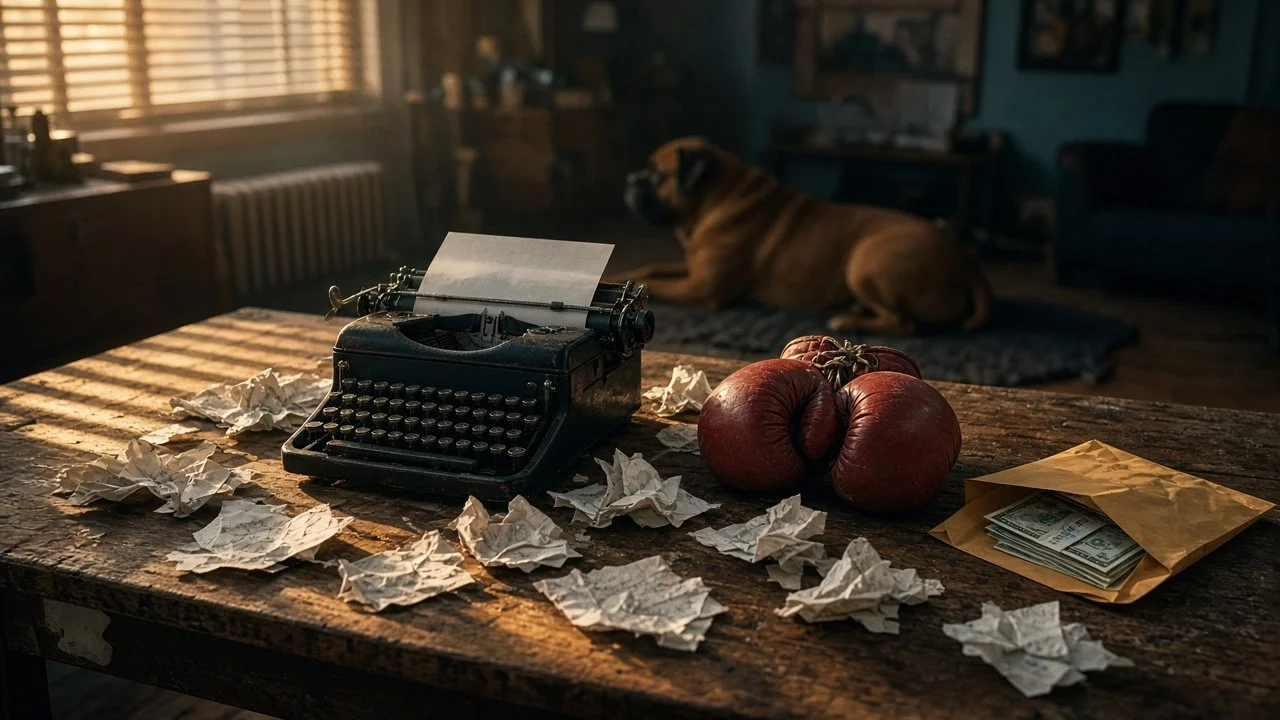
In 1975, An Unknown Actor Turned Down A Fortune So He Could Play His Own Boxer.
I Play Rocky, Peter Farrelly's 2026 film about the making of Rocky, rests on a story Sylvester Stallone has told for half a century. A broke actor watches a no-hope heavyweight last into the 15th round against Muhammad Ali, writes a boxing script in a matter of days, and then refuses to sell it unless he plays the lead. The short answer to whether that is true is yes, in its essentials. Stallone did write the first draft at speed, he did turn down a six-figure offer, and Rocky was made on a budget of about $1 million in 28 shooting days before winning Best Picture. What the film smooths over is how many people helped, how much the money changed in the retelling, and how much of the legend was polished by United Artists' publicity department in 1976.
Spoiler warning: this article discusses the whole of I Play Rocky, including its final scenes, alongside the real history of Rocky (1976).
Is I Play Rocky Based on a True Story?
I Play Rocky is a dramatisation of real events, written by Peter Gamble and directed by Farrelly, the Oscar-winning director of Green Book. Anthony Ippolito, who played the young Al Pacino in The Offer, the Paramount+ series about the making of The Godfather, plays Stallone. The film covers roughly five years, from Stallone's struggling days in New York in the early 1970s to the premiere of Rocky in November 1976 and the Academy Awards that followed.
Gamble has said publicly that "98%" of the story is true and that, if anything, the filmmakers had to pull back. That is a writer's claim rather than an independent verdict, and it sits awkwardly beside the record. Several of the film's most memorable moments come from Stallone's own retellings, and Stallone's accounts have shifted over the decades. Other people who were there remember some events differently, and at least one central character is invented.
Stallone himself was not involved. In 2025 he said nobody had contacted him about the project and that he learnt of it by reading about it. Farrelly has disputed that, saying he advised Stallone against taking a producer credit so that audiences would not see the film as an authorised portrait. Either way, I Play Rocky is not Stallone's official version, even though much of it follows the stories he tells in his 2026 memoir, The Steps.
Who's Who: The Real People Behind the Characters
Most of the characters in I Play Rocky are real people, and the casting tracks the history closely.
- Anthony Ippolito plays Sylvester Stallone, the writer and star of Rocky.
- AnnaSophia Robb plays Sasha Czack, Stallone's first wife, who typed up his handwritten pages.
- P.J. Byrne and Toby Kebbell play Irwin Winkler and Robert Chartoff, the producing partners who made Rocky for United Artists.
- Jay Duplass plays John G. Avildsen, the director hired for his record of finishing low-budget films on time.
- Matt Dillon plays Frank Stallone Sr., Stallone's father.
- Stephan James plays Carl Weathers, who played Apollo Creed.
- Kiki Seto plays Talia Shire, who played Adrian.
- Robert Morgan plays Burgess Meredith, who played the trainer Mickey.
- Scot Teller plays Burt Young, who played Paulie.
The exception is Sandy Maddox, the blunt studio executive played by Tracy Letts. Maddox is a composite of several United Artists executives rather than a single real person. That matters, because many of the hard-nosed negotiating scenes are built around him. The real decision-maker most often named in accounts of the Rocky deal is Mike Medavoy, then United Artists' head of production.
Before Rocky: Stallone's Struggling Years in New York
The film opens in New York, where the young Stallone, whom friends call Mike, works a string of low-paid jobs and auditions for bit parts as thugs and cops. He meets Sasha at a cinema where they both work, and the film shows him sleeping rough after being thrown out of his room for unpaid rent.
The broad outline is accurate. Before Rocky, Stallone's only leading role had been in The Lords of Flatbush, a low-budget 1974 film about a group of Brooklyn friends. In 1970 he had appeared in a softcore film, The Party at Kitty and Stud's. I Play Rocky presents that job as a matter of survival, and does so without dwelling on it. In reality the film was later re-released on videotape as The Italian Stallion after Rocky made him famous, and promoted as Stallone going "X-rated". In 1977 Stallone told Variety that, to his knowledge, the film had never been released in cinemas, and he condemned the video release for exploiting him and Rocky.
The film also introduces Butkus, the bull mastiff who would later appear in Rocky. In I Play Rocky, Stallone finds him as a puppy while sleeping outside. That origin is part of the Stallone story rather than something independently documented, and as we will see, what happened to the dog later is disputed.
The Night Stallone Watched Ali v Wepner
The most famous part of the legend is true in its basic facts. On 24 March 1975, Muhammad Ali defended the world heavyweight title against Chuck Wepner, a 36-year-old journeyman from New Jersey nicknamed "the Bayonne Bleeder", at the Richfield Coliseum in Ohio. Almost nobody gave Wepner a chance. In the ninth round Ali went down, and the referee, Tony Perez, counted it as a knockdown. Ali complained that Wepner had stood on his foot, and film of the fight supports his complaint, but the knockdown stands in the record books. Ali then took control and stopped Wepner in the 15th and final round, with only 19 seconds left. Wepner had nearly gone the distance.
In I Play Rocky, Stallone watches the fight in a bar, is moved by the underdog lasting far longer than anyone expected, and goes home to write all night. Stallone's own best-known account says much the same. He has described paying for a closed-circuit broadcast of the fight and watching what he called a "miracle" unfold, and has said that on that night "Rocky Balboa was born."
Even this foundation story has cracks. Accounts disagree about where Stallone watched the fight: a 2011 BBC report placed him in a cinema in Philadelphia, while the News-Herald in Ohio, reporting on the fight's 50th anniversary in 2026, placed him in Los Angeles. More strikingly, Stallone has since played down Wepner's role altogether. Answering questions by email for Mike Sielski's 2026 book about the film, Going the Distance: Stallone, Philly, and the Story of Rocky, he said the Wepner connection had been "completely blown out of proportion" and that he had written the character with the 1950s champion Rocky Marciano in mind.
That is a remarkable change of story, and it should be read alongside a legal fact. In 2003, Wepner sued Stallone, claiming a share of the profits from the Rocky films because the first had been based on his life. The case was settled in 2006 on undisclosed terms. Wepner has said since that what he wanted was an acknowledgment that he was "the real Rocky", and that he holds no grudge. So the film's version, in which the Wepner fight sparks the script, matches what Stallone said for decades and what most accounts still say. Stallone's newer claim that it was always about Marciano is his own late revision, made after a lawsuit over exactly this question.
Did Stallone Really Write Rocky in Three and a Half Days?
I Play Rocky shows Stallone writing feverishly through the night while Sasha types up his handwritten pages. The often-repeated figure is three and a half days, and it comes from Stallone himself. A 1976 New York Times profile quoted him on writing the words "in 3-1/2 days".
The fuller record is more nuanced. The American Film Institute's catalogue entry for Rocky, which draws on press coverage from the time, says Stallone ruminated on the idea for several months before writing a rough first draft in three and a half days, and then wrote two further drafts. Variety, examining the new film's accuracy in November 2026, found that Stallone did work day and night for about 72 hours with his wife typing, but that what he produced was the first third or so of the story. Dozens of revisions followed before the script was ready to shoot.
So the burst of writing is real, and so is the image of Sasha at the typewriter. What the film compresses is the long tail of rewriting that turned a rough draft into the shooting script.
How the Script Really Reached Chartoff and Winkler
In the film, a friendly customer at the restaurant where Stallone parks cars gives him an introduction to Chartoff and Winkler. The meeting goes nowhere, but on his way out he slips his script for Paradise Alley into a pile on a secretary's desk. The producers like his writing but not that project, and tell him to bring them whatever he writes next.
The real route was more ordinary and more crowded. According to Larry Kubik, one of Stallone's early agents, he and his partner Craig Rumar introduced Stallone to their friend Gene Kirkwood, a producer with a deal at Chartoff and Winkler's company. Kirkwood and the agents first tried to set up a Stallone script called Hell's Kitchen, which later became Paradise Alley, but Stallone had already sold it elsewhere. Kubik says that is when Stallone went home and wrote a new screenplay inspired by a boxing match. Kirkwood went on to receive an executive producer credit on Rocky.
Craig Rumar's son, Chris Rumar, told Variety in 2026 that his father and Kubik were "integral" to getting Rocky off the ground, and complained that Stallone's interviews leave them out. That is the clearest gap between the film and the record. The agents' version comes from people with a stake in being remembered, but it is consistent with how Hollywood deals were made, and with Kirkwood's credit on the finished film.
Hell's Kitchen caused trouble of its own. In 1977, the producers of Force Ten Productions sued Chartoff and Winkler for $30 million, arguing that they held options on a Stallone film about a club fighter who builds a reputation before losing a climactic bout, and that Rocky had grown out of it. Universal financed the other project anyway, and it was released in 1978 as Paradise Alley, Stallone's first film as director.
How Much Money Did Stallone Turn Down?
This is the heart of I Play Rocky, and the title comes from it. Chartoff and Winkler love the script but want a star. They float names such as Burt Reynolds, Ryan O'Neal and Charles Bronson, and keep raising their offer for the script alone. In the film the offer climbs to about $350,000 to $360,000, and Stallone keeps answering with the same three words.
The refusal is real, and contemporary reporting backs it up. A November 1976 report in the Los Angeles Herald Examiner, cited by the AFI catalogue, said that United Artists and several other companies were interested in the script and had offered up to $275,000 for the rights, but that Stallone would not sell unless he played the lead. Variety's 2026 fact-check put United Artists' offer at up to $250,000. Irwin Winkler recalled in 1996 that United Artists insisted on Ryan O'Neal, James Caan or Burt Reynolds, and Robert Redford has also been reported as a possibility. Kubik remembers being told that Medavoy loved the script, but loved it for James Caan.
So the principle is solid, but the figure has grown. The film's $360,000 is above the numbers in contemporary reports, and the sums vary from source to source. Whether Stallone ever actually said "I play Rocky" to the producers is unknown. Variety concluded that it is not clear anyone can remember.
There is another layer. Gabe Sumner, then head of marketing at United Artists, later described how the studio built a publicity campaign around the unknown actor who would not sell his script unless he could star, using a figure of $18,000 for what Stallone was paid. "Is this true? It was horsesh*t!" he said, adding that it kept the underdog story going. A Daily Variety report from 16 November 1976, days before the film opened, noted that a carefully orchestrated campaign had already placed magazine stories presenting Rocky as a "Cinderella story", built around Stallone's refusal to sell. The refusal happened. The polished way the world heard about it was, in part, a marketing exercise.
Stallone's real payday came later. Reports differ on his share of the profits. Women's Wear Daily reported in October 1976 that he had one per cent of the gross for writing and two per cent for acting, while the New York Times reported the same year that he had 10 per cent of Rocky. Either way, his stake in the box office was worth far more than any of the offers he rejected.
The $1 Million Gamble and the Clause That Could Have Replaced Him
In I Play Rocky, the studio agrees to a $2 million budget only if it can choose the star. The producers instead halve the budget so that they can cast Stallone, but the deal comes with a sting: if the shoot runs over, he can be fired and replaced.
This part is closely grounded in the record. In 1996 Winkler told the Los Angeles Times that he and Chartoff had a provision in their United Artists deal allowing them to make any film of their choice costing up to $1.5 million. The studio proposed a $2 million budget, which would have taken the film outside that provision and let United Artists choose its own star. In a heated meeting with Medavoy, the producers agreed to make the film for $1 million and to guarantee its completion themselves, which kept control in their hands. Avildsen later said he was hired because he had a record of keeping low-budget films on track, and that he agreed both to cast Stallone and to hold the budget at $1 million.
Stallone described the contract to Howard Stern in 2005 in similar terms: a 14-day period during which he could be fired, a budget that could be cut to $900,000 "all in", and a 30-day window to finish. Kubik has argued that the firing threat was largely theoretical, because nobody would shoot half a film with Stallone and then replace him. Variety reached the same conclusion: the contract was strict, but it would not have been in anyone's interest to force Stallone out once filming was under way.
The film's suggestion that the producers raised some of the money themselves fits the completion guarantee, which put them on the hook for overruns. The exact budget figure varies by source. The AFI catalogue and the 1976 New York Times profile give $1 million, while the Directors Guild of America's magazine later put it at $1.1 million.
Did Stallone Really Sell His Dog Butkus?
The Butkus subplot gives I Play Rocky some of its most emotional scenes. In the film, Stallone sells the dog to a stranger for about $40 when money runs out, then tracks the new owner down after selling the script and pays thousands to get him back, because he wants Butkus in the film.
Stallone has told this story many times, but the details move. In a 2013 interview he said he sold Butkus for $50 outside a shop to a man he called "Little Jimmy", and bought him back for $3,000 after threats from the new owner. Other tellings put the buy-back price at $15,000, and Variety notes that versions range from $1,500 to $15,000. Gamble has said Stallone told the filmmakers he paid $4,000, and that Farrelly felt nobody would believe it. Stallone has also said that the man who bought Butkus appears in Rocky, asking Rocky whether he won.
A very different account comes from Jimmy Gambina, the boxing trainer who prepared Stallone for Rocky. Gambina told Mike Sielski that he looked after Butkus during the production, that Stallone gave him the dog after his son Sage was born, and that Stallone asked for Butkus back when it was time to make Rocky II. Gambina says they fell out after that.
What is certain is that Butkus is on screen in Rocky, as Rocky's dog. The sale, the stranger and the price are Stallone's story, told in several versions and contradicted by at least one person who was close to the production. The film picks the most dramatic one.
Making Rocky in 28 Days
The second half of I Play Rocky is a production story: a punishing schedule, a cash-strapped crew and a star who keeps getting hurt. The schedule is real. Avildsen was given 28 days to shoot, and trade papers recorded production starting on 9 January 1976. Stallone had trained daily with Gambina for about five months beforehand.
Several of the film's best-known recreations rest on documented history.
- The running montage. Most of Rocky's training run through Philadelphia was shot during a quick pre-production trip with a skeleton crew, before the main shoot moved to Los Angeles. Avildsen later said the street scenes were shot guerrilla-style from the back of a rented van, with no permits or extras. One stallholder in the Italian Market threw Stallone an orange, which he caught; the man had no idea a film was being made.
- The steps. The climb up the Philadelphia Museum of Art steps was filmed by Garrett Brown with his new stabilising camera rig, soon known as the Steadicam. Avildsen chose Brown partly because Brown's test reel happened to show someone running up those same steps. Rocky was among the first feature films to use the device.
- The ice rink. Rocky and Adrian's date at a closed, empty rink was a budget decision. The script had them at a busy rink, but extras cost money, so Avildsen had the rink closed in the story. It became one of the film's most memorable scenes.
- The meat locker. Stallone did punch frozen sides of beef for hours and later said he damaged his knuckles. The location was in the Los Angeles area, not Philadelphia, although sources disagree on exactly where: Avildsen remembered a small meat-packing plant in Culver City, while Variety's 2026 fact-check named Shamrock Meats in Vernon.
Other production details in the film are harder to pin down. I Play Rocky shows Stallone running about 20 miles on the first day of location shooting and being told by a doctor to stay off his feet for two weeks. Sielski's research suggests he ran about nine miles on the first day and 11 on the second, in Converse trainers, and developed shin splints. Variety found no confirmation of the doctor's orders. Stallone did break a rib in the final fight scenes with Carl Weathers, and Weathers suffered a broken nose. The fight itself was rehearsed for weeks, with Avildsen filming the actors on Super 8 so they could study their weak points, and the big bout was shot at the Los Angeles Sports Arena with extras lured by raffles and free food.
The economy was relentless. Variety has reported that Avildsen even saved $200 by having Stallone provide three or four disguised voices heard from bars and television sets.
Did Stallone Improvise the Mickey Scene?
One of the film's turning points comes when Avildsen tells Stallone the film is good but not great. Filming the confrontation in which the old trainer Mickey asks to manage Rocky, they agree the written scene is not working. Stallone walks away, channels his anger at his father, and comes back with a semi-improvised version that gives the film its emotional peak.
This is one of the film's least verifiable sequences. Reviewers describe it as a pivotal invention of the script, and none of the sources reviewed for this article independently confirms that the real scene was rewritten or improvised on set in this way. It works as drama, linking Rocky's resentment of Mickey with Stallone's relationship with his father. But it should be treated as a dramatisation of the kind of rewriting that happened throughout the shoot, rather than a documented account of one afternoon.
Did Frank Stallone Sr. Really Ring the Bell in Rocky?
I Play Rocky gives Stallone and his father a reconciliation of sorts. Stallone, who had a difficult relationship with an abusive father, calls Frank Sr. and invites him to play the timekeeper who rings the bell in the final fight.
Frank Stallone Sr. does appear in Rocky, as does Stallone's brother, Frank Stallone Jr. But by Stallone's own account in The Steps, the invitation never happened that way. He writes that he arrived on set to find his father already there, insisting on a part. The timekeeper role had already been cast, and Stallone says he had to let the actor go to make room. When the cameras rolled, his father repeatedly missed his cue to ring the bell, and Stallone describes the result as a "big Italian drama" of a row. The real story is less tender than the film's version, and arguably more revealing.
What Happens at the End of I Play Rocky?
After the shoot wraps, I Play Rocky jumps forward "ten months and one baby later" to the New York premiere. Stallone is too anxious to sit and watch. The small premiere audience rises and cheers, and the film closes on Rocky becoming a runaway success and winning at the Academy Awards. Stallone has kept the role and the script, and Butkus is back at his side.
The real ending matches the film's arc. Rocky premiered in New York on 21 November 1976 and went on general release in the United States in early December. Stallone and Sasha's first son, Sage, had been born in May that year. Critics were divided. Vincent Canby of the New York Times called it "absurdly oversold", while others raved, but audiences embraced it. By 2006 it had earned about $117 million in North America and $225 million worldwide, figures reported by the Hollywood Reporter and later cited by the Directors Guild. Bill Conti's theme, Gonna Fly Now, reached number one on the Billboard chart.
At the 49th Academy Awards in March 1977, Rocky received 10 nominations, including Best Actor and Best Original Screenplay for Stallone. It won three: Best Picture, Best Director for Avildsen, and Best Film Editing. Stallone did not win either of his personal nominations, a detail the film's triumphant ending does not dwell on.
One more twist from the real production never makes it into I Play Rocky. Rocky's original ending was quieter: the arena was empty as Rocky walked out, a fellow fighter offered a word of consolation, and Rocky and Adrian left down a corridor hand in hand. After filming, that was judged too downbeat. To save money, Avildsen reshot the finale in close-ups with only a few extras, giving the film the ending everyone remembers, with Rocky in the ring calling for Adrian as the split decision is announced. The final words of the film, in other words, were also rewritten under budget pressure.
What I Play Rocky Leaves Out
The biggest omission is the supporting cast of the real story. The agents Larry Kubik and Craig Rumar, and the producer Gene Kirkwood, all have strong claims to a role in getting Rocky made, and the film largely folds their work into a lone-genius narrative. Chris Rumar has said that Stallone has been on a "tour" of inaccuracies about how Rocky was put together, with a new memoir, a biopic and a 50th-anniversary re-release arriving within weeks of each other.
The film also skips the arguments that followed success. Wepner's lawsuit is absent, as is the Force Ten case over Hell's Kitchen. And it does not address Stallone's later dispute with the film's editors. Mike Sielski interviewed Richard Halsey and Scott Conrad, who won the editing Oscar, for Going the Distance, and has said that Stallone, in an email, criticised the quality of their work and claimed he had to re-edit everything they did.
None of that makes I Play Rocky dishonest. It is open about being a crowd-pleaser and about borrowing Rocky's shape for Stallone's own story. The Guardian's Peter Bradshaw called the making-of drama "more Hollywood-mythic" than the original film. For anyone who has also read our guide to Once Upon a Time in Hollywood's ending and the real 1969 story, the pattern will be familiar: Hollywood loves rewriting its own history. The useful thing to know is which parts of the myth rest on documents and which rest on anecdotes.
Fact or Fiction: The Quick Verdict
- Stallone was inspired by the Ali v Wepner fight. Largely true, and long told by Stallone himself, though he now says Rocky Marciano was the real model.
- He wrote the script in three and a half days. True of the first rough draft, but several more drafts and many revisions followed.
- He turned down big money to play the lead. True. Contemporary reports put the offers at up to $250,000 to $275,000, below the film's figure.
- The studio wanted a bigger star. True. Names reported include Ryan O'Neal, James Caan, Burt Reynolds and Robert Redford.
- Sandy Maddox ran the studio side. Fiction. He is a composite of several United Artists executives.
- The budget was cut to about $1 million with a firing clause. True in substance, though the threat to replace Stallone was more theoretical than the film suggests.
- He sold Butkus and bought him back. Stallone's story, told with different prices and disputed by Jimmy Gambina.
- He invited his father to ring the bell. Changed. Stallone's own memoir says his father turned up uninvited.
- He improvised the Mickey scene on the spot. Unverified, and best treated as dramatisation.
- Rocky won Best Picture. True. It won three Oscars from 10 nominations.
How to Watch I Play Rocky in the UK and US
In the UK and Ireland, I Play Rocky opened in cinemas on 6 November 2026 through Entertainment Film Distributors. The British Board of Film Classification rated it 12A for moderate sex references, violence, injury detail and strong language, with a running time of about 128 minutes. In the US, Amazon MGM Studios opened it in seven cinemas on 6 November, then expanded it to 2,477 cinemas on 20 November, when it finished second at the weekend box office with about $9.3 million behind The Hunger Games: Sunrise on the Reaping. By 27 November, going into its first Thanksgiving weekend, it had taken about $15.9 million in North America and about $23.8 million worldwide, according to box-office tracking figures, against a reported production budget of $30 million. It is rated PG-13 in the US. Australian audiences get it on 1 January 2027. No streaming date had been announced by the distributors at the time of writing.
The original Rocky has been part of the anniversary too. Amazon MGM returned a 4K restoration to nearly 1,000 US cinemas from 7 to 11 November, alongside events in Philadelphia that included a rededication of the Rocky statue at the top of the museum steps.
The Underdog Story Was Real, the Legend Was Polished
The core of I Play Rocky survives scrutiny. An actor with one leading role behind him wrote a script quickly, refused to sell it without himself attached, persuaded two producers to bet their own guarantee on him, and made a Best Picture winner for about $1 million. The film's liberties come where Stallone's own anecdotes are softest: the dog, his father, the exact money and the lonely-genius framing. That is fitting, because Rocky's underdog story was sold to the public in 1976 with the same mixture of truth and showmanship that I Play Rocky celebrates now.
Sources
- I Play Rocky review – Anthony Ippolito adds knockout sweetness to the story of Stallone's Hollywood triumph (The Guardian, 5 Nov 2026) — Peter Bradshaw's review; cast, UK and US release date, the Godfather link.
- 'I Play Rocky' Fact vs Fiction: Butkus the Dog, Bloody Knuckles and Stallone's Fight to Get 'Rocky' Made (Variety, 20 Nov 2026) — the agents' account, the 72-hour draft, the $250,000 offer, Butkus versions, the contract, injuries and Frank Stallone Sr. in The Steps.
- Rocky (1976), AFI Catalog of Feature Films — contemporary-press history: three-and-a-half-day draft, $275,000 offer, $1.5m provision and $1m deal, 28-day schedule, ice rink, reshot ending, Oscars, Force Ten and Wepner lawsuits.
- Stairway to Heaven: John Avildsen on Rocky (DGA Quarterly, Winter 2012) — Avildsen on the guerrilla Philadelphia montage, the Steadicam, the meat locker, the steps and the $225m gross.
- 'I Play Rocky' Review (The Hollywood Reporter) — plot outline of the new film, including Sandy Maddox, the $360,000 offer and the premiere ending.
- Did a Struggling Sylvester Stallone Sell His Dog for $25? (Snopes, 2015) — the 1976 New York Times profile, Gabe Sumner's account of the UA publicity myth and Stallone's 2013 Butkus interview.
- How 'Rocky' and Richfield connected as film's 50th anniversary nears (The News-Herald, 19 Aug 2026) — the Ali v Wepner fight, Stallone's Marciano email to Mike Sielski, the Wepner lawsuit and the 21 Nov 1976 premiere.
- Muhammad Ali vs. Chuck Wepner (BoxRec) — fight date, venue, ninth-round knockdown and 15th-round stoppage.
- The Bayonne Bleeder: Meeting the real Rocky (BBC Sport, 2011) — disputed knockdown and the account placing Stallone at a Philadelphia screening.
- AFF '26: Interview with Peter Gamble – Writer of I Play Rocky (Hyperreal Film Club) — the writer's "98%" claim and the $4,000 dog anecdote.
- I Play Rocky (BBFC) — UK 12A classification, 6 Nov 2026 release and running time.
- Weekend Domestic Box Office, November 20, 2026 (The Numbers) — US limited and wide release figures.
- I Play Rocky (2026) Box Office (The Numbers, accessed 28 Nov 2026)#tab=box-office) and Domestic 2026 Weekend 47 (Box Office Mojo) — domestic and worldwide totals to 27 November and the $30 million budget.
- 50 Years Later, 'Rocky' Officially Returns to Nearly 1,000 Theaters (Collider) — 4K re-release and anniversary events.
Next Reads
- Sylvester Stallone Opens Up About The Coldest Call Of His Life — "Sage, He's Gone" — Stallone on the son born in the year Rocky was made.
- The Godfather: Summary, Analysis, and Why It Matters — the film whose success helped make Rocky possible, and Talia Shire's other great role.
- Once Upon a Time in Hollywood Ending Explained: What Happens on Cielo Drive and the Real 1969 Story — another film that rewrites Hollywood history, checked against the record.
