Is the Ending Real or Cliff's Acid Trip?
A Fading TV Cowboy Lives Next Door to Sharon Tate
In February 1969, Rick Dalton has stopped being the hero. The former star of a television western now earns his living as the guest villain who gets punched out by younger leading men, and his agent tells him plainly where that road ends. Rick's stunt double, driver and only real friend, Cliff Booth, cannot get work at all. The couple who have just moved in next door on Cielo Drive are the director Roman Polanski and the actress Sharon Tate, and anyone who knows what happened at that address in August 1969 watches Quentin Tarantino's 2019 film with a knot in the stomach. Once Upon a Time... in Hollywood spends most of its two hours and forty minutes with these three people across a handful of days in 1969, then reaches the night everyone in the audience is dreading.
Spoiler warning: the following summary discusses the plot, major twists and ending.
Rick Dalton Is Told He Is Becoming the Villain
The first real blow lands over lunch. Marvin Schwarz, a veteran agent played by Al Pacino, explains to Rick that every week he spends playing a heavy on someone else's show teaches the audience to watch him lose. His advice is to go to Italy and star in spaghetti westerns. Rick hears it as a verdict on his career and breaks down outside the restaurant, and Cliff puts his own sunglasses on Rick's face so passers-by will not see him cry.
Cliff's own problem is different. Studio people believe he killed his wife and got away with it, so even Rick's lobbying cannot get him onto most sets. The film shows only a fragment of that story, a boat, a speargun and an argument, and cuts away before the answer. We look at that scene and what Tarantino later settled in his novel in our full guide to whether Cliff Booth killed his wife. For this ending, the important point is simpler: the man who will stand between the killers and Cielo Drive is someone the film never clears.
The film adds a second warning about Cliff. While fixing the television aerial on Rick's roof, he remembers being thrown off the set of The Green Hornet after a sparring match with Bruce Lee ended with Lee slammed into the side of a car. The stunt coordinator's wife already despised Cliff because of the rumour about his own wife, and the fight gave her husband his excuse. Some critics read the flashback as Cliff's flattering version of events, since the crowd watching the fight seems to vanish mid-scene. Either way, it shows how quickly Cliff's calm turns into force.
Rick, meanwhile, has noticed who lives next door. One evening he watches Polanski and Tate drive up the hill past his gate and tells Cliff he could be one pool party away from starring in a Polanski film. The idea of the gate as the boundary between Rick and the career he wants is planted here.
Sharon Tate Gets a Day of Her Own
Margot Robbie's Sharon Tate has very little plot, and that is deliberate. She buys a first edition of Tess of the d'Urbervilles for her husband, picks up a hitchhiker and walks into the Bruin Theatre in Westwood, which is showing The Wrecking Crew, the Dean Martin spy comedy in which she has a supporting role. She points to her name on the poster to get in free, then sits among strangers and watches them laugh at her martial arts scene, mirroring the kicks in her seat.
Nothing happens to her, and the film asks you to enjoy that. Tate has been remembered almost entirely for how she died. Here she is given the ordinary pleasure of seeing her work land with an audience. Tarantino has said that this was his way into the story: a chance to show her simply living. Every minute of it makes the approaching August date heavier.
Cliff Drives Pussycat to Spahn Ranch
While Rick works, Cliff finally gives a ride to a teenage hitchhiker called Pussycat whom he has seen around town. She directs him to Spahn Ranch, an old western film set where Cliff once did stunt work. It is now home to dozens of young followers of Charles Manson.
The sequence is the film's most frightening stretch, because Tarantino plays it like a western standoff with no music to lighten it. Cliff insists on seeing George Spahn, the nearly blind owner, to check that nobody is exploiting him, while the women stand watching from the porches. Outside, a ranch hand called Clem slashes one of his tyres. Cliff beats him until he changes it, then drives away.
That visit matters later. Cliff has seen the faces of the people who live at the ranch, and some of them have seen his.
Rick Breaks Down, Then Delivers on the Lancer Set
Rick's best stretch comes on the set of the western pilot Lancer, where he plays a villain under a fake moustache. He is hung over and keeps forgetting his lines. Between takes he talks to Trudi, an eight-year-old co-star who takes acting more seriously than he does, and he finds himself describing the plot of a western novel about a washed-up bronco buster that sounds a lot like his own life.
After blowing a scene, he storms into his trailer and berates himself in the mirror. Then he goes back out and gives the performance of his career in a tense hostage scene opposite Trudi's character. The director, Sam Wanamaker, is delighted, and Trudi whispers that it was the best acting she has ever seen in her whole life. The scene shows that Rick still has the talent. What he lacks is a part worthy of it.
Six Months in Italy and a Farewell Night
The narrator, voiced by Kurt Russell, then skips forward. Rick takes Schwarz's advice, flies to Rome and makes a western for the director Sergio Corbucci, then three more films. He comes back with money and a new Italian wife, Francesca Capucci. On the flight home he tells Cliff that he can no longer afford to employ him. Cliff accepts without argument.
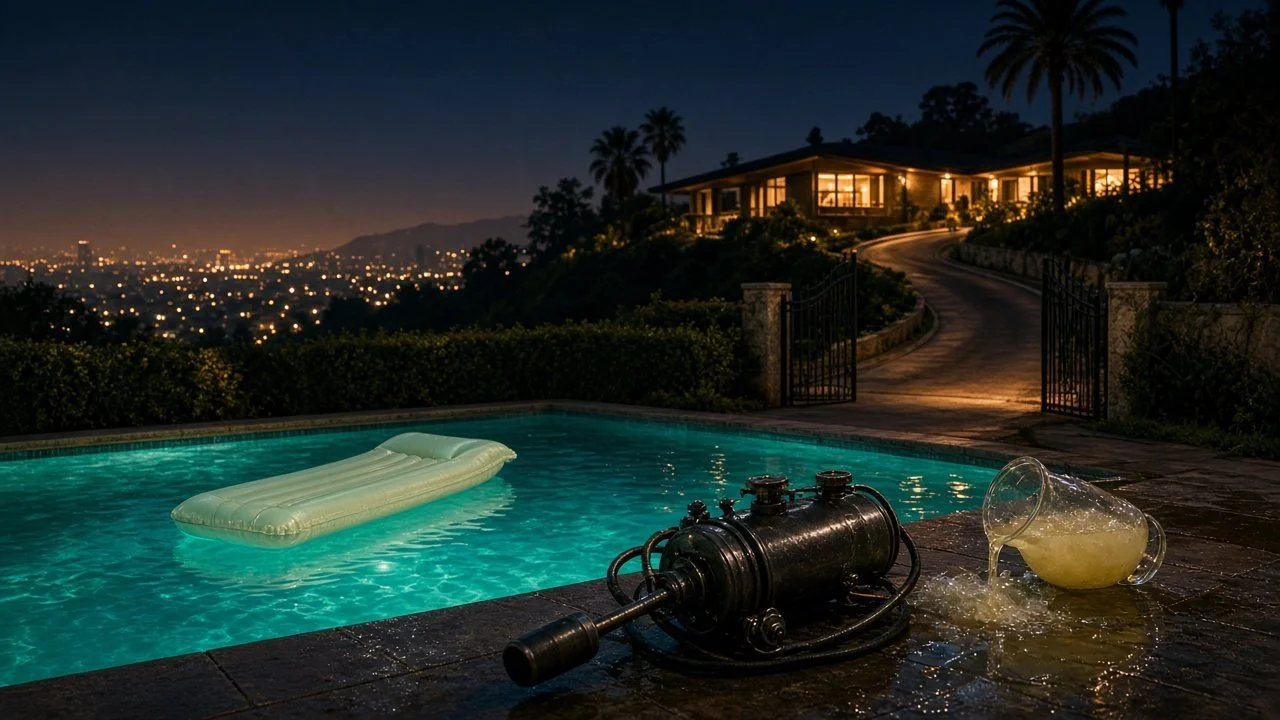
They land in Los Angeles on 8 August 1969 and decide to make the most of their last night working together. They go out for drinks and Mexican food, then return to Rick's house. Cliff lights a cigarette dipped in LSD and takes his pit bull, Brandy, out for a walk. Rick makes a jug of frozen margaritas and floats in the pool with headphones on. The narrator times each step, so the audience knows exactly how close midnight is.
Why the Manson Family Choose Rick's House
A car with a broken exhaust rattles up the private road and parks at the top. Inside are four Manson followers: Tex, Sadie, Katie and Flowerchild, the film's version of Linda Kasabian. Their target, as in history, is the house beyond Rick's gate.
Rick, drunk and still in his dressing gown, marches out holding his margarita jug and yells at them to move the car. They reverse back down the hill. Then they recognise him as the star of Bounty Law. Sadie argues that the television they grew up with taught them to kill, so they should "kill the people who taught us to kill". In one exchange the film turns its villains into critics of violent entertainment, setting up the answer Tarantino is about to give them.
Flowerchild loses her nerve and drives off with the car, leaving the other three stranded on the hill. Tex, Sadie and Katie climb towards Rick's house instead of Sharon Tate's.
What Happens at the End of Once Upon a Time in Hollywood?
The intruders burst into Rick's house and find Cliff, high on acid, feeding Brandy, and Francesca asleep in the bedroom. Nobody next door is harmed. Cliff recognises the three from Spahn Ranch, can't quite remember Tex's name, and when Tex announces that he is the devil and has come to do the devil's business, Cliff remarks that it was dumber than that. He then sets Brandy on Tex.
What follows is staged as a riot of comic violence rather than horror. Cliff throws a tin of dog food at Tex's face, and Brandy brings Tex down while Cliff finishes him. Cliff is stabbed in the struggle but kills Katie. Sadie, badly mauled by Brandy, crashes through a window into the pool, firing wildly. Rick, who heard nothing through his headphones, scrambles out, fetches the flamethrower he kept from his war film The 14 Fists of McCluskey, and burns her. The prop was set up earlier in a clip from that film, so the payoff is pure movie logic.
Afterwards, police take statements and paramedics load Cliff into an ambulance. Rick tells him he is a good friend, and Cliff answers that he tries. It is the last moment the two share on screen.
Jay Sebring, Sharon Tate's friend, walks down the drive to the gate to ask what the noise was about. He recognises Rick, and Sharon's voice comes over the intercom inviting Rick up for a drink. The gate opens. Rick walks up the drive and Sharon, heavily pregnant, comes out to greet him with her friends. The camera rises over the house and the title appears for the first time: Once Upon a Time... in Hollywood. During the credits, a Red Apple cigarette advert starring Rick plays.
The plain answer to the most searched question is that Sharon Tate does not die in this film. Nor do Jay Sebring, Wojciech Frykowski, Abigail Folger or Steven Parent. In Tarantino's version, the people who meant to kill them die first.
What Really Happened at 10050 Cielo Drive
In reality, there was no Rick Dalton next door and no one stopped the killers. In the early hours of 9 August 1969, Tex Watson, Susan Atkins and Patricia Krenwinkel, on Manson's orders, killed Sharon Tate, who was 26 and more than eight months pregnant, along with Jay Sebring, Wojciech Frykowski, Abigail Folger and an 18-year-old visitor, Steven Parent. Linda Kasabian, who kept watch outside, became a key prosecution witness. The following night, members of the group killed Leno and Rosemary LaBianca at their home elsewhere in Los Angeles.
Manson and the killers were convicted in 1971. Manson died in prison in 2017 while serving a life sentence. The "devil's business" line Tex speaks in the film was borrowed from words attributed to the real Watson at the house. We set out the cult, the evidence and how the case was broken in our account of the Charles Manson murders.
The film's history is accurate in smaller ways too. The real Clem Grogan was later convicted over the murder of a Spahn Ranch stuntman, Donald "Shorty" Shea, which gives Cliff's beating of Clem a pointed edge. And Debra Tate, Sharon's sister, initially objected to the project, then withdrew her opposition after Tarantino showed her the script.
Why Tarantino Gives Sharon Tate a Happy Ending
The title has been telling viewers what kind of story this is all along. "Once upon a time" is how fairy tales begin, and the ellipsis is a pause before the spell. By holding the title card until the camera rises over the Tate house, Tarantino makes the rescue the point where the fairy tale formally starts. The history ends at the gate. Everything beyond it belongs to the film.
The ending also completes Rick's arc in a way no studio would offer him. Schwarz warned that playing villains would teach audiences to see him lose. On the night that matters, Rick plays the hero for real, using a prop from one of his own forgotten films, and his reward is the invitation he has wanted since the opening scenes. The gate opening is the career break he hoped a pool party would bring, given by the people he saved, though they will never know the full story.
Some viewers read the finale as Cliff's acid trip, pointing to the cigarette he smokes just before the attack. The film offers no cue that the events are imagined. Police and paramedics arrive, Cliff is genuinely hurt and Rick, who has taken nothing, witnesses all of it. The fairy tale is Tarantino's, not Cliff's hallucination.
The finale is also open to fair criticism. Sadie accuses violent television of making killers, and Tarantino replies with the most violent sequence in the film, played for laughs at the expense of three real people whose real victims are absent from the scene. Several critics found the turn rushed or tonally jarring after two hours of patient hanging out. The film is most persuasive where it is quietest, in Tate's afternoon at the cinema, and least where it asks the audience to cheer.
Then there is Cliff. The person who saves Sharon Tate is the man the film suspects of killing his own wife. Tarantino never resolves that on screen, and the ending deliberately enjoys Cliff's violence while it is aimed at the right people. It also quietly separates the friends. Rick walks up the drive into the life he wanted while Cliff leaves in an ambulance, without a job.
Where the Ending Leaves Cliff Booth
That separation is exactly where the story picks up again. The Further Mis-Adventures of Cliff Booth, directed by David Fincher from a new Tarantino script, finds Brad Pitt's Cliff in 1977, eight years after the Manson encounter. Netflix describes him working as a bartender and cinema projectionist while taking jobs as a Hollywood fixer, drawn into a crime story involving a television star who does his own stunts, the star's agent and a pair of gangster brothers. Netflix's own description puts it bluntly: the fairy tale is over.
The film opens in IMAX cinemas from 25 November and arrives on Netflix on 23 December. If the 1969 ending felt like a reward for both men, the sequel's very setup suggests Cliff's share of that reward did not last.
Once Upon a Time... in Hollywood ends with the most famous murder scene in Hollywood history never happening. Tarantino spends more than two and a half hours making the audience fond of Sharon Tate as a living woman, then lets two fictional men take the violence meant for her. The result is a fantasy, and the film knows it, which is why the title appears only once Rick has walked through the gate.
Sources
Vulture: let's talk about the ending of Once Upon a Time in Hollywood. The finale, Sadie's line, Kasabian's real role and critics' objections.
Vox: the twist ending explained. An independent account of the climax and the real events.
Radio Times: what happened to Sharon Tate?. The margaritas, the flamethrower and the intercom invitation.
Polygon: how the film rewrites the Manson murders. The cinema scene, Tarantino on Tate and Debra Tate's support.
Encyclopaedia Britannica: Charles Manson. The victims, dates, convictions and Manson's death.
Wikipedia: Once Upon a Time in Hollywood. Plot outline, Clem Grogan and the acid-trip and Bruce Lee readings.
Netflix Tudum: The Further Mis-Adventures of Cliff Booth. The sequel's premise and dates.
Next Reads
Did Cliff Booth Kill His Wife? What Tarantino's Film Shows and the Novel Reveals. The boat scene and what the novel settles.
True Crime: Charles Manson Murders - Inside the Family, the Evidence and the Myth. The real story the film rewrites.
Golden Globes History and Controversial Moments: From Hollywood Outsider Club to Industry Flashpoint. The awards body that named Tarantino's film Best Musical or Comedy.
