The Bell, the Hobo and the Meaning of "Believe"
Why Can't The Parents Hear The Bell At The End Of The Polar Express?
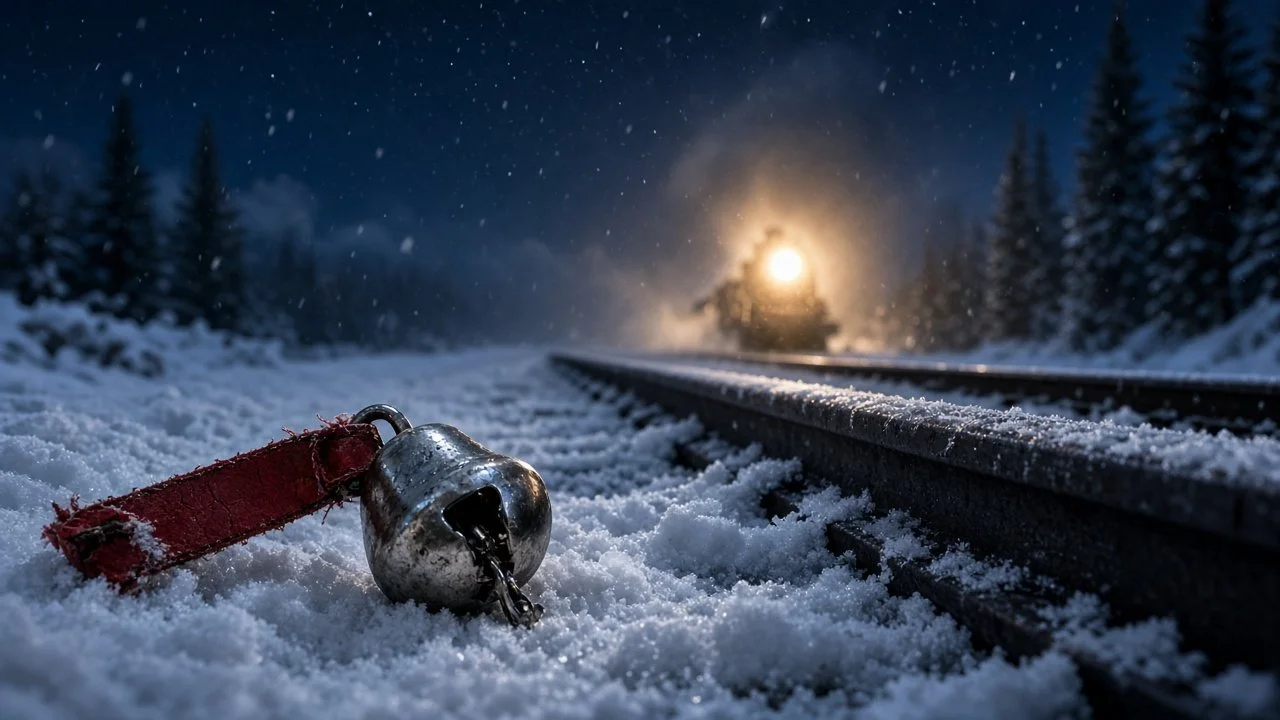
The Polar Express ends with a small silver bell that only some people can hear. A boy who has spent the whole film wondering whether Santa Claus is real wakes on Christmas morning to find the bell he lost on his journey, wrapped in a box under the tree. He and his little sister hear it ring. His parents, standing right beside them, hear nothing at all.
Robert Zemeckis's 2004 film, based on Chris Van Allsburg's 1985 picture book, has become a Christmas Eve ritual for millions of families, but its ending still raises questions. Was the journey a dream? Why can't the parents hear the bell? And who is the ghostly hobo who keeps appearing on the roof of the train? Here is what the ending means, what the book says and how the film changed it.
Spoiler warning: the following article discusses the plot, major twists and ending of The Polar Express.
What Happens in The Polar Express
On Christmas Eve, a boy who is beginning to doubt that Santa exists lies awake listening for sleigh bells. The film never names him; the credits call him Hero Boy. Just before midnight, a huge steam train pulls up outside his house, and its Conductor (Tom Hanks) invites him aboard the Polar Express, bound for the North Pole. In his hurry, the boy tears the pocket of his dressing gown, a detail that matters later.
On board he meets a confident girl, credited as Hero Girl, and a boastful Know-It-All. When the train stops for a lonely boy called Billy, who hesitates and lets it pull away, the hero boy pulls the emergency brake so Billy can get on. From there the journey becomes a series of near-disasters: a lost ticket that blows out of the window and somehow finds its way back, a walk across the snowy carriage roofs, a herd of caribou blocking the line, a throttle malfunction that sends the train hurtling down a steep hill, and a frozen lake of cracking ice.
At the North Pole, the hero boy, the Hero Girl and Billy accidentally unhitch a carriage, roll into Santa's workshop and end up tumbling into Santa's sack of presents before rejoining the crowd in the town square. As the reindeer gallop, a silver bell comes loose from their harness and lands at the boy's feet. He cannot hear it ring until he quietly tells himself, "I believe." Santa then lets him keep the bell as the first gift of Christmas.
How the Film Ends
On the way home, the boy discovers that the bell has slipped through the hole in his pocket. The Conductor punches each child's ticket with a single word or phrase as they leave. Billy is dropped home, and the boy is returned to his house, heartbroken about the bell.
On Christmas morning, his sister Sarah finds one last small box behind the tree. Inside is the silver bell, with a note signed "Mr. C." telling him to fix the hole in his pocket. When the boy shakes the bell, he and Sarah hear it clearly. Their parents hear nothing and assume it is broken.
The film then jumps forward in time. In the closing narration, the grown-up boy, voiced by Hanks, explains that his friends could once hear the bell, but over the years it fell silent for them. Even Sarah, one Christmas, found she could no longer hear it. For him, though, the bell still rings, as it does, in the words of the book, "for all who truly believe".
Is the Bell Real? What the Ending Means
The bell is the film's answer to the question it asks at the start. The boy wanted proof, and the ending gives him a physical object that has come back from the North Pole. If it were only a dream, the bell could not be under the tree.
But the bell is not proof in the way an adult would want it. It works only for those who already believe. Van Allsburg has said the story is about the moment when childhood belief starts to slip: "the coming-of-age event is no longer believing in reindeer flight," he said in a 2025 interview marking the book's 40th anniversary. "I remember being on that cusp, and clinging to belief." In his 1986 Caldecott Medal acceptance speech, he described the book as being about faith and the desire to believe in something.
That is why the parents cannot hear it. They are not cruel or careless; they have simply grown up. Sarah, younger than her brother, can still hear it, until one year she cannot. The ending is gentle about this. It does not punish anyone for losing the sound, it just records that most people do.
The bell, then, is real in the story, and the journey happened. What fades is not the bell but the ability to hear it. The film suggests that belief is less about a sleigh or a man in a red suit than about keeping a sense of wonder alive as you get older, which is why the narrator says it still rings for him.
Who Is the Hobo?
The strangest figure in The Polar Express is the Hobo, another of Hanks's roles. He materialises on the roof of the moving train, a ghostly figure who should not be there at all, and he helps the boy cross the icy roofs towards the engine, saving him from slipping off, before vanishing. He returns later in an abandoned carriage full of old toys, operating a puppet of Ebenezer Scrooge that mocks the boy's doubts about Santa.
The film never explains him. He seems to know what the boy is thinking, he needles him about what he does and does not believe, and he appears and disappears without warning. Many viewers see him as the voice of doubt and scepticism, the part of the boy that suspects it is all nonsense. Others see him as a guardian, since he keeps the boy safe on the roof and points him towards the engine.
The best reading is that he is both. He tests the boy, mocks him and pushes him to make up his mind, and in the end that is what helps him to believe. The Scrooge puppet is a deliberate clue: like Dickens's miser, who is shown visions to change his heart, the boy is being pushed towards a choice. Our summary of A Christmas Carol explains how Scrooge's journey works.
Fans also point to a scene cut from the finished film, in which the train's two engineers suggest that the Hobo is the ghost of a man who once rode the Polar Express. That backstory is not in the released film and should not be treated as the official answer; the film-makers left him deliberately mysterious.
What the Ticket Words Mean
As the children leave the train, the Conductor punches a word into each child's ticket, and each word points to what that child needs to learn. The Know-It-All's ticket says "LEARN". The Hero Girl, who has been gently encouraging the others all night, gets "LEAD". Billy, who arrived alone and has never felt anyone was on his side, gets "DEPEND ON", which shifts to "RELY ON" and "COUNT ON". The hero boy's ticket says simply "BELIEVE".
The Conductor also gives the boy two lessons that sum up the film. "One thing about trains: it doesn't matter where they're going. What matters is deciding to get on," he says. And later: "Seeing is believing, but sometimes the most real things in the world are the things we can't see."
Book vs Film: What Chris Van Allsburg Wrote
Van Allsburg's book is a 32-page picture book published in 1985, and it won the Caldecott Medal, America's top award for picture-book illustration, the following year. Its text is barely 1,000 words long, so the film had to invent most of its story.
The book's outline is the same: a boy, a train at midnight, hot cocoa, a journey through forests and mountains to the North Pole, Santa giving him the first gift of Christmas, a bell lost through a hole in his pocket and returned on Christmas morning, and parents who cannot hear it. In the book, the boy chooses the bell himself when Santa offers him any gift; in the film it falls at his feet. The final words of the film's narration come almost directly from the book.
Zemeckis and his co-writer, William Broyles Jr., kept the beginning and end of the book and wrote an almost entirely new middle. The Hero Girl, Billy and the Know-It-All, the engineers, the hot chocolate song, the roof scenes, the runaway train and the frozen lake are all additions. The Hobo does not appear in the book at all. Van Allsburg, who was an executive producer, wanted the film not to be "an animated cartoon", Zemeckis said, and the director's aim was to turn the book's paintings into "moving paintings". Every illustration in the book is represented somewhere in the film.
Van Allsburg has been broadly positive about the result. "There's a central melancholy quality to the film which I thought was faithful to the book," he said in 2025. He added: "I think it was successful, aside from the children's faces," and admitted, "I still haven't gotten used to the spooky-looking kids."
The Look, the Song and the Legacy
That last point is the film's most famous weakness. The Polar Express was made entirely with performance capture, in which actors' movements are recorded and turned into digital characters. Hanks performed the boy's movements, voiced the grown-up narrator and played the Conductor, the Hobo, the Scrooge puppet, Santa and the boy's father. The result looked like the book's paintings, but many critics found the characters' faces and eyes eerily lifeless.
None of that stopped the film becoming a perennial. Its song "Believe", sung by Josh Groban, was nominated for an Academy Award and won a Grammy, and the film is now a fixture of Christmas television schedules on both sides of the Atlantic. For more on where the figure of Santa came from, read our history of Saint Nicholas and how he became Santa Claus.
Why the Ending Still Works
The ending of The Polar Express works because it refuses to settle the question in a way that would spoil it. The bell is real, the journey happened and the gift came from Santa, but the proof only works for people who are willing to listen. The parents are not wrong, just grown up, and even Sarah eventually loses the sound.
The final line belongs to the adult narrator, who still hears the bell. That is the hope the story offers every December: that something of a child's wonder can survive growing up. It is why the bell, and the boy's single ticket word, "BELIEVE", has outlasted every complaint about the animation.
Sources
Los Angeles Times: 'Polar Express' (24 October 2004). How the book was adapted and performance capture.
BBC Films: Robert Zemeckis interview (December 2004). "Not an animated cartoon" and "moving paintings".
BBC Films: Tom Hanks interview (December 2004). Hanks bringing the book to Zemeckis.
Boston.com: The Polar Express at 40 (23 December 2025). Van Allsburg's quotes and the book's history.
AFI Catalog: The Polar Express (2004). Credits and character names.
Wikipedia: The Polar Express (book). The book's plot, final lines and Caldecott speech.
25YL: Seeing Is Believing, a Ride on The Polar Express. The Conductor's lines and readings of the Hobo.
Looper: things you may have missed in The Polar Express. The torn pocket.
Wikipedia: The Polar Express (film). Plot sequence, Hanks's roles and the song's awards.
Next Reads
A Christmas Carol Summary. The story behind the Hobo's Scrooge puppet.
Who Was Saint Nicholas and How Did He Become Santa Claus?. The real history of the man the boy travels to meet.
Why Does Jacob Marley Wear Chains in A Christmas Carol?. Another Christmas ghost with a message.
Ebenezer vs A Christmas Carol: What Johnny Depp's Scrooge Changes About Dickens' Ghost Story. Another book-to-film Christmas story.
The History of Christmas: How It Began, How It Changed, What Endured. Where the film's traditions came from.
