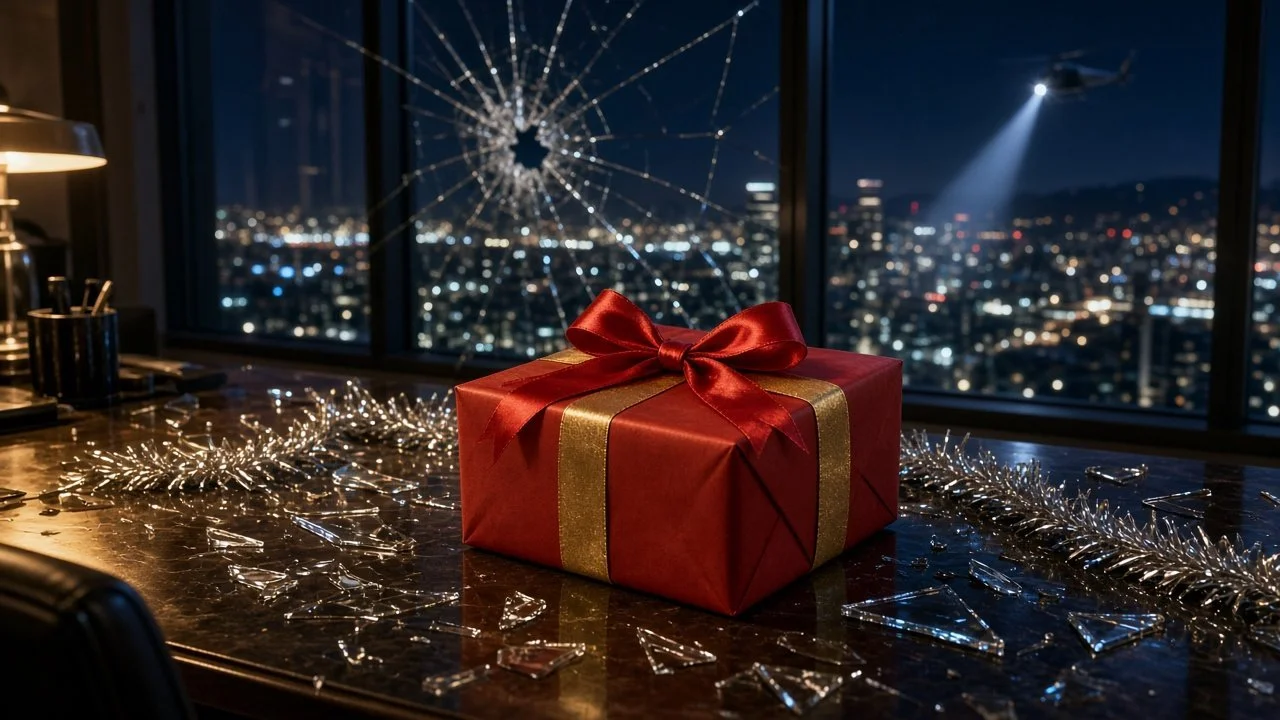
The Checklist That Started a Holiday Argument
The Men Who Wrote Die Hard Say It Is A Christmas Film, But Bruce Willis Said No.
Every December the same argument breaks out: is Die Hard a Christmas film? John McTiernan's 1988 action thriller sends a New York police officer to Los Angeles on Christmas Eve, traps him inside a skyscraper during an office Christmas party and makes him fight his way through a gang of armed thieves until dawn. It also opened in American cinemas in July, carried an 18 certificate in Britain and contains no Santa and no snow.
The short answer is that the people who wrote and directed it say it is a Christmas film, the man who starred in it said it is not, and the public is split almost down the middle, with younger viewers increasingly on the "yes" side. Here is the evidence on both sides, and what the people who made it have actually said.
Spoiler warning: the following article discusses the plot, major twists and ending of Die Hard.
What Happens in Die Hard, and Where Christmas Fits In
Bruce Willis plays John McClane, a New York cop who flies to Los Angeles on Christmas Eve hoping to patch up his marriage. His wife, Holly (Bonnie Bedelia), has moved west for a senior job at the Nakatomi Corporation and is now using her maiden name, which McClane takes badly. He arrives at her company's Christmas party on the upper floors of the Nakatomi tower, and within minutes the two of them have argued again.
Then Hans Gruber (Alan Rickman) and his armed crew seize the building. They present themselves as political terrorists, but they are really thieves after more than $600 million in negotiable bearer bonds locked in the company vault. McClane, barefoot and unseen, becomes the one man loose inside the tower, picking off Gruber's team, radioing a sympathetic police sergeant on the ground and trying to stay alive long enough to save Holly.
Christmas is not wallpaper in this story. It explains why the building is nearly empty, why everyone is drinking, why McClane is in Los Angeles at all and why Holly is the hostage Gruber eventually singles out. The siege runs from Christmas Eve into the early hours of Christmas Day. By the end, McClane has said the apology he could not manage at the party, Holly reclaims his surname when she introduces herself, and paper from the shattered vault floats down over the building like snow.
Where the Christmas Setting Came From
Die Hard is adapted from Roderick Thorp's novel Nothing Lasts Forever, which screenwriter Jeb Stuart has described as bearing "just some passing resemblance" to the film. In the book, he recalled, a 65-year-old man comes to Los Angeles to visit his 40-year-old daughter, who turns out to be caught up in a crime, and the story ends with her falling from the top of the building.
Stuart has explained that the Christmas Eve timing solved a practical problem. "I needed that building to be pretty much empty," he said in a 2020 interview, adding that putting the story "on the eve of a great holiday like Christmas when everybody is already gone" made that possible. In a 2023 interview he put it more bluntly: "It's definitely a Christmas movie because I had to have the building empty. So it was either Thanksgiving or Christmas." Readers who like their holiday films with a body count may enjoy our explainer on the slasher film Thanksgiving, which took the other option.
Stuart also changed the emotional centre of the book. He turned the 65-year-old father into a 30-year-old husband who, in his words, is "essentially, all he's trying to do is tell his wife he's sorry for screwing up". That shift, from a man rescuing a relative to a man trying to repair a marriage at Christmas, is the heart of the "yes" case.
The Case That Die Hard Is a Christmas Film
The strongest argument is that Christmas runs through almost every scene. Visiting the set, co-writer Steven E. de Souza noticed the tinsel "Merry Christmas" banners, the Santa hats, the cards on employees' desks and the giant tree in the lobby. His script added the "Season's Greetings" gift tape McClane uses to hide a gun on his back in the climax, and he counts three Christmas songs on the soundtrack: Let It Snow, Winter Wonderland and Run-DMC's Christmas in Hollis. McClane even dresses a dead gunman in a Santa hat and sends him down in a lift with a festive message for Gruber scrawled on his sweatshirt: "Now I have a machine gun. Ho-ho-ho."
After the news anchor Jake Tapper tagged him in the debate in 2017, de Souza drew up a checklist comparing Die Hard with the 1954 musical White Christmas: his film takes place entirely during the holiday, while White Christmas only uses it for its first and final scenes. "I do get offended, because what is your benchmark?" he said in 2018. "Is it because 'Die Hard' came out in July? Well, 'Miracle on 34th Street' came out in the summer, too." He has also recalled that producer Joel Silver predicted, during the shoot, that it would play "perennially on television during Christmas".
The second argument is thematic. Strip away the gunfire and Die Hard is a story about an estranged family reunited on Christmas Day, with a stranger's good deed (Sergeant Al Powell, the police officer McClane befriends over the radio) and a final act of grace. Stuart has described that as the "holiday aspect": "Love is still the point of it." He considered ending with snow falling on Los Angeles, decided that was "one step too far", and had the bearer bonds rain down instead.
The third argument comes from the director. In a 2020 video for the American Film Institute, John McTiernan said he had been inspired by the "Pottersville" sequence in It's a Wonderful Life, in which a greedy banker is shown taking over a town. He wanted McClane to be an ordinary working man who makes powerful people look foolish. "We hadn't intended it to be a Christmas movie," he said, "but the joy that came from it is what turned it into a Christmas movie."
The Case Against
The opposing view is just as easy to state. Die Hard is an action film set at Christmas, not a film about Christmas, and the festive details serve the plot and the jokes rather than the other way round. Film historian Leonard Maltin, who considers himself a traditionalist, asked in 2018: "Does it evoke the spirit of Christmas?" He called Die Hard "a terrific thriller set at Christmas time", adding: "it's more of 'It's a Wonderful Survival' than a 'It's a Wonderful Life'."
The release history is the other plank. Twentieth Century Fox released Die Hard in American cinemas in July 1988, as a summer blockbuster rather than a holiday film. The British Board of Film Classification passed it uncut at 18 in 1988, and it was only lowered to 15 on resubmission in 2008. An adults-only rating for two decades sits awkwardly with a genre built around family viewing, and in a 2022 YouGov survey 13% of Britons named family suitability as essential to a Christmas film.
What Bruce Willis Said
The most quoted voice on the "no" side is the film's own star. Closing the Comedy Central Roast of Bruce Willis, recorded in Los Angeles in July 2018, Willis declared: "Die Hard is not a Christmas movie! It's a [expletive] Bruce Willis movie!"
It is worth remembering where that line was delivered. A roast is a comedy event, and Willis was ending his set on a punchline. He followed the line with a harmonica solo, and it was a joke about his own star persona as much as a verdict on genre. De Souza had already answered Tapper on Twitter: "How could it not be a Christmas movie?" adding, "Plus a woman about to give birth features prominently." Only one of them wrote the script.
What the Studio Did Next
Five months after the roast, the studio quietly sided with the writers. In December 2018, Twentieth Century Fox recut the original trailer for the film's 30th-anniversary home release, billed Die Hard as "the greatest Christmas story ever told", set it to music from The Nutcracker and added a festive voiceover. The new synopsis began with McClane "facing Christmas 3,000 miles from his estranged wife and two children" and flying west "bearing presents".
That was marketing, not scholarship, but a film sold as a July action spectacle was now being sold as a Christmas gift.
What the Polls Say
Surveys suggest the public has never fully agreed, but the balance is shifting. A Morning Consult poll in late 2018 found only 25% of Americans considered Die Hard a Christmas film, with 62% saying it was not. In December 2022, YouGov found 37% of Britons said yes and 46% said no.
The splits are revealing. In the British poll, 60% of people aged 55 and over rejected the idea, while those aged 35 to 44 backed it 53% to 36%. Men were far more likely than women to call it a Christmas film, by 45% to 29%. A 2023 YouGov survey of Americans who had seen the film found 56% of under-30s calling it a Christmas film, against 20% of those aged 65 and over.
By December 2025, YouGov's American poll of people who had seen Die Hard found the country essentially split: 44% said it should be considered a Christmas movie and 45% said it should not. Only one in five Britons, 19%, said the same of the 1990 sequel, Die Hard 2.
So, Is Die Hard a Christmas Film?
On the evidence, the "yes" side has the stronger case. The story is set entirely on Christmas Eve and Christmas morning, the holiday drives the plot, the emotional arc is a Christmas reconciliation, both credited screenwriters say they wrote a Christmas film and the director says it became one. The best "no" argument is about genre and tone rather than facts: Die Hard is primarily an action film, and it does not celebrate Christmas in the way It's a Wonderful Life or A Christmas Carol does. Our summary of Dickens's A Christmas Carol shows what that more traditional model looks like.
The most honest answer may be that Die Hard has become a Christmas film through use. People choose to watch it every December, studios market it as one and cinemas schedule it alongside the classics. That is how most festive traditions are made, as our look at how the John Lewis Christmas advert became a British tradition shows.
Die Hard was built from Christmas parts: an empty office on Christmas Eve, a marriage in trouble and a man who wants to say sorry before morning. Its makers meant it as a Christmas story and audiences have increasingly agreed, even if its star preferred a punchline. Whether it counts depends on whether you define a Christmas film by its message or by its calendar, and Die Hard, unusually, can claim both.
Sources
NBC News: the debate over Christmas movies continues to Die Hard (16 December 2018). De Souza's quotes and checklist, Maltin's verdict and the Morning Consult poll.
Task & Purpose: Die Hard is a Christmas movie, according to the guy who wrote the script (22 December 2020). Jeb Stuart on the empty building, the novel and the ending.
Collider: Jeb Stuart interview (2023). "It was either Thanksgiving or Christmas."
UPI: Jeb Stuart on Die Hard as a Christmas movie (10 December 2022). Corroboration.
The Hollywood Reporter: McTiernan's explanation (December 2020) and Radio Times: McTiernan confirms. The AFI video and his "joy" quote.
Variety: Bruce Willis roast (July 2018) and The Independent (16 July 2018). Willis's remark and de Souza's replies to Tapper.
Variety: Die Hard gets Christmas trailer (December 2018). Fox's 30th-anniversary recut.
YouGov: Britons don't think Die Hard is a Christmas film (December 2022). UK poll figures.
YouGov: it might depend on how old you are (15 December 2023) and YouGov: most widely seen Christmas movies (December 2025). US polls.
BBFC: Die Hard (1988) case study. The 18 and 15 certificates.
Next Reads
Thanksgiving Explained: The Killer, the Clues and the Ending. The holiday Jeb Stuart nearly chose instead.
A Christmas Carol Summary. The traditional Christmas story.
Ebenezer vs A Christmas Carol: What Johnny Depp's Scrooge Changes About Dickens' Ghost Story. This year's darker take.
The 10 Best New Year's Eve and New Year's Day Films, Ranked. What to watch once Christmas is over.
How Did the John Lewis Christmas Advert Become a British Tradition?. How commercial culture became part of the season.
