Why Did Saint Nicholas Give Away Gold?
Before Children Looked To The North Pole, Pilgrims Looked To A Mediterranean Port.
Myra, the city associated with Saint Nicholas, lies in what is now southern Türkiye. The Mediterranean is close by. A bishop working there in late antiquity would have recognised ships, merchants and families worried about money. He would have found a flying sleigh harder to explain. Between that bishop and Santa Claus lie a story about three daughters, a sailors’ expedition, a Dutch name and an American poem whose opening is more famous than its original title.
Nicholas is traditionally identified as a fourth-century bishop. Evidence from his own lifetime is thin. There is no surviving diary in which he describes giving presents, and the biographies that made him famous were written later. To understand how he became Santa, the most promising question is what successive generations wanted him to bring. The answer changed from financial security for an endangered household to a night of anticipation for children.
Why the Earliest Famous Gift Was Money
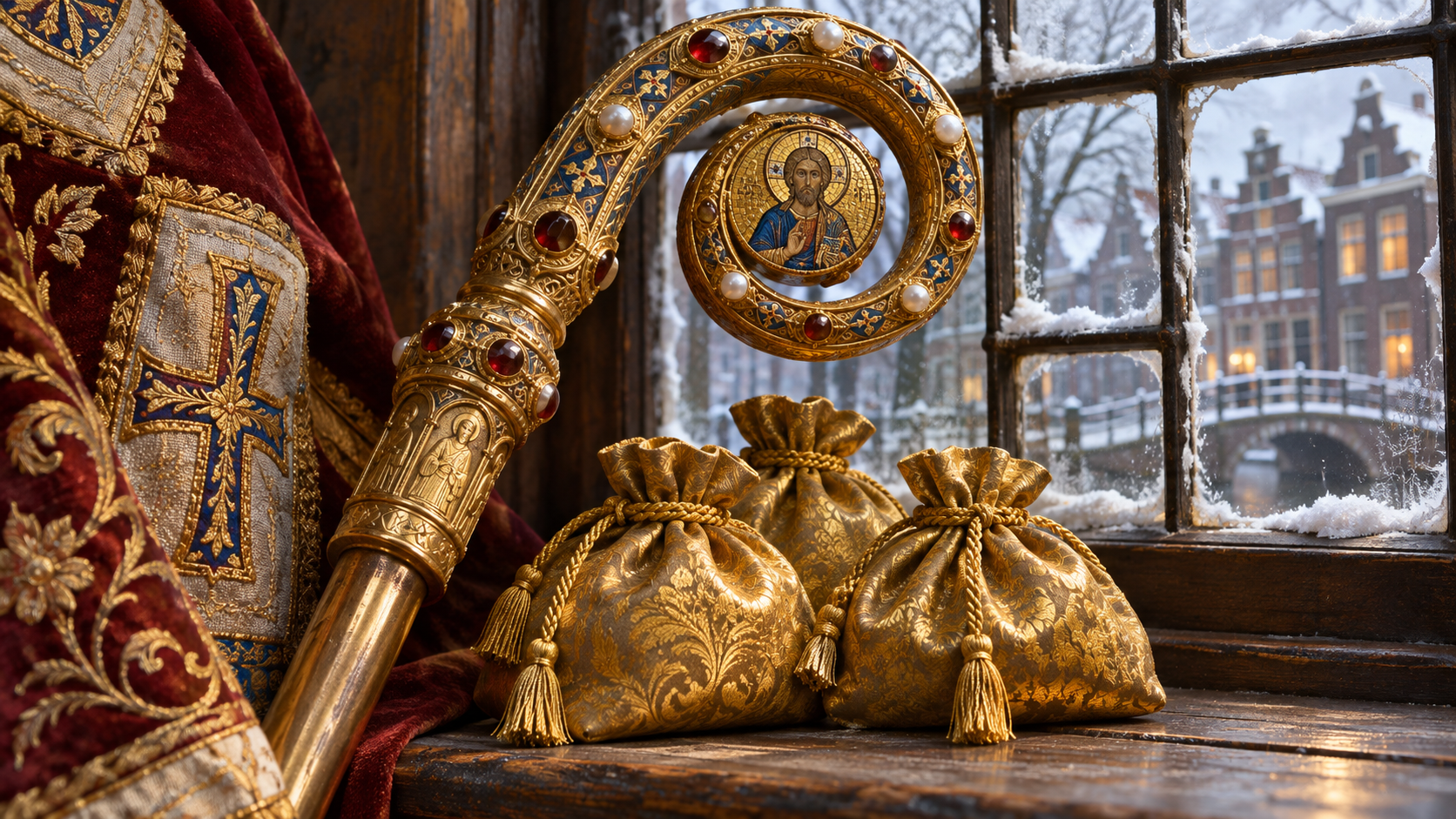
In the best-known Nicholas legend, a father has fallen on hard times. His three daughters lack the dowries expected for marriage, and the story gives their predicament a frightening urgency. Nicholas secretly provides gold. Modern retellings concentrate on how the money entered the house and where it landed. The original attraction is easier to appreciate by looking at what followed. The family had choices that poverty had taken away.
Secrecy is essential. A public gift from a prominent bishop might have relieved the family while advertising its misfortune. A gift delivered unseen preserved the household’s dignity and left the giver without the immediate reward of thanks. It is easy to see why a story about dowries could survive in societies with quite different marriage arrangements. Anyone who has slipped money through a friend’s letterbox understands the awkward kindness at its centre.
Other stories made Nicholas a protector of sailors. That mattered in a world in which families on shore might wait a very long time for news of a missing ship. A saint could become part of domestic life through dangers that had little to do with childhood. The modern Santa has gathered so much of Nicholas’s fame into a single night that it takes an effort to imagine people calling on him at sea in summer.
Why an Italian City Became Part of the Story
In 1087 men from Bari carried away remains venerated at Myra as Nicholas’s relics and brought them to southern Italy. In Bari the arrival became part of the city’s history. From the perspective of the people who lost their shrine’s contents, taking the bones could look very different. Medieval communities had strong reasons to want a saint close at hand, and competition for relics could lead Christians who honoured the same man into conflict with one another.
The transfer helps explain how devotion travelled. A sailor could visit a shrine at a busy port and carry a story home. A church elsewhere could adopt Nicholas as its patron. Parents could give a child his name. None of that depended on a printed biography reaching every village. His feast on 6 December gave households an annual occasion to renew the connection.
How Sinterklaas Became Santa Claus
In Dutch tradition Sinterklaas remained recognisably episcopal. His mitre and staff identified a bishop, and gifts belonged to the eve of his December feast. The name Santa Claus comes through the Dutch form of Saint Nicholas. Keeping the names side by side helps explain the link. It also makes the changes conspicuous. The American visitor eventually acquired his own vehicle, wardrobe, household arrangements and appointment on Christmas Eve.
Nineteenth-century New York supplied a particularly effective vehicle for that transformation. A poem published anonymously in 1823 and now usually called A Visit from St Nicholas gave an entire household encounter a pace and sequence. A noise outside wakes the narrator. A sleigh appears. The visitor enters, attends to the stockings and departs before the children need to wake. Readers who could not have named Nicholas’s episcopal see could learn the rules of his visit in a few minutes.
The poem also solved a logistical problem for families. Gifts could appear in the house overnight without a parent having to arrange a public performance by a bishop. Reading the poem aloud became one more way of making the visit happen again. Its traditional attribution to Clement Clarke Moore has been disputed. Whatever conclusion one reaches about authorship, the published poem allows us to see the transformation taking place in words.
Who Gave Santa His Modern Appearance?
Illustrators, including Thomas Nast, repeatedly drew Santa for mass audiences. Illustration offered something a poem alone could leave open. A reader could now recognise the visitor before hearing his name. Later advertising circulated particular versions of the red-suited figure on a vast scale. The sequence matters. Nineteenth-century readers already possessed an illustrated Santa well before twentieth-century soft-drink campaigns.
British Father Christmas brought another inheritance to the encounter. The older figure personified Christmas festivity. Over time his name and the gift-bringing Santa became largely interchangeable in Britain. That is why an English speaker can use two apparently different job titles for the same visitor, while a Dutch household can still distinguish the December feast of Sinterklaas from Christmas itself.
The most durable link with Myra is a small piece of conduct. Someone needs a gift. The person who supplies it comes unobserved. In the bishop’s legend the recipients were young women whose futures depended on money. In the Christmas poem they were children asleep in a comfortable house. The distance between those households explains how much Santa changed. The pleasure of leaving something for another person to find explains why Nicholas survived the journey.
Sources
National Gallery — St Nicholas of Bari
Fordham University — A Greek account of the transfer to Bari
Library of Congress — An illustrated edition of A Visit from St Nicholas
Oxford University Press — St Nicholas to Santa Claus
Next Reads
Why Is Christmas on 25 December? — Read the wider history of the date Christians chose for the Nativity.
Why Is It Called Boxing Day? — Explore the Christmas boxes and seasonal gifts behind the British name.
Why the Number Three Keeps Appearing in Jesus’ Life and the Bible — Explore the patterns that connect the Gospel narratives.
