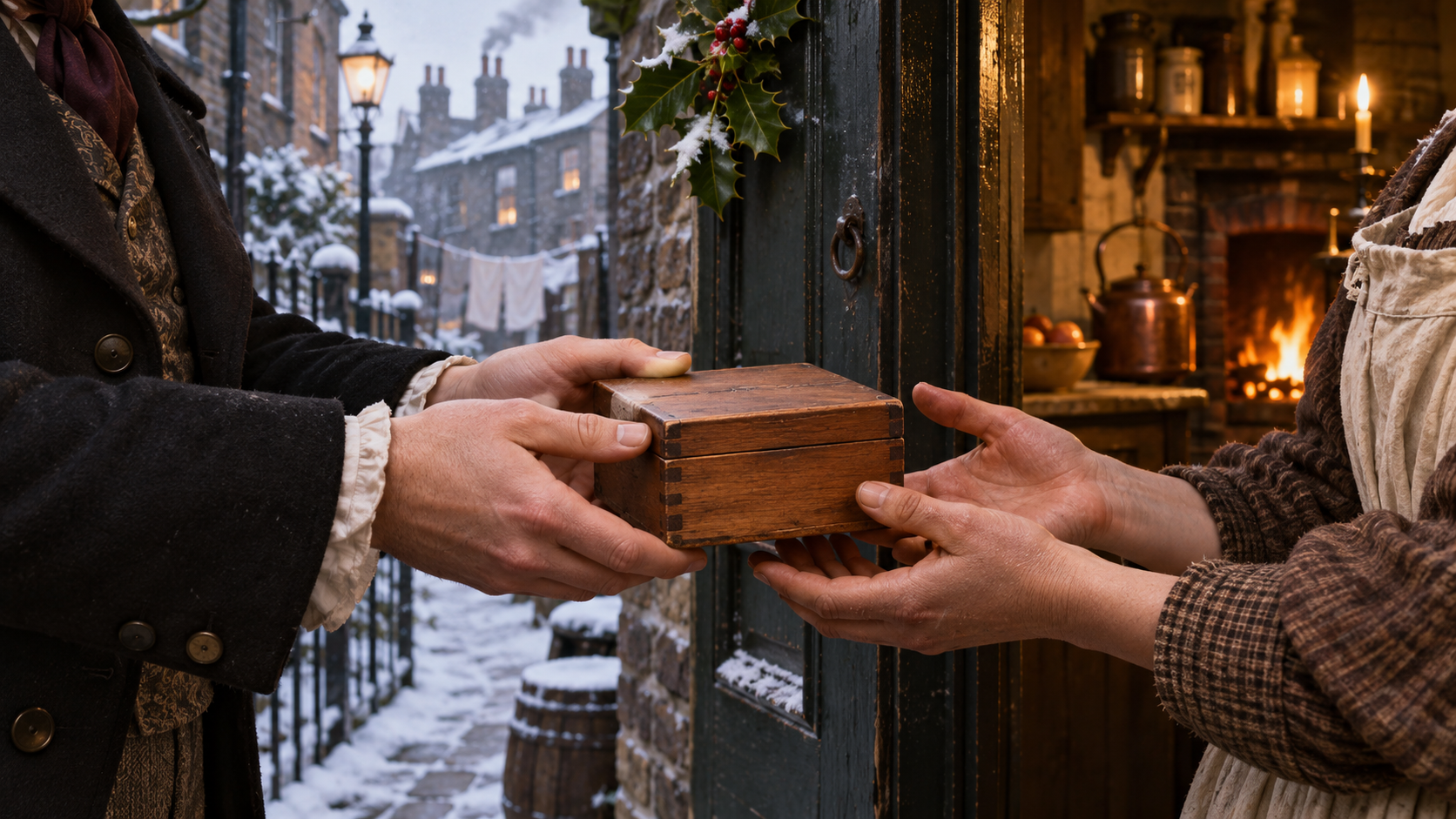
What Was in a Christmas Box?
A Christmas Box Could Fit In Your Pocket Even When Nobody Had Given You A Box.
The boy who delivered goods, the apprentice who had run errands and the servant who had helped a household through Christmas had a reason to look forward to the next knock at the door. A customer or employer might give them a Christmas box. By the time the custom was familiar, the gift could be a sum of money handed over without a container. The box had become what went into it.
Boxing Day takes its English name from the custom of giving these seasonal gifts or gratuities. The evidence is especially good for payments to people who had provided a service. St Stephen's Day explains the older Christian identity of 26 December. Victorian legislation explains how the day after Christmas acquired a place in the bank holiday calendar. Those are three overlapping histories, and only one of them explains the word boxing.
What A Christmas Box Meant
It is tempting to start with the modern Christmas parcel, all wrapping paper and ribbons, and imagine a second morning of opening family presents. The people in early accounts of Christmas boxes make the distinction clearer. In seventeenth-century England, apprentices and servants received money from their employers. Customers also gave to tradespeople who had served them during the year. The gift marked a relationship established through work.
Think of three people who might cross the same threshold in December. A relative brings a present to exchange. A neighbour comes to share a meal. A delivery worker calls on a round that has taken them to this house throughout the year. A gift of money to the third person has a different social meaning from a present between cousins, even if both gifts cost the same and are given in exactly the same spirit of affection.
The word box could designate the receptacle into which a contribution went and then the contribution itself. English has plenty of expressions that make a similar transfer. Somebody passing the collection plate is interested in what people put on it. A person describing a generous collection is talking about what was received, without implying that the plate was especially fine. Once people understood a Christmas box as a gratuity, any actual box could disappear from the transaction.
This helps explain a potentially misleading question about the origin. Asking what the very first Boxing Day box looked like assumes that an identifiable object must have launched a national holiday. The surviving evidence is better suited to explaining a change in language and a repeated practice. It offers recipients, occasions and increasingly familiar expectations. A photograph of a single attractive wooden box can illustrate the idea, but it could never settle where an entire custom began.
The Servants’ Day Off Story
One popular account sets the scene in a wealthy house. Servants work through the family's Christmas Day and on the following morning receive gifts, leftovers or money and leave to spend time with their own families. It is a plausible picture of how some households might organise festivities. It also appeals because the arrangement gives everyone a turn at Christmas. Its weakness as a complete explanation is the range of recipients left standing outside the front door.
Tradespeople, apprentices and others whose work brought them into contact with customers could receive Christmas boxes. They did not all live in the houses where they collected them, and their gifts did not all depend on a formal day of leave. A person might receive a box as an employee in one setting and be expected to give one as a customer in another. The custom spread along the relationships linking households, shops and services.
That arrangement helps explain why the tradition generated complaint as well as gratitude. A handful of individually modest gifts could amount to a substantial annual expense for someone expected to remember a long list of people. Eighteenth-century writers complained of demands on their pockets. In the nineteenth century Punch satirised the pressure placed on tradesmen. An account that presents the custom as an act of uninterrupted Victorian benevolence misses the arguments people were already having about the price of belonging to it.
There is no reason to assume the recipient experienced the money as a sentimental gift either. Someone who had delivered goods in poor weather all year might regard an annual gratuity as earned recognition. An employer might view the same payment as a personal kindness. We need not decide whose interpretation was correct to see how a gift could become expected without becoming an ordinary item in the wage bill.
Where The Church Collection Box Fits
Another familiar explanation begins inside a church. Money collected for people in need is distributed during the Christmas season. The giving of alms and the association of St Stephen with service make this a natural story to tell. The more demanding claim is that one particular opening of church alms boxes on 26 December gave the whole day its English name. The evidence for ordinary Christmas boxes is clearer than the evidence for that single point of origin.
There is no competition in principle between religious charity and gratuities to workers. Members of a household could contribute to a church collection, give a servant some money and present a child with a gift in the same week. The distinction matters when the question is etymological. To explain a name, it helps to find people using the relevant word in association with the custom. A worthy activity that also involves a box supplies only part of that evidence.
St Stephen's place in the calendar is much older than a Victorian bank holiday. In Acts he is among seven men selected after a complaint about the daily distribution to widows. He later gives a speech and is killed by stoning. Western churches commemorate him on 26 December. The conjunction of charity, service and martyrdom helps explain why people hearing a church-box explanation find it convincing. It does not document what a London apprentice meant when asking for a Christmas box.
The carol Good King Wenceslas preserves another clue to the date's identity. The king looks out on the feast of Stephen. Someone hearing the song at Christmas may recognise that the action belongs to the following day even if nobody in their household has ever called it anything except Boxing Day. The liturgical name and the social name can remain perfectly intelligible to the same listener.
Why A Tip Could Flow In More Than One Direction
A tradesman giving a Christmas box can sound like a reversal of the whole custom. Surely the tradesman was the one going to the door to collect it? The difficulty disappears once we consider whose labour a particular payment acknowledged. A trader had customers, employees, delivery workers and suppliers. The same person could receive thanks in one relationship and be expected to recognise a service in another.
Imagine a shopkeeper whose assistant had spent the year carrying purchases to customers. A grateful household might give the assistant money. The shopkeeper might also be expected to remember people who regularly brought goods to the shop. One newspaper complaint about the cost to a shopkeeper need not contradict a diarist's reference to a tradesman's welcome tip. Both could be describing the same economy viewed from different doorways.
Gratuities also leave a curious kind of historical record. Someone who quietly handed over a few coins each year had little reason to write an essay about the exchange. A person who resented a dozen expectations arriving together had an excellent reason to complain in print. The complaints document how familiar and potentially burdensome the practice had become. They cannot tell us how many recipients appreciated the money or how many givers took pleasure in providing it.
That imbalance matters for another reason. The gift took place between people who did not have equal control over their work or income. A humorous account by someone annoyed at being asked can preserve the request while saying very little about the person who needed the proceeds. Reading the custom through the names of its recipients helps restore the working people whose time and errands gave the payment a purpose in the first place. The old word became national currency, in a manner of speaking, while most of the people who collected individual boxes went unnamed.
What Parliament Did In 1871
The Bank Holidays Act 1871 is an unusually useful source because its preoccupations are so different from those of a Christmas story. Read the opening provisions and the subject is banks, bills of exchange, promissory notes and payments coming due. If banks close on an appointed day, the law needs to say what happens to obligations that would otherwise fall due then. The practical answer was to allow performance on the next applicable day.
The schedule for England and Ireland included the twenty-sixth day of December if it was a weekday. Other dates in the schedule included Easter Monday, the Monday in Whitsun week and the first Monday in August. Scotland had a separate list. Describing the Act as a sovereign announcing a universal day off for every British servant would give an entirely misleading impression of both its wording and its reach.
Parliament gave statutory standing to a day whose social life already existed. Complaints about Boxing Day demands in the 1840s predate the Act by decades. An earlier reference to a Christmas box proves the practice was older still. Parliament could help make a date predictable for financial transactions without being responsible for the nickname by which millions of people would recognise it.
This distinction has a modern echo. A UK bank holiday can appear prominently on a calendar while people in hospitals, hospitality, transport or retail still have work to do. An entitlement to paid annual leave does not automatically mean a right to take every individual bank holiday off in addition to it. The calendar gives institutions and families a common reference point. It does not describe the working arrangements of every person who makes the holiday possible.
What Happens When Boxing Day Falls At A Weekend?
In 2026, 26 December falls on a Saturday. The bank holiday for England and Wales is observed on Monday 28 December as a substitute day. A family having Boxing Day lunch on Saturday and a payroll team recording a Monday bank holiday are using the same words for related purposes. There is no need to move the leftovers to Monday to make the dates agree.
The distinction is particularly clear if someone asks when the feast of St Stephen falls in the Western calendar. Its location in relation to Christmas gives the answer. A list of statutory substitute days is designed to solve a different problem, namely how a public holiday is observed when its usual date coincides with a weekend. The dates can diverge without either calendar being wrong.
Sport and shopping provide yet further uses for the name. A fixture advertised as a Boxing Day match tells spectators where it sits in the festive schedule. A retailer announcing Boxing Day reductions may begin trading at an hour when most recipients of traditional Christmas boxes would have preferred to be asleep. Both activities can become familiar features of the day without having contributed the original noun.
What remains of the older custom is easiest to recognise when someone gives a year-end tip to a person whose name they may barely know but whose work they would notice immediately if it stopped. That small transaction reproduces the most distinctive feature of the Christmas box. Once a year an ordinary commercial relationship becomes personal enough for giver and recipient to acknowledge what has passed between them throughout the other seasons.
Sources
Oxford University Press — What Is Boxing Day? — Evidence from English folklore for Christmas boxes, recipients and complaints.
UK Parliament — Bank Holidays Act 1871 — The original banking provisions and the separate national schedules.
UK Government — UK Bank Holidays — Substitute dates, including Monday 28 December 2026 in England and Wales.
Next Reads
The History of New Year’s Eve Celebrations: From Ancient New Year Festivals to the Midnight Countdown to What The Future Holds… — How a recurring date came to organise public celebrations.
A Christmas Carol Summary — The Christmas households and social obligations imagined by Dickens.
The History of Good Friday and Easter: How a Sacred Story Became a Global Season — How Christians built a sequence of observances around the Passion narratives.
