Was Jesus Betrayed for Four Months’ Wages?
Matthew Counts The Coins Exactly And Leaves Their Denomination Unnamed.
If somebody offered you thirty coins, the first sensible question would be which coins. Thirty modern British silver-coloured pieces could buy anything from a small snack to a meal, depending on their denomination. Two thousand years and a change of currency make the question harder. In the Gospel of Matthew the number offered to Judas is precise. The word for the money tells us it is silver. It gives us no portrait, mint, weight or denomination.
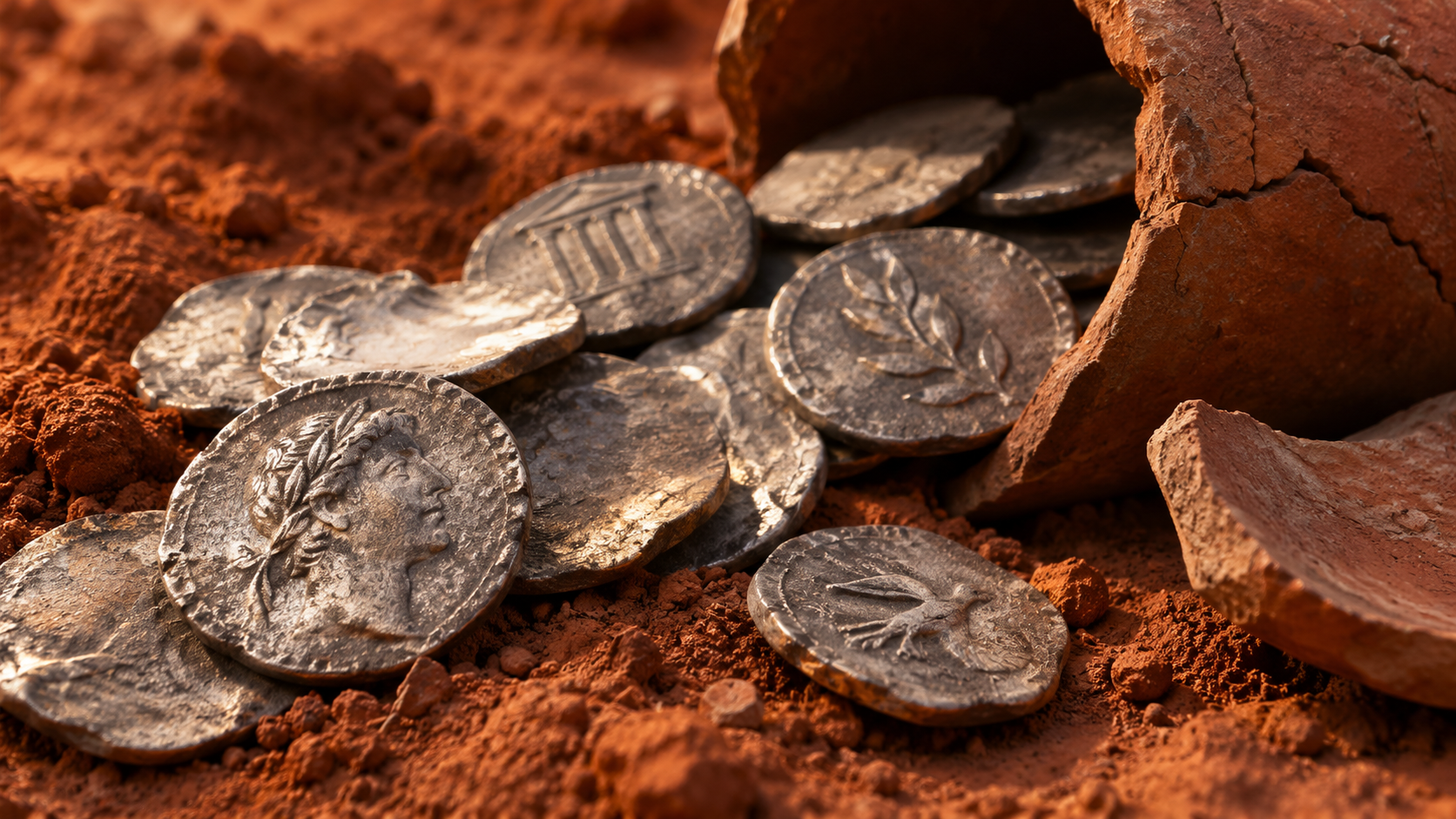
One plausible reconstruction makes the payment thirty full Tyrian shekels. On that assumption the coins would weigh roughly 420 grams altogether and represent about 120 drachmas in traditional accounting. The familiar claim that Judas received several months of wages adds another assumption about the pay and working days of a labourer. A reliable modern pound value lies beyond the evidence. What we can recover is the remarkable range of meanings Matthew gives the same sum as it passes from one pair of hands to another.
What Was Judas Being Paid To Do?
In Matthew 26 Judas approaches the chief priests and asks what they will give him to hand Jesus over. They set the sum at thirty pieces of silver. Judas then looks for an opportunity. Later he accompanies the armed group to the place where Jesus has been praying and identifies him by a prearranged sign. The agreement concerns access to a particular person at a time and place where an arrest can be made.
That last point is easy to miss if the coins are treated as a fee for providing a name. Jesus has taught in public. The identity of the teacher is scarcely secret. The account has already shown the authorities concerned about a disturbance among the people. A member of the inner circle can provide an opportunity away from a sympathetic crowd and distinguish the person sought during a night-time arrest. Matthew gives the transaction a function within the plot.
Mark also records a promise of money. Luke mentions an agreement to give money. Neither supplies Matthew's figure. John's account of Judas develops other material, including his role in relation to the common purse. Popular retellings can draw on all four to create a fuller portrait of his motives. The calculation involving thirty belongs specifically to Matthew. It gains little historical precision by being attributed to the Gospels collectively.
There is another limit on what the payment reveals. The amount one party agrees to pay does not by itself measure the other party's inward reasons for acting. A reader may see greed, disillusionment or something more complicated in Judas. The bargain supplies an action and a sum. It cannot tell us how much money he already possessed, what he expected to happen after the arrest or what additional amount might have changed his mind.
Why The Tyrian Shekel Is A Candidate
Judaea under Roman rule was a place where more than one kind of money circulated. Coin values had to make sense across local trading habits, imperial institutions and religious payments. A single modern national currency is a poor starting point for picturing a place where the silver accepted for one purpose could have particular weight and fineness requirements.
Tyrian silver is relevant because of its association with payments at the Jerusalem Temple. The annual levy was a half-shekel, and Tyrian coinage was valued for its silver content. That gives full shekels of the Tyrian standard a plausible connection to a story involving the chief priests. It falls short of establishing that coins taken out for this transaction were identical to coins acceptable for the levy. Matthew never traces the original money to a named account or store.
The distinction between a full shekel and a half-shekel matters immediately to the arithmetic. A statement about the tax due from one person need not identify the face value of every coin used to pay it. A larger coin can settle more than one obligation. Matthew 17 even tells a story in which a single coin is sufficient to cover the payment for two people. In that passage the writer has vocabulary capable of distinguishing a particular amount. He leaves it unused in the Judas narrative.
Actual Tyrian silver can be weighed. One surviving shekel discussed in the Ashmolean collection weighs just over fourteen grams. Thirty similar coins would have a total mass a little above 420 grams. That is a useful way to imagine the payment in a hand or pouch. It is an estimate of the mass of coins under an explicit identification, rather than a measurement of anything archaeologists have recovered from Judas.
Gross weight and the amount of pure silver are also distinct. Multiply the total mass by the fineness to estimate the silver content. Without identifying the issue or coins, allowing for wear and establishing their composition, the result remains approximate. An online calculation that multiplies a confidently specified number of grams by today's silver price can produce an answer to the penny while leaving its most consequential assumption untested.
Was It Really Four Months’ Wages?
The second popular calculation moves from a full shekel valued at roughly four drachmas to thirty times four, or about 120 drachmas. Readers then treat a drachma as broadly comparable to a denarius for this purpose and use a denarius as a day's pay. The multiplication is straightforward. Each step on either side of it requires some care.
A familiar biblical reference for the day rate comes from Matthew 20. A vineyard owner agrees to pay early hires a denarius for the day. Later arrivals eventually receive the same sum, producing the complaint around which the parable turns. That episode gives readers an intelligible benchmark for a day's casual agricultural labour. Turning the owner's agreement in a parable into a comprehensive wage survey of first-century Judaea would ask the example to do too much.
Suppose the assumptions are accepted for illustration. The result is around 120 such daily payments. Four months is the loose conversion obtained by treating a month as thirty paid days. A worker who received no wages on rest days or could find work only intermittently would take longer to earn them. A craft worker with a different daily rate would arrive at a different comparison. A statement in days of a specified kind of pay is consequently more informative than a flat claim about months of anybody's earnings.
There is a temptation to improve the answer by finding a modern wage for a comparable British labourer and multiplying that by 120. The arithmetic would tell you what a modern worker might earn over the assumed number of paid days. It would tell you little about the relative prices of grain, rent, tools, transport and other necessities in Judaea. Wages and the cost of living have changed in relation to one another as well as in absolute terms.
The difference is familiar closer to home. People comparing the price of a house in their parents' youth can adjust for inflation, compare it with an annual salary or ask how much it would fetch today. Each gives a different answer because each measures a different relationship. Introduce a disputed ancient denomination before even beginning the comparison and the promise of one correct sterling figure becomes particularly difficult to defend.
Why Thirty Already Sounded Familiar
In Exodus 21 an ox that kills an enslaved person gives rise to a payment of thirty shekels of silver to the owner. This is the passage behind the claim that Jesus was sold for the price of a slave. The verbal shorthand is memorable. The provision itself concerns compensation for a death under a specified law. It is not an advertisement setting a universal purchase price for enslaved people across the ancient world.
A direct commercial comparison would in any case cross periods, circumstances and kinds of payment. Judas is offered money to facilitate an arrest. An owner in Exodus receives a prescribed sum following the death of an enslaved person. The literary connection is more defensible than an economic equation. A reader who knows the law can hear humiliation and a grim valuation of human life in Matthew's choice of number.
Zechariah 11 offers an even closer cluster of details. A shepherd asks for wages and receives thirty pieces of silver. The payment becomes the subject of bitter irony. The silver is thrown in the house of the Lord, and the Hebrew wording has a famous connection with the potter. Translations vary in their handling of the difficult passage. The convergence of thirty, silver, rejection and the temple is nevertheless closer to Matthew's unfolding scene than a modern silver-price calculation could ever be.
Matthew later attributes a fulfilment saying to Jeremiah. Much of its wording recalls Zechariah, while Jeremiah supplies resonances of the potter, the purchase of a field and judgement. Readers have debated the precise relationship among those passages. The note of attribution is genuinely in Matthew and deserves to be left visible. Silently changing the prophet's name to Zechariah would make a tidy reference while concealing the very feature an explanation ought to address.
Why The Other Famous Thirty Is A Different Unit
The English word silver can hide a difference between a weight of metal, a denomination and a collection of individual coins. A shekel began as a unit of weight. A coin issued to a shekel standard is a physical object that can be counted. An author can also refer to silver money in general without specifying how much each coin represents. Translate all three into the loose English expression pieces of silver and the arithmetical uncertainty can disappear from sight.
A useful comparison is the English pound. It can name a unit of weight or a unit of currency. Someone promising thirty pounds for a job has not agreed to deliver a bag weighing thirty pounds. A coin collector, a historian of wages and a silversmith would ask different follow-up questions because they are interested in different properties of the payment. Matthew's reference is quite sufficient for the moral and narrative purpose of the scene. The desire for an exchange rate is what creates the need for further information.
There is consequently a real trap in borrowing the explicit shekels from Exodus to fill the gap in Matthew and then presenting the shared denomination as proof of the link between the passages. The similarity in the count helps explain why readers compare them. It cannot independently establish the denomination used in the later transaction.
The Money Changes Hands Again
When Judas sees that Jesus has been condemned, he returns to the chief priests and elders. He acknowledges that he has betrayed innocent blood and tries to give the silver back. The men who made the agreement refuse responsibility for his judgement. He throws the money into the temple and leaves. The attempted refund cannot reverse an arrest or undo what the authorities set in motion after it.
The chief priests now recognise a problem with the funds. They regard the coins as blood money unsuitable for return to the treasury. They use them to buy the potter's field for the burial of strangers. The transaction gives the place its association with blood in Matthew's account. Money that could change hands quite readily when an arrest was wanted becomes awkward to account for once the condemned man's fate is visible.
It is sometimes suggested that the purchase provides an independent means of converting the sum. If it bought a field near Jerusalem, surely one could look up an equivalent plot and value it. Matthew supplies no acreage, survey, title conditions, expected agricultural income or competing offers. A field belonging to a potter and destined for burials is an especially poor proxy for a standard unit of prime farmland. The sequence establishes a use for the money and a name for the place.
Acts also knows a field associated with Judas and blood. Its account handles the acquisition and Judas' death differently. A reader interested in the Gospel's economic details gains nothing by combining the two into a single imagined set of property documents. The claim that the priests used the returned money to buy a burial ground belongs to Matthew's telling and plays a particular part in its judgement on their conduct.
Read the movement of the coins as a whole and each participant gives them a different value. To the chief priests at the outset they are a means of getting hold of a man. To Judas after the condemnation they are unbearable to keep. To the treasury they are unacceptable income. To those making arrangements for strangers who die in Jerusalem they can still purchase land. The number remains thirty throughout. Its meaning changes because the people holding it discover things they can and cannot do with it.
That is why the most honest short answer can retain figures without pretending they settle the story. Thirty full Tyrian shekels would make a substantial payment, perhaps roughly 120 labouring days on the assumptions usually made. Matthew guarantees only thirty pieces of silver. By the time those pieces come to rest in a field purchase, the one price the reader can identify with certainty is the one Judas cannot pay back.
Sources
USCCB — Matthew 26 — The payment agreement and circumstances of the arrest.
USCCB — Matthew 27 — The returned silver, purchase of a field and prophetic allusions.
British Museum — Money Gallery, Room 68 — The relationship between Tyrian silver and Temple payments.
Eli Brackman — Ancient Jewish Coins at the Ashmolean Museum: The Tyrian Shekel — The weight of a surviving shekel used for the illustrative calculation.
Next Reads
The History of Good Friday and Easter: How a Sacred Story Became a Global Season — How Christians built a sequence of observances around the Passion narratives.
Why the Number Three Keeps Appearing in Jesus' Life and the Bible — Other occasions when a biblical number takes on a life in tradition.
The Abrahamic Religions Explained: How One Ancient Idea of God Changed the World — The scriptural and historical setting of Jewish and Christian traditions.
